

How to Write a Statement of the Problem for Your Thesis in 2026 (Step by Step)
Your statement of the problem is the first test your examiner applies to your thesis: does this student know why their research needs to exist? Getting it wrong — writing something vague, over-broad, or disconnected from the literature — can undermine the entire chapter before your examiner reaches page two. Learning how to write a statement of the problem properly is therefore one of the highest-leverage skills you can develop at the start of your project.
This guide walks you through four numbered steps, from establishing broad context down to scoping your objectives. You will also find a fill-in template, annotated before-and-after examples, the critical distinction between a problem statement and a research question, and a list of the mistakes supervisors flag most often.
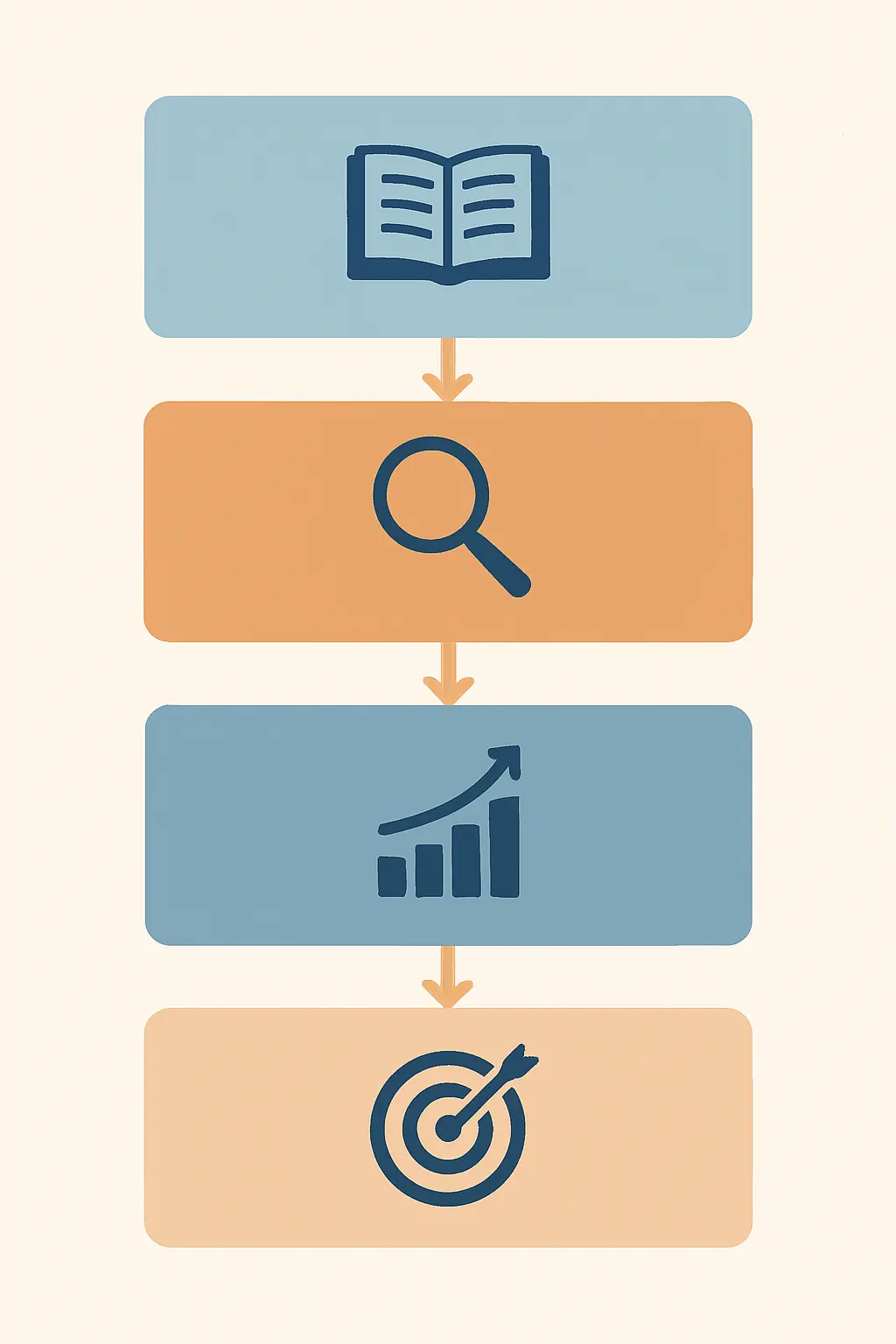
A statement of the problem is a concise passage (150–400 words) placed at the start of your thesis introduction that (1) establishes the broad context, (2) identifies the specific gap or unresolved issue in existing knowledge, (3) explains why that gap matters, and (4) signals the objectives your study will pursue. It is not the same as your research question, which is a direct interrogative sentence that follows from the problem.
What Is a Statement of the Problem?
A statement of the problem is a structured, evidence-backed passage that argues a specific issue in your field remains unresolved — and that your thesis will address it. It typically appears within the first section of Chapter 1 (Introduction), immediately after any brief disciplinary background and before your stated research objectives.
The passage performs three rhetorical tasks simultaneously. It demonstrates that you have read the field carefully enough to know what is missing. It persuades the reader that the missing piece is worth filling. And it narrows the reader’s expectations from “all of education research” down to “reading comprehension outcomes in year-4 bilingual classrooms in urban Wales.” Every word should be doing one of those three jobs.
Most examiners expect the statement of the problem to be between 150 and 400 words at undergraduate and master’s level, and up to a page at doctoral level where greater depth of literature engagement is required. The statement is not an abstract, a thesis statement in the literary-essay sense, or a list of your research objectives — those are separate, adjacent elements in your introduction. For a full picture of how these elements fit together, see our guide on how to write a thesis: the complete 2026 guide.
Step 1 — Establish the Broad Context
Open with two to four sentences that situate your topic within the wider disciplinary conversation. This is not the place for sweeping historical claims or rhetorical flourishes about the importance of your field. Instead, name the specific domain, the population or phenomenon at stake, and the current state of knowledge as reflected in recent peer-reviewed literature.
A useful test: could your opening sentence appear word-for-word in a rival thesis on a completely different sub-topic within your field? If yes, it is too generic. Push the specificity one level further. “Mental health support in UK universities has expanded significantly over the past decade, driven by rising demand documented in HEPI surveys and UCAS data” is more useful than “Mental health is a growing concern in society today.”
Step 2 — Identify the Specific Gap
This is the heart of the statement of the problem. Having shown what is known, you now show what is not known, is contested, is under-studied, or is known in one context but not transferred to yours. There are four main gap types you can invoke:
| Gap type | What it means | Typical language |
|---|---|---|
| Knowledge gap | A phenomenon that has not been studied at all | “No study has examined…” |
| Empirical gap | Existing findings are contradictory or inconclusive | “Evidence remains mixed…” |
| Contextual gap | Studies exist elsewhere but not in your setting | “Prior research has focused primarily on… with little attention to…” |
| Methodological gap | Available studies rely on weak or outdated methods | “Previous investigations have relied exclusively on self-report measures that…” |
Name the gap type you are using and cite the literature that establishes its existence. If you claim “no study has examined X,” you need to have conducted a systematic search thorough enough to make that claim. The deeper your literature review, the more confidently you can state what the field is missing — see the step-by-step guide to how to write a literature review to build the foundation your gap claim depends on. For a structured approach to formulating your question, work through our guide on how to identify a research gap and formulate your research question, which covers PICO, SPIDER, and FINER frameworks.
Step 3 — State the Significance
Now answer the implicit question every examiner asks: so what? Why does it matter that this gap exists? Significance operates on two levels — theoretical and practical — and strong problem statements address both.
Theoretical significance means your findings will extend, test, or challenge an existing model, framework, or body of theory. “Addressing this gap will clarify whether Vygotsky’s zone of proximal development generalises to asynchronous, text-only learning environments” is specific and verifiable.
Practical significance means real-world actors — practitioners, policymakers, communities, patients — will be able to do something differently because of what you find. Quantify the population affected where you honestly can: “Approximately 240,000 students in England are enrolled in dual-language primary programmes; evidence-based guidance on reading support is currently absent for this group.”
Step 4 — Define Your Objectives and Scope
Close the statement of the problem with one to three sentences that make the transition from “here is the problem” to “here is what this study will do about it.” This is not the full list of research objectives — those typically appear in a dedicated paragraph or bullet list later in the introduction — but a brief forward-pointing signal that orients the reader.
Scope matters as much as objectives. Tell your reader what your study will not attempt to do, particularly if the problem space is large. “This study focuses on undergraduate students at three post-1992 universities in England; findings are not intended to generalise to Russell Group institutions or postgraduate populations” is the kind of scoping that examiners respect because it shows methodological self-awareness.
At this stage, your methodology is only gestured at rather than explained. The full justification of your design belongs in your methodology chapter — see our walkthrough of how to write a research methodology chapter for that detail.
Statement of the Problem vs Research Question
Students regularly conflate these two elements, and supervisors flag the confusion because it matters structurally. The distinction is straightforward once you see it:
| Statement of the Problem | Research Question | |
|---|---|---|
| Form | Declarative paragraph(s) | Interrogative sentence(s) |
| Function | Argues that a gap exists and that addressing it matters | Specifies exactly what the study will answer |
| Placement | Early in Chapter 1, before objectives | After the problem statement and objectives |
| Example | “Despite increased investment in peer mentoring programmes, no longitudinal evidence exists on their effect on first-year retention at UK commuter universities.” | “To what extent do peer mentoring programmes influence first-year retention rates at UK commuter universities over a two-year period?” |
The problem statement generates the research question; the research question does not replace the problem statement. Your examiner will look for both, in order.
Fill-In Template
Use the following scaffold to draft your statement of the problem. Replace the bracketed placeholders with your own field-specific content, then revise for prose fluency.
[Broad disciplinary context: 1–2 sentences establishing the topic and current state of knowledge, with citations.] For example: “Student mental health has become a leading institutional concern across UK universities, with demand for counselling services rising each year according to annual sector surveys.”
[Specific gap: 1–2 sentences naming what is unknown, contested, or under-studied, with citations.] For example: “However, most existing studies focus on students at large, campus-based universities; the distinct experience of students at commuter institutions — who face additional pressures of travel, employment, and family obligations — has received comparatively little empirical attention (Smith, 2022; Jones & Patel, 2023).”
[Significance: 1–2 sentences on theoretical and/or practical importance.] For example: “This gap is consequential because commuter students represent a growing share of UK enrolments, and without evidence tailored to their context, support strategies may be poorly matched to their needs.”
[Objectives and scope: 1–2 sentences scoping what this study will address.] For example: “This study therefore examines the mental health support experiences of commuter students at three post-1992 universities in England, with the aim of generating practice-relevant recommendations for student services teams.”
Before and After Examples
Example 1 — Education Research (Undergraduate Dissertation)
Before (too vague)
“Reading is very important for children’s development. Many children struggle to read well. There is a problem with reading in schools and this needs to be researched more.”
After (specific and evidenced)
“Phonics-based instruction has demonstrated consistent gains in word decoding for early readers (Education Endowment Foundation, 2024). However, evidence for its efficacy with bilingual year-4 pupils in Welsh-medium schools remains sparse, with most UK studies drawing samples exclusively from English-medium settings (Williams, 2023). Without context-specific evidence, practitioners lack a reliable basis for adapting phonics programmes to this growing population. This study investigates the reading outcomes associated with two phonics approaches delivered to bilingual year-4 pupils across six Welsh-medium primary schools.”
Example 2 — Business / Management (Master’s Thesis)
Before (too broad)
“Remote work has become very common. Employees work from home now and this has changed organisations. Research on this topic is needed.”
After (tight and purposeful)
“The widespread adoption of hybrid working models since 2020 has reshaped how knowledge workers experience organisational belonging. While survey-based studies report that remote workers frequently cite reduced social connection (CIPD, 2024), longitudinal evidence on whether belonging perceptions recover as hybrid arrangements stabilise is lacking. This gap is significant because sustained low belonging is associated with increased turnover intention, with direct cost implications for organisations. This study therefore examines changes in organisational belonging among hybrid knowledge workers at three UK professional services firms over an eighteen-month period.”
Common Mistakes to Avoid
- Overstating the gap. Writing “nothing is known about X” when a substantial body of literature exists undermines your credibility with examiners. The correct framing is usually “little is known about X in context Y” or “evidence on X is inconclusive.”
- Confusing the problem with the topic. “Mental health in universities” is a topic. The unresolved issue within that topic — the gap in longitudinal evidence for commuter populations — is the problem. The statement must argue for the gap, not just name the topic.
- Using only outdated citations. Most supervisors and doctoral committees treat sources older than five to seven years as insufficient anchors for a gap claim unless they are foundational works. Fill your problem statement with the most recent empirical literature you can find.
- Making the statement too long. A problem statement that runs to three pages has likely absorbed content that belongs in the literature review. Keep the statement focused; the literature review is where you expand the evidence in depth. These are related but distinct sections — your theoretical framework, for instance, is developed separately as shown in our guide to writing a theoretical framework for your thesis.
- Omitting the significance. Some students identify the gap but forget to argue why it matters. An examiner reading a problem statement without a significance sentence has no reason to care about your research.
- Conflating the problem statement with the abstract. The abstract summarises the entire thesis including your findings. The problem statement is written before your research is complete and focuses only on the justification for the study.
Frequently Asked Questions
How long should a statement of the problem be?
At undergraduate and taught master’s level, aim for 150–300 words — roughly three to four short paragraphs. For a research master’s or PhD thesis, 300–500 words is typical, with some disciplines allowing up to a full page. The measure of the right length is whether every sentence is earning its place by establishing context, naming the gap, arguing significance, or scoping objectives. Padding is more damaging than brevity.
Does a statement of the problem need citations?
Yes, and this is non-negotiable at postgraduate level. Every claim about the current state of knowledge — what is known, what is unknown, and why it matters — requires a citation. At doctoral level, examiners treat an uncited problem statement as evidence that the candidate has not engaged sufficiently with the literature. Use recent peer-reviewed journal articles wherever possible.
Where does the statement of the problem go in a thesis?
It sits in Chapter 1 (Introduction), usually after one or two orienting sentences or a short background paragraph, and before your stated research objectives and research questions. In some institutional templates — particularly in social science and health disciplines — it appears as a clearly labelled sub-section headed “Statement of the Problem.” In others it is woven into the introductory narrative without a standalone heading. Check your faculty’s thesis guidelines to confirm the expected format.
Can I write the statement of the problem before I have finished my literature review?
You can — and many students write a working draft early to guide their reading — but you should expect to revise it substantially once your literature review is complete. The gap you identify at the proposal stage sometimes shifts as you read more deeply. Treat the early draft as a navigational tool, not a final statement. Most experienced supervisors advise finalising the problem statement only after the literature review chapter is in strong draft form.
Is a statement of the problem the same as a problem statement in a research proposal?
They serve the same persuasive function — arguing that a specific gap warrants investigation — but differ in audience and consequence. In a research proposal, the problem statement is written to convince a supervisor, ethics board, or funding body to approve your study before you conduct it. In the thesis itself, it is written retrospectively (the research is done) but still argues the justification for why the study was worth conducting. The structure and content are nearly identical; the tense and some framing language may differ.
How is a statement of the problem different from a hypothesis?
The statement of the problem identifies what is unknown; a hypothesis is a testable prediction about what you expect to find. Hypotheses appear in quantitative studies where you are testing a specific directional or null claim. Qualitative and many mixed-methods studies use research questions rather than hypotheses. The problem statement always comes first and applies to all research designs; the hypothesis (if used) comes later and is specific to certain methodological traditions.
Draft Your Thesis Introduction with AI Support
Tesify is an AI thesis writing tool built for academic integrity. It helps you structure your introduction, draft a problem statement grounded in your sources, and maintain your own voice throughout — without fabricating citations.
Write your thesis with AI
Structure, draft, cite, and format your thesis faster with Tesify’s AI writing tools, automatic bibliography, and plagiarism checker. Free to start, no credit card required.






Leave a Reply