
How to Write an Appendix for a Thesis or Dissertation in 2026 (Step by Step)
Most students know the appendix exists — few know exactly what to put in it, how to label it, or how to connect it to the main body without disrupting the flow of their argument. If you have finished a draft and are staring at a pile of raw data, interview transcripts, survey instruments, and code you do not know where to place, this guide walks you through every decision, from deciding what belongs in an appendix versus the main body to formatting multiple appendices correctly in APA, MLA, and Chicago style.
Getting the appendix right matters more than it appears. Examiners check that every appendix is cited in-text, that items appear in citation order, and that labels match consistently across the document. A mislabelled appendix — or one that is never referenced at all — is a formatting error flagged on almost every examiner checklist.
What the Appendix Is — and What It Isn’t
The appendix (plural: appendices) is back matter — supplementary content placed after your reference list that supports your thesis without cluttering the main argument. It is not the same as other back-matter or front-matter sections that students sometimes confuse it with:
- Dedications and acknowledgements appear at the front of the thesis, before the abstract.
- Limitations belong in your discussion chapter, not the appendix — they are core to your argument and interpretation, not supplementary material.
- Abbreviations lists or glossaries are typically placed before the introduction, not in the appendix.
- Footnotes and endnotes appear within the relevant chapter, not collected in an appendix.
The appendix is specifically for material that is too detailed, too lengthy, or too raw for the main body but that a reader, reviewer, or examiner might need to verify your work, replicate your methods, or understand your process.
Step 1: Decide What Belongs in the Appendix
Apply a simple test to each item you are considering: Does a reader need this to follow my argument, or do they only need it to verify or extend my work? If the answer is “verify or extend,” it belongs in the appendix.
Material that routinely belongs in a thesis appendix:
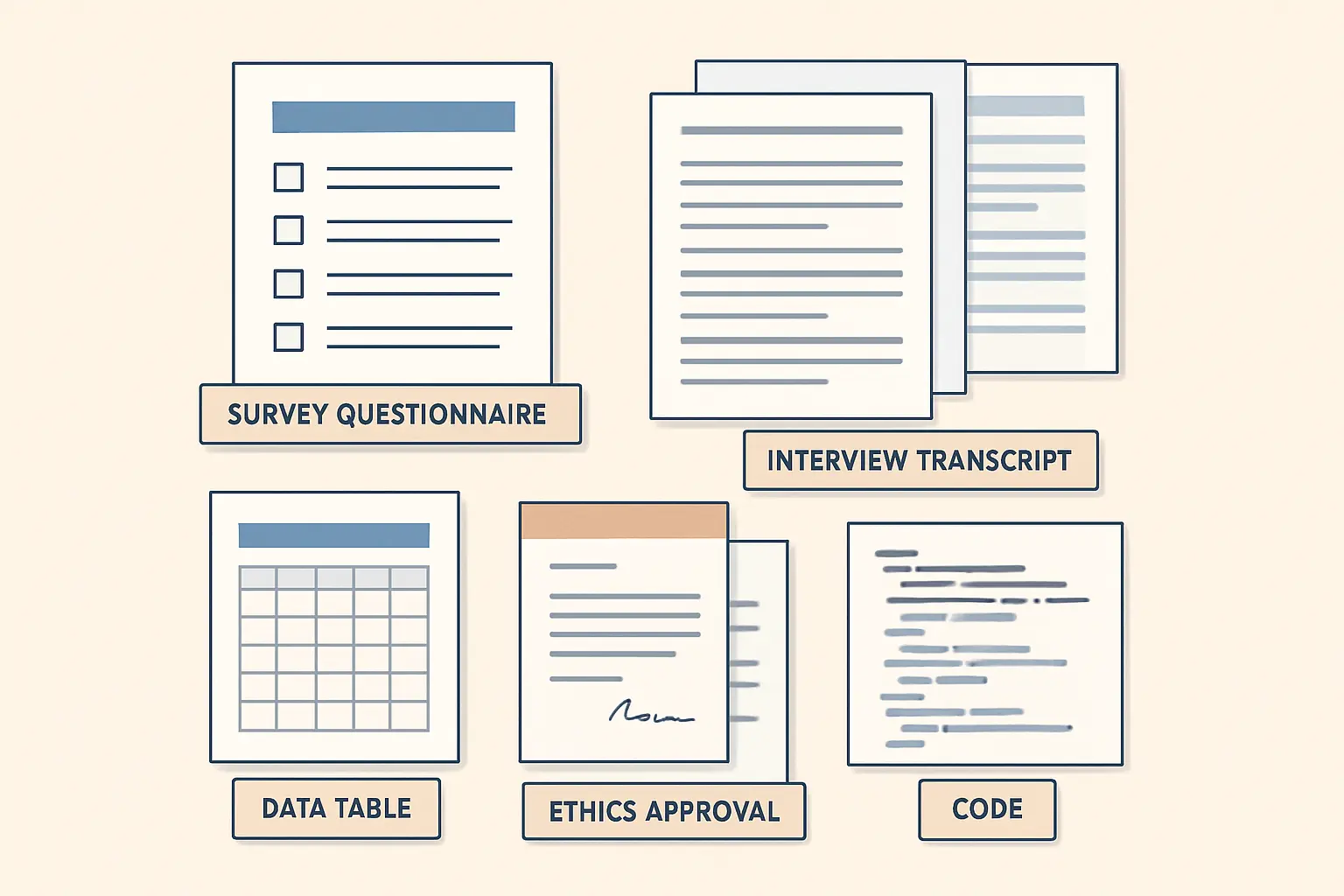
- Survey instruments and questionnaires — the full version of any questionnaire you designed, including all items, response scales, and participant instructions
- Full interview transcripts — the complete verbatim record; excerpts and direct quotes stay in the main body
- Raw data tables — large datasets, extended statistical model output, or frequency distributions too voluminous for the results chapter
- Ethics approval documentation — your institution’s approval letter or signed informed consent form
- Code and analysis scripts — R, Python, SPSS syntax, or MATLAB scripts used to process or analyse your data
- Additional maps, photographs, or figures — visual material that supports a point but is not central to the argument
- Supplementary calculations or derivations — extended mathematical proofs referenced briefly in the main body
What stays in the main body: any figure, table, or piece of data that you directly discuss or interpret. If you build an argument from a specific finding, the table containing that finding belongs in the results chapter, not the appendix. The appendix holds material your reader may want to consult but does not need to read in sequence.
Step 2: Plan Multiple Appendices (A, B, C…)
Before you begin organising appendix content, list every item you want to include. Group related material into separate appendices — one appendix per type of material is a clean and examiner-friendly convention. A typical qualitative dissertation might plan:
- Appendix A: Interview schedule (the list of questions put to participants)
- Appendix B: Full interview transcripts
- Appendix C: Codebook used for thematic analysis
- Appendix D: Ethics approval letter
- Appendix E: Participant information sheet and consent form
The final letter assigned to each appendix depends on the order in which it is first cited in your main body (covered in Step 6), but planning them at this stage prevents duplication and helps you spot gaps — for example, a consent form you mentioned using but never saved.
If you have only one piece of supplementary material, do not use a letter. In APA and MLA style, a single appendix is labelled simply “Appendix.” In Chicago style, it is “Appendix 1” — but still treated as a single unit.
Step 3: Label and Title Each Appendix
Each appendix begins on its own page. The label and title appear at the top, formatted as follows in APA 7th edition — the most common standard for UK, US, Australian, and Canadian dissertations:
- Line 1: Appendix A — bold, centred, title case
- Line 2: Title of the Appendix — bold, centred, title case
- Leave one blank line before the content begins
- The first paragraph is flush left (not indented); all subsequent paragraphs are indented 0.5 inches
- Double-space throughout, just as in the main body
A formatted example looks like this:
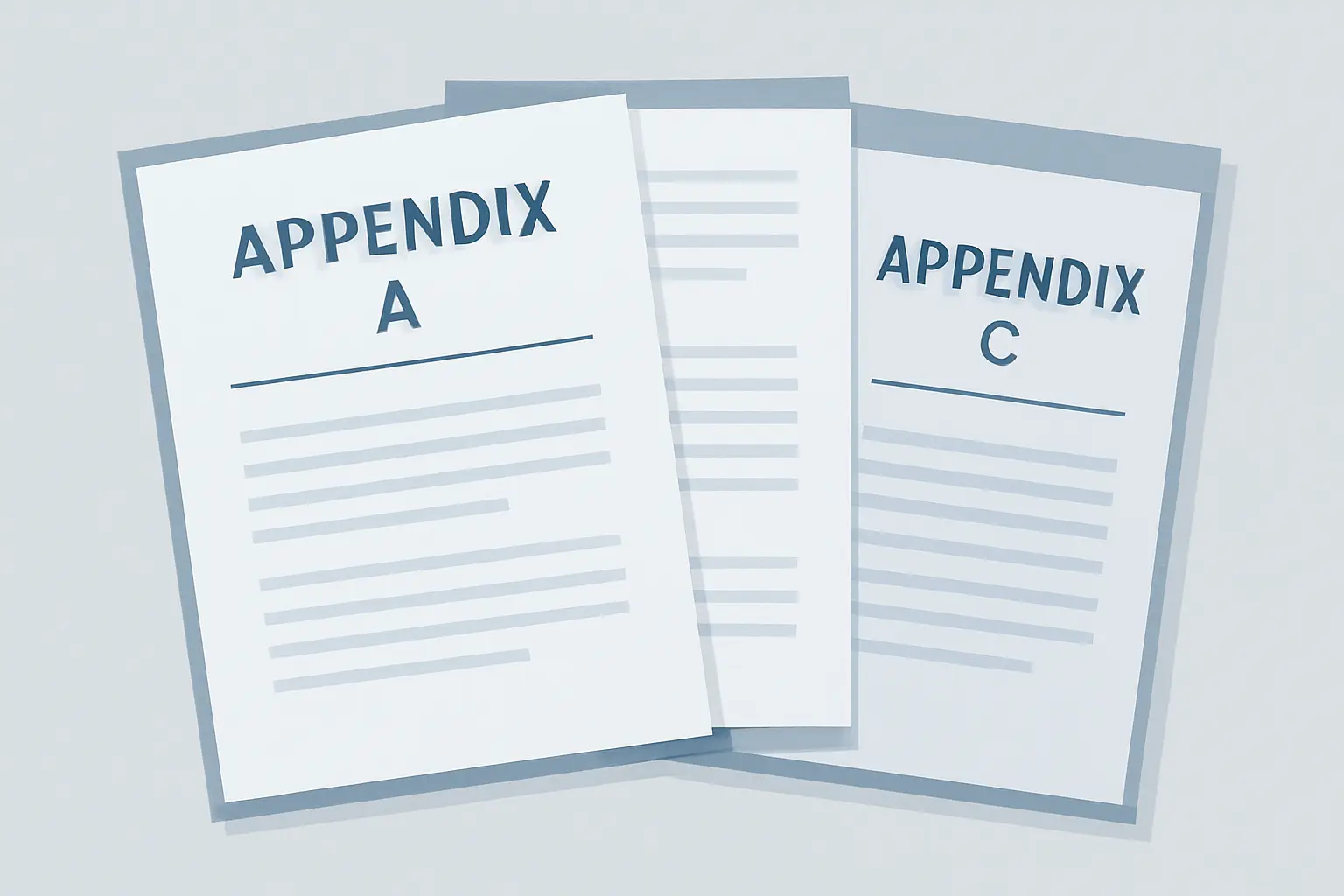
Appendix B
Semi-Structured Interview Transcript: Participant 3
If an appendix contains a table, label it with the appendix letter and a sequential number: Table A1 for the first table in Appendix A, Table B1 for the first table in Appendix B, Table B2 for the second table in Appendix B. This distinguishes appendix tables from the numbered tables in the main body (Table 1, Table 2, etc.) and prevents examiner confusion. The same prefix rule applies to figures: Figure A1, Figure B2, and so on.
Step 4: Format Tables, Transcripts, Survey Instruments, and Code
Different types of appendix content require slightly different handling.
Tables
Apply the same rules you use in the main body. In APA 7th, the table number and title appear above the table in bold, and any explanatory notes appear below. The only difference is the label (Table A1 rather than Table 1). For a complete walkthrough of APA table rules — including column alignment, cell borders, and note formatting — see How to Format APA Tables and Figures Step by Step.
Interview transcripts
Present each transcript clearly. Include a participant identifier at the top (e.g., “Participant 3, Interview 2, conducted 14 March 2025”), and use a consistent format for speaker turns — typically bold abbreviations such as I: (Interviewer) and P3: (Participant 3). Apply standard double-spacing. You do not need to reproduce every hesitation or filler word unless your analysis is specifically linguistic or discourse-analytic.
Survey instruments
Reproduce the questionnaire exactly as participants saw it — include all instructions, section headings, response options, and the order of items. If you used a validated scale (for example, the PHQ-9 or the Big Five Inventory), include the full scale, note the source, and confirm whether copyright permission is required for reproduction.
Code and analysis scripts
Use a monospace font such as Courier New at 10pt and include inline comments so a reader can follow the logic. If the script runs to hundreds of lines, consider whether a publicly archived repository (GitHub, OSF, Zenodo) with a URL and DOI cited in the appendix is more practical than embedding the full code in the document.
Step 5: Reference Each Appendix In-Text
Every appendix must be mentioned at least once in the main body of your thesis. If you never refer to it, it has no purpose in the document — remove it or integrate the content into the relevant chapter.
There are three natural ways to refer to an appendix in the text:
- Parenthetical: “The full interview protocol is provided (see Appendix A).”
- Integrated: “Appendix B presents the complete codebook used for thematic analysis.”
- Mid-sentence: “Participants completed the questionnaire shown in Appendix C before the intervention began.”
Always capitalise “Appendix” when referring to a specific appendix — “see appendix A” with a lowercase a is a consistent error on examiner feedback sheets. The parenthetical form “(see Appendix A)” is preferred in APA; the integrated form is equally acceptable in all three major styles.
Step 6: Order Appendices to Match Citation Order
The letter you assign to each appendix must reflect the order in which it is first mentioned in the main body. Appendix A is the first appendix you cite in the text; Appendix B is the second; Appendix C is the third — regardless of content type, length, or perceived importance.
The most reliable workflow: finish a complete draft of your thesis, run a document search for every “(see Appendix” reference, list the appendices in the sequence they first appear, then assign letters at that point. This prevents the common mistake of assigning letters while drafting and discovering later that heavy editing has reshuffled the order.
If during revision you add a new appendix referenced earlier in the text than an existing one, you must relabel all subsequent appendices — a small but necessary cascade of changes. Completing this step last saves significant rework.
Step 7: Handle Page Numbering
In the vast majority of universities, appendix pages continue the same Arabic numeral page sequence as the main body. If your discussion chapter ends on page 112, Appendix A begins on page 113. Do not restart numbering or switch to Roman numerals for the appendix.
A minority of institutions use a supplementary system — A-1, A-2, B-1, B-2 — where the letter prefix tracks the appendix. Check your institutional formatting guide explicitly before assuming the default. If your university requires section breaks, separate page-number sequences, or specific header styles for the appendix, see How to Format a Thesis in Word Step by Step for a technical walkthrough of how to configure these in Microsoft Word without breaking the rest of the document.
The appendix section appears in the table of contents with its page numbers, listed as individual entries: “Appendix A: Interview Schedule … 113” and “Appendix B: Interview Transcripts … 115”.
APA, MLA, and Chicago: Key Differences at a Glance
| Feature | APA 7th | MLA 9th | Chicago 17th |
|---|---|---|---|
| Single appendix label | Appendix | Appendix | Appendix |
| Multiple appendices | Appendix A, B, C (letters) | Appendix A, B, C (letters) | Appendix 1, 2, 3 (numbers) |
| Label formatting | Bold, centred | Centred | Centred |
| Separate title line | Yes, bold, centred | Yes | Yes |
| Table/figure labelling | Table A1, Figure B2 | No strict rule | No strict rule |
| Placement | After reference list | After Works Cited | After bibliography |
| First paragraph indent | Flush left (no indent) | Standard indent | Standard indent |
These conventions are the defaults. Many universities publish their own thesis formatting guide that extends or overrides them — always consult your institution’s requirements before the defaults.
Common Mistakes to Avoid
- Assigning letters out of citation order. Appendix A must be the first appendix mentioned in the text. A common error is labelling appendices by content type and then finding the in-text references do not match.
- Leaving an appendix unreferenced. If no sentence in your main body points to it, remove it entirely.
- Placing interpreted content in the appendix. If you discuss a table’s findings in the text, that table belongs in the main body, not the appendix.
- Using lowercase “appendix a.” Always capitalise when referring to a specific appendix: Appendix A, Appendix B.
- Labelling appendix tables as Table 1, Table 2. Tables in Appendix A are Table A1 and Table A2; tables in Appendix B are Table B1 and Table B2.
- Putting study limitations in the appendix. Limitations are part of your discussion argument — they are not supplementary.
- Restarting page numbers at 1. Unless your university guidelines explicitly require it, continue the same Arabic numeral sequence from the main body into the appendix.
- Omitting the appendix from the table of contents. Each appendix should appear as a separate entry in the table of contents with its page number.
Frequently Asked Questions
Does the appendix come before or after the reference list?
The appendix comes after the reference list in all three major styles — APA, MLA, and Chicago. The correct back-matter order for a thesis is: reference list (or Works Cited / bibliography), then appendices. Never place an appendix between chapters or before the references.
Do I use a letter if I only have one appendix?
No. In APA and MLA style, a single appendix is simply labelled “Appendix” — no letter. Refer to it in-text as “(see Appendix)” rather than “(see Appendix A)”. Chicago style labels a single appendix “Appendix” as well, unless the document uses a numbered series.
Can I put photographs or maps in an appendix?
Yes. Images, maps, and photographs that support your work but are not central to your argument can go in an appendix. Label each as a figure with the appendix-letter prefix: Figure A1 for the first figure in Appendix A. Include a descriptive caption below each image and ensure any third-party images have the required copyright permissions noted.
Should each appendix start on a new page?
Yes. Every appendix begins on a fresh page regardless of how much space remained at the bottom of the previous one. Insert a page break between appendices in your word processor. This rule applies even when two appendices are very short.
Do sources cited inside the appendix go in the reference list?
Yes. Any source cited inside an appendix uses the same in-text citation format as the main body, and the full reference entry goes in the main reference list alongside all other sources. Appendices do not have their own separate reference list.
How many appendices is too many?
There is no fixed upper limit. A qualitative dissertation with ten interview participants may legitimately run to ten transcript appendices plus a codebook, consent form, and ethics letter. What matters is that every appendix is referenced in the text and contains material that genuinely cannot be placed in the main body without disrupting the argument.
Build Your Appendix — and Your Whole Thesis — in One Place
Formatting an appendix is the last structural task before submission. If you are still working through the earlier chapters, Tesify keeps your chapter outline, references, and writing in one workspace — so nothing gets lost in a stack of files by the time you reach the appendix.
Write your thesis with AI
Structure, draft, cite, and format your thesis faster with Tesify’s AI writing tools, automatic bibliography, and plagiarism checker. Free to start, no credit card required.





Leave a Reply