
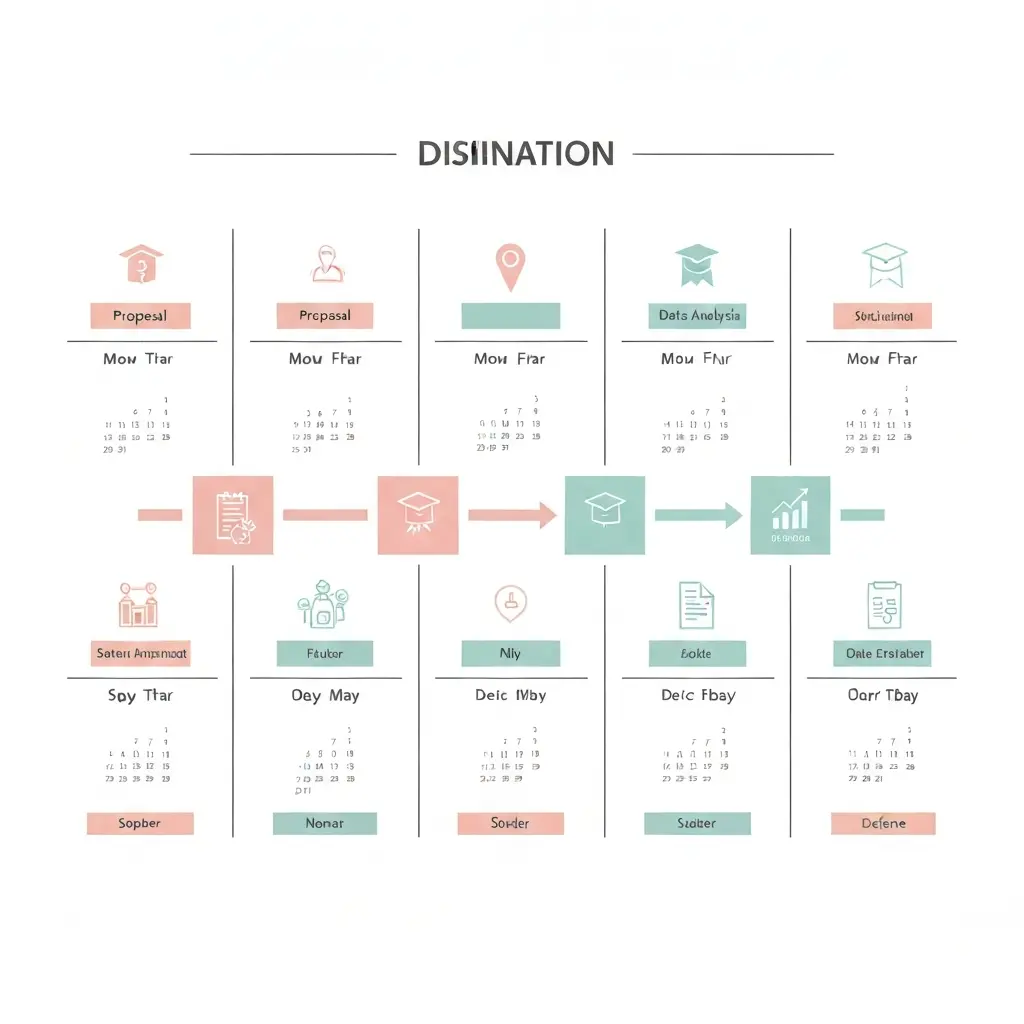
How to Write a Dissertation in 2026: The 12-Month Roadmap From Proposal to Defence
Understanding how to write a dissertation is not just a matter of knowing what goes in each chapter — it is a matter of managing a sustained, complex project across many months while maintaining intellectual rigour, personal motivation, and a working relationship with your supervisory team. Research by the Council of Graduate Schools shows that nearly a third of doctoral students who have completed all coursework and passed qualifying examinations fail to finish their dissertation — a phenomenon known in academic circles as “ABD” (All But Dissertation). For master’s students, the dissertation is frequently cited as the most significant reason for programme non-completion.
This guide provides a concrete 12-month roadmap, designed primarily for master’s-level dissertations at UK and US universities, though the structure maps onto the first year of most doctoral programmes with appropriate scaling. Each month has specific, achievable milestones. The roadmap incorporates current guidance on AI tool use from UK, US, and Australian institutions in 2026, and draws on completion-rate data from the Higher Education Statistics Agency (HESA) and the National Science Foundation.
What Is a Dissertation?
A dissertation is a substantial piece of independent research submitted as the culmination of a graduate programme. In the UK, the term dissertation is most commonly applied to the research project produced at the end of a master’s degree — typically 15,000–20,000 words — while the longer, original-research document submitted for a doctorate is called a thesis. In the US, the terminology is broadly reversed: a dissertation refers to the doctoral document, and the master’s equivalent is called a thesis.
In either tradition, the core requirements are the same: a focused research question, a systematic review of relevant literature, a clearly described and justified methodology, a presentation of findings, a critical discussion that situates those findings within the scholarly conversation, and a conclusion that articulates the contribution and implications of the work. The dissertation distinguishes graduate-level study from undergraduate work primarily through its expectation of original scholarly contribution — a requirement that escalates significantly from master’s to doctoral level.
For a detailed side-by-side comparison of dissertations and theses across degree levels and countries, see our complete dissertation and thesis writing guide.
Months 1–2: Topic Selection and Research Proposal
Month 1: Identify and scope your research question
The research question is the most consequential decision in the entire dissertation process. A well-scoped question enables focused data collection, a coherent literature review, and a definitive conclusion. A vague or overambitious question produces a dissertation that fails to cohere at any stage.
Use the following checklist when evaluating candidate research questions:
- Is the question answerable within the word limit and timeframe? A question requiring multi-country comparative fieldwork is not feasible for a 12-month master’s dissertation.
- Does existing literature suggest a genuine gap or contested finding that your question addresses? Perform a Google Scholar search and read the “future research” sections of the ten most relevant recent papers.
- Does your supervisor have expertise in this area? A supervisor who actively researches your topic will provide far more substantive feedback than one working outside their specialism.
- Is there an existing dataset, archive, or accessible population you can use for data collection? Never plan to create a new dataset from scratch unless you have the time and resources budgeted explicitly.
Month 2: Write and submit the research proposal
Most graduate programmes require formal approval of a research proposal before you begin data collection. A strong proposal typically runs 1,500–3,000 words and includes: the research question and its significance, a preliminary literature review (10–15 sources), the proposed methodology, ethical considerations, and a timeline. Submit to your supervisor at least ten days before the institutional deadline to allow a revision cycle.
Months 3–4: Literature Review
Month 3: Build your search strategy and reading base
A systematic literature search should cover at minimum three databases relevant to your discipline. Set up keyword alerts in Google Scholar and Scopus so that new papers matching your search terms are automatically flagged. Aim to read the abstracts of 150–200 papers and the full texts of 40–60, depending on the density of your field.
Use a reference management tool — Zotero (free), Mendeley, or Endnote — from day one. Retrospectively adding citations to a reference list is one of the most time-consuming and error-prone tasks in dissertation writing, and completely avoidable with proper early setup. Tesify Auto Bibliography integrates directly with your writing environment to automate citation formatting in APA 7, MLA, or Chicago styles.
Month 4: Write the literature review chapter
Organise your literature review thematically, not chronologically. Create a thematic matrix: list the key themes or debates in your field down the rows, list your most important sources across the columns, and mark where each source contributes to each theme. Write from the themes, synthesising what multiple authors say about each one, rather than summarising sources one by one.
A distinction-level literature review argues a position: by the end of the chapter, the reader should understand not only what has been published but what the field has failed to resolve, and why your specific research question is the right next step. For guidance on writing every component of the research methodology chapter that follows, see our guide on how to write the research methodology chapter.
Months 5–6: Research Design and Ethics Approval
Month 5: Finalise your research design
The methodology chapter documents not just what you will do but why. For each design decision — choice of research paradigm, sampling strategy, data collection instrument, and analytical framework — provide an explicit justification grounded in the methodological literature. A survey design must be defended against the alternative of interviews; a purposive sample must be justified against a random sample.
Common methodology types and their philosophical underpinnings:
| Paradigm | Ontology | Methods typically used | Disciplines |
|---|---|---|---|
| Positivist | Objective reality | Surveys, experiments, quantitative analysis | Psychology, health sciences |
| Interpretivist | Socially constructed | Interviews, ethnography, thematic analysis | Sociology, education, management |
| Critical realist | Structures exist independently | Mixed methods, case studies | Political science, economics |
| Pragmatist | What works to answer the question | Mixed methods, sequential designs | Business, applied research |
Month 6: Submit ethics application and prepare instruments
If your dissertation involves human participants, ethics approval is non-negotiable and non-expeditable. Submit your ethics application at the earliest opportunity in month 5 or at the very start of month 6. Use the waiting period to finalise your data collection instrument — survey questionnaire, interview guide, coding framework — and pilot it with two or three people who match your target participant profile. Pilots reveal ambiguous questions, missing response options, and technical problems that would otherwise contaminate your data.
Months 7–8: Data Collection
Data collection is the phase most subject to external delays. For primary research involving human participants, common delays include: slow recruitment response rates (build in at least three follow-up contact attempts), participant drop-out between consent and data collection, transcription time for qualitative interviews (budget one hour of transcription per ten minutes of recorded interview if doing it manually), and equipment or platform failures.
For secondary data or archival research, build in time for access request processing, digitisation gaps in archives, and quality-checking downloaded datasets. A recurring error in student dissertations is failing to document data-cleaning steps — this documentation is essential for demonstrating methodological rigour and must be included in the methodology chapter or a technical appendix.
Months 9–10: Analysis and Results
Analysis must be conducted using exactly the approach specified in your methodology. If you deviated from the planned approach — because the data did not meet the assumptions of the planned analysis, or because an unexpected pattern prompted a different analytical strategy — document the deviation explicitly and justify it. Undisclosed deviations are a significant academic integrity issue.
Quantitative results chapters should present statistical outputs in full — test statistics, effect sizes, confidence intervals, and significance values — in the format required by your institution’s style guide (APA 7 for most social sciences). Qualitative results chapters should present representative excerpts in sufficient length to allow the reader to evaluate the interpretation offered. Six to eight words per extract is rarely sufficient — twenty to forty words typically provides the context needed for genuine illustrative power.
The discussion chapter — in which you interpret your results in relation to the literature you reviewed in months 3–4 — is the most intellectually demanding and most heavily weighted chapter. For a detailed guide to structuring the discussion, see our article on how to write the discussion chapter.
Months 11–12: Writing, Revision, and Defence
Month 11: Complete all chapters and revise
By the start of month 11, you should have drafts of all core chapters: introduction, literature review, methodology, results, and discussion. Month 11 is for completing the introduction (now that the thesis is written, you can introduce it accurately), writing the conclusion, producing the abstract (written last, summarising the complete thesis in 150–300 words), and compiling your reference list.
A comprehensive self-editing checklist for the revision phase:
- Does the abstract accurately reflect the thesis as submitted, not the thesis as originally planned?
- Does the introduction’s roadmap match the actual chapter structure?
- Is every claim in the literature review supported by a citation?
- Does the methodology describe what you actually did, not what you planned to do?
- Are all tables and figures numbered, titled, and referenced in the text?
- Is the citation style consistent throughout? Even one inconsistently formatted reference signals carelessness to examiners.
- Have you declared your AI tool use in accordance with your institution’s current policy?
For comprehensive guidance on academic integrity and AI declaration requirements across institutions, see our guide on academic integrity and plagiarism in 2026.
Month 12: Submission and defence preparation
Submit at least five working days before the institutional deadline to allow for administrative processing issues. Most universities require submission through an electronic repository (Turnitin or equivalent) as well as in PDF format. Check your institution’s specific formatting requirements — margin widths, font sizes, line spacing, and binding requirements vary considerably.
For the oral defence or viva voce, the most effective preparation strategy is to read your dissertation critically from the examiner’s perspective. Identify the three weakest points in your work — methodological limitations, under-developed arguments, or findings that were not fully explained. Prepare articulate, confident responses to examiner challenges on each of these points. Showing that you understand your work’s limitations demonstrates scholarly maturity rather than weakness.
Using AI Tools in 2026
By 2026, the majority of UK and US universities have established formal policies on AI tool use in dissertations. A survey by the Higher Education Policy Institute (2025) found that 61% of UK universities permit AI-assisted editing and paraphrasing with mandatory declaration, 28% take a case-by-case approach, and 11% have blanket prohibitions on generative AI in assessed work. The trend is towards permissive-with-declaration frameworks rather than blanket prohibition, but individual policies vary enormously — always check yours.
Permitted uses at most institutions in 2026 typically include: grammar checking and copyediting, generating citation suggestions (with manual verification), brainstorming outline structures, paraphrasing to improve clarity (with declaration), and translating between English dialects. Prohibited uses at most institutions include: generating substantive arguments or analysis, producing literature summaries to be incorporated into the dissertation without reading the originals, and fabricating citations (a known limitation of general-purpose AI models that dissertation-specific tools have addressed).
For a detailed comparison of AI tools suitable for dissertation writing in 2026, see our guide on AI dissertation writing tools: a complete comparison. Tesify is purpose-built for academic writing — it generates citation-accurate suggestions, flags potential integrity risks, and exports in APA 7, MLA, and Chicago formats.
The Five Most Common Dissertation Pitfalls
An analysis of examiner reports from UCL, the University of Edinburgh, and the Australian National University identifies five failure patterns that account for the majority of refer (resubmit) and fail outcomes in dissertation assessment:
- Leaving writing until the final two months. Students who write all chapters in the last eight weeks consistently produce weaker work — insufficient critical reflection, inadequate revision, and more surface errors. Writing in parallel with data collection and analysis produces substantially better outcomes.
- Describing instead of arguing. The most common feedback across all disciplines: “more analysis, less description.” Every chapter after the introduction should be making an argument, not reporting what happened.
- Ignoring supervisor feedback. Advisors can identify structural problems in a literature review or methodology that a student, too close to their own work, cannot see. Multiple revision cycles with your supervisor are a feature of high-quality dissertations, not a sign of weakness.
- Underestimating the conclusion. A conclusion that merely summarises the findings already reported earns minimal marks. The conclusion must articulate what the findings mean for the field, what their practical implications are, and what future research they make possible.
- Inconsistent or incorrect citations. An APA reference list with five different capitalisation styles for journal titles, or a bibliography that omits sources cited in the text, signals carelessness that affects examiner perception of the entire document. Use a citation manager and verify every entry before submission.
Frequently Asked Questions
How long does it take to write a dissertation?
A master’s dissertation typically takes 9–12 months when managed according to a structured plan. Unplanned dissertations — where serious writing begins in the final two to three months — routinely take longer and produce worse outcomes. Doctoral dissertations typically take 3–5 years in STEM fields and 5–9 years in humanities and social sciences, according to NSF Survey of Earned Doctorates data.
What is the structure of a dissertation?
A standard dissertation structure includes: title page, abstract (150–300 words), table of contents, introduction, literature review, methodology, results, discussion, conclusion, reference list, and appendices. Some disciplines combine results and discussion into a single chapter, or divide the methodology into separate design and data collection chapters. Always check your institution’s specific format requirements.
How do I choose a dissertation topic?
Choose a topic that (1) addresses a genuine gap in existing literature, (2) is feasible within your timeline and resources, and (3) aligns with your supervisor’s research expertise. Read the “future research” sections of ten recent papers in your area of interest — these explicitly identify the questions the field has not yet answered. The most tractable dissertation topics are usually narrower than students initially imagine.
How many sources should a dissertation have?
There is no universal rule, but a master’s dissertation literature review typically draws on 40–80 sources, and the full dissertation (including methodology and discussion citations) often references 60–120 sources. Quality and relevance matter far more than quantity. A smaller number of deeply engaged sources produces stronger work than a larger number of sources that are merely catalogued.
What happens at a dissertation defence?
A dissertation defence (or viva voce in UK terminology) is an oral examination in which you defend your research before a panel of examiners, typically including one internal and one external examiner. The examination typically lasts 90 minutes to three hours. Examiners ask questions about your methodology, findings, and contribution to knowledge. The most common outcome is “pass with minor revisions” — requiring specific amendments within a defined period — rather than outright pass or fail.
Can I use ChatGPT or other AI tools in my dissertation?
Most universities in 2026 permit AI tools for editing, paraphrasing, and citation assistance — provided you declare the use and did not use AI to generate substantive arguments or analysis submitted as your own. Policies vary: some institutions require a detailed AI declaration statement appended to the submission; others require notation in specific chapters. Check your institution’s current policy and declare AI use transparently.
Write Your Dissertation with AI Support Built for Academia
Tesify guides you through every stage of the 12-month dissertation roadmap — with chapter structure templates, automatic APA/MLA/Chicago citation generation, plagiarism checking, and academic integrity safeguards built in.
Write your thesis with AI
Structure, draft, cite, and format your thesis faster with Tesify’s AI writing tools, automatic bibliography, and plagiarism checker. Free to start, no credit card required.


Leave a Reply