

Translating a Validated Scale for Your Thesis: Back-Translation and Cross-Cultural Adaptation (2026)
The instrument that measures your construct exists, it is well validated, and it is in the wrong language. Translating it yourself over a weekend is the intuitive move and the one that will cost you a chapter at viva, because a translated questionnaire is a new instrument until you demonstrate otherwise. This guide sets out the established adaptation procedure, the four kinds of equivalence you have to argue for, and the psychometric evidence an examiner will expect alongside the translation.
Why translation is a measurement problem, not a language problem
An instrument’s validity evidence attaches to a specific set of words administered to a specific population. Change the words and you have changed the stimulus; the accumulated evidence that the original scale measures what it claims does not automatically transfer to your version. This is why the methodological literature treats translation as one component of a wider process called cross-cultural adaptation, in which the linguistic work is necessary but nowhere near sufficient.
The consequences are concrete. If your translated item means something subtly different, your factor structure may not replicate, your reliability may fall, and — most damagingly — any comparison you draw with published scores from the original-language population is uninterpretable, because you cannot tell whether a difference in scores reflects a difference in the construct or a difference in the instrument.
Note also that adaptation is a modification, and modification is usually a rights question as well as a methodological one. Most licensed instruments require the rights-holder’s specific approval to produce a translation, separate from permission to administer the original — our guide to getting permission to use a validated questionnaire covers that step, which should happen before any translation work begins. Where an official validated translation already exists, use it and cite it; producing a second one is duplicated effort that also forfeits the existing version’s validation evidence.
The four types of equivalence you must argue for

Guillemin, Bombardier and Beaton (1993, Journal of Clinical Epidemiology) set out the framework that later guidance builds on. A defensible adaptation addresses four distinct kinds of equivalence, and a literal translation reliably delivers only the first.
Semantic equivalence — the words carry the same meaning. This is the one dictionaries help with, and it is where the difficulty is lowest.
Idiomatic equivalence — idioms and colloquialisms are replaced by expressions with the same force, not the same words. An item asking whether the respondent has been “feeling blue” translates literally into nonsense in most languages; the equivalent is whatever phrase carries that shade of low mood locally.
Experiential equivalence — the item refers to an activity that exists in the target setting. A daily-functioning scale asking about “getting in and out of the bath” is unanswerable where showers are universal; the item has to be substituted with a comparable task, and the substitution documented.
Conceptual equivalence — the underlying concept means the same thing in both cultures. This is the deepest and least tractable: constructs such as independence, family support or wellbeing carry different boundaries in different societies, and no wording choice fixes a mismatch at this level. Where conceptual equivalence fails, the honest conclusion is that the instrument does not transfer, and that is a legitimate finding to report.
The five-stage procedure
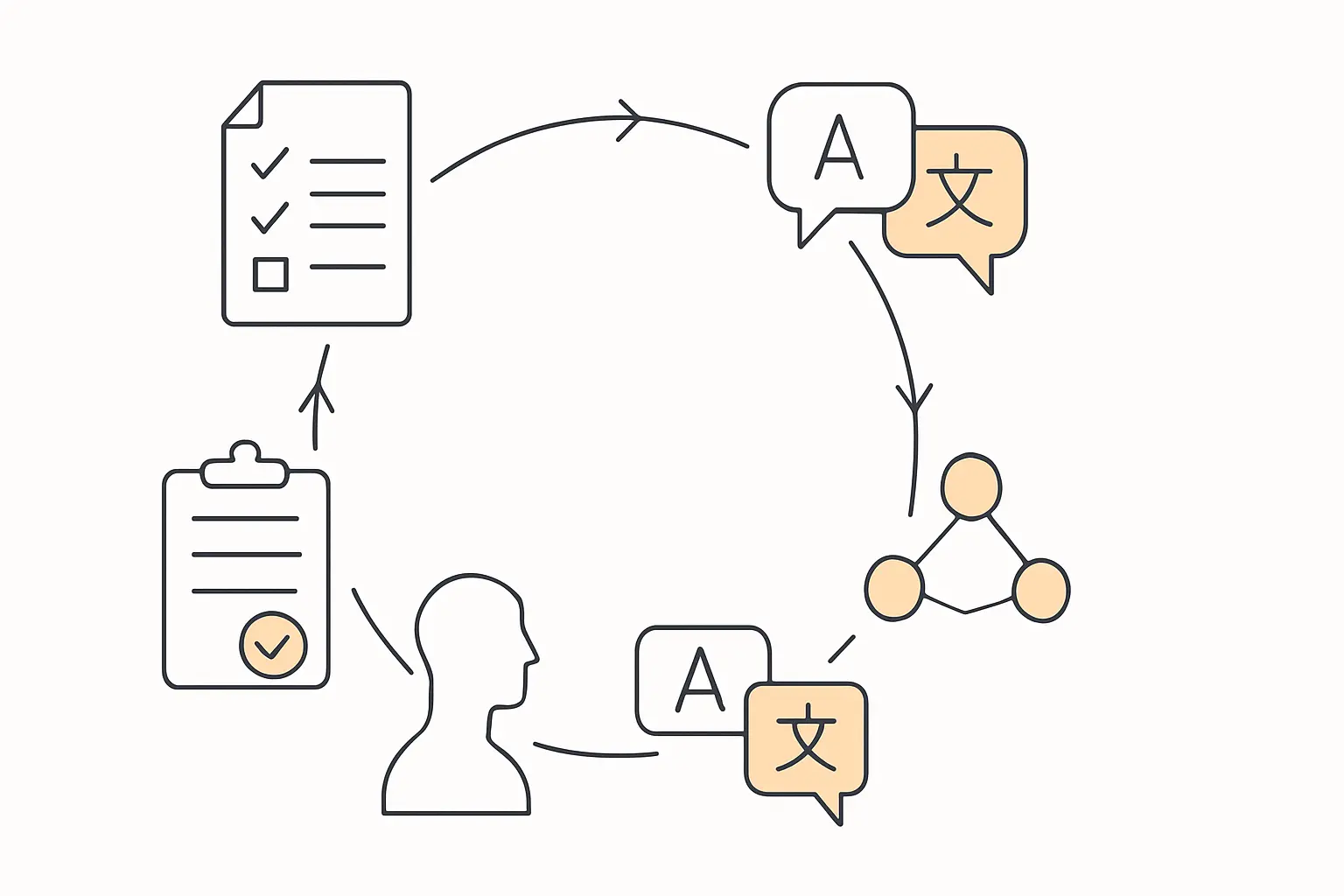
The most widely cited operational protocol is Beaton, Bombardier, Guillemin and Ferraz (2000, Spine). It specifies five stages, and its value to you is that it is a recognised standard — naming it tells your examiner you followed an established method rather than improvising.
- Forward translation. At least two independent translations into the target language, produced by different translators working separately. Both should be native speakers of the target language. Crucially, the two should differ in background: one informed translator who knows the construct being measured, and one naive translator who does not and works purely from the text. The naive translator is there to expose meanings that a subject-matter expert would unconsciously repair.
- Synthesis. The translators and a recording observer reconcile the two versions into a single agreed translation, documenting each disagreement and how it was resolved. That written record is evidence, not administrative overhead.
- Back-translation. Two translators, blind to the original instrument and ideally not specialists in the subject, translate the synthesised version back into the source language. The blinding is essential — a back-translator who has seen the original will unconsciously reproduce it and the check becomes worthless.
- Expert committee review. A committee — methodologist, health or subject professional, language professional, and the translators — compares all versions and resolves discrepancies to produce a pre-final version, explicitly considering each of the four equivalences above.
- Field testing. The pre-final version is administered to a modest sample from the target population, each of whom is then interviewed about what they understood each item to mean. This is cognitive debriefing, and it catches the failures nothing earlier detects.
The most common misunderstanding is treating back-translation as the whole method. It is one stage of five, and on its own it is a weak check: a fluent back-translation can be produced from a target-language item that respondents find ambiguous or irrelevant, because the back-translator is a translator and not a member of the target population. Only field testing tests the thing that actually matters.
What field testing should actually produce
Cognitive debriefing is the stage students most often reduce to “we piloted it”. Done properly, you administer the pre-final instrument to a sample from the target population — Beaton and colleagues suggest a modest number, on the order of 30 to 40 respondents — and then interview each participant on what they believed each item and each response option meant.
You are listening for three specific things: items whose intended meaning was not recovered, items respondents found irrelevant or inapplicable to their circumstances, and response scales that were used differently from the way the original intends. Each finding goes back to the expert committee, and each amendment is recorded. What you can write afterwards — “cognitive debriefing with 35 respondents identified three items requiring rewording, detailed in Appendix C” — is a far stronger methodological claim than any statement about translation fidelity.
For patient-reported outcome measures specifically, the ISPOR Task Force principles of good practice (Wild et al., 2005, Value in Health) set out a closely related sequence with additional emphasis on concept elaboration before translation begins and on proofreading the final version. If your instrument is a PRO measure, cite that guidance alongside Beaton.
The psychometric evidence you still owe
Completing the five stages gives you a linguistically and culturally adapted instrument. It does not give you a validated one. Your adapted version needs its own psychometric evidence, and how much depends on what you intend to claim.
At minimum, report internal consistency in your own sample and compare it with the original’s published value; our guide to reporting Cronbach’s alpha covers the thresholds. Where sample size permits, test whether the factor structure replicates — a confirmatory factor analysis of the original structure is the standard test, and if it fails, an exploratory factor analysis of the adapted version tells you how the structure differs, which is a genuine finding rather than a failure.
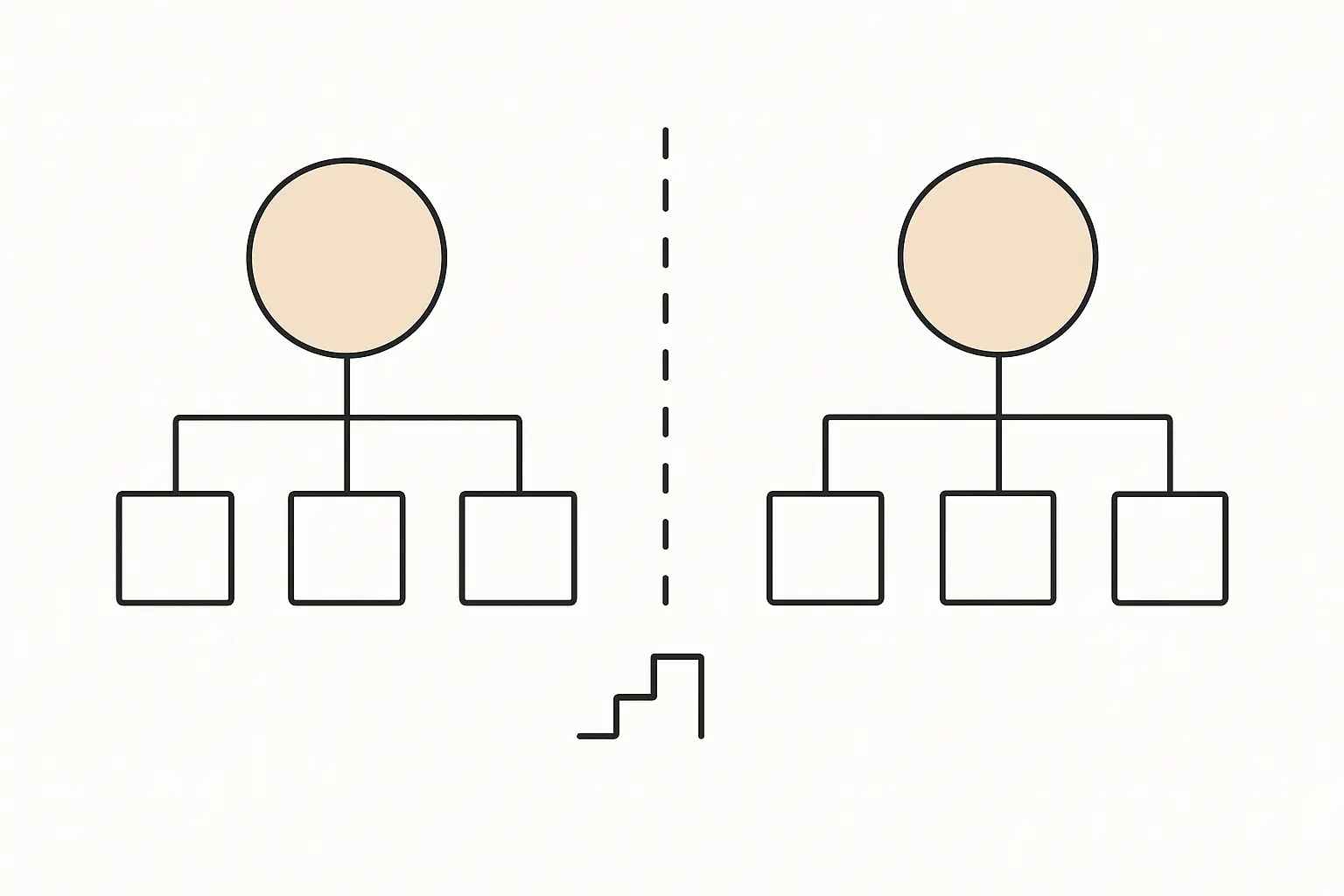
The demanding case is the one many students walk into unawares: if you intend to compare scores between the two language groups, you need measurement invariance. Invariance testing works through nested models — configural (same structure), metric (equal loadings) and scalar (equal intercepts) — within the structural equation modelling framework. Without at least scalar invariance, a mean comparison between groups is not interpretable, because the same latent level of the construct produces different observed scores in the two languages. This requires substantial samples in both groups, which is why the honest scope for most student projects is to adapt and validate within one population and to leave cross-language comparison to future work — and to say so.
The COSMIN checklist (Mokkink et al., 2010, Quality of Life Research) is the standard reference for what constitutes adequate evidence on each measurement property, and is worth citing when you justify the scope of validation you undertook.
Scoping this realistically for a thesis
A full adaptation with two forward translators, two back-translators, an expert committee and cognitive debriefing is a substantial undertaking, and for many master’s projects it is the entire study rather than a preliminary step. That is not a reason to do a thin version — it is a reason to decide deliberately which of three positions you are in.
If an official validated translation exists, use it, cite its validation study, and spend your effort elsewhere. If none exists and adaptation is genuinely necessary, consider making the adaptation and validation itself your research contribution: a properly executed adaptation study with reliability and factor-structure evidence is a publishable piece of work and a very defensible thesis. If neither is feasible within your timeline, the remaining honest option is to select a different instrument that already exists in your target language, even if it is a slightly less perfect fit for the construct — a good-enough validated measure beats a perfect unvalidated one.
What you should not do is translate quietly, administer, and describe it in one sentence as “the scale was translated into the target language by the researcher”. That sentence invites the question you cannot answer.
How to report it
Your methods section should name the guideline you followed and cite it; list the stages completed and by whom, including translators’ native language and whether each was informed or naive; state that back-translators were blinded; describe the expert committee’s composition; report the field-testing sample size and what changed as a result; and present the psychometric evidence for the adapted version. Substantive item changes, particularly experiential substitutions, belong in an appendix with their justification.
Then state your limitation precisely. “The adapted version demonstrated acceptable internal consistency and replicated the original three-factor structure; measurement invariance against the source-language version was not tested, so scores are not directly comparable with published norms” is a sentence that closes the question rather than inviting it.
Frequently asked questions
Is back-translation enough to validate a translated questionnaire?
No. Back-translation is one stage of a five-stage process and checks only that a translator can recover the source wording. It cannot detect items that respondents in the target population find ambiguous or inapplicable — only cognitive debriefing in field testing does that.
How many translators do I need?
The Beaton protocol specifies at least two independent forward translators, one informed about the construct and one naive to it, plus two back-translators blinded to the original instrument. The naive translator and the blinding are the parts most often skipped and the parts that make the check meaningful.
Do I need permission to translate a validated scale?
Usually yes, and separately from permission to administer it. A translation is a derivative work, and most licensed instruments require the rights-holder’s specific approval for a modified or translated version. Ask before the translation work starts.
What if a validated translation already exists?
Use it and cite its validation study. Producing your own competing translation discards existing validation evidence and makes your results harder to compare with the literature.
Can I compare my translated version’s scores with the original-language published norms?
Not without evidence of measurement invariance, at minimum at the scalar level. Without it, a score difference between language groups could reflect the instrument rather than the construct.
How big a sample do I need for the field test?
Beaton and colleagues suggest roughly 30 to 40 respondents for cognitive debriefing. That is separate from, and much smaller than, the sample you need for psychometric validation of the adapted version.
What if the construct does not exist in the target culture?
Then conceptual equivalence fails and the instrument does not transfer. Report that as a finding — it is substantive information about the construct’s cultural boundaries — and select or develop a different measure.
Document the adaptation as you run it
Every stage of a cross-cultural adaptation generates evidence — translator disagreements, committee decisions, debriefing findings — and it is almost impossible to reconstruct months later. Tesify helps you build the methodology chapter and its appendices while the process is happening, so the audit trail is written as it is created — 100% written by you.
Write your thesis with AI
Structure, draft, cite, and format your thesis faster with Tesify’s AI writing tools, automatic bibliography, and plagiarism checker. Free to start, no credit card required.






Leave a Reply