
How to Get Permission to Use a Validated Questionnaire in Your Dissertation (2026)
You found the perfect validated scale for your study. Now the question nobody warned you about: are you actually allowed to use it? Research instruments are copyrighted works, and their licensing ranges from genuinely free through registration-gated to commercially priced per participant — and the terms have been changing. This guide walks through establishing what a scale’s real conditions are, getting the permission your ethics application will ask about, and handling the surprisingly tricky question of whether the instrument can appear in your appendix.
Step 1: Establish who owns the instrument
Every validated scale has a rights-holder — typically the original authors, their university, or a publisher to whom rights were assigned. Your first stop is the instrument’s official home: the developers’ institutional page, the origin paper, or a test database entry. Databases such as APA PsycTests and the Measurement Instrument Database for the Social Sciences (MIDSS) catalogue validated instruments and are the standard discovery route — the finding-and-checking workflow our Likert questionnaire guide builds into its Step 2. What that workflow compresses into one clause — “check whether its items are freely available or require permission” — is this article’s whole subject.
Step 2: Read the licence, not the folklore
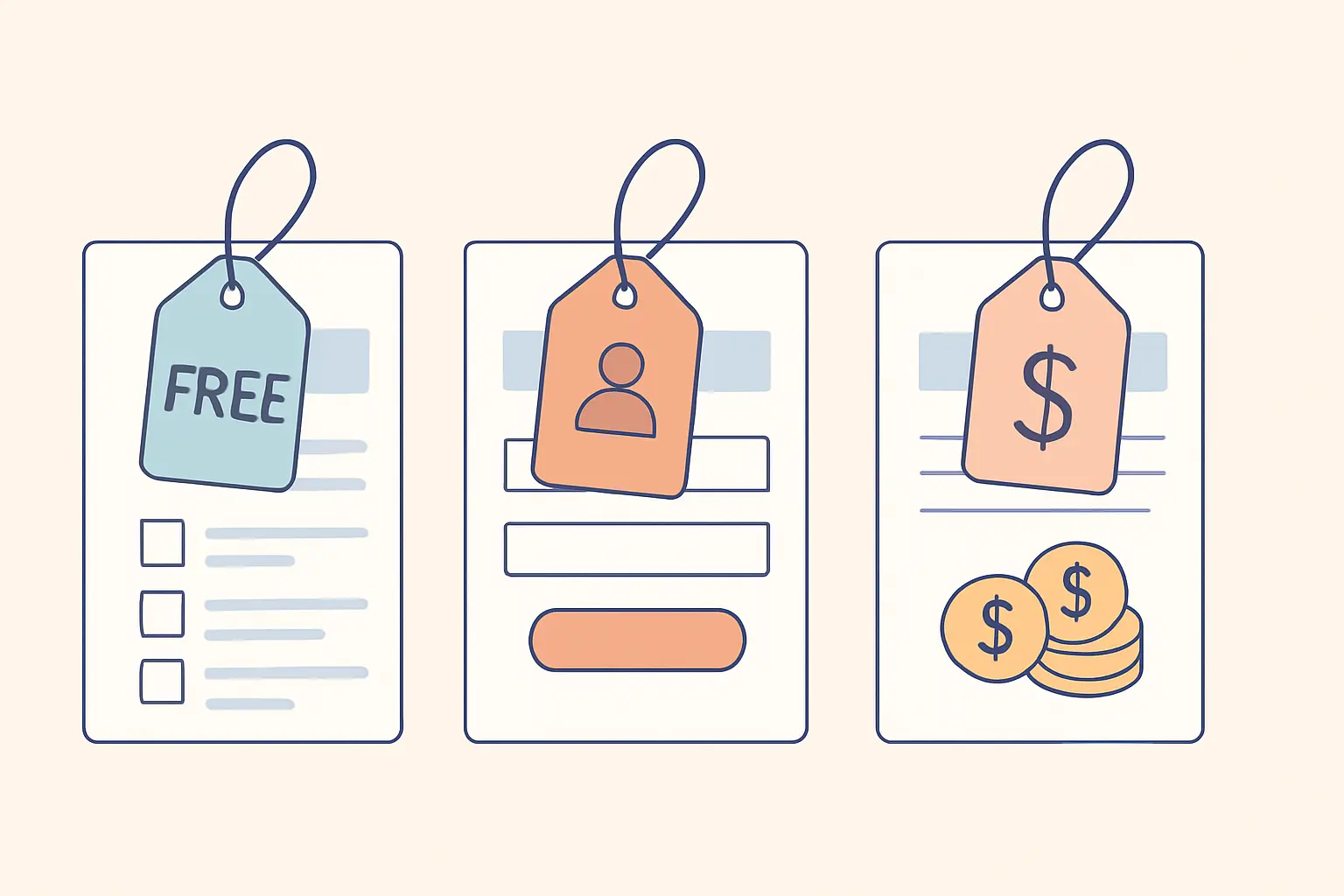
The licensing landscape sorts into three tiers, and real instruments illustrate how different they are — and how terms move:
| Tier | Example | The actual terms |
|---|---|---|
| Free to use | PHQ-9 and GAD-7 | The official PHQ screeners site distributes the Patient Health Questionnaire family — developed in the 1990s by Spitzer, Williams, Kroenke and colleagues — as free downloads with an instruction manual (phqscreeners.com). |
| Licensed, free for some users | WEMWBS (Warwick–Edinburgh Mental Wellbeing Scale) | The University of Warwick licenses WEMWBS: a non-commercial licence is available for academic institutions via a registration form, but NHS organisations have been charged since 1 December 2024 (from £45 for up to 30 participants to £3,000 for 30,000) and commercial users pay annual fees from £90 to £6,000. The non-commercial licence explicitly does not permit publicly sharing the scale or passing it to third parties (Warwick Innovations). |
| Commercial | MMSE-2 (Mini-Mental State Examination) | Sold by PAR — a standard kit costs $268 — and any modified version or translation requires a completed Permission Request Form (PAR). |
Three lessons fall out of that table. First, “everyone uses it” proves nothing: the MMSE is ubiquitous and commercial. Second, terms rot — WEMWBS was widely described as free-with-registration for years, and for NHS users that stopped being true in December 2024. Check the current licence page on the day you plan, not a 2019 methods section. Third, the tier determines your budget and timeline: a paid instrument in an unfunded student project is a design decision to make in week one, not a discovery for the ethics form.
Step 3: Get the permission in writing
For registration-gated instruments, the registration is the permission — complete the correct form (using the right category: student academic use is normally non-commercial, but if your project is NHS-embedded, check whether the NHS terms apply) and keep the confirmation. For scales without a formal licensing operation, email the corresponding author of the origin paper: name the instrument and version, your institution, the study population and sample size, and ask for permission for non-commercial student research use. Authors overwhelmingly say yes; the point of the email is the written record. File whatever you receive — licence confirmation, author email — with your ethics documents, because review forms increasingly ask how instruments were obtained, and “downloaded the items from a paper I found” is the wrong answer for a licensed scale.
Step 4: Decide what goes in the appendix
Here is the trap that catches students at submission: permission to administer a scale is not permission to republish it. A dissertation deposited in a repository is a publication, and reproducing a licensed instrument’s full item set in your appendix can breach terms that allowed only administration to participants — WEMWBS’s non-commercial licence, for instance, expressly withholds the right to share the scale publicly. The safe pattern: reproduce items only where the licence or rights-holder permits it, otherwise describe the instrument (name, version, number of items, response format, scoring, source citation) and cite where it can be obtained. Free public-domain-style instruments like the PHQ screeners are the easy case; when in doubt, the same permission email settles it in one line.
Step 5: Report it like a methodologist
Your methods chapter should state: the instrument’s full name and version; its origin citation; the licence or permission under which you used it; any adaptation you made — with the re-validation that adaptation triggers, per our questionnaire design guide — and the reliability you obtained in your own sample. If you used a translated version, name the specific validated translation; translating a licensed instrument yourself is a modification that typically needs the rights-holder’s approval (PAR’s modification form for the MMSE-2 is the explicit version of a general rule). And cite the instrument itself properly, not just the paper about it — the mechanics parallel dataset citation, covered in our guide to citing datasets, software and code.
Budgeting the time as well as the money
Permission is a pipeline stage with a real duration, and it belongs on the same project plan as ethics review. Registration-gated licences usually resolve in days; author-permission emails run from same-day to never; commercial purchases add procurement time if your department is paying. The dependency chain matters more than any single duration: your ethics application wants the instrument named and its permission status stated, your pilot cannot run before the licence exists, and your appendix decision depends on the redistribution clause you will only see once registered. Work the chain backwards from your data-collection start date and send the registration or permission email in the same week you shortlist the instrument.
Money follows the same logic. A per-participant licence prices your sample size: the WEMWBS commercial tiers, for example, are banded by participant count, which means a design that doubles its sample can double its licensing cost. Student non-commercial routes usually avoid fees entirely — but only if your project genuinely fits the non-commercial category, and mislabelling the category is not a shortcut: Warwick’s licensing page warns that selecting a non-commercial licence when a commercial one applies leads to standard fees being charged to correct it.
The decision flow, condensed
- Is there an official distribution site or database entry? Its licence text overrides everything you have heard.
- Free download stated? Save the page and the manual; note the version and date.
- Registration or licence form? Complete it in the correct user category; keep the confirmation; read the redistribution clause before planning your appendix.
- Priced? Decide now whether the budget exists; if not, find a validated free alternative measuring the same construct — the databases in Step 1 are searchable by construct.
- No licensing information anywhere? Email the corresponding author for written permission; silence is not consent.
- Adapting or translating? Ask specifically about the modification, not just use — modified versions commonly need separate approval.
Frequently asked questions
Do I need permission to use a published questionnaire in my dissertation?
Assume yes until the instrument’s official source says otherwise. Some scales are distributed free (the PHQ screeners), some are licensed with free non-commercial tiers (WEMWBS), and some are commercial products (MMSE-2). The licence text — current, not remembered — is the answer.
Is the PHQ-9 free to use for student research?
The official PHQ screeners site offers the PHQ and GAD-7 screeners as free downloads with an instruction manual. Save the version you use and cite the developers.
Is WEMWBS free for students?
A non-commercial licence for academic institutions is available via Warwick’s registration form. Note the boundaries: NHS organisations have paid licence fees since 1 December 2024, commercial use is priced, and the non-commercial licence does not allow publicly sharing the scale.
Can I put the questionnaire in my dissertation appendix?
Only if the licence permits reproduction — administering a scale and republishing it are different rights, and a deposited dissertation is a publication. Where reproduction is not permitted, describe the instrument and cite its source instead.
Can I change the wording of a validated scale?
Two separate issues: methodologically, adaptations require at minimum a reliability pilot and sometimes full re-validation; legally, modified versions of licensed instruments commonly require specific permission — PAR’s Permission Request Form for MMSE-2 modifications is the explicit example.
What if the authors never reply to my permission email?
Escalate to the co-authors or the publishing journal’s listed contact, and consider a free alternative for the same construct. Do not proceed on silence for an instrument whose terms you could not establish — your ethics committee may ask, and “no reply” is not a licence.
Settle the rights before the pilot
Instrument licensing is a week-one design constraint, exactly like sample access and ethics timelines. Tesify helps you document instruments, permissions and adaptations in the methodology chapter as you build it — 100% written by you.
Write your thesis with AI
Structure, draft, cite, and format your thesis faster with Tesify’s AI writing tools, automatic bibliography, and plagiarism checker. Free to start, no credit card required.




Leave a Reply