
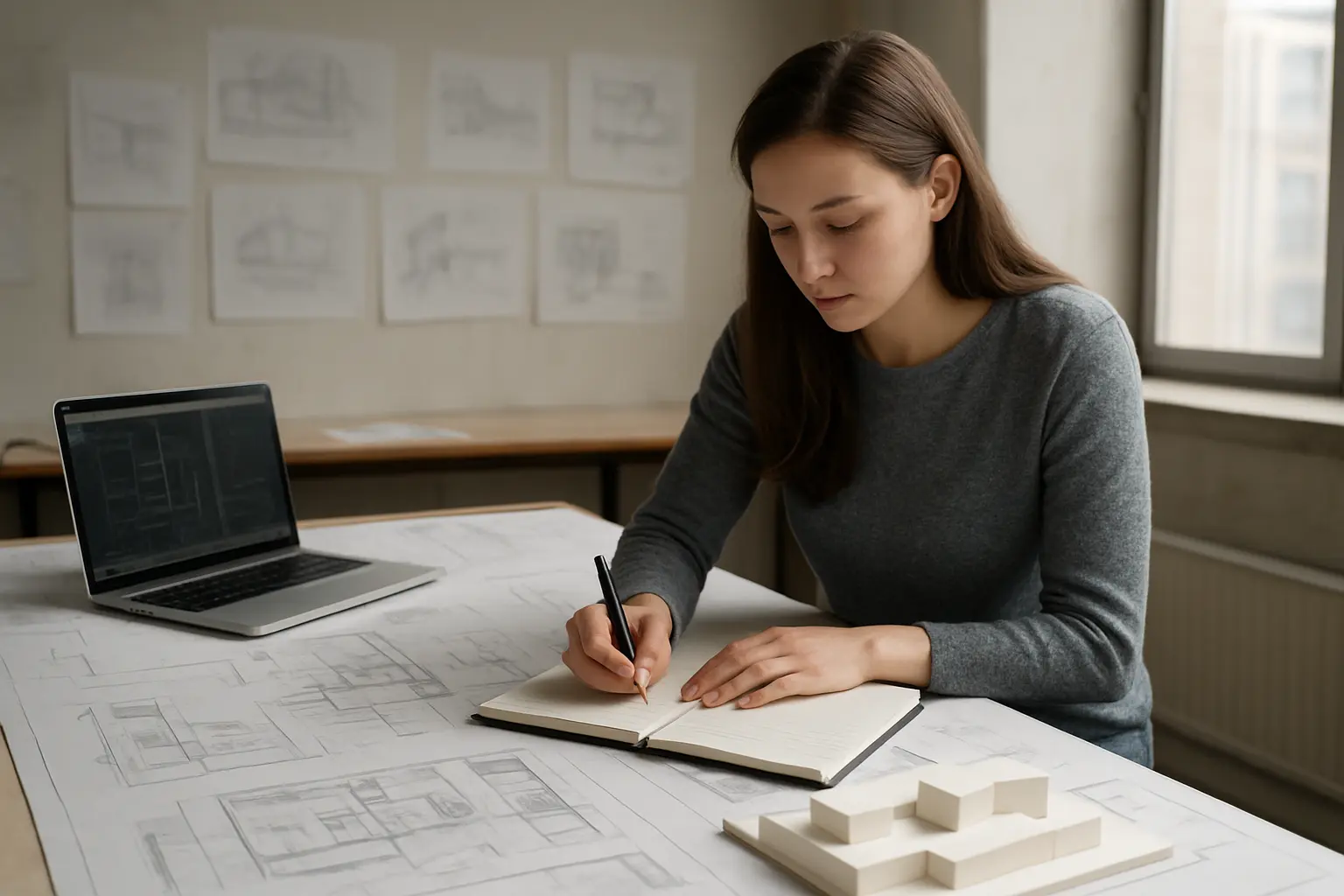
Writing the Findings and Discussion Chapter of an Architecture Thesis in 2026: How to Argue From a Design Project
You have the plans, the sections, the site model and three months of iteration behind you. The design works — you can feel it in the crit room. And then you open the written document, look at the heading that says “Findings and Discussion”, and realise you have no idea what a finding is when your research output is a building.
This is the specific place where architecture theses stall, and it stalls almost everyone. It is not writer’s block in the ordinary sense. It is a genuine structural problem: you were trained to argue visually, and now you are being asked to argue in prose, about evidence that is partly spatial, partly empirical, and partly your own judgement. Most students respond by writing a narrated tour of their scheme — “the entrance is placed to the north, then the visitor moves through the double-height foyer” — and lose a whole classification band for description masquerading as analysis.
Here is how to write it properly, and how to do it in days rather than weeks.
The core problem: your design is not your finding
In an empirical thesis, findings are what the data showed and the discussion is what they mean. In a design thesis the equivalence is not obvious, so state it explicitly for yourself:
- Your findings are what your investigation established — about the site, the users, the precedents, the regulatory or environmental constraints, and about what the design proposition does when tested against them.
- Your design is the instrument through which some of those findings were produced, and the vehicle through which the argument is demonstrated.
- Your discussion is what the whole thing means for the thesis question you set in chapter one, and for anyone designing under similar conditions elsewhere.
The test to apply to every paragraph: could someone disagree with this sentence? “The atrium is 12 metres high” is unarguable and therefore not a finding — it is a fact about your drawing. “A 12-metre atrium was required to bring daylight to the lower floor plate given the 1:4 street canyon ratio recorded on site, and the daylight modelling shows it achieves an average daylight factor of 2.1% at the rear of the ground floor” is a finding: it has a claim, a reason and evidence, and someone could contest it.
Rewrite every descriptive sentence into that shape and your chapter changes character entirely.
Step 1: Inventory your evidence before you write a word
Spend one afternoon listing everything you generated that functions as evidence. Architecture theses are evidence-rich and students consistently underuse what they already have:
- Site analysis — measured surveys, sun path and shadow studies, wind and noise observations, movement counts, figure-ground and grain analysis, materials survey, condition survey.
- Contextual and archival data — census and demographic figures for the ward, planning history, listed building records, historic maps, local plan policy.
- Precedent studies — but analysed comparatively, not admired. A precedent study is evidence only when you extract a transferable parameter: circulation-to-floor-area ratio, structural grid, threshold sequence, unit mix.
- User and stakeholder evidence — interviews, observation, occupancy mapping, behavioural traces, workshops.
- Performance testing — daylight and glare analysis, thermal modelling, embodied carbon estimates, acoustic calculations, wayfinding tests.
- The iterative design record — the options you tested and rejected, and why. This is the most underused evidence in the entire discipline.
That last item deserves emphasis. Every scheme you abandoned is a test you ran. “The courtyard was first placed centrally, but shadow studies showed it received under two hours of winter sun; relocating it to the south-west corner raised this to five hours at the cost of two units” is a controlled comparison and reads as rigorous research. Students throw these away because they feel like failures. They are your results section.
Step 2: Structure the chapter around claims, not around your building
Do not organise by building element — site, plan, section, materials, details. Organise by the sub-questions your thesis asked. If your thesis asks how adaptive reuse of a mid-century civic building can accommodate contemporary community use without erasing its institutional character, your findings sections might be:
- What the building’s existing structure and fabric permit and prohibit
- What current community use actually requires, from your user evidence
- Where those two sets of demands conflict, and the design strategies that resolve each conflict
- What the resolved proposal achieves and fails to achieve when tested
Each section then presents evidence, states what the design does in response, and evaluates the outcome. The building appears throughout, but as demonstration rather than subject. This structural discipline — argument-led rather than artefact-led — is what separates a distinction-level written document from a well-illustrated project report. Our broader guide to writing an architecture thesis covers how this chapter sits within the dual structure of design project and written document.
Step 3: Make drawings carry argumentative weight
In the findings chapter every image needs a job. Ask of each one: what claim does this support? If the answer is “it shows my design,” it belongs in the portfolio or the appendix, not here.
Practical rules that markers respond to:
- Write analytical captions. Not “Figure 14: Ground floor plan” but “Figure 14: Ground floor plan showing the three retained structural bays (hatched) that constrained the position of the new circulation core.” The caption should be readable on its own and should contain the claim.
- Reference every figure in the body text at the point the argument needs it, and interpret it in the sentence that follows.
- Use comparative pairs. Two shadow studies side by side, or the rejected and adopted plan at the same scale, do argumentative work that a single beautiful render cannot.
- Prefer diagrams over renders in this chapter. Renders persuade emotionally; diagrams demonstrate. Save the atmospheric imagery for the design presentation.
- Keep quantitative results in tables. Daylight factors, areas, unit counts, carbon figures and occupancy numbers read as evidence in a table and as decoration in a paragraph.
Step 4: Write the discussion as four moves
Once the findings are laid out, the discussion answers “so what?” Four moves cover it, and they work in this order:
Move 1: Return to the question
Open by restating the thesis question in one sentence and answering it directly. Not “this chapter will discuss” — an actual answer. Markers look for this in the first paragraph, and its absence is the most common reason a discussion feels unfocused.
Move 2: Interpret against the literature and precedents
This is where your chapter two finally earns its place. Does your outcome support what the literature on adaptive reuse, thermal comfort or community-led design predicted, extend it, or contradict it? Name the authors and engage with them specifically. Where your proposal diverges from your precedents, explain what condition in your site or brief made the divergence necessary — that is a contribution, and it is the paragraph external examiners most often quote back to you.
Move 3: State the implications
Who could use what you found, and for what? Implications in architecture can be for practice (a design strategy applicable to similar building types), for policy (what your findings suggest about a local plan requirement or a regulation), and for the discipline (a way of framing a problem). Be specific and proportionate. One well-argued implication beats five vague ones.
Move 4: Be honest about limitations
Your building is unbuilt. Your performance figures come from models, not measurements. Your user sample was eleven people from one community group. Your cost assumptions are indicative. Say all of it plainly. Markers reward candour heavily here, and every limitation you name is one an examiner cannot ambush you with in the crit. Frame each as a boundary on the claim rather than as an apology, and pair it with what future work would resolve it.
Step 5: Fix the four failure modes before submission
The guided tour. If your chapter reads as a walk through the building, it is description. Diagnostic: count the paragraphs that contain the word “because” or an equivalent causal link. If it is fewer than half, rewrite.
Retrospective justification. Claiming every decision followed logically from evidence is not credible, because design does not work that way. Where intuition or formal ambition drove a decision, say so and then evaluate it against your criteria. Honest reflection reads as maturity; invented causality reads as defensiveness.
The disconnected literature review. If chapter two is never cited again after page 40, your discussion is not doing its job. The discussion chapter is where the literature returns.
Uncredited images. Every drawing, photograph and diagram that is not yours needs a full source, and your own work should be marked “Author’s own”. Institutions treat uncredited images as an academic integrity matter, not a formatting slip. The same applies to text: precedent descriptions lifted from architectural websites are one of the most common triggers for a similarity report in design schools.
If the general anatomy of the chapter is what is troubling you rather than its architectural specifics, our guide to the structure of a thesis discussion chapter works through the generic six-part model with annotated examples, and our practical piece on writing the discussion chapter faster covers the drafting sequence when you are already short of time.
A five-day plan when the deadline is close
- Day 1. Evidence inventory. List everything you have, tag each item with the sub-question it addresses, and discard nothing yet.
- Day 2. Write the section headings as claims — full sentences you believe and can defend. This alone converts a blank chapter into a skeleton.
- Day 3. Draft the findings sections. Evidence, then design response, then evaluation, section by section. Do not edit.
- Day 4. Draft the discussion in the four moves. Restate, interpret, imply, limit.
- Day 5. Figure audit: every image referenced in the text, every caption carrying a claim, every source credited. Then a read-through purely for description that should be analysis.
If you also have a reflective component to submit — many schools require one alongside the design project — our guide to writing a reflective portfolio without it reading like a diary covers the register that assessors expect, which is different from the analytical register of this chapter.
Stop staring at a blank findings chapter
You already have the evidence — the site studies, the shadow analyses, the rejected options, the user interviews. What you are missing is the prose that turns them into an argument. Tesify takes your notes, figure list and design decisions and drafts structured findings and discussion sections in academic voice, referencing your figures where the argument needs them and keeping every citation formatted to your school’s style. You keep the thinking; it removes the blank page.
Frequently asked questions
Should my architecture thesis have separate findings and discussion chapters?
Check your school’s handbook, because design programmes vary more than most. Combining them into a single “Findings and Discussion” chapter often works better for design research, because evidence and interpretation are genuinely interwoven — the reason a design decision was made is frequently the finding itself. If you do combine them, keep a distinct closing section that answers the thesis question overall, so the argument does not dissolve into the project narrative.
How do I write findings when I did not collect empirical data?
You almost certainly did collect data, just not in survey form. Site analysis, measured surveys, shadow and daylight studies, precedent comparisons, planning and archival research, and the record of design options you tested and rejected are all evidence. Present each as a result with a claim and a source, and treat the rejected iterations as comparative tests. A design thesis with no empirical component at all is rare; a design thesis whose author has not recognised their own evidence is very common.
How many words should the findings and discussion be?
In a typical 8,000 to 12,000 word architecture written document, findings and discussion together usually occupy 40 to 50% of the total. Where the design project carries most of the assessment weight and the written component is shorter — 5,000 to 6,000 words is common — the same proportion still holds. Check your handbook for whether figure captions, appendices and reference lists count toward the limit, since practice differs between schools.
Can I write in the first person in an architecture thesis?
Usually yes, and often it is preferable. Design research involves the researcher as an agent, and “I tested three courtyard positions” is clearer and more honest than “three courtyard positions were tested”. Many architecture programmes explicitly encourage first person in reflective and design-decision passages while expecting a more impersonal register for site data and literature. Confirm with your supervisor and then apply the convention consistently throughout the document.
Do I have to discuss the parts of my design that did not work?
Yes, and doing so raises your mark rather than lowering it. Examiners can already see the compromises in your drawings; naming them first demonstrates critical awareness and removes the easiest line of questioning in the crit. Present unresolved conflicts as findings about the difficulty of the problem — “servicing the retained structural bays could not be resolved without a dropped ceiling that compromises the original volume” is a genuine result about adaptive reuse, not a confession.
Write your thesis with AI
Structure, draft, cite, and format your thesis faster with Tesify’s AI writing tools, automatic bibliography, and plagiarism checker. Free to start, no credit card required.


Leave a Reply