
COM-B and the Behaviour Change Wheel in Your Dissertation (2026)
Health psychology, public health, nursing and implementation-science dissertations keep circling one question: why do people not do the thing — take the medication, attend the screening, wash their hands, use the service? Since 2011 the discipline’s standard scaffold for answering it has been the COM-B model and the Behaviour Change Wheel (BCW), introduced by Michie, van Stralen and West in Implementation Science (“The behaviour change wheel: A new method for characterising and designing behaviour change interventions”, doi:10.1186/1748-5908-6-42). This guide explains what the model claims, what the wheel adds, and how to use both in a dissertation without the two classic mistakes — treating COM-B as a checklist, and treating the wheel as decoration.
Where the model came from
The BCW was not invented from intuition. Michie and colleagues reviewed existing frameworks for classifying behaviour change interventions — nineteen of them — and found they collectively covered nine intervention functions and seven categories of enabling policy, yet none covered the full range, and “only a minority met the criteria of coherence or linkage to a model of behaviour” (Michie et al., 2011). The BCW is the repair: a single framework that is comprehensive, coherent, and anchored to an explicit model of what generates behaviour. That model is COM-B.
COM-B: the behaviour system at the hub
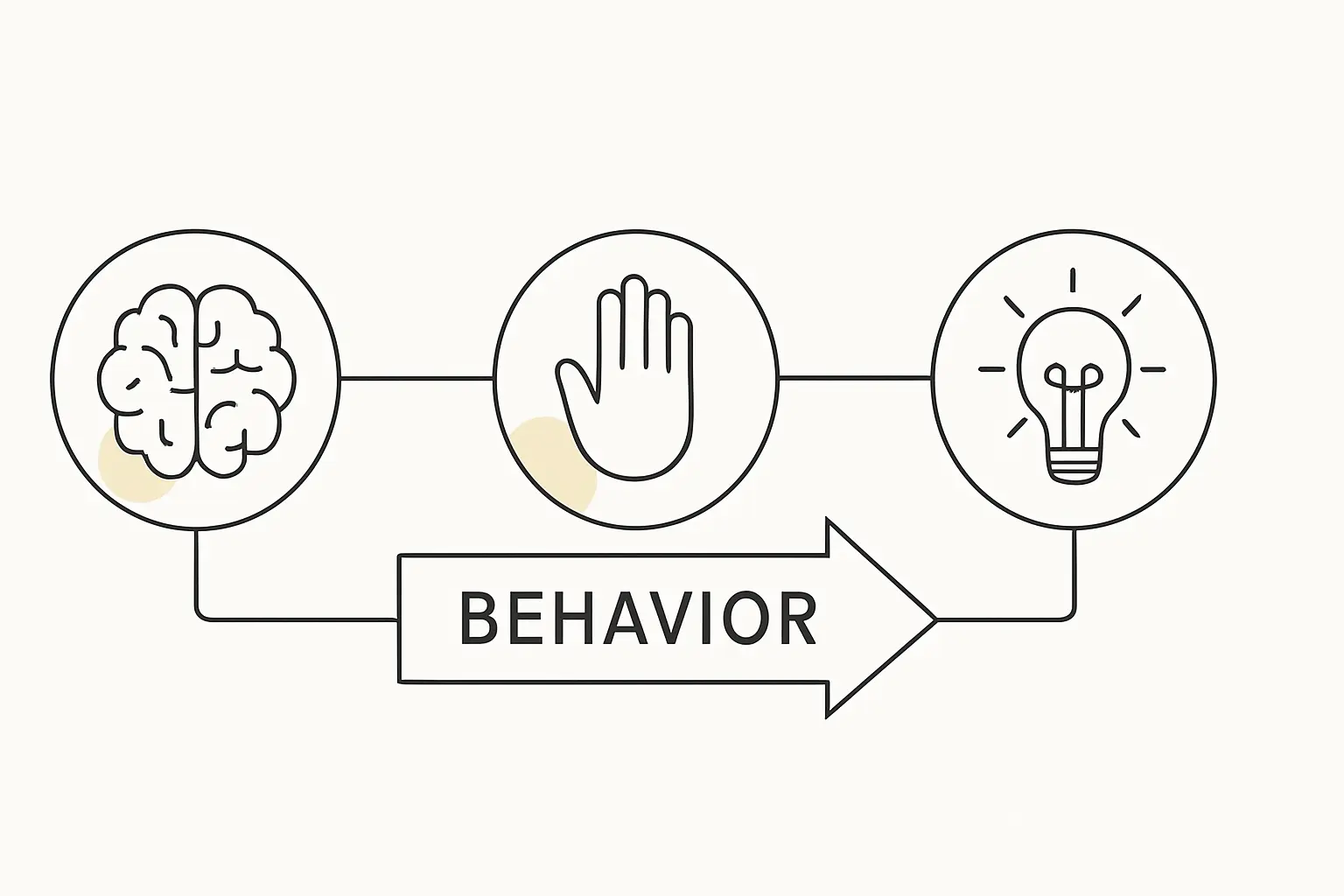
COM-B holds that any behaviour (B) occurs only when three conditions are met together:
- Capability — the individual’s capacity to perform the behaviour, physical and psychological (knowing how, being able).
- Opportunity — everything outside the individual that makes the behaviour possible or prompts it, physical and social.
- Motivation — the brain processes that energise and direct the behaviour, from deliberate plans to habits and emotional responses.
The analytical power is in the interaction: a behaviour deficit can sit in any component or several at once, and interventions fail when they target the wrong one. An information campaign (targeting psychological capability) does nothing for a screening programme whose real deficit is opportunity — clinic hours that working patients cannot attend. For a dissertation, COM-B’s first job is diagnostic: structure your literature review or your qualitative analysis around which of the three conditions the evidence implicates for your behaviour and population.
The wheel around the hub
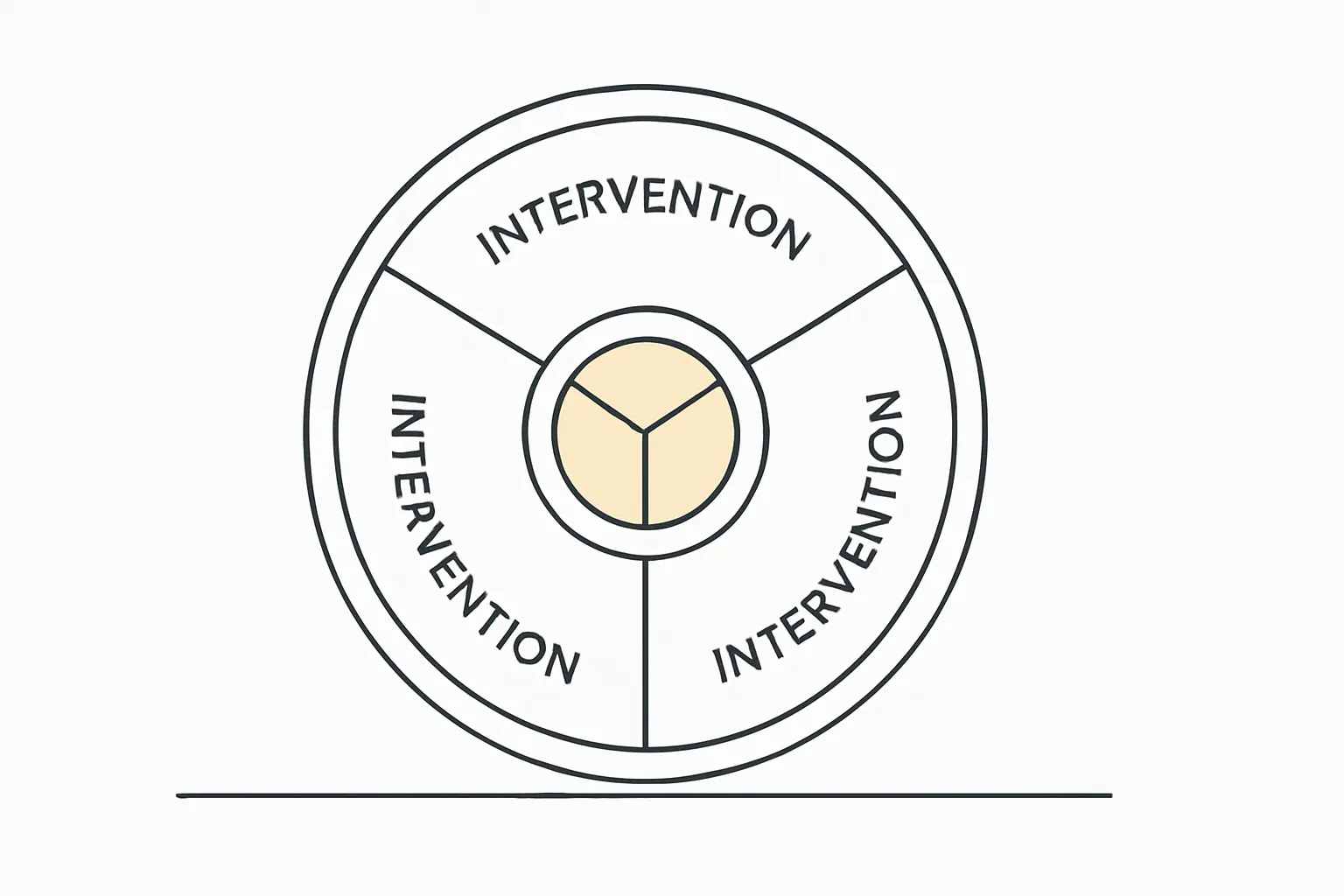
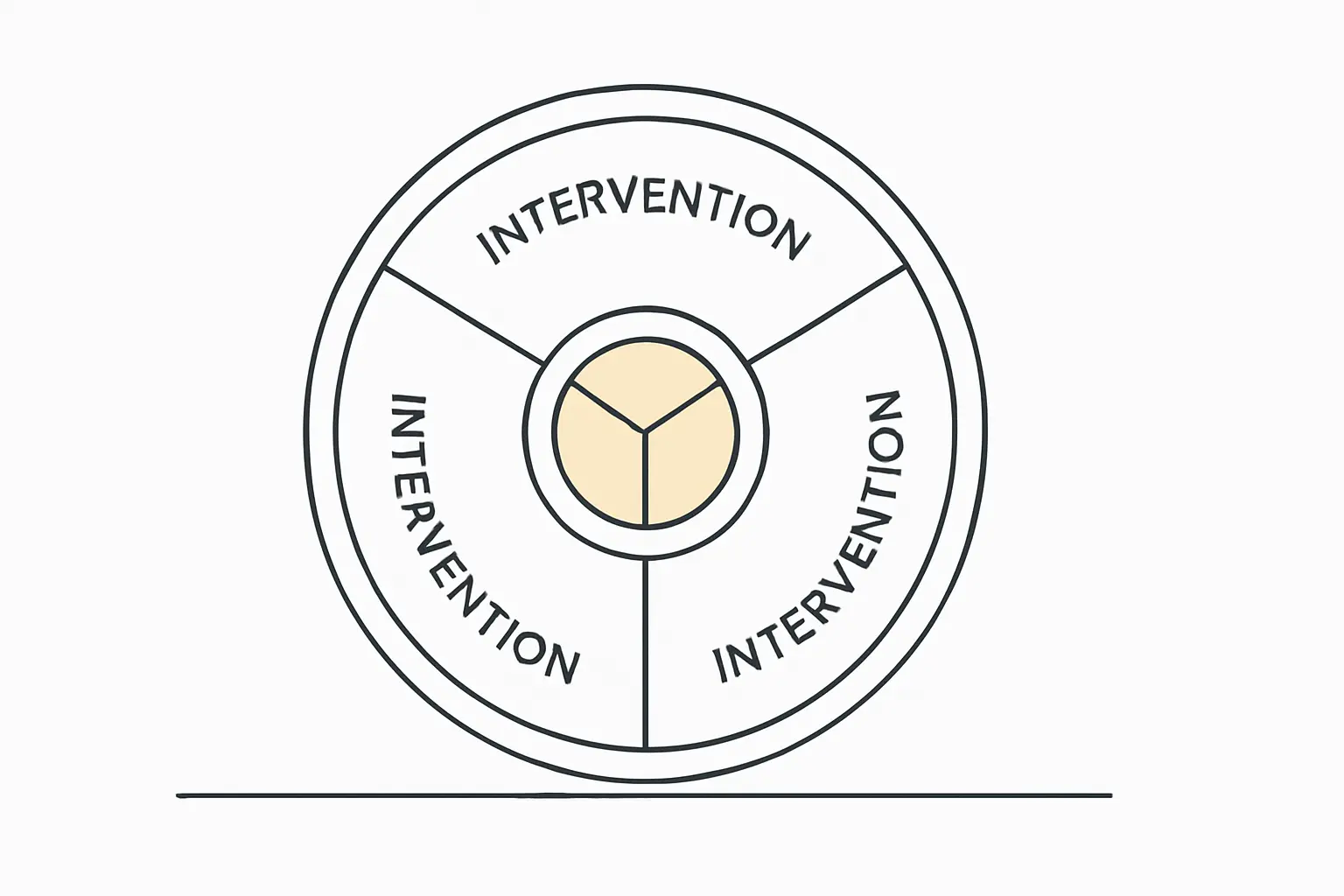
The BCW arranges the machinery in three rings (Michie et al., 2011). At the centre sits the COM-B behaviour system. Around it are the nine intervention functions — types of intervention aimed at addressing deficits in one or more of the three conditions. Around those sit the seven policy categories that could enable or support those interventions. The wheel’s promise is traceability in both directions: an intervention can be characterised by which functions it uses and which COM-B deficits those functions address, and a proposed policy can be traced inward to the behaviour it is supposed to change. In the original paper the authors demonstrated this by reliably characterising the interventions in the English Department of Health’s 2010 tobacco control strategy and NICE’s guidance on reducing obesity.
Three dissertation designs that use COM-B properly
- Diagnostic qualitative study. Interview a population about a target behaviour, code the barriers and enablers into COM-B components, and report which components dominate. This is the workhorse design; its strength is that the coding frame is published and defensible rather than invented. Pair it with the analysis discipline in our thematic analysis guide, and be explicit that you are using COM-B as a deductive coding frame.
- Intervention characterisation. Take an existing programme — a policy document, a service, a campaign — and characterise it against the wheel: which intervention functions does it use, and which COM-B deficits do they target? This is exactly what the original paper did with the tobacco strategy, and it converts a descriptive “policy review” dissertation into an analytical one. Note the boundary that matters for governance: characterising a service against a framework to judge that service is evaluation territory, not research with participants — the distinction unpacked in our guide to research, service evaluation and audit.
- Intervention design proposal. Diagnose the deficit with COM-B, then select intervention functions the wheel links to that deficit, and present the designed intervention as your dissertation’s output. Examiners respond well to the explicit chain: deficit → function → intervention component.
A worked diagnosis, in miniature
Take “final-year nursing students completing incident reports on placement” as the behaviour. Interview extracts sort like this. “I don’t know which form is the right one for a near-miss” — psychological capability. “The terminal is in the office and there’s never a free machine on shift” — physical opportunity. “Nobody on the ward reports the small stuff; you’d look like you were making trouble” — social opportunity. “By the end of a shift I just want to go home; it doesn’t feel like it changes anything” — motivation, and note the two distinct mechanisms inside it: fatigue-driven habit and a belief about consequences. A checklist coder stops there with four labels. The analytical move the wheel demands is next: the capability deficit points to education or training functions; the physical-opportunity deficit to environmental restructuring; the social-opportunity deficit to modelling and enablement at ward level; and the motivation findings to persuasion or incentivisation — with the honest observation that training alone, the intervention most services reach for first, addresses only the first quote. That single sentence — the dominant deficits are not the ones the default intervention targets — is a dissertation finding.
The mistakes that flatten COM-B dissertations
- Checklist coding. Sorting every quote into C, O or M and stopping. The component labels are the beginning of analysis; the finding is what the pattern implies for intervention choice, and the wheel exists to make that implication explicit.
- Wheel as wallpaper. Reproducing the wheel diagram in the framework chapter and never using it again. If your analysis never traces deficit → function, the wheel did no work and the examiner will say so.
- Skipping the origin paper. The 2011 paper is open access in Implementation Science. Cite it directly — not a textbook’s summary — and resolve it by DOI. Secondary summaries drift, and the paper itself states the framework’s claims more carefully than most descriptions of it.
- Confusing COM-B with a theory of everything. COM-B is a model of the conditions for behaviour, built for intervention design. If your question is about deep psychological mechanism — why motivation forms as it does — you may need a different or additional theory, chosen with the discipline set out in our guide to building a theoretical framework.
- Claiming causal proof from a cross-sectional diagnosis. Mapping barriers into components does not demonstrate that fixing them changes the behaviour. Frame the contribution as diagnosis and design, and let the limitations section say what a trial would add.
Writing it into the framework chapter
A clean COM-B framework section makes four moves in order: the behaviour, precisely specified (who, what, when, where — “medication adherence in adults with type 2 diabetes attending community pharmacies”, not “health behaviour”); the model, cited to Michie et al. (2011) with its three conditions defined in your population’s terms; the mechanism of use — deductive coding frame, characterisation matrix, or design chain; and the boundary statement, naming what the model will not do in your study. Four paragraphs, and every one earns its place in the analysis that follows. The empirical stack you attach it to — sampling, instruments, coding reliability — is standard methodology, and the model does not exempt you from any of it.
Frequently asked questions
What does COM-B stand for?
Capability, Opportunity, Motivation — Behaviour: the three conditions that must be present together for a behaviour to occur, forming the hub of the Behaviour Change Wheel (Michie, van Stralen and West, 2011).
What is the difference between COM-B and the Behaviour Change Wheel?
COM-B is the model of behaviour at the centre; the wheel is the full framework around it — nine intervention functions addressing COM-B deficits, encircled by seven policy categories that could enable those interventions.
Can I use COM-B in a qualitative dissertation?
Yes — as a deductive coding frame for barriers and enablers, stated explicitly as such. It is one of the most common and defensible uses at dissertation level.
Is COM-B only for health research?
It was developed in a health context and dominates there, but the behaviour system is domain-general — sustainability, safety and education dissertations use it. Check your discipline’s literature for precedent before transplanting it.
Where do I find the original paper?
Michie, van Stralen and West (2011), “The behaviour change wheel: A new method for characterising and designing behaviour change interventions”, Implementation Science 6:42 — open access, resolvable at doi:10.1186/1748-5908-6-42.
How is COM-B different from the theory of planned behaviour?
The theory of planned behaviour models how intentions form from attitudes, norms and perceived control; COM-B models the conditions under which behaviour occurs and is built to drive intervention selection. Diagnosing a system to change it is COM-B’s home ground; explaining intention formation is TPB’s.
Make the model do work
A named model earns its chapter when every later section uses it — coding frame, characterisation matrix, design chain. Tesify helps you hold that thread from framework to findings — 100% written by you.
Write your thesis with AI
Structure, draft, cite, and format your thesis faster with Tesify’s AI writing tools, automatic bibliography, and plagiarism checker. Free to start, no credit card required.






Leave a Reply