

Thematic Analysis in Research: The Complete Step-by-Step Guide (2026)
Thematic analysis is the most widely used qualitative research method in social science dissertations, yet it is also the most frequently misunderstood. Students routinely confuse thematic analysis with simple content summarisation, producing “analysis” that merely describes interview responses rather than generating conceptual insight. This guide explains exactly how to conduct thematic analysis with the rigour expected by examiners at research universities — drawing on Braun and Clarke’s foundational framework as updated in their 2022 methodological refinements.
Whether you are analysing interview transcripts, focus group data, documentary sources, or survey open-text responses, thematic analysis provides a systematic method for identifying patterns of meaning within qualitative data. When executed correctly, it meets the epistemological standards of journals indexed on JSTOR, Google Scholar, and Web of Science. When executed poorly, it produces nothing more than organised description — which no examiner at Oxford, Cambridge, or a Russell Group university will accept as genuine analysis.
What Is Thematic Analysis?
Thematic analysis (TA) is a method for qualitative data analysis that identifies, analyses, and reports patterns of meaning across a dataset. Unlike grounded theory, it does not require theory generation. Unlike interpretative phenomenological analysis, it does not require focus on individual experience. Its flexibility is its primary advantage: thematic analysis can be applied within realist, constructionist, or critical theoretical frameworks, making it suitable across a wide range of dissertation research designs.
Braun and Clarke first published their definitive guide to thematic analysis in the journal Qualitative Research in Psychology in 2006 — an article that has since accumulated over 100,000 citations, making it among the most-cited methodology papers in the social sciences. Their subsequent refinements, particularly the distinction between reflexive and codebook approaches formalised in 2019–2022, now represent the current standard in dissertation methodology chapters at most UK and Australian universities.
What Thematic Analysis Is Not
- Not content analysis: Content analysis counts the frequency of predefined categories. Thematic analysis interprets the meaning of patterns.
- Not summarisation: Identifying that “many participants mentioned stress” is not a theme. A theme is an interpretive claim about what that pattern means.
- Not grounded theory: Grounded theory requires theoretical saturation and aims to generate substantive theory. Thematic analysis does not.
- Not a single method: The label “thematic analysis” covers multiple distinct approaches with different epistemological assumptions. You must specify which approach you are using in your methodology chapter.
Theoretical Positioning: Choosing Your Approach
Before generating a single code, you must decide where your thematic analysis sits epistemologically. This decision determines what kind of themes you will look for, how you will interpret them, and what claims your analysis can legitimately make.
| Approach | Epistemological Base | What You Claim | Appropriate For |
|---|---|---|---|
| Realist TA | Positivist/post-positivist | Themes reflect what participants actually experience | Health sciences, psychology |
| Constructionist TA | Social constructionism | Themes reveal how meaning is socially produced | Sociology, education, cultural studies |
| Critical TA | Critical realism / Foucauldian | Themes expose power relations and ideological constructions | Political science, media studies, nursing |
Your methodology chapter must explicitly state your epistemological position and explain how it shapes your analytical approach. An examiner reading “I used thematic analysis” without this context will be unable to assess the rigour of your method.
Braun and Clarke’s 6-Phase Framework
Braun and Clarke describe six phases — not steps, because the process is iterative and recursive, not linear. You will move back and forth between phases throughout your analysis.
Phase 1: Familiarisation With the Data
Before touching your coding software or framework, immerse yourself in the data. For interview data, this means transcribing recordings yourself where possible (rather than relying solely on automated transcription) and reading every transcript multiple times without immediately trying to code. Write initial reflective notes — gut reactions, patterns you notice, things that surprise you.
Practical guidance: for a typical 15–20 interview dissertation dataset, allow a minimum of one full day for Phase 1 per 5 interviews. Rushing this phase is the single most common reason thematic analysis produces superficial results.
Phase 2: Generating Initial Codes
Coding is the systematic labelling of data segments that are relevant to your research question. A code is a short phrase that captures what is analytically interesting about a piece of data. Codes are not summaries — they interpret.
For example, if an interview participant says: “I knew I had to finish the chapter before I could sleep, even if it took all night” — a summary label might be “works late.” An interpretive code might be “compulsive productivity,” “perfectionism as self-punishment,” or “temporal control as anxiety management,” depending on your theoretical framework.
Apply codes systematically across your entire dataset, not just the parts that seem relevant. Code everything that might be relevant — you will discard codes in later phases. Qualitative analysis software such as NVivo, ATLAS.ti, or MAXQDA supports this process, though many researchers code effectively in Word or Excel.
Phase 3: Searching for Themes
In Phase 3, you cluster related codes into potential themes. A theme is not defined by frequency alone — a pattern occurring in only two transcripts may still be analytically significant if it represents a conceptually important insight. You are looking for coherent patterns of meaning, not statistical prevalence.
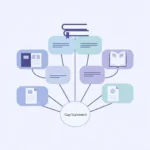
Create a visual theme map: place candidate themes in bubbles, connect related codes to each theme, and note the relationships between themes. This map will become the organising structure of your findings chapter.
Phase 4: Reviewing Themes
Return to the data and test your themes. Ask two questions: (a) Does the coded data within this theme form a coherent, meaningful picture? (b) Does this theme accurately represent the full dataset, not just a subset? This phase often results in splitting over-broad themes, merging under-developed ones, and discarding themes that are not adequately supported.
Phase 5: Defining and Naming Themes
Each theme needs a precise, informative name and a clear definition. A weak theme name is “communication.” A strong theme name is “institutional silence as complicity” or “the negotiation of vulnerability in professional contexts.” The name should capture the essence of what the theme reveals, not merely label its subject matter.
Write a detailed definition for each theme (150–300 words) that explains: what the theme captures, how it relates to your research question, what distinguishes it from adjacent themes, and what its theoretical significance is.
Phase 6: Producing the Report
The write-up of your thematic analysis is itself an analytical act — it is not simply transcription of your coding work. Each theme section should follow this structure: introduce the theme and its significance; present two to four carefully selected data extracts; provide analytical commentary on each extract that connects it to your research question and theoretical framework; build an argument across extracts rather than presenting them in isolation.
Coding in Practice: From Transcript to Theme
Below is an example of how a single interview extract moves through the coding process in reflexive thematic analysis. The participant is a final-year PhD student discussing their experience of academic supervision.
“My supervisor is brilliant, obviously — but there are some things I just don’t tell her. Not because I’m hiding anything, just… she has her own pressures. I don’t want to be another thing on her list.”
| Analysis Level | What You Write |
|---|---|
| Descriptive code | Withholds information from supervisor |
| Interpretive code | Emotional labour management / protecting supervisor from student need |
| Candidate theme | “Emotional containment as doctoral professionalism” |
| Theoretical connection | Relates to Hochschild’s emotional labour theory; suggests doctoral students perform emotional regulation as a form of institutional loyalty |
Reflexive TA vs Codebook TA
Braun and Clarke’s 2019 revisions introduced a critical distinction that now appears in most methodology marking rubrics at UK universities.
Reflexive TA positions the researcher’s subjectivity as a productive analytical resource, not a source of bias to be controlled. The researcher generates codes and themes through sustained engagement with data, and the resulting analysis is explicitly situated within their theoretical and personal perspective. This is now Braun and Clarke’s preferred term for their original 2006 approach.
Codebook TA uses pre-specified or collaboratively developed coding frames applied consistently across data, with the goal of achieving reliability across multiple coders. This approach is appropriate when transparency of coding decisions is paramount — for example, in health services research or multi-site studies.
For most single-researcher dissertations, reflexive TA is the appropriate choice. Attempting to achieve inter-rater reliability in a solo project is both methodologically misguided and practically unachievable.
Writing Up Your Thematic Analysis
The most common mistake in thematic analysis write-ups is presenting extensive data extracts with minimal analytical commentary — sometimes called “quote-dumping.” Examiners expect you to do analytical work in the text, not merely present evidence and assume its meaning is self-evident.
Use this structure for each theme section:
- Open with a conceptual claim about what the theme reveals (1–2 sentences)
- Introduce your first data extract with context (participant code, context)
- Present the extract (indented, italicised, clearly attributed)
- Provide 3–5 sentences of analytical commentary, connecting the extract to your theoretical framework
- Introduce the second extract and explain how it develops or complicates the argument from the first
- Continue until you have built a coherent argument that your theme claim is substantiated by the data
- Close with a paragraph synthesising the theme and connecting it to your overall research question
For related guidance on qualitative methodology, see our complete guide to qualitative research methods and the step-by-step methodology chapter guide. German-speaking students can find parallel methodological guidance at tesify.io’s guide to Wissenschaftliche Methoden, and French students can consult the French research methodology guide on tesify.fr. For AI-assisted academic writing tools that support qualitative research structuring, Authenova’s AI content guidance discusses quality standards relevant to academic AI tools. Portuguese-language researchers can find ABNT-compliant guidance at tesify.pt’s methodology guide.
Common Errors and How to Avoid Them
| Error | What It Looks Like | How to Fix It |
|---|---|---|
| Themes as categories, not claims | Theme named “Communication” with no interpretive content | Ask: “What about communication does my data reveal?” Rename as a claim. |
| Quote-dumping | Three extracts in a row with no analytical commentary between them | Never present two consecutive extracts without analytical text between them |
| Frequency = significance fallacy | “Most participants mentioned X, therefore X is a theme” | Justify themes by analytical significance, not word counts. One powerful deviant case can be more analytically valuable than ten repetitions. |
| Missing reflexive statement | No discussion of how researcher positionality influenced coding | Include a reflexivity section in your methodology chapter. For reflexive TA, this is not optional. |
| Unclear epistemological positioning | Stating “I used thematic analysis” without specifying theoretical approach | Name your theoretical framework (realist/constructionist/critical) and cite Braun and Clarke’s relevant publications |
FAQ
How many themes should a thematic analysis have?
Most dissertation thematic analyses produce between three and six main themes, each potentially subdivided into two or three sub-themes. Fewer than three themes usually indicates under-developed analysis; more than eight usually indicates that themes are actually codes rather than higher-level patterns. There is no universally correct number — the test is whether each theme is analytically distinct and makes a meaningful contribution to your overall argument.
Do I need software like NVivo for thematic analysis?
No. Software assists with data management but does not produce analysis. Many excellent thematic analyses are conducted in Word, Excel, or with printed transcripts and highlighters. If your institution provides NVivo or ATLAS.ti access, using it demonstrates methodological competence and helps manage large datasets. But no examiner will reward an analysis solely because it used software.
How do I show rigour in thematic analysis?
Rigour in reflexive thematic analysis is demonstrated through: (1) detailed description of your analytical process in the methodology chapter; (2) a reflective statement on researcher positionality; (3) clear justification of theme construction with reference to the data; (4) respondent validation or member-checking where possible; (5) an audit trail (coding records, theme development notes) that you can show your supervisor. The goal is transparency, not objectivity.
What is the difference between a code and a theme in thematic analysis?
A code is a label applied to a specific segment of data capturing what is analytically interesting about it. A theme is a higher-level pattern across multiple codes that represents a meaningful insight about your research question. Multiple codes feed into a single theme. Think of codes as the building blocks and themes as the architectural structures that organise those blocks into meaningful patterns.
Can I use thematic analysis with secondary data?
Yes. Thematic analysis can be applied to any qualitative text: interview transcripts, focus group notes, policy documents, social media posts, open survey responses, literary texts, or archival documents. The method is data-format agnostic. What changes is how you address issues of context, authenticity, and access in your methodology chapter.
Conduct Your Thematic Analysis with AI Support
Structuring a findings chapter from qualitative data is one of the most cognitively demanding writing tasks in academic research. Tesify helps you organise your themes, draft your analytical commentary, and ensure your discussion chapter connects your findings to your theoretical framework — while maintaining full academic integrity. Available in English, German, French, Spanish, and Portuguese.




Leave a Reply