

How to Write a Thesis: Complete 2026 Guide for Students
Writing a thesis is, without question, one of the most demanding things a university student will ever attempt. You’ve survived lectures, exams, and group projects — yet somehow this single document feels heavier than all of them combined. That’s not just in your head: according to the NSF Survey of Earned Doctorates (2023), the median time to complete a doctoral degree in the US is now 5.9 years — and a significant portion of that time is spent wrestling with the thesis itself.
The good news? Knowing how to write a thesis is a learnable skill, not a talent you’re either born with or not. This guide breaks the entire process into clear, manageable steps — from your very first research question right through to submission day.
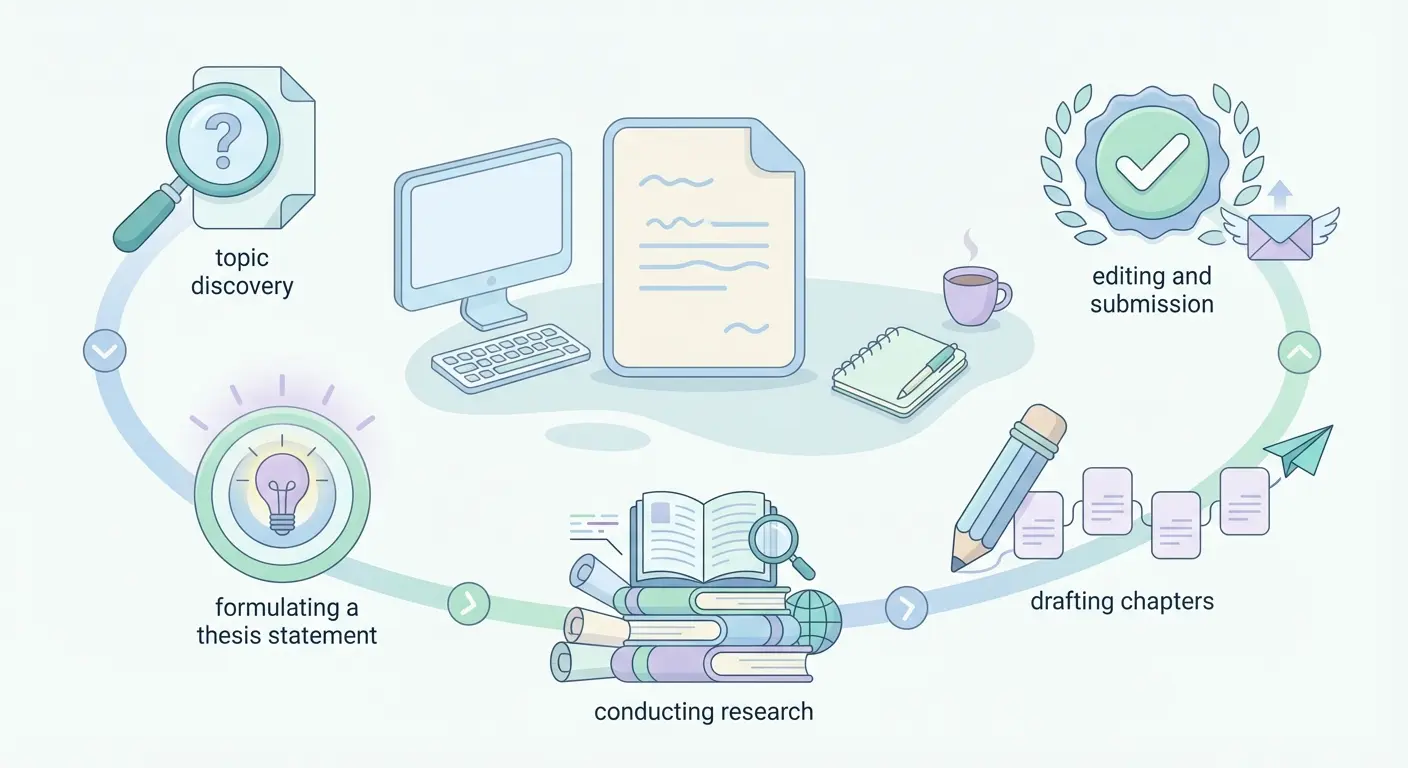
To write a thesis, choose a focused research topic, develop a clear thesis statement, conduct original research, and structure your work into chapters: Introduction, Literature Review, Methodology, Results, Discussion, and Conclusion. Plan your timeline carefully, write consistently, and revise multiple drafts. Most undergraduate theses run 10,000–15,000 words; master’s theses 15,000–50,000 words; doctoral theses 80,000–100,000 words.
What Is a Thesis? (Definition and Purpose)
A thesis is an extended piece of original academic writing that presents research findings and arguments in support of a central claim. At university level, it demonstrates a student’s ability to identify a research problem, engage critically with existing scholarship, apply appropriate methods, and contribute new knowledge or interpretation to their field.
Think of a thesis as the academic equivalent of making a case in court. You’re not just summarising what others have said — you’re building an argument, presenting evidence, and defending a position. That’s what separates a thesis from a standard essay or report.
At undergraduate level, a thesis (sometimes called a dissertation) is typically the capstone of a degree programme. At master’s level, it demonstrates independent research ability. At PhD level, it must make an original contribution to knowledge — a genuinely new finding, theory, or interpretation that didn’t exist before you wrote it.
Different countries use these terms differently, which can cause real confusion. In the UK and Australia, ‘dissertation’ usually refers to a piece of research at undergraduate or master’s level, while ‘thesis’ refers to doctoral work. In the US and Canada, it’s often the reverse. If you’re unsure which applies to your degree, see our detailed breakdown in Dissertation & Thesis Writing: Which Works Better?
Thesis vs Dissertation: Key Differences
Before you write a single word, it helps to know exactly what kind of document you’re writing. Here’s a clear comparison across the countries most students reading this will be studying in:
| Document Type | Degree Level | Typical Word Count | Country |
|---|---|---|---|
| Dissertation | Undergraduate / Master’s | 10,000–20,000 words | UK, Australia, NZ |
| Thesis | PhD / Doctoral | 60,000–100,000 words | UK, Australia, NZ |
| Master’s Thesis | Master’s | 15,000–50,000 words | US, Canada, Ireland |
| Doctoral Dissertation | PhD | 50,000–90,000 words | US, Canada |
The structural expectations differ too. US dissertations typically follow a five-chapter model almost universally. UK theses tend to be more flexible in structure, with chapters tailored to the discipline. Always check your university’s specific regulations — Oxford, Cambridge, UCL, and Imperial all have slightly different formatting requirements.
Step 1 — Choosing Your Research Topic
Your topic is the foundation of everything that follows — choose poorly here and no amount of good writing will save you.
What most students get wrong is starting too broad. ‘The impact of social media on mental health’ is not a thesis topic. It’s an entire field. You need something specific enough to be argued in the space you have, but significant enough to be worth arguing.
How to narrow down a thesis topic
- Start with genuine curiosity. You’ll be living with this topic for months. Pick something that actually interests you, not just what sounds impressive.
- Identify the gap. Read recent literature and look for what hasn’t been studied, what’s contested, or what needs updating with new data.
- Test feasibility. Can you realistically access the data, participants, or materials you’d need? A brilliant topic you can’t research is a dead end.
- Consult your supervisor early. Most supervisors would rather help you refine a topic before you commit than rescue you six months in.
- Check scope against word count. Your topic must be answerable within your allocated word count. A 10,000-word undergraduate thesis needs a very focused question.
Here’s something counterintuitive: the best thesis topics are often narrow enough to feel almost too small. A focused question answered thoroughly beats a sweeping question half-answered every single time.
Step 2 — Writing a Strong Thesis Statement
Your thesis statement is the single most important sentence in your entire document. Everything else — every chapter, every paragraph, every piece of evidence — exists to support or develop this one claim.
A thesis statement is a concise, arguable claim that tells the reader exactly what your thesis will prove or demonstrate. It typically appears at the end of your introduction chapter and serves as a roadmap for the entire document. A strong thesis statement is specific, debatable, and supported by evidence throughout your work.
Weak vs strong thesis statement examples
Weak: “Social media affects teenagers.” (Too vague. Everyone already knows this.)
Stronger: “Heavy Instagram use among female adolescents aged 13–17 is significantly associated with decreased body satisfaction, but this effect is moderated by the type of content consumed rather than frequency of use alone.”
See the difference? The stronger version makes a specific, falsifiable claim that can be argued with evidence. It also hints at a nuanced finding — not just ‘bad thing causes bad outcome’ but something more textured.
The Purdue OWL Thesis Statement Guide is one of the best free resources for practising this skill — it includes worked examples across multiple disciplines.
Three-part thesis statement formula
A reliable structure for an academic thesis statement: [Your position] + [on what topic] + [because of what evidence/reasoning].
It sounds mechanical, but it works. Once you’ve got the core argument down, you can refine the language to feel more natural.
Step 3 — Understanding Thesis Structure and Chapters
Every thesis has a skeleton. The specific structure varies by discipline and institution, but most follow a recognisable pattern that’s worth understanding before you write a single word.
Standard thesis chapter structure
| Chapter | Purpose | Typical Length (Master’s) |
|---|---|---|
| Abstract | Summary of the entire thesis | 150–300 words |
| Introduction | Context, rationale, research questions | 1,500–2,500 words |
| Literature Review | Critical survey of existing research | 3,000–5,000 words |
| Methodology | How you conducted your research | 2,000–3,000 words |
| Results / Findings | What you found | 2,000–3,500 words |
| Discussion | What your findings mean | 2,000–3,000 words |
| Conclusion | Summary, implications, future research | 1,000–1,500 words |
| References / Bibliography | All cited sources | Not counted in word count |
Some disciplines — particularly in the arts, humanities, and some social sciences — use a different structure. A history thesis might not have a formal ‘Methodology’ chapter. A creative writing thesis might include a portfolio alongside a critical commentary. When in doubt, look at past theses in your department. Most university libraries have them.
Oxford’s guidance on essay and dissertation writing skills is excellent for understanding how structure serves argument — worth reading even if you’re not at Oxford.
Step 4 — Conducting Your Literature Review
The literature review is where most students struggle hardest — and where many theses are made or broken. It’s not a list of summaries. It’s a critical conversation.
Your job isn’t to prove you’ve read a lot. Your job is to show where your research fits within the existing body of knowledge — what you’re building on, what you’re challenging, and why your study is needed.
How to structure a literature review
- Thematic organisation: Group sources by theme or concept, not by author or date. This is almost always more effective than a chronological list.
- Identify agreements: Where do scholars agree? Establish the settled consensus before you introduce the contested territory.
- Map the debates: Where do scholars disagree? These are the most valuable parts of your review — they show you understand the field’s complexity.
- Identify the gap: End your review by explicitly identifying what’s missing — and explaining how your research addresses it.
- Synthesise, don’t summarise: Compare sources against each other. ‘Smith (2019) argues X, while Jones (2021) contends Y — this tension is unresolved because…’
A practical tip: use a spreadsheet or reference manager (Zotero, Mendeley, or EndNote) to track sources from day one. Students who start managing citations properly at the literature review stage save themselves enormous stress at submission time.
Step 5 — Designing Your Research Methodology
Your methodology chapter explains not just what you did, but why you did it that way. It needs to be detailed enough that another researcher could replicate your study — that’s the standard you’re writing to.
The most common methodological mistake students make is choosing a method because it sounds impressive (or because it’s what their supervisor uses) rather than because it’s the right tool for their research question. Method choice must follow from your question, not precede it.
Key elements every methodology chapter needs
- Research philosophy / paradigm: Positivist, interpretivist, pragmatist? This tells readers how you understand knowledge and evidence.
- Research approach: Inductive (theory-building from data) or deductive (testing an existing theory)?
- Research design: Qualitative, quantitative, or mixed methods?
- Data collection methods: Surveys, interviews, experiments, archival research, secondary data analysis?
- Sampling strategy: Who or what did you include, how did you select them, and why?
- Ethical considerations: How did you handle consent, anonymity, data storage, and potential harm?
- Limitations: Be honest about what your method can’t tell you. Examiners respect self-awareness.
For a deeper breakdown of research paradigms, sampling techniques, and ethics protocols, the Research Methodology Guide 2026 covers every major design type with practical checklists you can apply directly to your own thesis.
Step 6 — Writing Each Chapter Effectively
Here’s where the thesis actually gets written — and where most students lose momentum. The blank page is brutal, and perfectionism kills productivity faster than any other force in academic writing.
The single most effective technique for thesis writing? Write badly first. Get words on the page in a ‘rough draft’ mindset, then refine. Waiting until you have something ‘worth writing’ is how people spend six months without a single chapter.
Writing the Introduction chapter
Your introduction must do several things simultaneously: establish context, explain why the topic matters, state the research problem, present your research questions, and outline the structure of the thesis. Think of it as a funnel — starting broad and narrowing to your specific study.
One reliable approach: write your introduction last, or at least revise it last. You can’t fully introduce something you haven’t fully written yet.
Writing the Discussion chapter
The discussion is where your intellectual voice matters most — and where many students underperform by simply repeating their results. Your discussion should interpret findings, explain unexpected results, connect back to the literature, and articulate the significance and limitations of your work.
Ask yourself with every paragraph: ‘So what? Why does this finding matter?’ If you can’t answer that question, the paragraph probably isn’t analysis — it’s description.
Writing the Conclusion chapter
A strong conclusion does three things: summarises your key findings (briefly), states your contribution to the field, and identifies directions for future research. It should not introduce new evidence or arguments — the time for that has passed.
Many students write weak conclusions because they’re exhausted by the time they get there. Don’t let that happen. Your conclusion is one of the first things an examiner reads carefully.
Step 7 — Building a Realistic Writing Timeline
One of the biggest reasons theses stall is the absence of a concrete schedule. ‘I’ll write it over the summer’ is not a plan. It’s a wish.
Breaking the thesis into weekly milestones — and writing consistently rather than in panicked bursts — is genuinely the most reliable predictor of on-time completion. Research on academic writing productivity by Robert Boice consistently shows that writers who work in daily scheduled sessions produce more and better work than those who rely on inspiration or large blocks of time.
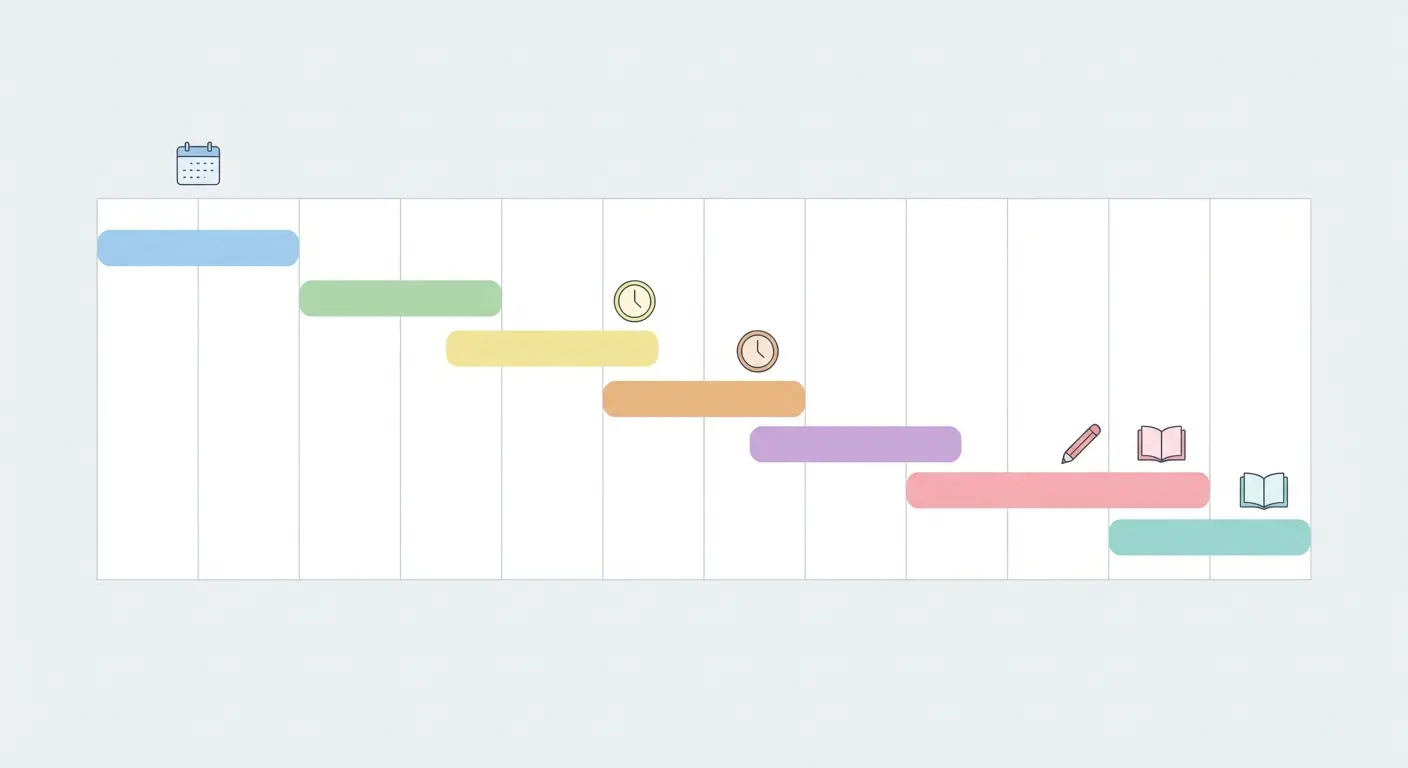
Sample 12-month master’s thesis timeline
- Months 1–2: Topic finalisation, initial reading, research proposal
- Months 3–4: Systematic literature review; draft literature review chapter
- Month 5: Finalise methodology; obtain ethics approval if needed
- Months 6–7: Data collection
- Month 8: Data analysis; draft results chapter
- Months 9–10: Draft discussion and conclusion chapters
- Month 11: Revise introduction; ensure coherence across all chapters
- Month 12: Full editing, formatting, proofreading, submission preparation
This is an idealised timeline — real life rarely goes this smoothly. Build in buffer weeks and don’t skip supervisor meetings, even when you feel like you have nothing ready to show. Something half-written is still worth discussing.
If you’re working to a tighter deadline, the Dissertation Writing: Finish Draft in 6 Weeks guide offers a compressed plan with daily word-count targets and milestone checkpoints that students consistently find genuinely helpful.
Step 8 — Editing, Proofreading, and Formatting
There’s a version of every thesis that’s a good thesis, buried inside a poorly edited one. Editing isn’t a final polish — it’s where arguments become clear, logic gaps get filled, and a passable piece of work becomes something genuinely impressive.
Three-pass editing approach
- Structural edit (first pass): Read the entire thesis for logic and flow. Does each chapter build on the last? Does every section serve the central argument? Don’t touch individual sentences yet.
- Chapter-level edit (second pass): Within each chapter, check paragraph order, transitions, and argument coherence. Cut repetition ruthlessly — it’s one of the most common weaknesses in student theses.
- Line edit and proofread (third pass): Now check sentences for clarity, grammar, punctuation, and style. Read aloud — you’ll catch awkward phrasing your eyes skip over.
For formatting, check your university’s specific requirements carefully. Most UK universities provide a style guide; some require LaTeX formatting (particularly in STEM). The Overleaf thesis template library is excellent for anyone using LaTeX — it has templates formatted specifically for Oxford, Cambridge, Imperial, and dozens of other universities.
Formatting checklist before submission
- Title page matches department requirements exactly
- Abstract within word limit (usually 150–300 words)
- Page numbering correct (front matter often uses Roman numerals)
- Consistent citation style throughout (APA, Harvard, Chicago, MLA, Vancouver — whatever your department specifies)
- All figures and tables labelled and captioned
- Reference list complete and formatted correctly
- Word count confirmed (know what’s included/excluded in your count)
- Declaration of originality / plagiarism statement signed
Common Thesis Mistakes (and How to Avoid Them)
After seeing hundreds of student theses, a handful of mistakes appear again and again. Here are the ones worth knowing about before you start — not after you’ve already made them.
1. Research question too broad
The most common mistake, full stop. A broad question leads to superficial answers. Narrow your question until it feels almost uncomfortably specific — that’s usually about right.
2. Literature review as annotated bibliography
Listing sources and summarising them one by one is not a literature review. You need synthesis, critical engagement, and a clear narrative thread that leads to your research gap.
3. Method chosen before question
Deciding ‘I’ll do interviews’ before you’ve fully articulated your research question puts the cart before the horse. Your question determines your method, always.
4. Discussion that only restates results
Results say what happened. Discussion says what it means. If you’re writing ‘The results showed that X, which means X happened,’ you’re not analysing — you’re restating.
5. Leaving editing until the end
Writing and editing as you go — at chapter level, at least — means you catch structural problems before they become structural disasters. Don’t submit a first draft as a final thesis.
6. Ignoring supervisor feedback
This sounds obvious, but supervisors regularly report students who receive detailed feedback and simply don’t act on it. Supervisor feedback is a gift. Use it.
Best Tools for Thesis Writing in 2026
The right tools won’t write your thesis for you — but they will save you a significant amount of time and frustration.
| Tool | Best For | Cost |
|---|---|---|
| Zotero | Reference management, citation generation | Free |
| Overleaf | LaTeX thesis writing, STEM disciplines | Free / Premium |
| Scrivener | Long-form document organisation, outlining | £49 one-time |
| Notion | Research notes, project management | Free / Premium |
| NVivo / ATLAS.ti | Qualitative data analysis, coding interviews | University licence (often free to students) |
| SPSS / R / STATA | Quantitative data analysis, statistics | University licence / Free (R) |
| Grammarly | Grammar, clarity, style checking | Free / Premium |
One resource worth adding to this list: Umberto Eco’s classic book How to Write a Thesis (MIT Press). Written in 1977 and translated into English in 2015, it remains the most insightful — and most humanely written — guide to thesis writing ever produced. It’s funny, wise, and surprisingly practical. Read it.
For a helpful video walkthrough of the process, this step-by-step thesis writing video guide covers the key stages in an accessible format — useful if you’re a visual learner or just want to hear someone explain the process before you dive in.
Complete Thesis Writing Checklist
Use this checklist to track your progress from start to submission. Tick each item off as you complete it.
Planning Phase
- ☐ Research topic selected and supervisor approved
- ☐ Research question(s) clearly articulated
- ☐ Thesis statement drafted
- ☐ Full writing timeline created with milestones
- ☐ Reference manager set up (Zotero/Mendeley/EndNote)
Research Phase
- ☐ Systematic literature search completed
- ☐ Sources organised by theme in reference manager
- ☐ Research design finalised
- ☐ Ethics approval obtained (if required)
- ☐ Data collection completed
Writing Phase
- ☐ Literature review chapter: first draft complete
- ☐ Methodology chapter: first draft complete
- ☐ Results/Findings chapter: first draft complete
- ☐ Discussion chapter: first draft complete
- ☐ Introduction chapter: revised after other chapters complete
- ☐ Conclusion chapter: first draft complete
- ☐ Abstract written
Editing and Submission Phase
- ☐ Structural edit completed (argument logic)
- ☐ Chapter-level edit completed
- ☐ Line edit and proofread completed
- ☐ All citations verified against reference list
- ☐ Formatting matches university requirements
- ☐ Plagiarism check completed
- ☐ Supervisor final review completed
- ☐ Submitted
Frequently Asked Questions About How to Write a Thesis
How long does it take to write a thesis?
An undergraduate thesis typically takes 3–6 months; a master’s thesis takes 6–12 months; a doctoral thesis takes 2–4 years for the writing phase alone (after research). The actual writing time depends heavily on your discipline, data complexity, and how consistently you write. Daily writing sessions of 1–2 hours are significantly more productive than weekend marathons.
What is the difference between a thesis and a dissertation?
In the UK, Australia, and New Zealand, ‘dissertation’ typically refers to undergraduate or master’s research, while ‘thesis’ refers to doctoral work. In the US and Canada, the terms are often reversed — a master’s student writes a ‘thesis’ and a PhD student writes a ‘dissertation.’ Both terms describe a substantial piece of original research, but the conventions vary by country and institution.
How do I write a thesis statement?
A strong thesis statement makes a specific, arguable claim that your entire thesis will support. Use this formula: [Your position] + [on what topic] + [because of what evidence or reasoning]. It should appear at the end of your introduction and be specific enough to be proven or disproven. Avoid vague claims — the more precise your statement, the clearer your argument.
Can I write a thesis in one month?
Writing a thesis in one month is extremely challenging but not impossible — provided your research is already complete and you have a clear structure planned. At a master’s level (20,000 words), you’d need to write approximately 700–1,000 polished words per day while simultaneously editing. It’s survivable with the right plan, but it’s not recommended. A compressed 6-week drafting plan is more realistic for most students.
Write your thesis with AI
Structure, draft, cite, and format your thesis faster with Tesify’s AI writing tools, automatic bibliography, and plagiarism checker. Free to start, no credit card required.





Leave a Reply