
How to Write a Thesis Introduction Step by Step: With Real Examples (2026)
Your thesis introduction sets the tone for everything that follows. It is the first substantive chapter your examiner reads, and first impressions in academic examination are hard to reverse. Yet most students write their introduction last — and rush it, because after months of writing the main body chapters, the energy for yet another draft is in short supply.
This guide shows you exactly how to write a thesis introduction step by step — with seven concrete stages, annotated examples from real theses, and the specific elements examiners are looking for at master’s and PhD level.
Step 1: Write Your Introduction Last
The most important piece of advice for writing a thesis introduction: do not write it first. Your introduction needs to accurately describe the research you have conducted, the findings you made, and the contribution you can claim — none of which you fully know until the thesis is complete.
Many students write a “placeholder introduction” early in the process, and that is fine — it helps you clarify your initial direction. But you should plan a substantial rewrite once the rest of the thesis is drafted. The introduction you write after finishing Chapter 5 will be dramatically better than the one you wrote before starting Chapter 2.
Step 2: Establish Context and Significance
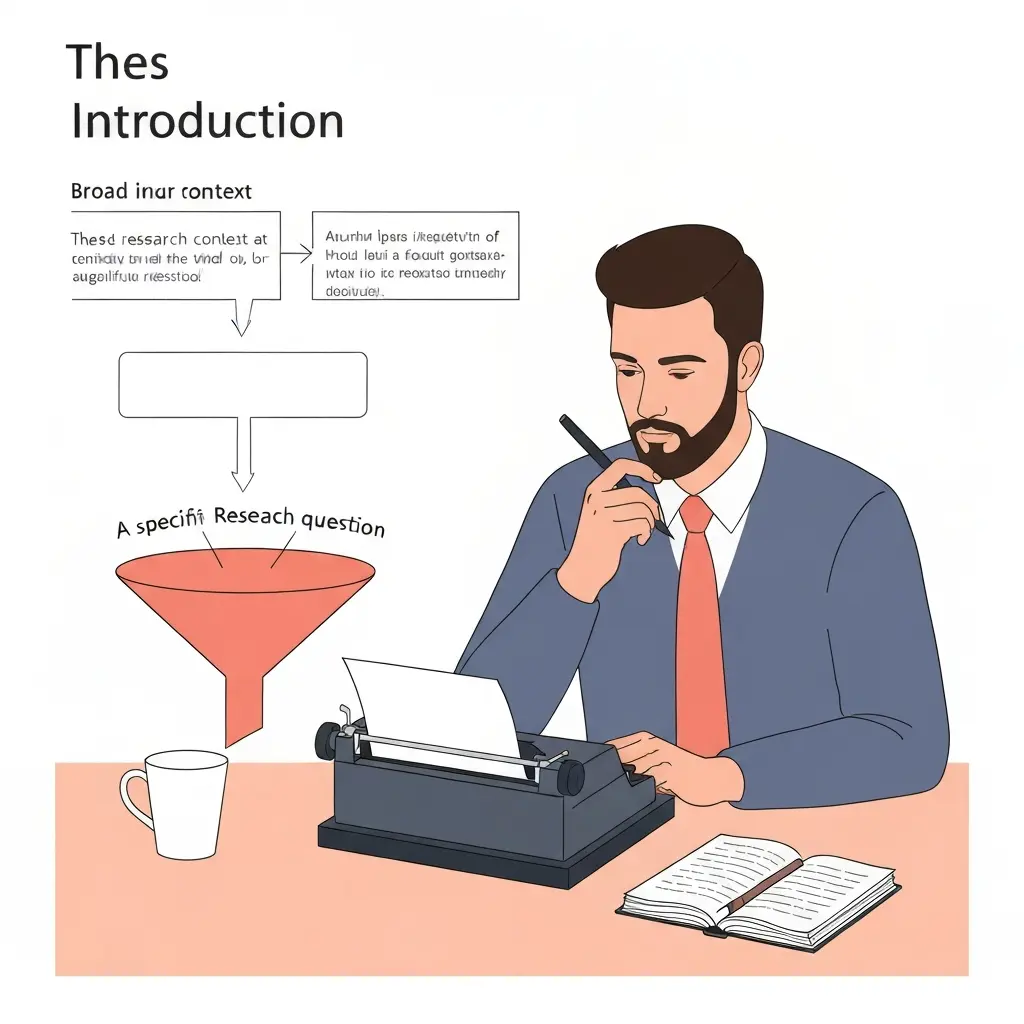
Your opening paragraphs must answer the question: why does this research exist, and why should the reader care? This is sometimes called the “inverted pyramid” or “funnel” approach — you begin with the broad context (your field, the real-world problem, the theoretical landscape) and gradually narrow to your specific study.
Good contextualisation:
- Establishes the broader significance of the research area in two to three sentences
- Uses data, statistics, or concrete observations to make the problem tangible
- Avoids sweeping statements that are too general to be informative (“In today’s society, technology is everywhere”)
- Cites key sources that establish the current state of knowledge
Strong opening: “One in four adults in the UK will experience a mental health condition each year, yet only 36% of those with anxiety disorders access any form of treatment (NHS, 2024). This treatment gap has widened significantly since 2019, driven in part by pandemic-related demand surges and a chronic shortage of trained practitioners in NHS community mental health teams.”
Step 3: Identify the Research Problem or Gap
After establishing context, you must identify the specific problem or gap that your thesis addresses. This is the transition from “the broad field” to “the specific question my research answers.” The gap statement should:
- Be specific enough to be clearly identified and bounded
- Be supported by citations to prior work (which demonstrated that the gap exists)
- Lead logically and inevitably to your research question
Common gap types include: empirical gaps (a population or context that hasn’t been studied), methodological gaps (prior studies used suboptimal methods), theoretical gaps (conflicting theories that haven’t been reconciled), and temporal gaps (studies are outdated given changed conditions). For more on identifying gaps, see our guide on choosing a thesis topic.
Step 4: State Your Research Question(s) or Aims
Your research question(s) or aims should appear clearly and unambiguously in your introduction — typically at the end of the gap identification section. This is not the place for elegant prose: state your research question directly and specifically. Examiners look for this explicitly.
Step 5: Briefly Describe Your Methodology
In the introduction, you provide a brief methodological overview — not the full methodology chapter, but enough for the examiner to understand your basic research approach. Two to four sentences is appropriate: research design, data collection method(s), and sample or data source. Justification belongs in the methodology chapter, not here.
Example: “This study employed a mixed methods approach, combining a quantitative survey of 312 programme participants with 20 in-depth qualitative interviews. Survey data were analysed using multilevel modelling to account for nesting within programmes; interview data were analysed using reflexive thematic analysis following Braun and Clarke (2022).”
Step 6: Summarise Your Key Findings
Include a two to three sentence summary of your most significant findings. This previews what the examiner will encounter and creates a narrative thread that connects your introduction to your conclusion. Do not save all findings for later chapters — examiners appreciate knowing what you found before they read 80,000 words about how you found it.
Step 7: State Your Original Contribution
For PhD-level work especially, your introduction should explicitly state your original contribution to knowledge — the one thing your thesis adds to the field that did not exist before. This is sometimes called the “contribution statement.” Examiners of doctoral theses are specifically evaluating whether a contribution has been made: make it explicit, not implicit.
Example: “This thesis makes three original contributions: first, it provides the first longitudinal evidence of arts participation effects on loneliness in this population from a UK context; second, it develops and validates a novel measure of social connectedness specifically designed for community arts settings; third, it proposes a theoretical model linking arts participation mechanisms to social connectedness outcomes that extends current theory.”
Step 8: Map Your Chapter Structure
Close your introduction with a brief chapter map — one to two sentences on each chapter explaining what it contains and how it contributes to the overall argument. This helps examiners navigate your thesis and signals that you understand the logical architecture of your work.
Example: “Chapter 2 reviews existing literature on loneliness, social connectedness, and arts participation, establishing the theoretical framework that underpins this study. Chapter 3 presents the research design and methodological justification. Chapter 4 reports the quantitative survey findings, followed by qualitative analysis in Chapter 5. Chapter 6 synthesises both strands in the discussion, and Chapter 7 draws conclusions and articulates the study’s contributions and limitations.”
Annotated Introduction Examples
The most common introduction structure failure is the “general to specific” funnel that never quite reaches the specific — the gap statement is vague, the research question is buried, and the contribution is implicit rather than explicit. Contrast this with the strong example format above, where every paragraph has a specific function and the research question appears unambiguously stated. For a deeper look at what great introductions look like section by section, see our guide to how to write a thesis introduction step by step with examples. See our detailed guide with five annotated introduction examples in our thesis introduction examples analysis.
Common Introduction Mistakes
| Mistake | How to Fix It |
|---|---|
| Writing it before the thesis is complete | Write a placeholder, then do a full rewrite at the end |
| No clear gap statement | Add a paragraph explicitly identifying what is missing from current knowledge |
| Buried or vague research question | State your question in italics or bold at the end of the gap section |
| No contribution statement (PhD) | Add a numbered list of your three to five specific original contributions |
| Too long (becoming a mini literature review) | Move detailed literature discussion to Chapter 2; keep intro to ~10% of total word count |
| No chapter map | Add a final section: “This thesis is structured as follows…” |
For the full thesis writing journey, see our complete step-by-step thesis writing guide.
Frequently Asked Questions
How long should a thesis introduction be?
Typically 5–12% of your total thesis word count. For a master’s thesis of 20,000 words, aim for 1,500–2,500 words. For a PhD thesis of 80,000 words, aim for 5,000–10,000 words. Introductions that run significantly longer than this are usually including material that belongs in the literature review. Those that are shorter often fail to adequately justify the research or establish the gap.
Should I include findings in my thesis introduction?
Yes — a brief summary of your key findings (two to three sentences) should appear in the introduction. This is especially important at PhD level, where the examiner needs to understand your contribution before reading 80,000 words of evidence. Some supervisors prefer to leave findings entirely to the results and discussion chapters; discuss this preference with your supervisor before writing your final introduction draft.
Should my thesis introduction include a literature review?
No. Your introduction should establish context, identify the gap, and state your research question — but the detailed critical engagement with the literature belongs in Chapter 2 (your literature review). A common error is including too much literature in the introduction, which makes it too long and undermines the function of the literature review chapter. In the introduction, cite strategically to establish context; save the analysis for your literature review.
How do I start the first sentence of my thesis introduction?
Open with a statement that immediately establishes the significance of your research area — backed by a concrete statistic or observation where possible. Avoid starting with a dictionary definition, a sweeping philosophical statement (“Throughout history…”), or an observation so general it could apply to any thesis (“This thesis examines an important topic…”). The best opening sentences establish the real-world stakes of your research immediately and pull the reader toward the specific problem your thesis addresses.
Can I use first person in my thesis introduction?
Yes, in most disciplines and institutions. First person (“I conducted”, “This thesis argues”) is now standard in social sciences, education, and humanities, and increasingly accepted in sciences. Some traditional science and engineering departments still prefer passive constructions (“The study examines”, “Data were collected”). Check your institution’s style guide and look at recent successful theses in your department for the prevailing convention.
Write Your Introduction with Structure and Confidence
Tesify walks you through every element of your thesis introduction with guided templates, AI-powered feedback on your argument structure, and automated citation management — so you spend your energy on thinking, not formatting.
Write your thesis with AI
Structure, draft, cite, and format your thesis faster with Tesify’s AI writing tools, automatic bibliography, and plagiarism checker. Free to start, no credit card required.





Leave a Reply