
How to Write a Thesis Introduction Step by Step (2026 Guide with Examples)
The thesis introduction is the single chapter examiners read most carefully before forming their first impression — yet most students write it last, rush it, and underestimate how much structural work it has to do. If you want to know how to write a thesis introduction step by step, you need more than a template: you need to understand the logical sequence that moves a reader from a broad research context down to your precise question, and back out to why that question matters. This guide gives you exactly that — ten concrete steps, each with a mini-example paragraph you can use as a model.
Whether you are writing a master’s dissertation or an undergraduate thesis, the introduction must accomplish the same core tasks: establish context, identify a gap, state your problem and question, and signal how the rest of the document is organised. Get these right and your examiner arrives at Chapter 2 already convinced your project is worthwhile. Get them wrong and even excellent findings can feel ungrounded.
Prerequisites Before You Start
Do not open a blank document and start Step 1 until you have the following in place. Skipping these prerequisites is the most common reason students rewrite their introduction three times.
| Prerequisite | Why it matters |
|---|---|
| Research question finalised | Your introduction builds toward this question — if it changes, the whole funnel breaks. |
| Literature reviewed | You cannot credibly identify a gap you have not actually mapped through the literature. |
| Chapter outline drafted | Step 9 (structure preview) requires knowing what chapters actually follow. |
| Key sources bookmarked | Steps 1–4 require 3–6 authoritative citations for context and gap evidence. |
.png)
Time estimate: Allow 3–5 hours for a first draft introduction, plus 1–2 hours for revision. Difficulty: Intermediate — the logic is straightforward once you understand the funnel, but the writing demands precision.
Step 1 — Open With the Hook (Topic Significance)
Your first paragraph should place the topic in a real-world or scholarly context that makes its importance immediately obvious. Do not open with a dictionary definition. Instead, cite a striking statistic, reference a recent policy development, or point to a documented real-world consequence. The goal is to make even a generalist reader think: “yes, this is worth investigating.”
Video: Grad Coach — How To Write A Dissertation Introduction Or Thesis Introduction Chapter: 7 Steps + Examples
“Burnout among early-career healthcare workers has risen by 34% since 2019, contributing to staff shortages estimated to cost the UK National Health Service £2.4 billion annually (NHS England, 2024). Despite growing institutional awareness, the psychological mechanisms driving burnout in the first three years of clinical practice remain poorly understood.”
Notice two things: the opening sentence anchors the topic in concrete stakes, and the second sentence immediately signals a gap. You are priming the funnel from sentence one. Keep this paragraph to 80–120 words.
Step 2 — Define Key Terms
After the hook, identify the two or three central constructs your thesis depends on and define them academically. This is not a glossary — it is a signal to your examiner that you are working with precise, theoretically grounded definitions, not everyday usage.
“Throughout this thesis, ‘formative assessment’ refers to the ongoing, low-stakes evaluation of student understanding used to adjust instruction in real time (Black & Wiliam, 1998), as distinguished from summative assessment, which evaluates learning after instruction concludes. ‘Digital formative assessment’ is defined here as any formative practice mediated by a software platform.”
Limit definitions to terms that are genuinely contested or discipline-specific. Over-defining common words wastes word count and signals weak academic judgement. Aim for 100–150 words in this segment.
Step 3 — Establish Research Context
Now expand the scholarly landscape. Summarise what research already exists, which theoretical frameworks dominate, and what methodological approaches have been applied. This is a condensed version of your literature review’s opening — not a full review, but enough to demonstrate command of the field.
“Research on urban heat island effects has grown substantially over the past two decades, with studies documenting surface temperature differentials of 3–8°C between urban cores and surrounding rural areas in temperate climates (Oke et al., 2017; Zhao et al., 2021). The majority of this work has focused on large metropolitan areas in North America and East Asia, with relatively few investigations in mid-sized European cities.”
Cite 3–5 high-quality sources here. Use APA 7 in-text citation format consistently. This segment should run 150–200 words. For more on building your literature map, see our guide to writing your research methodology chapter.
Step 4 — Identify the Research Gap
This is the pivot point of your entire introduction. After establishing what is known, you must clearly articulate what is missing, contested, or underexplored. Examiners look for a gap that is genuine (not manufactured), significant (worth investigating), and addressable (within the scope of your study).
“While considerable attention has been paid to the adoption barriers for AI-driven recruitment tools among large corporations, scant research has examined how small and medium-sized enterprises (SMEs) with limited HR infrastructure navigate these barriers. This gap is significant given that SMEs account for 99.9% of UK businesses and employ 61% of the private-sector workforce (ONS, 2024).”
Use gap-signalling language precisely: “however,” “despite,” “while X has been studied, Y remains underexplored.” Avoid claiming no research exists — claim that existing research is insufficient, incomplete, or context-limited. Target 100–150 words.
Step 5 — Craft the Problem Statement
The problem statement translates the gap into a concrete, researchable problem. It answers: “What specific situation or phenomenon demands investigation?” This is distinct from your research question — the problem statement describes the issue; the question formalises what you will do about it.
“The problem addressed in this thesis is the absence of evidence-based dietary guidance tailored to university students in low-income brackets during exam periods — a demographic group whose nutritional intake has been shown to decline sharply under academic stress (Mikolajczyk et al., 2009) but who remain largely absent from targeted intervention studies.”
A strong problem statement is specific (names the population, context, and consequence), evidence-backed (at least one citation), and sets up the question naturally. Keep it to 80–120 words — one tight paragraph.
Step 6 — State Your Research Question(s)
Present your research question or questions explicitly, usually in a sentence beginning: “This thesis addresses the question:” or “The central research question guiding this study is:” Do not bury the question inside a paragraph. Make it visible.
“This thesis addresses the following research question: To what extent do mentorship structures within the first year of clinical practice moderate the relationship between workload intensity and burnout severity among NHS junior doctors? Two subsidiary questions follow: (1) Which mentorship characteristics are most protective? (2) Are these effects moderated by specialty type?”
For most master’s theses, one primary question and two to three sub-questions is the appropriate scope. Undergraduate theses typically have one or two questions. Avoid questions answerable with “yes” or “no” — use “to what extent,” “how,” “in what ways,” or “what factors.” See our complete thesis writing masterclass for question formulation frameworks.
Step 7 — Present Hypotheses or Objectives
If your study is quantitative or experimental, state your hypotheses (H1, H2…) here. If it is qualitative or exploratory, state your research objectives instead. Both serve the same structural purpose: they tell the reader precisely what your study will attempt to demonstrate or achieve.
“H1: Junior doctors in formal mentorship programmes will report significantly lower burnout scores (as measured by the Maslach Burnout Inventory) at 12 months than those without mentorship. H2: The protective effect of mentorship will be stronger in high-acuity specialties (emergency medicine, surgery) than in lower-acuity settings.”
“This study has three objectives: (1) to document the lived experience of burnout among first-year NHS junior doctors; (2) to identify the informal coping strategies participants develop in the absence of formal support; and (3) to generate a grounded theoretical account of how mentorship functions as a protective resource.”
Step 8 — Outline Significance and Contribution
Explicitly state why your study matters. Who benefits from the findings? What will this thesis contribute that did not exist before? Significance can be theoretical (advances a framework), empirical (fills a data gap), methodological (applies a novel approach), or practical (informs policy or practice).
“This study makes three contributions. Theoretically, it extends the Job Demands-Resources model (Bakker & Demerouti, 2007) to a clinical training context previously unexamined in the model’s literature. Empirically, it provides longitudinal burnout data for a UK junior doctor cohort — a population underrepresented in existing MBI databases. Practically, findings will inform NHS foundation programme mentorship policy currently under review by Health Education England.”
This is where you sell your study to your examiner. Be specific and confident. Generic claims like “this study will contribute to the field” say nothing. Name the model, the policy, the population, the gap you are filling. Aim for 120–160 words.
Step 9 — Preview the Thesis Structure
End your introduction with a paragraph that walks the reader through each chapter. This is not a summary of findings — it is a roadmap. Use consistent, active language: “Chapter 2 reviews,” “Chapter 3 presents,” “Chapter 4 analyses.”
“Chapter 2 reviews the theoretical and empirical literature on burnout, mentorship, and clinical training, culminating in the conceptual framework guiding this study. Chapter 3 presents the research design, including participant sampling, data collection instruments, and analytic strategy. Chapter 4 reports quantitative findings from the MBI survey data. Chapter 5 presents qualitative interview themes. Chapter 6 integrates both strands, discusses limitations, and outlines implications for NHS workforce policy.”
Keep this paragraph concise — one sentence per chapter, maximum 150 words total. Do not include findings or conclusions here. The structure preview tells readers where they are going, not what they will find.
Step 10 — Polish and Cite Using APA 7
Once your draft is complete, run a focused revision pass for three things: citation accuracy, sentence-level clarity, and word count proportionality.
APA 7 citation checklist for your introduction:
- Every factual claim has a citation — statistics, definitions, and model attributions all need sources.
- In-text format: (Author, Year) for parenthetical; Author (Year) for narrative.
- Multiple authors: use “&” inside parentheses, “and” in running text.
- Three or more authors: use first author + “et al.” from first citation.
- Page numbers required for direct quotes: (Author, Year, p. X).
- Every in-text citation has a corresponding reference list entry.
For word count, your introduction should represent roughly 10% of your thesis total. A 10,000-word thesis needs an 800–1,000 word introduction. A 20,000-word dissertation warrants 1,500–2,000 words. Cut any paragraph that does not advance the funnel logic. If you can remove it without losing the thread, remove it. See our full guide to APA 7 format rules for complete citation guidance.
Tesify Write generates a structured, APA-ready thesis introduction draft based on your research question, field, and key sources — so you spend your time refining arguments instead of staring at a blank page. The built-in AI thesis writing tool follows the exact funnel structure described in this guide.
Full Annotated Example Introduction
Below is a condensed but complete thesis introduction that applies all ten steps in sequence. Annotations are in brackets.
[Step 1 — Hook] Remote work adoption among knowledge workers increased from 5% to 42% of the UK workforce between 2019 and 2021 (ONS, 2022), representing the fastest structural shift in workplace organisation since industrialisation. [Step 2 — Key terms] Throughout this thesis, ‘knowledge work’ refers to occupations in which the primary output is information rather than physical goods (Drucker, 1959), and ‘remote work’ denotes any arrangement in which an employee performs the majority of work tasks outside a shared organisational facility. [Step 3 — Context] Research on remote work productivity has accelerated since 2020, with studies reporting both productivity gains (Bloom et al., 2022) and losses (Gibbs et al., 2021), depending on task type and home environment. [Step 4 — Gap] However, existing studies have focused predominantly on individual productivity metrics, largely neglecting how sustained remote work affects team-level knowledge creation and collaborative innovation capacity. [Step 5 — Problem statement] The problem this thesis addresses is the absence of longitudinal evidence on how remote-first team structures affect the quality and quantity of collaborative knowledge outputs in UK technology SMEs — organisations whose competitive advantage depends directly on such outputs. [Step 6 — Research question] The central research question is: How does sustained remote work (≥12 months) affect collaborative knowledge creation in UK technology SMEs? [Step 7 — Objectives] Three objectives guide the enquiry: (1) to document changes in collaborative output patterns before and after the shift to remote work; (2) to identify the organisational practices associated with sustained collaborative performance; and (3) to develop a framework for remote knowledge-work management applicable to SME contexts. [Step 8 — Significance] This study contributes empirically by providing longitudinal data on a population absent from existing remote work literature, and practically by producing an evidence-based management framework directly applicable to the SME sector. [Step 9 — Structure preview] Chapter 2 reviews the knowledge management and remote work literatures. Chapter 3 presents the mixed-methods design. Chapters 4 and 5 report quantitative and qualitative findings respectively. Chapter 6 synthesises findings into the Remote Collaborative Knowledge Framework and discusses policy implications.
Notice how each step transitions naturally into the next, and how the entire introduction can be read as a single logical argument: “Here is why the topic matters → here is what we know → here is what we do not know → here is the specific problem → here is my question → here is how I will answer it → here is why that answer matters → here is the route we will take.”
For additional annotated models across disciplines, see our companion article on thesis introduction examples. For the broader writing process, our complete thesis writing masterclass covers every chapter in the same step-by-step format. You can also check thesis completion rates by university to understand how structured writing approaches affect outcomes.
Frequently Asked Questions
How long should a thesis introduction be?
A thesis introduction should be approximately 10% of your total word count. For a 10,000-word undergraduate thesis, that is 800–1,000 words. For a 20,000-word master’s dissertation, aim for 1,500–2,000 words. For a PhD thesis of 80,000 words, the introduction may run 6,000–8,000 words. Always check your institution’s guidelines, as some programmes specify a word count range explicitly.
Should I write the introduction first or last?
Write a rough draft introduction first to clarify your thinking, then revise it last once you know exactly what your thesis argues and how it is structured. Many experienced researchers write the introduction twice — once as an outline before the main body, and once as a polished final version after completing every other chapter. The ten steps in this guide apply to the final version.
How many citations should a thesis introduction have?
A typical thesis introduction includes 8–15 citations, depending on length and discipline. Science and engineering introductions tend toward the higher end; humanities introductions may be more selective. Every statistic, definition, and theoretical claim requires a citation. Avoid over-citing by grouping related sources: e.g. “(Smith, 2020; Jones, 2021; Patel, 2022)” to support a broad contextual claim rather than three separate sentences.
What is the difference between a research question and a problem statement?
A problem statement describes the real-world or scholarly situation that requires investigation — it explains what is wrong, missing, or contested. A research question formalises what your study will specifically investigate in response to that problem. The problem statement says “here is the issue”; the research question says “here is what I am asking about it.” Both are needed: the problem statement provides motivation, the research question provides direction.
Can I use “I” in a thesis introduction?
Yes, in most disciplines in 2026. The APA 7 Publication Manual explicitly recommends first-person voice to avoid passive constructions that obscure agency. Write “I argue that” rather than “it is argued that.” However, some traditional science and law programmes still expect impersonal passive voice. Check your department’s style guidelines or ask your supervisor before adopting one approach consistently.
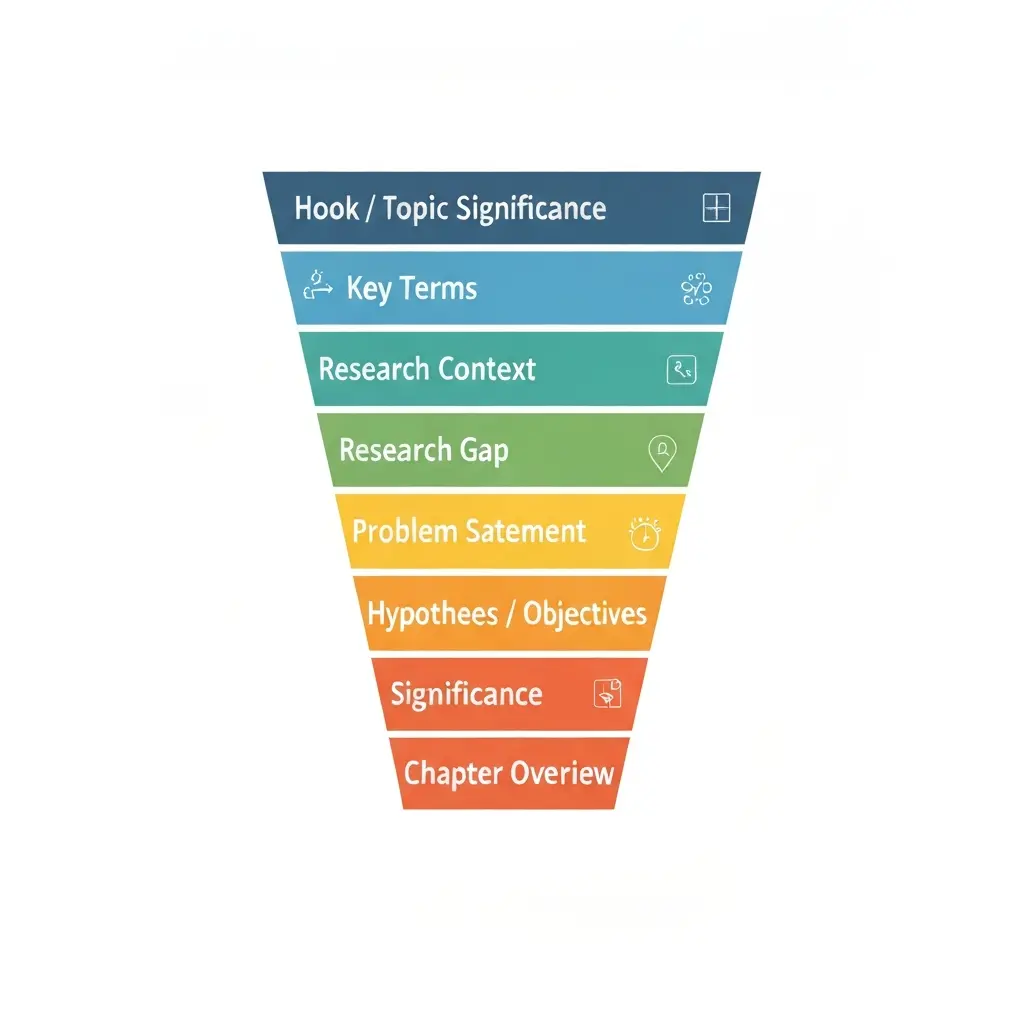
What is the funnel structure in a thesis introduction?
The funnel structure is a writing convention in which the thesis introduction begins with a broad, contextual statement (the wide part of the funnel) and progressively narrows through background, gap, problem, and research question to the specific focus of your study. It then widens slightly at the end to address significance and structure. The ten steps in this guide follow the funnel precisely: Steps 1–4 narrow toward the gap, Steps 5–7 reach the narrowest point (your question), and Steps 8–9 broaden again toward significance and overview.
How do I identify a genuine research gap?
A genuine research gap appears when existing studies share a consistent limitation: they cover a different population, use a different method, focus on a different time period, or test a theory in a different context. The most credible way to identify one is to read 15–30 high-quality papers in your area, note what their authors say in their own limitations sections and future research suggestions, and look for a pattern. When multiple authors point toward the same unanswered question, that is your gap. Tools like AI thesis tools and systematic database searches via Google Scholar or Scopus can help you map coverage systematically.
Ready to write your introduction?
Tesify Write follows the exact 10-step funnel in this guide. Input your research question, field, and key sources, and Tesify generates a structured draft introduction with APA 7 citations ready to refine. The Auto Bibliography feature formats every source automatically so you can focus on the argument, not the formatting.
Write your thesis with AI
Structure, draft, cite, and format your thesis faster with Tesify’s AI writing tools, automatic bibliography, and plagiarism checker. Free to start, no credit card required.





Leave a Reply