
Almost every stage of a research workflow now has a credible open-source alternative: JASP or jamovi for SPSS, Zotero for EndNote, Taguette or QualCoder for NVivo, LimeSurvey for Qualtrics, and R or Python for MATLAB. The genuine remaining gaps are large-scale qualitative team projects, specialist clinical trial software, and a handful of discipline-locked toolchains.
Which open-source tool replaces which paid one?
| Task | Common paid tool | Open-source alternative | Parity |
|---|---|---|---|
| Statistical analysis | SPSS | JASP, jamovi | High for standard tests |
| Advanced statistics | SAS, Stata | R | High, with a coding requirement |
| Numerical computing | MATLAB | Python (NumPy, SciPy), GNU Octave | High outside Simulink |
| Reference management | EndNote | Zotero | Full — Zotero is generally superior |
| Qualitative coding | NVivo, MAXQDA | Taguette, QualCoder | Partial — fine solo, limited for teams |
| Survey platform | Qualtrics, SurveyMonkey | LimeSurvey | High, if you can host it |
| Writing and typesetting | Word | LaTeX, LibreOffice | High; superior for technical work |
| Figures and diagrams | Illustrator | Inkscape | High |
| Image analysis | Photoshop, commercial imaging | ImageJ / Fiji, GIMP | Full in scientific imaging |
| Notes and knowledge base | Notion, Evernote | Obsidian (free tier), Joplin, Logseq | High |
| GIS | ArcGIS | QGIS | High |
| Literature discovery | Web of Science, Scopus | OpenAlex, Semantic Scholar, Lens.org | Partial — coverage differs |
Where does open source clearly win?
Reference management is the least ambiguous case. Zotero is free, syncs across devices, integrates with Word, LibreOffice and Google Docs, captures citations from the browser in one click, and handles thousands of citation styles. It is not a compromise relative to EndNote; for most users it is simply better, and its group libraries make collaboration straightforward. Our comparison of Zotero, Mendeley and EndNote covers the detail, and our guide to setting up a Zotero group library covers shared projects.
Scientific imaging is similarly settled. ImageJ and its Fiji distribution are the standard in cell biology, microscopy and materials science — not the budget option but the tools the field actually publishes with, precisely because their processing is scriptable and reproducible.
Statistical analysis is close behind. JASP and jamovi both wrap R in an SPSS-like interface, produce APA-formatted output directly, and cover the tests used in the vast majority of dissertations. Our comparison of JASP, jamovi, SPSS and R sets out where each stops.
Where does open source still fall short?
Three areas, and being honest about them saves a great deal of wasted time.
Team-based qualitative analysis. Taguette and QualCoder handle solo coding of interview transcripts perfectly well. What they do not match is NVivo’s and MAXQDA’s support for multiple coders working on a shared project with inter-rater reliability calculation, matrix queries and complex retrieval across large corpora. A doctoral researcher coding thirty interviews alone is well served by open source; a five-person team coding four hundred documents generally is not. Our comparison of qualitative coding tools covers the field, and Cohen’s kappa covers the reliability statistic itself.
Regulated and clinical research. Trial management, randomisation and regulatory submission run on validated commercial systems for compliance reasons, not technical ones. Sample size software such as PASS and nQuery sits in the same category — see our comparison of power and sample size tools.
Discipline-locked toolchains. Simulink in control engineering, certain structural and chemical modelling packages, and some proprietary instrument software have no realistic substitute, because the file formats and the field’s shared practice are built around them.
What is the real cost of “free”?
Open-source tools shift cost from money to time, and the trade is not always favourable.
Expect a steeper initial learning curve where the tool assumes technical fluency, thinner official documentation compensated by community forums, no institutional helpdesk, and self-hosting responsibility for server-based tools like LimeSurvey. Compatibility is a real friction too: a supervisor who annotates NVivo projects cannot easily read your Taguette export.
Weigh this against three genuine advantages beyond price. Open-source tools do not expire when you graduate and lose your institutional licence — a problem that catches out enormous numbers of researchers mid-project. They support reproducibility, since a reviewer can run your analysis without buying anything. And your data stays in open formats rather than a proprietary container you may not be able to open in ten years.
What does a fully open-source research workflow look like?
Assembled end to end, the stack is coherent rather than a collection of compromises.
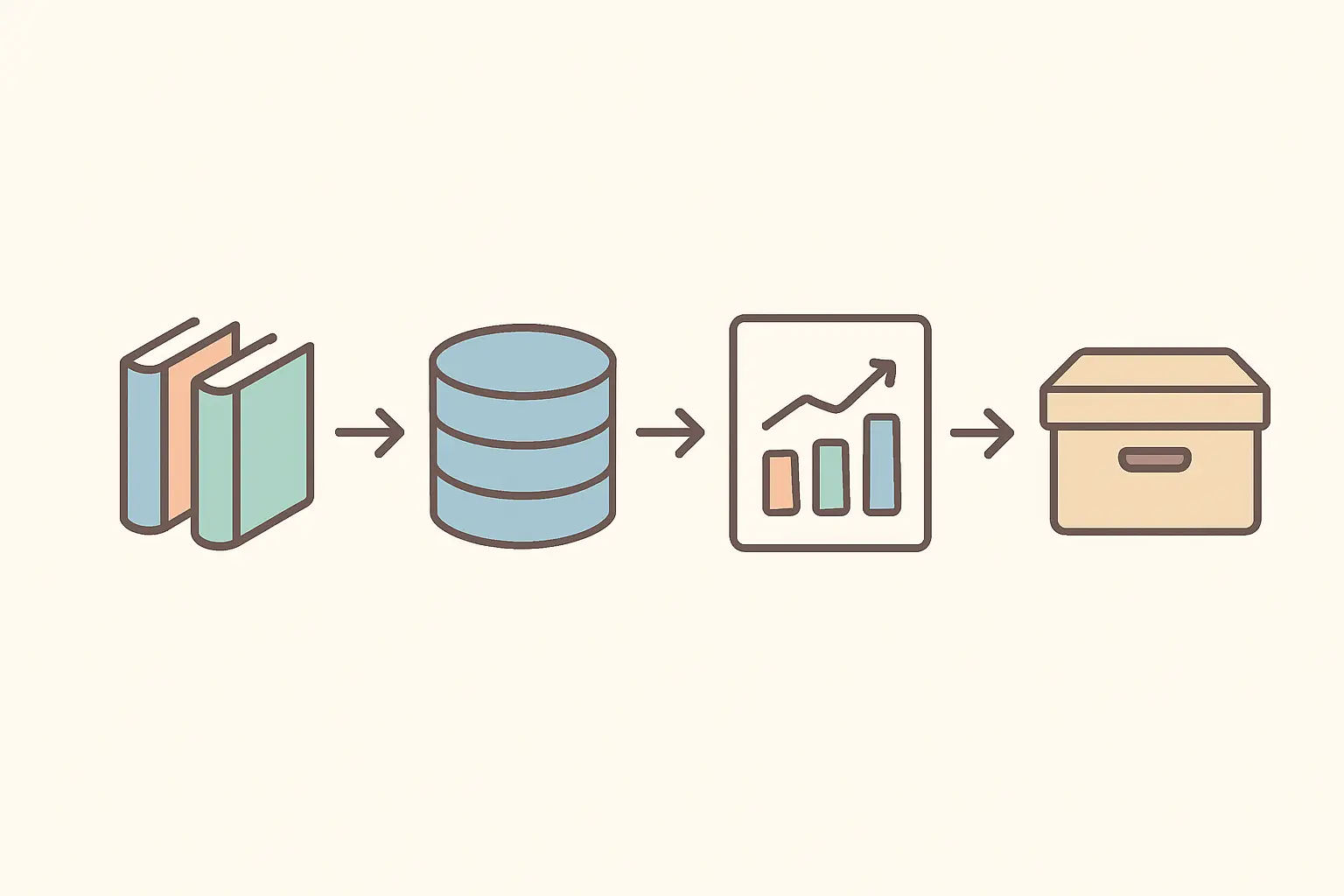
- Literature discovery through OpenAlex, Semantic Scholar and Google Scholar, using structured search strategies as in our guide to Boolean search operators.
- Reference management in Zotero, with a group library if collaborating.
- Note-taking in Obsidian or Logseq over plain Markdown files.
- Data collection via LimeSurvey, or open instruments as appropriate.
- Analysis in JASP, jamovi, R or Python, scripted rather than click-driven.
- Qualitative coding in Taguette or QualCoder.
- Figures in ggplot2, matplotlib or Inkscape.
- Writing in LaTeX or LibreOffice, under Git version control.
- Archiving to Zenodo or an institutional repository with a DOI.
Every stage is reproducible and nothing expires. Our guides to free statistical software for students and the 30 free research tools for PhD students cover further options, and open data repositories covers the data side.
Frequently asked questions
Is open-source software acceptable for a PhD thesis?
Entirely. R, Python, ImageJ, QGIS and Zotero are standard in published research across disciplines. Examiners assess whether your analysis is appropriate and correctly executed, not what the software cost.
What is the best free alternative to SPSS?
JASP or jamovi for anyone wanting a familiar point-and-click interface with APA-formatted output; R for anything beyond standard tests or requiring a reproducible script. Both JASP and jamovi are built on R, so the underlying computation is identical.
Is there a free alternative to NVivo?
Taguette and QualCoder both handle document import, coding and retrieval, and are sufficient for most single-researcher dissertations. They lack the team collaboration, reliability statistics and complex query features that justify NVivo for large multi-coder projects.
Can I use LimeSurvey without a server?
LimeSurvey offers a hosted cloud tier alongside the self-hosted open-source version. Many universities also run an institutional instance — ask your IT department before setting one up yourself, since institutional hosting usually resolves the data-protection questions too.
Will my supervisor be able to open my files?
Check before committing. Open formats are widely readable, but a supervisor working in NVivo or EndNote may not read your exports conveniently. Agree the toolchain at the start of the project rather than at the first shared draft.
What happens to my software licences when I graduate?
Institutional licences for SPSS, NVivo, MATLAB and similar typically end with your student status, sometimes immediately. This is one of the strongest practical arguments for open-source tools: your workflow survives graduation intact.
The writing layer
An open-source stack handles data, references and figures well. The remaining work — turning results into argued academic prose with consistent voice and correct citations — is where Tesify fits, drafting and refining chapters alongside whatever tools you have chosen for the analysis.
Write your thesis with AI
Structure, draft, cite, and format your thesis faster with Tesify’s AI writing tools, automatic bibliography, and plagiarism checker. Free to start, no credit card required.




Leave a Reply