
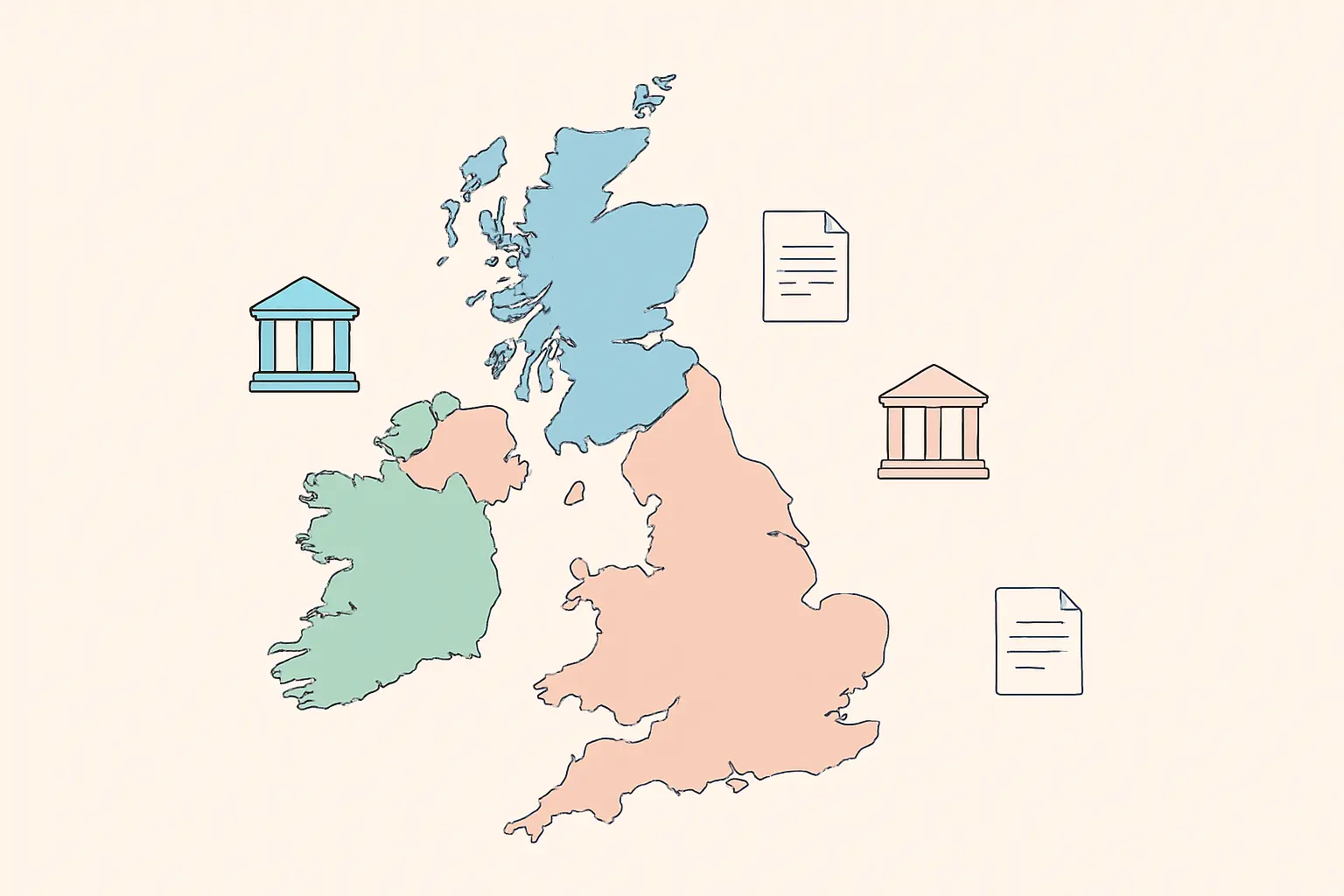
Who Publishes Official Statistics for England, Scotland, Wales and Northern Ireland? (2026)
“UK statistics” is, more often than not, a category error. The United Kingdom runs devolved statistical systems: four producers publish the official numbers, their series cover different territories, and a dissertation that quotes an “England and Wales” figure as “the UK” has made a sourcing mistake an examiner can spot from the reference list alone. This guide maps who publishes what for each nation, and gives you the one-line habit that prevents the whole error class.
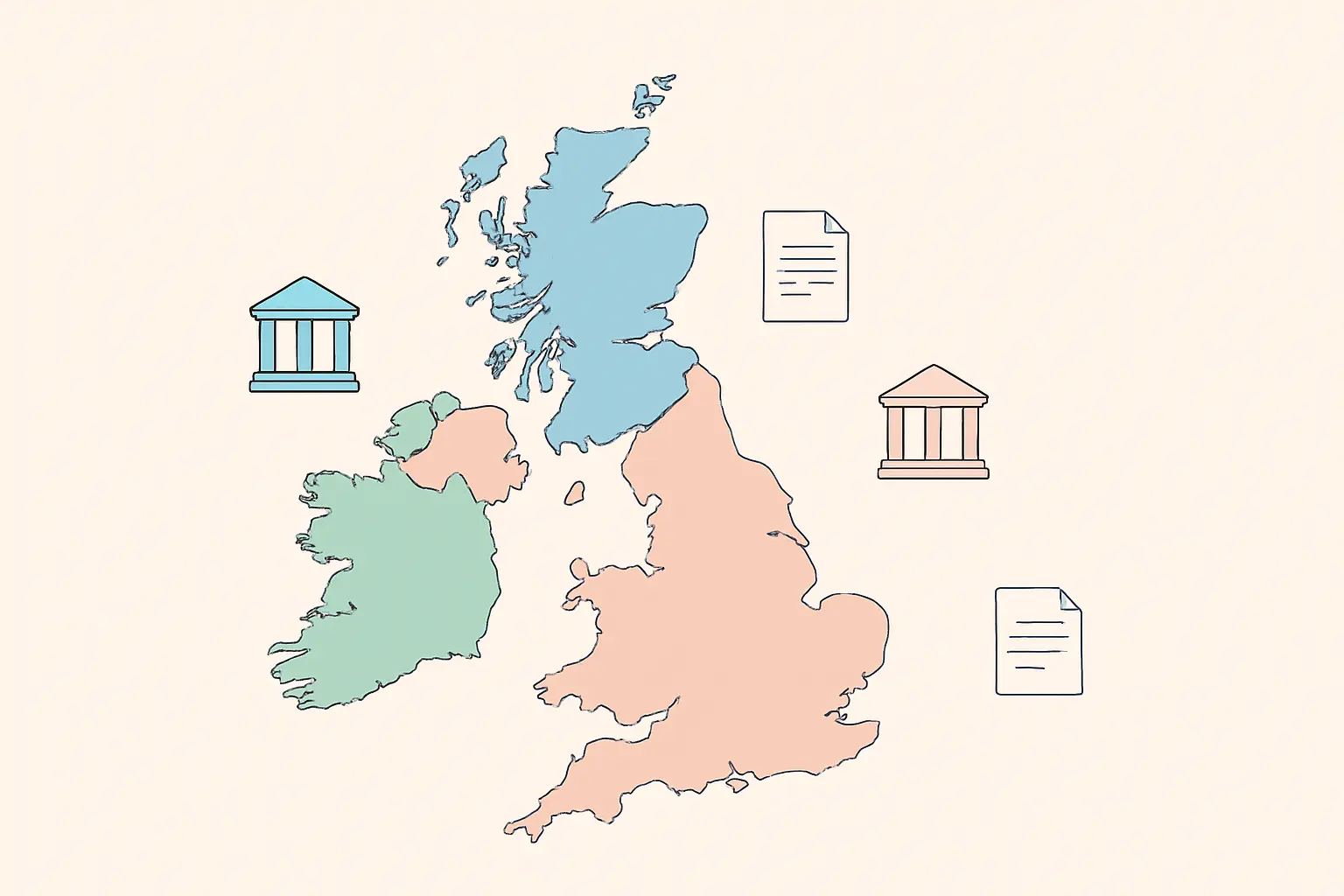
1. Office for National Statistics (ONS) — the UK’s national statistical institute
The ONS is the UK’s largest independent producer of official statistics, covering the economy, population and society. But its coverage is series-by-series: some outputs are genuinely UK-wide, others cover Great Britain, and many — including the census it runs — cover England and Wales only, with Scotland and Northern Ireland running their own. The ONS also operates the research-access infrastructure — the Secure Research Service for de-identified microdata, whose accreditation route we cover in our SRS explainer. Rule of thumb: never infer an ONS series’ coverage from the publisher’s name; read the coverage line on the release.
2. National Records of Scotland (NRS)
NRS collects, preserves and publishes information about Scotland’s people: Scotland’s Census (run separately from the England-and-Wales census), mid-year population estimates for Scotland and its administrative areas by age and sex, household estimates (2.57 million households in Scotland in 2025), vital events including births, deaths and marriages, and even the annual babies’ first names release (NRS). It also runs registration services and Scotland’s People, the genealogy archive of over 100 million records. If your dissertation involves Scottish demography, health geography or families, NRS — not the ONS — is the population-data producer of record.
3. Northern Ireland Statistics and Research Agency (NISRA)
NISRA is Northern Ireland’s official statistics producer, publishing across seven broad areas: people and communities (census, population and migration, births, deaths and marriages), health and social care (hospital activity, waiting lists, mental health), work, pay and benefits, education and skills (pupil enrolments, attendance, qualifications), transport and environment, crime and justice, and business and economy (NISRA). It also operates Northern Ireland’s General Register Office. Northern Ireland’s separateness runs deeper than statistics — its education, health and justice systems differ structurally — so a NISRA series is often measuring a genuinely different system, not just a different territory.
4. Wales: Welsh Government statistics and StatsWales
Wales shares many England-and-Wales series (the census, and justice statistics like those in our guide to civil justice statistics), but devolved matters — education, health, housing, Welsh language — are published by the Welsh Government, with StatsWales as the open data catalogue for finding statistics and data about Wales. The practical consequence for dissertations: on devolved topics, an “England” figure from a UK department and a Wales figure from StatsWales are outputs of different policy systems, and comparing them is a comparative-policy design, not a like-for-like statistic.
The extent trap, and the habit that prevents it
Every UK official release states its geographic coverage — “Applies to England and Wales”, “Scotland”, “United Kingdom” — usually at the top of the page. The habit: copy that coverage line into your notes with the number, every time, and carry it into the sentence you write. The error class this kills is endemic in student writing:
- Justice statistics are mostly England-and-Wales; Scotland’s courts and Northern Ireland’s publish separately.
- Exam results are nation-specific — Scottish attainment data comes from Scotland’s own system, as covered in our Scottish exam statistics guide, and cannot be averaged with A-level figures.
- “The census” is three censuses: England and Wales (ONS), Scotland (NRS), Northern Ireland (NISRA) — run separately and not always in the same year.
- Health statistics follow the devolved health systems: four nations, four reporting regimes.
How to work across all four nations
If your research question genuinely needs UK-wide numbers, you have three honest options. First, find a series the ONS publishes as UK coverage — some exist, and the coverage line confirms it. Second, assemble the four national series yourself and present the assembly as your own harmonisation, with the definitional differences stated (the four producers may define categories differently, and pretending otherwise is a validity hole). Third, narrow the claim to the nation your data actually covers — the cheapest fix and often the best one. Whichever you choose, cite each producer’s specific release, dated, with the coverage stated — dataset-citation mechanics are in our guide to citing datasets, software and code, and the wider map of downloadable sources is in our directory of free datasets and open data repositories.
A worked example: one question, four systems
Suppose your dissertation asks whether university students from disadvantaged backgrounds are more likely to leave without a degree “in the UK”. Run it through the map. Higher education is devolved: England, Scotland, Wales and Northern Ireland run different funding systems, different widening-participation measures, and different definitions of disadvantage (English series often use free-school-meal eligibility or area-based measures; Scotland has its own area-deprivation index; Northern Ireland’s system differs again). A defensible design therefore either narrows to one nation and says so in the title, or becomes explicitly comparative — asking how the four systems’ outcomes differ, with each nation’s figures cited to its own producer and the definitional mismatches treated as findings about policy divergence rather than nuisances to smooth over. The second design is more work and more interesting; the indefensible design is the silent average.
Where a genuinely cross-nation individual-level dataset is needed, the harmonised survey infrastructure is often the answer instead of official aggregates: the Millennium Cohort Study, for instance, follows around 19,000 people born across all four UK nations — the only birth cohort in its family that does — and the UK-wide household panel surveys are designed for exactly this use. Our guide to UK longitudinal cohort studies maps which study covers which nations and ages.
Which producer for which dissertation topic?
| Topic | England | Scotland | Wales | Northern Ireland |
|---|---|---|---|---|
| Population and migration | ONS | NRS | ONS (E&W series) / Welsh Government | NISRA |
| Census | ONS (with Wales) | NRS (Scotland’s Census) | ONS (with England) | NISRA |
| Births, deaths, marriages | ONS | NRS | ONS (E&W series) | NISRA (GRO) |
| Education and skills | UK/England departments | Scottish system sources | Welsh Government / StatsWales | NISRA |
| Health and social care | England bodies | Scottish sources | Welsh Government / StatsWales | NISRA |
| Crime and justice | England & Wales series (MoJ/ONS); Scotland separate | E&W series | NISRA | |
Treat the table as a routing aid, not a substitute for the coverage line on the specific release — series move, and the release page is always the authority.
Frequently asked questions
Is the ONS the statistics agency for the whole UK?
The ONS is the UK’s national statistical institute, but its individual series cover the UK, Great Britain, or England and Wales depending on the output — and Scotland and Northern Ireland maintain their own producers (NRS and NISRA) for population, census and much else. Check each release’s coverage statement.
Who runs the census in Scotland and Northern Ireland?
National Records of Scotland runs Scotland’s Census; NISRA runs Northern Ireland’s. The ONS census covers England and Wales.
What is StatsWales?
The Welsh Government’s catalogue for finding statistics and data about Wales — the entry point for devolved-topic Welsh data such as education, health and housing.
Why do “UK” figures sometimes exclude Northern Ireland?
Some series are produced for Great Britain (England, Scotland and Wales) rather than the UK, and some administrative systems simply differ in Northern Ireland. The coverage line on the release tells you which world you are in — Great Britain and the United Kingdom are not synonyms.
Can I compare statistics across the four nations?
Yes, as an explicit comparative design: cite each nation’s producer, state the definitional differences, and present any harmonisation as your own work. What you cannot do is silently average outputs of four different systems into “the UK”.
How should I cite these producers?
Producer, exact release title, reference period, publication date, and the coverage — for example “(NRS, mid-2025 population estimates, Scotland)”. The coverage in the citation is what makes the claim checkable.
Write the coverage into every sentence
The four-producer map is not trivia — it decides what your numbers mean. Tesify helps you keep sources, coverage and citations straight while the chapters take shape — 100% written by you.
Write your thesis with AI
Structure, draft, cite, and format your thesis faster with Tesify’s AI writing tools, automatic bibliography, and plagiarism checker. Free to start, no credit card required.






Leave a Reply