

Sampling Methods in Research: Probability and Non-Probability Techniques (2026)
Sampling methods in research determine who or what ends up in a study, and that single decision shapes almost everything an examiner will later ask about a methods chapter: whether the findings can be generalised, whether the estimates are biased, and whether the sample actually answers the research question at all. Students frequently choose a sampling technique because it is convenient to execute rather than because it is defensible for the design, and that mismatch is one of the most common reasons a methodology chapter gets sent back for revision.
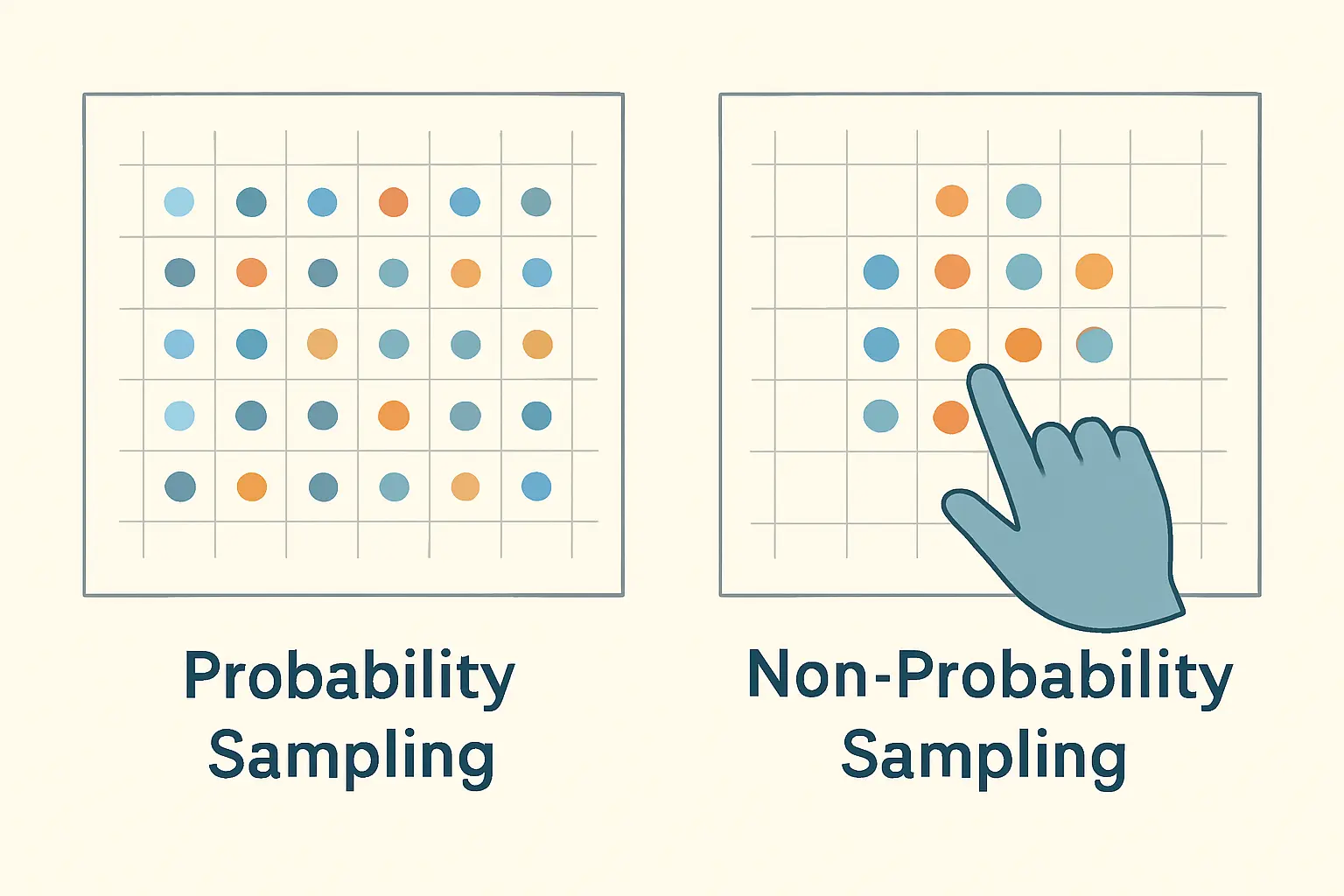
This guide sets out the full taxonomy of sampling methods used in academic research, split into the two families that matter for how you justify your choice: probability sampling, where every unit in the population has a known, non-zero chance of selection, and non-probability sampling, where selection is based on judgement, accessibility, or theoretical relevance rather than random chance. For each technique, you will find what it is, when it is the right choice, and what bias it introduces if used carelessly.
Quick answer: Sampling methods in research fall into two families. Probability sampling — simple random, systematic, stratified, cluster, and multistage — gives every population unit a known chance of selection and supports statistical generalisation, so it is the standard for quantitative, hypothesis-testing research. Non-probability sampling — purposive, convenience, snowball, quota, and theoretical sampling — selects participants based on relevance, accessibility, or emerging theoretical need, and is standard in qualitative research where the goal is depth of insight rather than statistical representativeness.
Why Your Sampling Method Choice Matters
Almost no study can collect data from every member of a population, so researchers select a subset — the sample — and use it to make claims about the whole. The logic connecting the sample back to the population depends entirely on how that sample was drawn. Probability samples let researchers use statistical inference, because the mathematics of random selection is what makes confidence intervals and significance tests meaningful in the first place. Non-probability samples cannot support the same statistical generalisation, but they are often the only realistic way to reach people who share a specific, hard-to-locate characteristic or lived experience, and they are the methodologically correct choice, not a compromise, for most qualitative designs.
Probability Sampling Techniques
Simple Random Sampling
Every unit in the sampling frame has an equal, independent chance of selection, typically drawn using a random number generator against a complete list of the population. It is the theoretical benchmark against which other probability techniques are compared, but it requires a complete and accurate sampling frame, which is often unavailable for large or dispersed populations.
Systematic Sampling
Researchers select every kth unit from an ordered sampling frame after a random starting point, where k is the population size divided by the desired sample size. It is easier to execute than simple random sampling and works well when the list has no hidden periodic pattern that could align with the sampling interval and introduce bias.
Stratified Sampling
The population is divided into homogeneous subgroups (strata) — by gender, year group, disease severity, or another variable relevant to the research question — and units are then randomly sampled within each stratum, either proportionally to stratum size or with deliberate oversampling of smaller strata. Stratified sampling improves precision relative to simple random sampling when the stratifying variable is related to the outcome of interest, and it guarantees that small but important subgroups are represented rather than sampled out by chance.
Cluster Sampling
The population is divided into naturally occurring groups (clusters) — schools, hospitals, geographic areas — and a random sample of clusters is selected, with every unit inside a selected cluster included. Cluster sampling is far cheaper than sampling individuals directly across a wide geographic area, but it typically increases the standard error relative to a same-sized simple random sample because units within a cluster tend to be more similar to each other than to units in other clusters.
Multistage Sampling
Multistage sampling combines several of the above techniques in sequence — for example, randomly selecting regions, then randomly selecting institutions within those regions, then randomly selecting individuals within those institutions. It is the standard design for large national surveys, since a full single-stage random sample of individuals across an entire country is rarely logistically feasible.
Non-Probability Sampling Techniques
Purposive (Judgemental) Sampling
The researcher deliberately selects participants because they possess characteristics or experience directly relevant to the research question — the standard approach in phenomenological, case study, and much interview-based qualitative research. Purposive sampling maximises the relevance and richness of the data relative to the research question, at the cost of statistical generalisability. It has several well-known sub-variants, including maximum variation sampling (deliberately selecting cases that differ widely on key characteristics), critical case sampling, and typical case sampling.
Convenience Sampling
Participants are recruited because they are easy to access — students in the researcher’s own class, patients at the researcher’s own clinic, an online panel. It is fast and inexpensive but carries the highest risk of selection bias of any technique on this list, and reviewers frequently ask researchers to justify why a more purposive or random alternative was not feasible.
Snowball Sampling
Initial participants refer the researcher to further participants who share the characteristic of interest, which is particularly useful for reaching populations that are hidden, stigmatised, or otherwise difficult to identify through a conventional sampling frame, such as people who inject drugs or undocumented migrants. The main limitation is that the sample tends to reflect the social network of the initial “seed” participants, which can narrow the diversity of perspectives captured.
Quota Sampling
The researcher sets target numbers (quotas) for specific subgroups based on known population proportions — for instance, a set number of male and female respondents matching the wider population’s gender split — and then fills each quota using convenience or judgement rather than random selection. Quota sampling gives the appearance of representativeness on the quota variables while remaining, technically, a non-probability method, since selection within each quota is not random.
Theoretical Sampling
Associated principally with grounded theory, theoretical sampling is an iterative process in which the researcher selects each subsequent participant or data source based on what is needed to develop or test the emerging theoretical categories, rather than fixing the full sample in advance. Sampling continues until theoretical saturation is reached — the point at which new data no longer generates new theoretical insight. Our dedicated grounded theory methodology guide covers theoretical sampling and the coding process it feeds in full.
Choosing a Sampling Method for Your Design
| Research goal | Typical sampling family | Example techniques |
|---|---|---|
| Generalise a statistic to a defined population | Probability | Simple random, stratified, multistage |
| Understand the depth of a lived experience | Non-probability | Purposive, maximum variation |
| Reach a hidden or hard-to-identify population | Non-probability | Snowball |
| Build or extend a grounded theory | Non-probability, iterative | Theoretical sampling |
| Survey a large, dispersed population cost-effectively | Probability | Cluster, multistage |
Once you have chosen the sampling family and technique, the separate question of exactly how many units to sample is a statistical calculation rather than a sampling-method decision. For quantitative designs, that calculation is covered step by step in our sample size and power analysis guide, which walks through effect size, power, and alpha using G*Power. This article focuses on how the sample is drawn, not how large it should be. For a broader overview of where sampling strategy fits within the wider methodology chapter, our sibling site’s research methodology guide covers the same probability-versus-non-probability distinction as part of a full methodology chapter walkthrough.
Bias Implications by Technique
- Convenience sampling risks selection bias toward whoever is easiest to reach, which can systematically differ from the wider population on the variable being studied.
- Snowball sampling risks network homogeneity bias, since referrals tend to come from within existing social ties.
- Quota sampling risks the same selection bias as convenience sampling within each quota cell, even though the overall demographic profile looks representative.
- Cluster sampling risks a design effect that inflates standard errors if units within clusters are highly similar (high intraclass correlation), which needs to be accounted for in the statistical analysis, not just the sampling description.
- Systematic sampling risks periodicity bias if the sampling interval accidentally coincides with a repeating pattern in the ordered list.
- Purposive sampling risks researcher confirmation bias in case selection if the selection criteria are not stated and applied transparently before recruitment begins.
Common Student Errors
The most frequent mistake is labelling a convenience sample as “purposive” to make it sound more methodologically deliberate — reviewers can usually tell the difference from the recruitment description, and misrepresenting the technique damages credibility more than naming it accurately would. A second common error is using a non-probability sample and then making population-level generalising claims in the discussion chapter, which contradicts the sampling logic used to gather the data. A third is failing to state the sampling frame for probability techniques — without a defined, accessible list of the population, a “random sample” claim cannot actually be verified as random. A fourth, specific to quota sampling, is confusing it with stratified sampling; the two look similar on paper, but only stratified sampling involves random selection within each subgroup.
How to Report Your Sampling Strategy in the Methods Chapter
A defensible methods section names the specific technique (not just “random sampling” or “purposive sampling” in the abstract), states the sampling frame or population from which the sample was drawn, describes the exact selection procedure including any inclusion and exclusion criteria, reports the achieved sample size against any target and explains discrepancies, and discusses the resulting limitations on generalisability. For non-probability qualitative samples, also state the point at which recruitment stopped and why — saturation, resource constraints, or a predetermined target — since examiners routinely ask this at viva.
FAQ
What is the main difference between probability and non-probability sampling?
In probability sampling, every unit in the population has a known, non-zero chance of being selected, which supports statistical generalisation to the wider population. In non-probability sampling, selection is based on judgement, convenience, or theoretical relevance, which supports depth of insight but not statistical generalisation.
Can I use non-probability sampling in a quantitative study?
Yes, though it is a limitation to acknowledge explicitly. Convenience and quota sampling are sometimes used in quantitative pilot studies or exploratory research where full random sampling is not feasible, but any generalising claims in the discussion must be qualified accordingly.
Is stratified sampling better than simple random sampling?
Stratified sampling generally improves precision over simple random sampling when the stratifying variable is meaningfully related to the outcome being studied, and it guarantees representation of smaller subgroups. If the stratifying variable is unrelated to the outcome, the precision gain is minimal.
What is theoretical sampling and how is it different from purposive sampling?
Theoretical sampling, used in grounded theory, is iterative: each subsequent participant or data source is chosen based on what is needed to develop the theory that is emerging from the analysis so far. Purposive sampling is typically decided in advance based on fixed inclusion criteria relevant to the research question, without that same iterative feedback loop from ongoing analysis.
How do I justify my sample size if I used purposive sampling?
Justify it through saturation rather than a statistical formula: explain that recruitment continued until additional interviews or data sources stopped producing new codes or themes relevant to the research question, and report the point at which that occurred.
Bringing It Together in Your Methodology Chapter
Sampling method choice should follow directly from your research question and design, not the other way around. State the family (probability or non-probability), name the specific technique, justify why it fits your design, and be explicit about the limitations it introduces. Tools like Tesify can help structure the drafting of this section once you have made the substantive methodological decisions above, but the justification itself has to demonstrate that you understand the trade-offs, since that understanding is exactly what a supervisor or examiner will test.
Write your thesis with AI
Structure, draft, cite, and format your thesis faster with Tesify’s AI writing tools, automatic bibliography, and plagiarism checker. Free to start, no credit card required.






Leave a Reply