
Research software is now near-universal in academic work: a Software Sustainability Institute survey of 417 UK researchers found that 92% use research software and 69% say their research would not be practical without it. What the data does not show is a clean market-share breakdown by tool, because no comparable cross-disciplinary survey has been repeated at scale.
What are the headline figures?
The Software Sustainability Institute’s survey remains the most extensive study of its kind for UK researchers, and its findings are the ones most frequently cited in policy discussion of research software.
| Finding | Proportion |
|---|---|
| Use research software in their work | 92% |
| Say their research would not be practical without it | 69% |
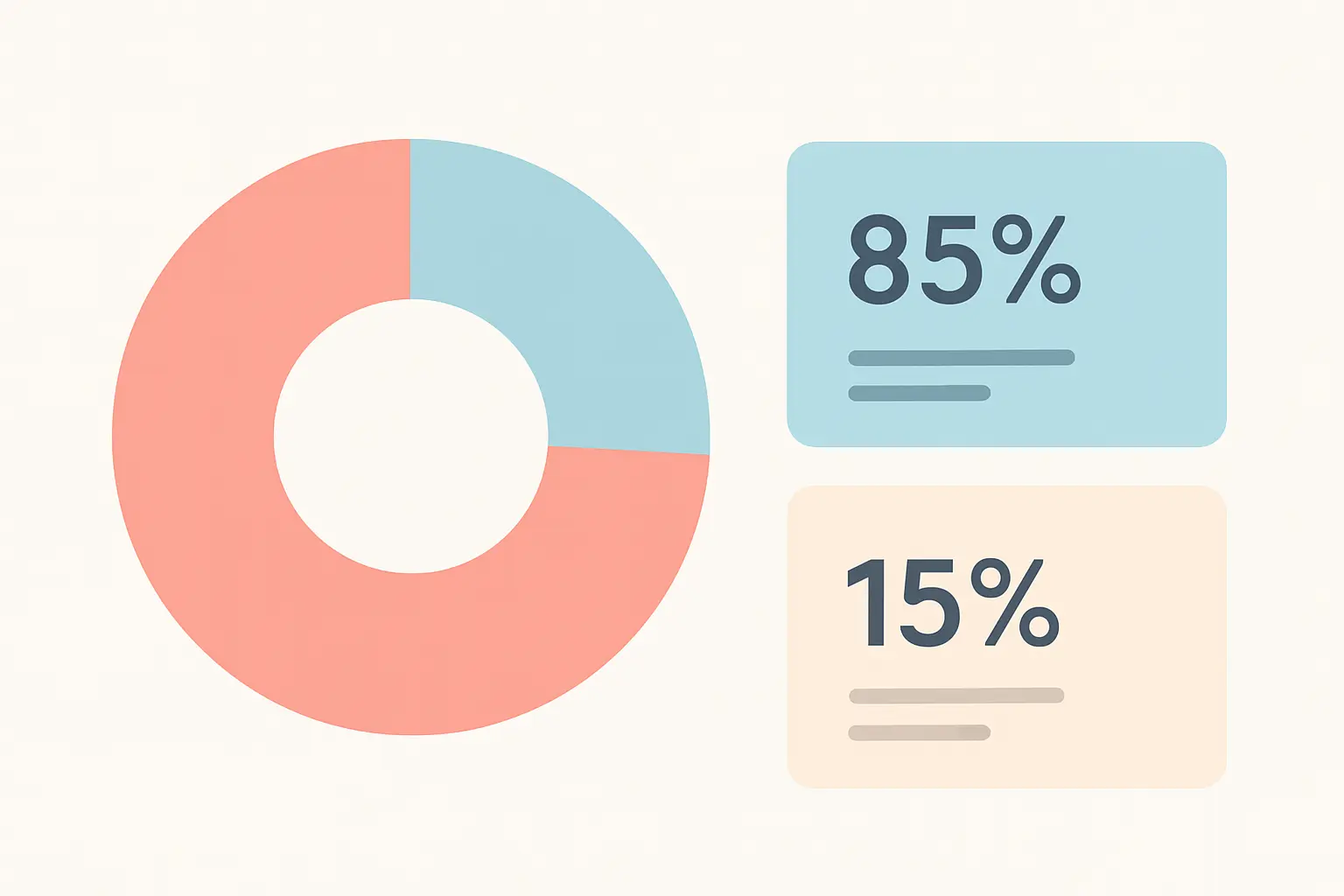
| Develop their own research software | 56% |
| Of those developers, have no training in software development | 21% |
| Male researchers who develop software | 70% |
| Female researchers who develop software | 30% |
Two of these numbers deserve to be read together. A majority of researchers write their own analysis code, and roughly a fifth of that majority have received no training in doing so. That combination — widespread self-built software, thin formal training — is one of the structural contributors to the reproducibility problems documented across the sciences. Our review of the reproducibility crisis statistics covers the downstream consequences.
Which statistical tools dominate?
Here the honest answer is that no authoritative, current, cross-disciplinary market-share figures exist. What can be said with confidence is directional and comes from consistent patterns across teaching curricula, published methods sections and job advertisements.
SPSS retains a dominant position in psychology, education, nursing and business research, largely because it is what departments teach and what institutional site licences cover. R dominates in statistics, ecology, epidemiology and increasingly the social sciences. Python leads wherever the work touches machine learning, text analysis or large-scale data engineering. Stata holds a strong position in economics, political science and health economics specifically. MATLAB persists in engineering and the physical sciences.
Treat any source quoting precise percentage shares of researcher tool use with caution — most trace back either to general developer surveys, which are not researcher-specific, or to single-institution samples. For a practical comparison rather than market data, see our guide to JASP, jamovi, SPSS and R for thesis statistics.
How fast is AI-assisted coding spreading in research?
This is the most rapidly changing part of the picture, and the evidence base is correspondingly thin and recent.
A 2023 Nature survey found that over 40% of researchers agreed generative AI would make programming faster, though it did not measure actual use. A more recent institutional survey reported that 43.2% of respondents had used AI to help write code — a figure from a single large research institute rather than a representative national sample.
The direction is unambiguous even where the magnitude is uncertain. What has not been established is the effect on correctness: code that runs is not code that is right, and generated analysis code that produces plausible output while implementing the wrong test is a failure mode that peer review is poorly equipped to catch. Our data on AI use in academic writing shows a parallel adoption curve on the writing side.
What does the software training gap look like?
The 21% figure for untrained developers understates the problem, because it counts only formal training in software development and not statistical training in the methods being implemented.

The practical consequence appears in how research code is written: analysis scripts without version control, undocumented manual steps between scripts, hard-coded file paths, and no test of whether the code does what its author believes. None of these is exotic; all of them are routine in doctoral research, and all of them make an analysis difficult to verify years later.
The counterweight has been the growth of carpentry-style training — short, practical workshops in shell, version control and reproducible analysis aimed specifically at researchers — alongside institutional research software engineering groups. Our guides to version control for thesis work and the FAIR data principles cover the practices these programmes teach.
Is research software properly cited?
Largely not, and this is one of the better-documented gaps. Software that underpins published findings is frequently mentioned in passing in a methods section rather than formally cited, which means its contribution is invisible to bibliometric systems and its maintainers receive no academic credit.
The infrastructure to fix this now exists — Zenodo DOIs for software releases, CITATION.cff files in repositories, the Journal of Open Source Software as a publication venue — and a growing number of journals require formal software citation. Adoption remains uneven. For doctoral researchers the practical implication is simple: cite the software you used, with version numbers, as our guide to citing datasets, software and code sets out.
What does this mean for a dissertation?
Three practical implications follow from the data.
First, your tool choice will be judged on whether it fits the analysis, not on what it cost. Free software is standard in published research, and our comparison of free statistical software for students covers the credible options.
Second, document your computational environment. Software name, version number, and key package versions belong in your methodology chapter or an appendix. This takes ten minutes and is the difference between an analysis that can be verified and one that cannot.
Third, if you are writing your own analysis code, treat it as part of the thesis rather than as scaffolding. Deposit it, cite it, and make sure it runs from a clean start on a machine that is not yours. Our review of research data sharing statistics shows how rarely this standard is currently met.
Frequently asked questions
What percentage of researchers use research software?
The Software Sustainability Institute survey of 417 UK researchers found 92% use research software, and 69% said their research would not be practical without it. The figure is UK-specific and cross-disciplinary.
How many researchers write their own code?
56% of respondents in the same survey develop their own research software. Of those, 21% reported having no training in software development.
Is R more popular than SPSS among researchers?
It depends entirely on discipline. R dominates statistics, ecology and epidemiology; SPSS remains dominant in psychology, education, nursing and business research, largely because of institutional teaching and site licences. No reliable cross-disciplinary market-share data exists.
Do researchers use AI to write analysis code?
Increasingly. One recent institutional survey reported 43.2% of respondents using AI to help write code, and a 2023 Nature survey found over 40% of researchers expected generative AI to speed up programming. Representative national data is not yet available.
Should I cite the software I used in my thesis?
Yes. Name the software, give the version number, and use its canonical citation where one exists. Formal software citation is increasingly required by journals and is straightforward to do.
Does using free software weaken a thesis?
No. R, Python, JASP, jamovi and G*Power are all standard in published research. Examiners assess whether the analysis is appropriate and correctly executed, not what it cost to run.
From analysis to written chapter
Whatever software you run, the output still has to become argued prose that an examiner can follow. Tesify helps you turn results into structured methodology and results chapters, with citations — including software citations — formatted correctly as you write.
Write your thesis with AI
Structure, draft, cite, and format your thesis faster with Tesify’s AI writing tools, automatic bibliography, and plagiarism checker. Free to start, no credit card required.



Leave a Reply