
How to Write a Thesis Abstract: A Step-by-Step Guide with Examples (2026)
The abstract is the most-read part of any thesis — and often the worst-written. In theory, writing 300 words should be simpler than writing 80,000. In practice, condensing months of complex research into a single paragraph that is simultaneously comprehensive, precise, and compelling is one of the hardest writing tasks in any academic programme. Get it right, and your thesis makes a strong first impression. Get it wrong, and examiners start reading the full document with doubts already formed.
This guide explains how to write a thesis abstract step by step, with annotated examples from real disciplines, common mistakes to avoid, and templates you can adapt for your own work.
What an Abstract Must Do
According to guidance from the University of Wisconsin Writing Center, an abstract should allow readers to determine the relevance of your thesis to their own work quickly and accurately. Examiners use the abstract to orient themselves before reading. Librarians and database users use it to decide whether to download the full text. Other researchers use it to decide whether your work is relevant to cite.
Crucially, the abstract must be able to stand completely on its own. It should convey the full essence of your thesis to a reader who has not seen any other part of your work — and who may never read further than the abstract.
Length Requirements by Degree Level
| Degree Level | Typical Word Count | Notes |
|---|---|---|
| Undergraduate dissertation | 150–250 words | Often not required; check guidelines |
| Master’s dissertation | 200–350 words | Usually required; strict word limit |
| PhD thesis | 250–400 words | Most UK universities specify 300 words maximum |
| Journal article | 150–250 words | Structured abstracts (Background/Methods/Results/Conclusions) common in sciences |
Always check your specific institution and programme requirements. The word limit is usually strict — submitting an abstract that exceeds it may result in a penalty or required revision.
The Five Essential Elements
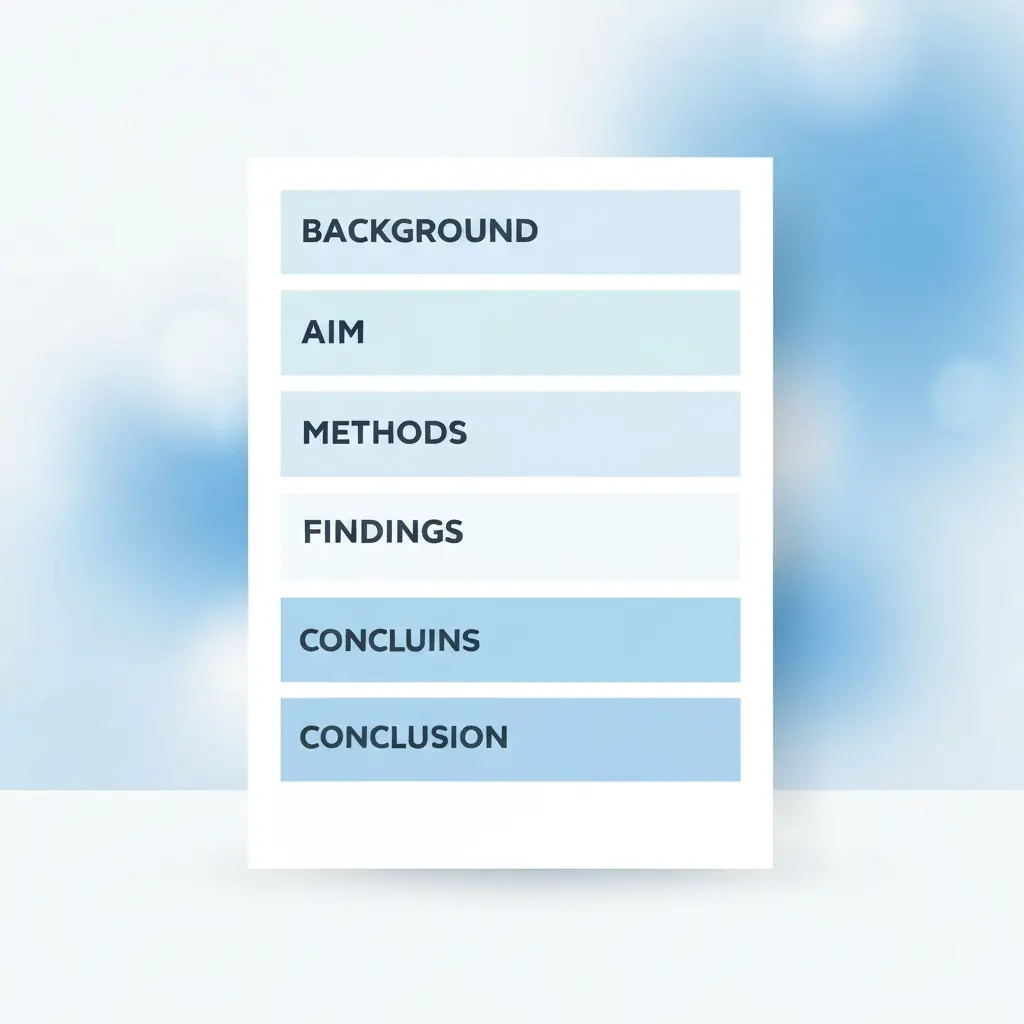
Every thesis abstract, regardless of discipline, should address these five elements:
- Background and problem (1–3 sentences): Why does this research exist? What problem or gap makes it necessary?
- Research aim or question (1–2 sentences): What specifically did this thesis set out to investigate or answer?
- Methodology (2–3 sentences): How was the research conducted? What data, participants, or analytical approach was used?
- Key findings (2–4 sentences): What did you find? Be specific — give numbers, themes, or key patterns.
- Conclusion and contribution (1–2 sentences): What does this mean? What is the implication for theory, practice, or policy?
Step-by-Step Writing Process
- Write after completing the thesis: Never write the abstract first. You need to know your full conclusions before you can summarise them accurately.
- Identify one sentence for each element: Open your completed thesis and find the single best sentence from each of the five sections above. This gives you a rough five-sentence draft to work from.
- Condense and connect: Expand where necessary, cut where possible. Each element should flow logically to the next.
- Remove jargon: Your abstract will be read by examiners across disciplines, database administrators, and sometimes non-specialists. Define field-specific acronyms; avoid obscure technical terms where plain language conveys the same meaning.
- Check for citations: Most disciplines do not permit citations in abstracts. If you reference a specific framework or tool, name it but do not add a bibliographic reference.
- Check the word count: Trim mercilessly. Every word must earn its place.
- Proofread separately: Read the abstract aloud — errors that escaped editing often become obvious when heard.
Annotated Abstract Examples
Example 1: Social Science (Master’s dissertation)
[Background:] Social media use among adolescents has been associated with negative mental health outcomes, yet most studies have relied on cross-sectional designs that cannot establish causality. [Aim:] This dissertation examines whether longitudinal changes in daily Instagram use predict subsequent changes in self-esteem and depression symptomatology among 16–18-year-old students in secondary schools in South London. [Methodology:] A longitudinal survey design was employed, with 312 participants completing validated measures of Instagram use frequency, the Rosenberg Self-Esteem Scale, and the PHQ-9 at three time points over six months. [Findings:] Multilevel modelling revealed that a one-hour daily increase in Instagram use was associated with a 0.23-point decrease in self-esteem scores (p=.003) and a 0.18-point increase in PHQ-9 scores (p=.019) at the subsequent measurement point. Effects were moderated by social comparison orientation, with stronger effects observed among high-comparers. [Conclusion:] These findings provide longitudinal evidence for a causal pathway between Instagram use and declining mental health among UK adolescents, and suggest that social comparison processes may be the key mechanism through which this effect operates.
What works about this abstract:
- Opens with a specific gap (cross-sectional limitation) rather than a broad statement
- Research question is precise (population, variables, timeframe)
- Methodology specifies design, sample, instruments, and time points
- Findings give actual numbers — not just “results were significant”
- Conclusion states a clear theoretical contribution (mechanism identified)
Example 2: Structured Abstract (Sciences)
Background: Antibiotic resistance in Klebsiella pneumoniae is a growing clinical challenge globally, with carbapenem-resistant strains now classified as Priority 1 pathogens by the World Health Organization.
Methods: A retrospective analysis of 218 K. pneumoniae isolates from a tertiary referral hospital was conducted using whole-genome sequencing and phenotypic susceptibility testing. Resistance gene carriage was mapped against clinical outcomes over a 24-month period.
Results: 34.4% of isolates carried the blaKPC gene, with carbapenem resistance confirmed phenotypically in 71 of 75 gene-positive strains. Patients infected with KPC-positive strains had significantly higher 30-day mortality (OR 3.14, 95% CI 1.87–5.26, p<0.001) than those infected with susceptible strains.
Conclusions: This study confirms the emergence of carbapenem-resistant K. pneumoniae as a clinically significant threat in UK tertiary care settings and highlights the need for rapid genomic surveillance to inform infection control protocols.
Seven Common Abstract Mistakes
- Vague findings: “The results showed significant differences” — what differences? Between what? How large?
- Writing in future tense: “This dissertation will examine…” — the thesis is complete; use past tense.
- Including citations: Most disciplines do not permit references in abstracts. Name theories or tools by name but do not add bibliographic entries.
- Introducing new information: The abstract must only summarise what is in the thesis.
- Too much background: Context takes one to two sentences maximum — not a mini literature review.
- Omitting methodology: A surprising number of abstracts state the aim and findings but say nothing about how the research was conducted.
- Generic conclusions: “This study has implications for future research” contributes nothing. State the specific implication.
Abstract Quality Checklist
- Does it state the research problem or gap clearly?
- Does it state the research question or aim precisely?
- Does it describe the methodology (design, sample, methods)?
- Does it report specific findings (with numbers or key themes)?
- Does it state the main conclusion and contribution?
- Is it within the required word count?
- Is it written entirely in past tense (for completed research)?
- Is it free of citations and bibliographic references?
- Can it be fully understood by a reader who has not read the thesis?
- Is every sentence essential?
For guidance on the full thesis structure that your abstract must summarise, see our thesis structure guide and our complete thesis writing guide.
Frequently Asked Questions
Should an abstract be written in first or third person?
This varies by discipline and institution. In sciences and social sciences, first person (“I examined”, “we found”) is increasingly accepted. In humanities, third person is more common (“This thesis examines”). Some institutions specify one or the other in their style guide. When in doubt, use the same person convention you used throughout your methodology and discussion chapters.
Can I include statistics in my thesis abstract?
Yes — in fact, including key statistics makes your abstract considerably stronger. Saying “a significant positive correlation was found” is far less informative than “a significant positive correlation was found (r=0.54, p<.001)”. Report your most important statistics concisely. For qualitative research, quote a key theme or finding rather than a number.
Is a thesis abstract the same as an executive summary?
They are similar but different. An abstract is a condensed scholarly summary, typically 250–350 words, that covers all five key elements (background, aim, methods, findings, conclusions). An executive summary is typically longer (one to two pages) and written for a non-specialist audience — it is more common in professional dissertations or business school theses. Check your institution’s requirements to confirm which is needed.
What tense should a thesis abstract be written in?
Most of the abstract should be in past tense — your research is complete, so “The study examined”, “Data were collected”, “Results showed” are the standard forms. Background context may be in present tense (“Antibiotic resistance poses a growing challenge”) since it describes an ongoing situation. Conclusions are sometimes written in present tense (“These findings suggest…”) to indicate their current relevance.
Should I write keywords below my abstract?
Many institutions and journals require five to seven keywords below the abstract. These are used for database indexing and make your work discoverable. Choose terms that accurately represent your topic, methodology, and key concepts — using standard subject headings from your discipline’s major databases (MeSH for medicine, ERIC for education, PsycINFO for psychology) improves discoverability. Avoid highly general terms that do not distinguish your work.
Write Every Part of Your Thesis with Confidence
Tesify helps you write and structure your entire thesis — from abstract to appendices — with AI-powered guidance, automated citation management, and real-time feedback. Join thousands of students who submit faster and with confidence.



Leave a Reply