
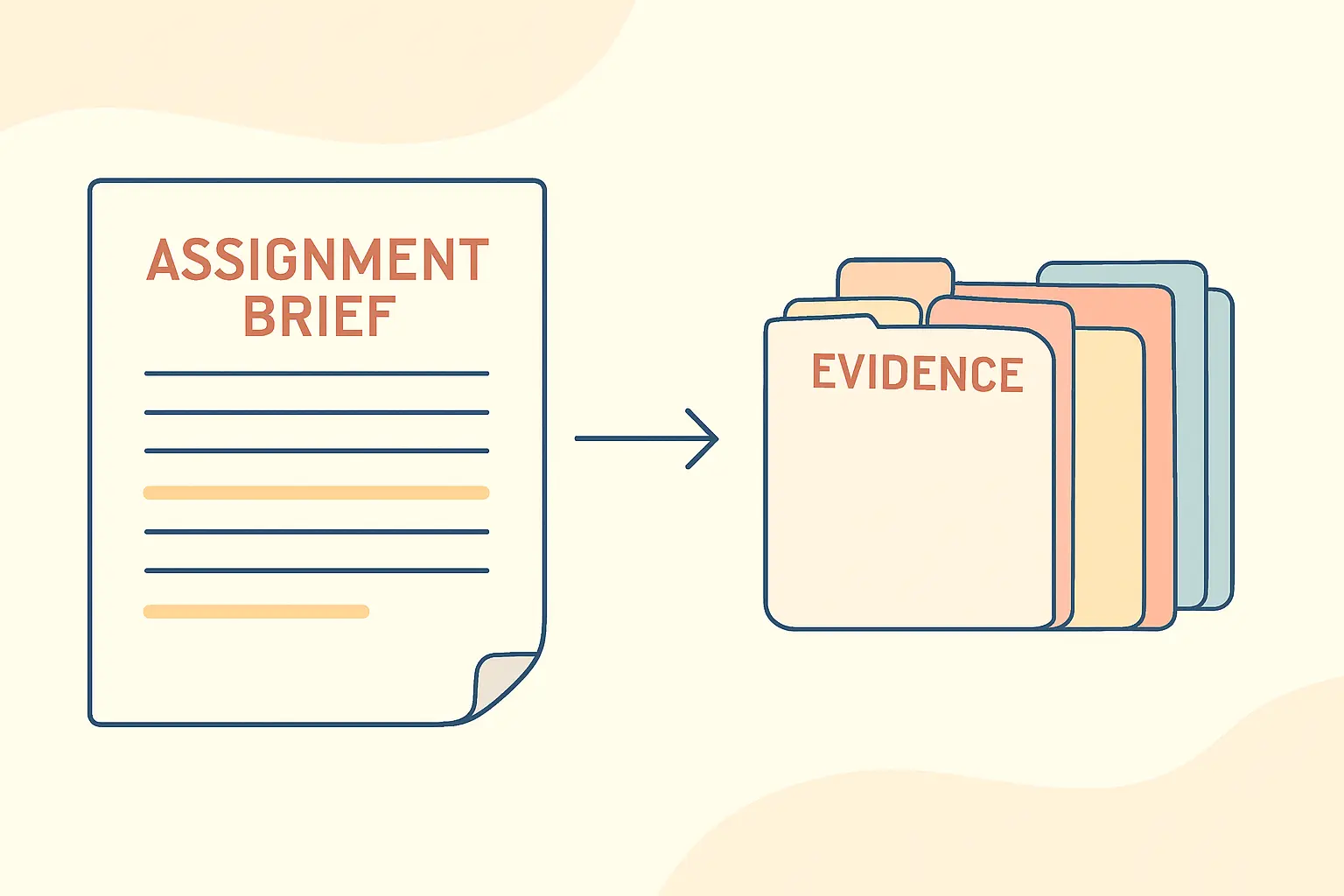
A Higher National assignment is assessed against named criteria rather than marked out of 100. To write one well, you map every criterion in the brief to a specific piece of evidence in your submission, then write to satisfy the highest criteria from the first draft — because on a Higher National, Merit and Distinction are not extra tasks.
That last point is the one students most often get wrong, and it costs grades every year. Below is the process, plus the two different systems you might be sitting under, which have different rules about redrafting.
Step 1: Work out which system you are on
Higher Nationals are awarded by two different bodies, and their assessment rules differ in ways that matter to you.
| Pearson BTEC Higher Nationals | Qualifications Scotland HNC/HND | |
|---|---|---|
| Mainly used in | England, Wales, Northern Ireland | Scotland |
| Core assessment | Assignments against unit learning outcomes | Units, plus a Graded Unit |
| Graded Unit exists? | No | Yes — project-based or examination-based |
| Redrafting after submission | Resubmission rules set by your centre | Formal remediation rules (see step 5) |
If your course documents mention a “Graded Unit”, you are on the Scottish system. If they refer to assignment briefs with Pass, Merit and Distinction criteria listed per unit, you are on the Pearson system. One naming note: the Scottish Qualifications Authority is now Qualifications Scotland, so you will see both names in circulation.
Step 2: Read the brief as a checklist, not as a question
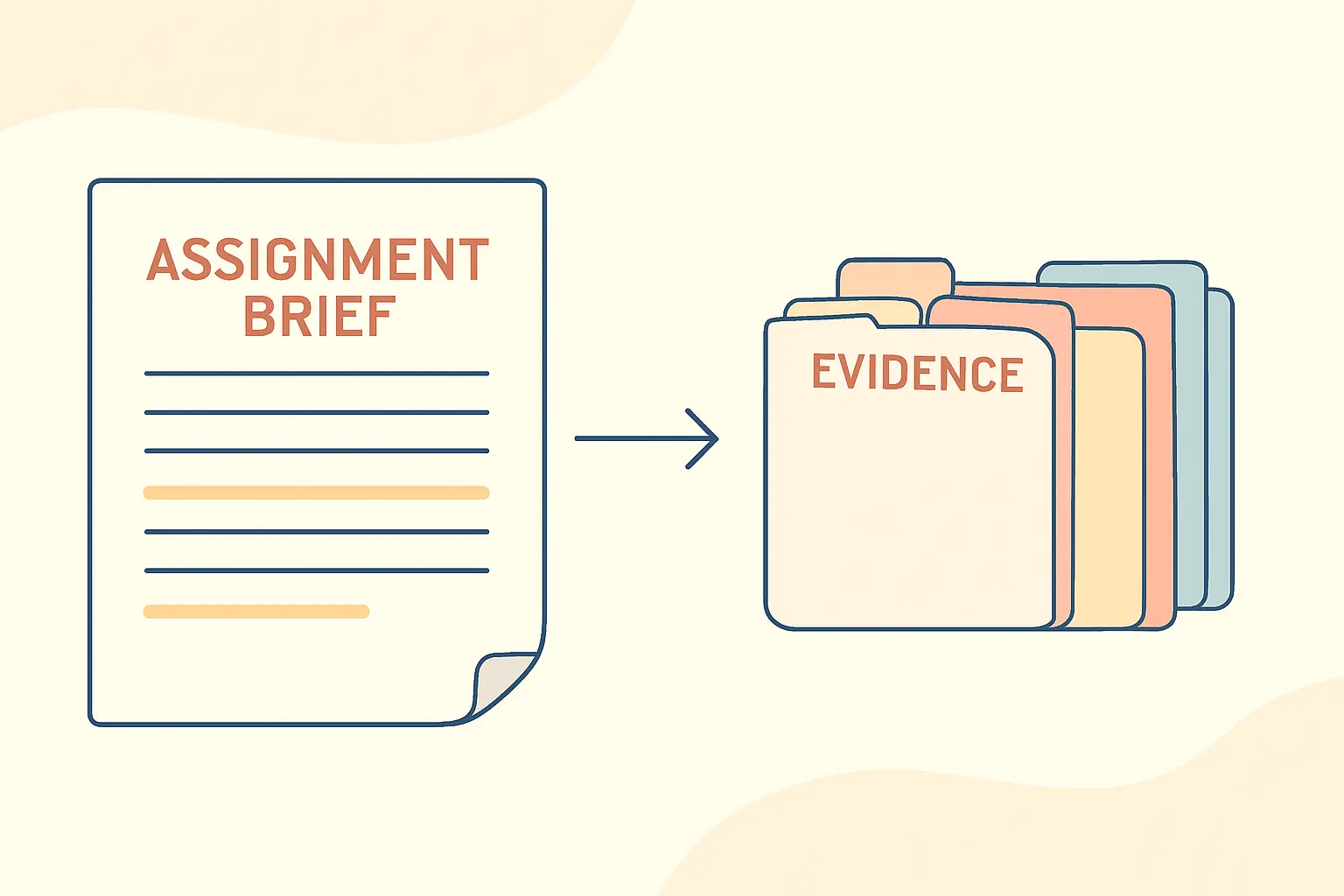
An essay question invites you to decide what is relevant. A Higher National brief does not. It lists criteria, and an assessor works down that list looking for evidence of each one.
Before writing anything, put the criteria in a table with a column for where in your submission each one is satisfied. Anything you cannot fill in is a gap you can still fix. Anything you write that maps to no criterion is unassessed, however good it is.
Pay attention to the command verb in each criterion. “Explain” and “evaluate” are not stylistic preferences — they name the level of thinking being assessed, and answering an “evaluate” criterion with explanation is the most common way a Distinction is missed.
Step 3: Aim at the highest criteria from the first draft
Pearson’s own centre guidance states that learning outcomes should not be split across assignments, and should not “require extra assignments or activities to meet the Merit or Distinction criteria within a unit”. Activities are to be written so as to allow “the full achievement of Pass, Merit and Distinction criteria”.
Read that as a student and it means something concrete: Merit and Distinction are the same task done to a higher standard, not additional work bolted on. If you draft to the Pass criteria intending to add the higher ones later, you will usually have to rewrite rather than extend, because the difference is in how you treat the material, not how much of it you cover.
The practical move is to draft each section against its Distinction criterion and let the lower criteria be satisfied on the way. Why the grades work like this — and why your grade does not move with the rest of the cohort — is covered separately in our guide to criterion-referenced grading.
Step 4: Know whether your unit is graded as a whole
Pearson distinguishes single-unit assessment, where all the learning outcomes of a unit are assessed together as one body of evidence, from staged assessment, where a unit is assessed through two or more assignments.
If yours is staged, one detail is worth knowing. Pearson describes it as good practice for centres to wait until all assignments have been submitted before grading, because a student “may have achieved the missing learning outcomes in a later assignment, even if that assignment did not directly target the learning outcomes in question”. Assessment is holistic across the whole unit.
So a weak first assignment is not necessarily a settled outcome — later work can carry evidence that fills the gap. That is a reason to keep going rather than to relax; it is a chance to recover, not a safety net you can plan around.
Step 5: If you are on a Scottish Graded Unit, use the remediation rules

The Graded Unit is where the Scottish system differs most, and its published conditions of assessment give you rights worth knowing about.
A project-based Graded Unit is generated over time in three distinct stages, each of which must be achieved before the next is undertaken. Assessors may give advice, clarification and guidance at every stage, from the issuing of the project instructions to the completion date — this is what Qualifications Scotland calls “reasonable assistance”. Candidates must be given the opportunity for remediation at each stage where there is a minor shortfall or omission, and remediation must be formally recorded for the verifiers.
An examination-based Graded Unit works differently. Remediation is not allowed at all, and reasonable assistance is limited to advice on examination technique and clarification of command words that may appear in the paper.
| Project-based Graded Unit | Examination-based Graded Unit | |
|---|---|---|
| Structure | Three sequential stages | Single examination |
| Remediation | Allowed, must be offered at each stage | Not allowed |
| Reasonable assistance | Advice, clarification and guidance throughout | Exam technique and command words only |
| Re-assessment | Must use a substantially different project | Must use a substantially different examination |
Two further points from the published conditions. Re-assessment of a stage must happen before you move on to the next one. And the final grade must be the highest grade you achieved, whether that came at first submission or through re-assessment — so taking a re-assessment opportunity cannot lower what you already hold.
One caution on the project route: the overall grade is derived from marks across all sections and is expected to reflect your ability to work autonomously and the amount of support you required. Asking for clarification is legitimate and built into the system. Leaning on your assessor to make your decisions is visible in the grade.
Step 6: Evidence it properly
Vocational assignments still carry full academic integrity requirements. Referencing is assessed, and applied work is not held to a lower standard than an essay — our Harvard referencing guide covers the style most Higher National centres use.
Two evidence problems are specific to this kind of assignment. If you are writing about your workplace, get explicit permission before naming an employer, and anonymise individuals by role rather than name. And if your evidence includes artefacts — screenshots, plans, logs, photographs of practical work — put them in clearly labelled appendices and refer to each one from the main text, because an appendix nothing points at is rarely credited.
Step 7: Check against the criteria before you submit

Go back to the table from step 2 and fill in the page or section number where each criterion is now met. Any criterion without a location is either unmet or invisible to the assessor, and both are fixed the same way — by signposting it explicitly in the text.
Then check your declarations. Most centres now require a statement of any AI assistance used, and the requirement applies to vocational assignments exactly as it does to dissertations. Our guide to writing an AI-use declaration covers what to include, and the academic integrity guide covers what counts as your own work.
Frequently asked questions
Do I have to do extra work to get a Distinction?
No. Pearson’s guidance is explicit that meeting Merit or Distinction criteria should not require extra assignments or activities within a unit. The higher grades reflect how you treat the material, not how much extra you produce.
What is a Graded Unit?
A Graded Unit is part of the Scottish HNC and HND structure, awarded by Qualifications Scotland. It is either project-based, run across three sequential stages, or examination-based. Pearson BTEC Higher Nationals do not have Graded Units.
Can I redraft after submitting a Graded Unit?
For project-based Graded Units, remediation must be offered at each stage where there is a minor shortfall or omission, and it must be formally recorded. For examination-based Graded Units, remediation is not allowed.
Will a re-assessment lower my grade?
No. The published conditions require that you are awarded the highest grade achieved, whether at first submission or through re-assessment.
Can my assessor help me with my project?
Yes, within limits. Assessors may give advice, clarification and guidance at each stage of a project-based Graded Unit. But the grade is expected to reflect how autonomously you worked and how much support you needed, so there is a real cost to over-relying on it.
Does a weak first assignment ruin the unit?
Not necessarily. Where a unit is assessed in stages, good practice is to grade holistically once all assignments are in, because later work can evidence learning outcomes an earlier assignment missed.
Do Higher National assignments need references?
Yes. Referencing is assessed and academic integrity rules apply in full. Applied and work-based assignments are not held to a lower standard than essays.
If the brief is in front of you and the criteria table is the part you are stuck on, Tesify will map an outline to your unit’s learning outcomes, format the references and generate an AI-use declaration for submission. What it produces is a starting draft to rewrite in your own words — on a Higher National the grade reflects how autonomously you worked, so the thinking has to be yours.
Write your thesis with AI
Structure, draft, cite, and format your thesis faster with Tesify’s AI writing tools, automatic bibliography, and plagiarism checker. Free to start, no credit card required.






Leave a Reply