
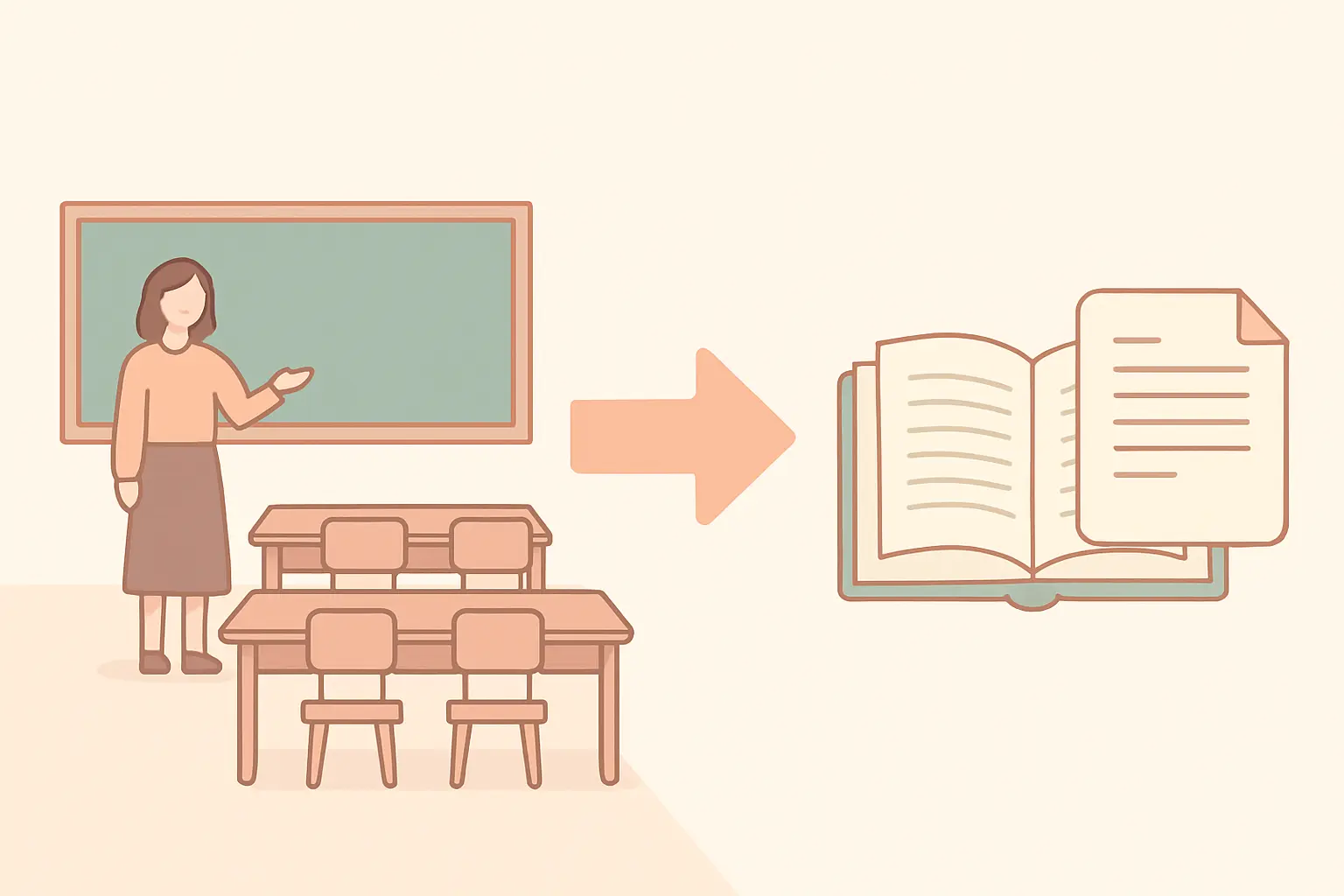
A PGCE assignment is a Level 7 academic essay that uses your placement as evidence. It is not a lesson evaluation and not a portfolio entry — it is a piece of postgraduate writing in which classroom experience functions as data, and the literature does the arguing.
That distinction is where most marks are lost. Trainees write vividly about what happened in their classroom and treat the reading as decoration. The assessment works the other way round.
Understand which document you are writing
PGCE programmes typically assess you through at least three different things, and they have different rules.
| Document | Assessed against | Register |
|---|---|---|
| Academic assignment | University Level 7 criteria | Formal, evidence-led, critical |
| Professional practice portfolio | Teachers’ Standards | Reflective, evidence-mapped |
| Lesson plans and evaluations | Mentor and placement judgement | Practical, immediate |
This page is about the first. If you are building the second, our guide to writing a reflective portfolio covers competency mapping and the anonymisation rules, which apply to both documents and are stricter than most trainees expect.
One thing worth checking before you start: not every teacher training route awards a PGCE. Some award qualified teacher status alone, in which case there is no academic assignment of this kind at all. Our comparison of routes into teaching in England covers the fee-based, salaried and apprenticeship options and which of them carry a PGCE alongside QTS.
Step 1: Find the question inside the title
PGCE assignment titles are usually broad — “critically evaluate an aspect of your practice in relation to relevant theory” — and a broad title is not an invitation to write broadly. It is a requirement that you narrow it yourself.
Narrow it to something a single essay can defend: not “behaviour management” but “the use of non-verbal redirection with a Year 8 class where verbal correction was escalating disruption”. The narrower the focus, the more analysis you can afford per point, and analysis is what carries Level 7 marks.
Check the narrowed question against the assessment criteria before you read anything. Our guide to RQF and FHEQ levels sets out what Level 7 demands: not that you apply a method competently, but that you contribute something the reading did not already give you.
Step 2: Read before you decide what you think
The common sequence is backwards. Trainees form a view from their placement, then search for citations that agree with it. Markers spot this quickly, because the literature all points one way and no alternative position appears.
Read first, and read for disagreement. Educational research is genuinely contested — on phonics, on grouping by ability, on feedback, on cognitive load — and finding the argument is the point. An assignment that presents one position as settled fact when the field is divided has misread the field.
Use the research your programme points you at, and prefer peer-reviewed sources and systematic evidence syntheses over blogs and CPD slide decks. A confident classroom practitioner writing without citations is exactly the profile that scores badly at Level 7.
Step 3: Use your placement as evidence, not as the argument

This is the core skill being assessed, and it has a precise shape.
| What trainees write | What it should be |
|---|---|
| “I used mini-whiteboards and engagement improved.” | “Mini-whiteboards made pupil thinking visible, consistent with the responsive teaching literature; in this class the effect was clearest among pupils who rarely volunteered answers, which the literature would predict.” |
| “Group work did not work with this class.” | “The group task produced little discussion. The literature attributes this partly to task design rather than to pupil capability, and the task I set was arguably completable by one pupil alone.” |
| “Praise motivates pupils.” | “Findings on praise are mixed and depend on whether it is directed at effort or ability; the pattern in my class is consistent with that distinction.” |
The move in each case is the same: the claim belongs to the literature, and your classroom is the instance that illustrates, complicates or fails to fit. A single class of thirty pupils in one school over six weeks cannot establish a general claim, and saying so explicitly demonstrates exactly the critical awareness being marked.
Step 4: Anonymise everything before you write it
Pupils, colleagues and the school itself. Use role descriptors — “a Year 9 pupil with an EHCP”, “my mentor”, “the placement school” — rather than names or pseudonyms that read like names.
Watch combinations, which is where anonymisation usually fails: a named school, a specific year group and an unusual circumstance can identify a child even with no name attached. If you cannot describe something without identifying someone, describe it more generally or leave it out.
Step 5: Get the balance of description and analysis right
A workable test: read each paragraph and ask whether it says what happened, or what it means. Paragraphs that only report events are description, and description is necessary but not creditable in itself.
Description earns its place when it is the minimum needed to make the analysis intelligible. Two sentences of context followed by a paragraph of analysis is a healthy ratio; a page of narrative followed by “this links to Vygotsky” is not.
Step 6: Write the conclusion as a change, not a summary
The strongest PGCE conclusions say what the trainee will now do differently and why the evidence supports it — specifically enough that someone could check whether you did it.
“I will continue to develop my behaviour management” is not that. “I will plan explicit checks for understanding at two fixed points in each lesson, because the pattern in my class matched the literature’s account of over-reliance on volunteered answers” is.
Common mistakes
| Mistake | Why it costs marks |
|---|---|
| Narrating a lesson at length | Description crowds out the assessed analysis |
| Citing one source per claim, all agreeing | Presents a contested field as settled |
| Generalising from one class | Overreaches what a single setting can evidence |
| Using CPD materials as academic sources | Not peer-reviewed; weak at Level 7 |
| Identifying pupils or the school | A professional conduct issue, not a formatting one |
| Ending with a summary | Wastes the section where impact on practice is shown |
Frequently asked questions
What level is a PGCE assignment?
Level 7, the same level as a master’s degree. Many PGCEs carry credits that can count towards a full master’s later, though this varies by provider.
How is a PGCE assignment different from my portfolio?
The assignment is an academic essay assessed against university Level 7 criteria. The portfolio evidences your practice against the Teachers’ Standards. They are different documents with different registers, and material rarely transfers directly between them.
Can I write about my placement class?
Yes, and you generally should — but anonymised, and used as evidence illustrating a claim from the literature rather than as the basis of a general claim in itself.
How much should I quote from my lessons?
Less than feels natural. Include the minimum description needed for the analysis to make sense; if a paragraph only reports what happened, it is not yet doing assessed work.
Can I use blogs and CPD materials as sources?
Sparingly, and not as your evidence base. Level 7 work is expected to engage with peer-reviewed research and evidence syntheses. Practitioner sources can illustrate how ideas circulate in schools, which is a different use.
What if my placement experience contradicts the research?
That is good material, not a problem. Say so, and consider why — task design, context, sample size, or a genuine limitation of the research. Handled well, it is one of the strongest things you can do at Level 7.
Do I need to reference the Teachers’ Standards in an assignment?
Only if the brief asks for it. The Standards belong primarily to the professional portfolio; academic assignments are assessed against university criteria. Check your brief rather than assuming.
The structural work — narrowing the question, mapping sections to the criteria, keeping references consistent, producing an AI-use declaration — is where trainee time disappears during a placement term. Tesify handles that and gives you a starting draft to rewrite in your own words. The classroom evidence and the judgement about what it means have to be yours; nobody else was in that lesson.
Write your thesis with AI
Structure, draft, cite, and format your thesis faster with Tesify’s AI writing tools, automatic bibliography, and plagiarism checker. Free to start, no credit card required.





Leave a Reply