
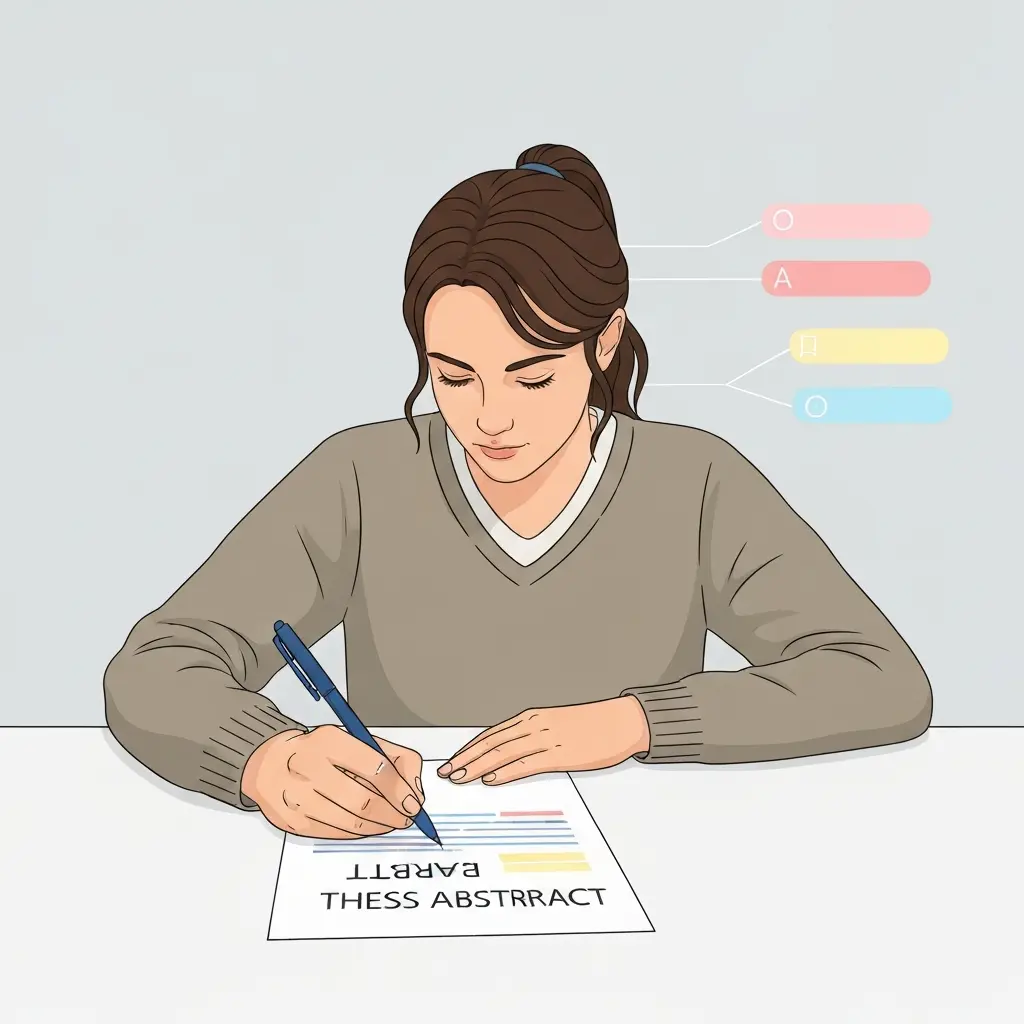
How Do I Write a Strong Thesis Abstract? A Step-by-Step Guide with Examples
The thesis abstract is the first — and often only — section of your thesis that readers will see. It must compress 40,000–100,000 words into 200–350 words that make an examiner want to read on, make a researcher decide it is worth downloading, and make a future employer understand what you spent three years doing. Despite its brevity, many students leave the abstract until the final days before submission and treat it as an afterthought. This guide shows you exactly how to write one that works.
What Goes in a Thesis Abstract? The 5-Element Framework
The most consistently effective abstract structure — used by successful PhD candidates at Oxford, Cambridge, UCL, MIT, and Harvard — follows this five-element sequence:
- Context (1–2 sentences): Situate your research. Why does this field matter? What is the broader problem? E.g., “AI tools are increasingly used in postgraduate thesis writing, yet their impact on academic integrity remains poorly understood.”
- Problem/Gap (1–2 sentences): State specifically what is not yet known, or what existing approaches fail to address. This is your research gap — see our guide on how to identify a research gap.
- Methodology (1–2 sentences): How did you study this? Qualitative, quantitative, mixed? How many participants/sources? What instruments? “This study employed a mixed-methods design, surveying 412 postgraduate students and conducting 20 semi-structured interviews.”
- Key Findings (2–3 sentences): What did you find? This is the most important part. Be specific — numbers, patterns, unexpected results. Do not hedge everything with “suggests” and “may” — examiners want to know what your data actually showed.
- Conclusion/Contribution (1–2 sentences): What does this mean for the field? What can practitioners, policymakers, or future researchers do differently because of your work?
Word Count Norms by Institution and Country
| Degree Level / Country | Typical Abstract Word Count |
|---|---|
| UK PhD thesis | 300 words (UKRI requirement is “around 300”) |
| UK master’s dissertation | 200–250 words |
| US dissertation (ProQuest) | 350 words maximum (ProQuest limit) |
| Australian thesis (most universities) | 300–500 words |
| European PhD (Doctorate) | 250–300 words in English; often separate abstract required in national language |
Always check your specific institution’s requirements. Some universities specify a maximum word count in their degree regulations — exceeding it can result in the abstract being cut during printing, or the thesis being returned for amendment before examination.
Thesis Abstract Examples Across Disciplines
Social Sciences (Education) — master’s level:
“Academic integrity policies increasingly address AI-assisted writing, yet universities have developed divergent and sometimes conflicting frameworks. This study examines how postgraduate students at five UK Russell Group universities understand and apply institutional AI policies in thesis writing. Using a mixed-methods design (n=412 survey respondents; 20 interviews), the study found significant variation in policy clarity across institutions, with 47% of students reporting uncertainty about permitted AI use and 34% having used AI in undeclared ways. Qualitative analysis identified three strategies students use to navigate policy ambiguity. The findings suggest current policy frameworks are insufficient for the current technological environment and recommend a standardised national framework analogous to the QAA Academic Integrity Advisory Group approach to plagiarism.”
Word count: 118 words — too short for a PhD, appropriate for a short master’s dissertation abstract.
Sciences (Biology) — PhD level:
“Antibiotic resistance represents a global health emergency, with drug-resistant infections projected to cause 10 million deaths annually by 2050 (WHO, 2019). This thesis examines the role of horizontal gene transfer (HGT) in the rapid spread of extended-spectrum beta-lactamase (ESBL) genes in clinical Escherichia coli isolates in UK hospital settings. Using whole-genome sequencing of 340 clinical isolates collected across eight NHS trusts between 2022 and 2024, combined with network analysis of transmission pathways, this study identifies three previously unreported HGT mechanisms and demonstrates that 23% of ESBL transmission events within hospitals occur via a plasmid type not included in current surveillance frameworks. These findings indicate that NHS resistance surveillance protocols require urgent revision to include this plasmid type, which current monitoring does not capture.”
Word count: 137 words — illustrates that STEM abstracts are often more data-dense.
For more structured examples, see the complete thesis structure guide and the worked dissertation examples in dissertation example analysis.
The Most Common Thesis Abstract Mistakes
- Describing the structure of the thesis instead of its content — “Chapter 1 introduces the topic, Chapter 2 reviews the literature…” This tells the reader nothing about your findings.
- Omitting findings — Writing about what you did without saying what you found. An abstract without findings is incomplete.
- Using citations — Abstracts should stand alone. In most cases, no citations are required or appropriate.
- Using undefined acronyms — The abstract will appear in database searches; readers may encounter it without context.
- Excessive hedging — “Results may possibly suggest a tentative relationship…” Be clear about what your study actually showed.
- Writing it first — The abstract should be written last, after the full thesis is complete. Many students write a placeholder and forget to update it.
Frequently Asked Questions
How long should a thesis abstract be?
For a UK PhD thesis, around 300 words (UKRI standard). For a UK master’s dissertation, 200–250 words. For a US dissertation submitted to ProQuest, the maximum is 350 words. For Australian theses, most universities allow 300–500 words. Always check your institution’s specific requirement — it is sometimes set in the degree regulations and non-compliance can delay your submission.
What should a thesis abstract include?
A strong thesis abstract covers five elements: (1) context — the broader problem, (2) research gap — what is not yet known, (3) methodology — how you conducted the study, (4) key findings — what you actually discovered (be specific), and (5) conclusion or contribution — what this means for the field. The abstract should stand alone — someone reading only the abstract should understand what you studied, how, and what you found.
When should I write the thesis abstract?
Write your abstract last, after your full thesis is complete. At that point, you know exactly what your findings are and what your study contributes. Many students write a placeholder abstract early on and then fail to update it — resulting in an abstract that describes what they planned to find rather than what they actually found, which examiners notice immediately.
Should a thesis abstract have citations?
Generally no. Most institutions advise against citations in the abstract because the abstract should stand alone and function as a summary without requiring the reader to consult references. The exception is when your research directly responds to a specific, widely known publication or policy — but even then, most examiners prefer a clean, citation-free abstract. Check your institution’s guidance; some explicitly prohibit them.
Can I use the same abstract for my thesis and a journal article?
No — they serve different functions and have different formats. A journal article abstract follows the journal’s specific structure (often structured with Background, Methods, Results, Conclusions headers). A thesis abstract is unstructured prose. You can use your thesis abstract as a starting point for a journal submission, but it needs substantial rewriting to match the journal’s requirements and word limit (typically 150–250 words for a structured journal abstract).
Write Every Section of Your Thesis with Confidence
From abstract to appendices, Tesify guides you through each section of your thesis with AI-assisted drafting and structure. Write a thesis your examiner will respect — and your future employer will understand.



Leave a Reply