

A rejected dissertation proposal almost never means the topic is unworkable. In the great majority of cases the committee has identified a specific structural fault — scope, method, feasibility, framing or contribution — and resubmission succeeds once that single fault is fixed. Diagnose before you rewrite.
What does a rejection actually mean?
Committees reject proposals to prevent a predictable failure eighteen months later. That is an uncomfortable kindness, but it is a kindness: the alternative is approving a project that cannot be completed and letting you discover it during data collection.
Outright termination of a candidature at proposal stage is rare. Far more common outcomes are “revise and resubmit”, “approve with conditions”, or a required meeting with the supervisor before resubmission. Read your written feedback for which of these you actually received, because the required response differs substantially.
Which of the five failure modes did you hit?
Nearly all proposal rejections reduce to five diagnoses. Identifying yours determines how much of the document you need to rebuild.
| Failure mode | What the feedback sounds like | Scale of rewrite |
|---|---|---|
| Scope too broad | “Ambitious”; “would constitute several theses”; “needs narrowing” | Moderate — narrow the question, keep the framing |
| Method mismatch | “The method will not answer the question as posed” | Moderate — replace the methodology chapter |
| Feasibility | “Access?”; “timeline unrealistic”; “ethics concerns” | Small — add an access plan and revised timeline |
| No identified gap | “What is new here?”; “this has been done” | Large — rebuild the literature review and rationale |
| Unclear contribution | “So what?”; “significance not established” | Small to moderate — rewrite framing, keep the design |
Note that only one of these — no identified gap — requires substantial new reading. Students routinely assume a rejection means starting over, and then spend three months rebuilding a proposal whose actual problem was a two-page feasibility section.
How do you decode vague committee feedback?
Academic feedback is often written in compressed shorthand that assumes context you may not have. Translating it is the first real task.
“Ambitious” almost always means unachievable in the time available, not impressive. “Interesting but underdeveloped” usually means the research question is not yet a question — it is a topic. “Consider the literature on X” is rarely a suggestion; it is an instruction indicating that a body of work you have not engaged with would change your framing. “The contribution needs sharpening” means the reader could not finish the sentence “this thesis will show that…”.
If the written feedback remains genuinely opaque after this exercise, request a short meeting and bring one specific question per comment. Open-ended requests for clarification produce open-ended answers; targeted questions produce actionable ones.
How do you narrow a proposal that was rejected for scope?
Scope is the most common rejection and the most mechanically fixable. There are four dimensions along which you can narrow, and you generally need to constrain only one or two.

- Population. Not “nurses” but “newly qualified nurses in their first NHS post”.
- Time period. Not “the effect of remote work” but “the effect of remote work during the 2020–2022 period”.
- Geography or setting. One region, one sector, one institution type.
- Constructs. Two variables examined properly beats six examined superficially.
The test of adequate narrowing is whether you can state the research question in a single sentence without using “and” to join two separate inquiries. If you cannot, you still have two theses. Our framework for writing a research question covers how to get there, and our guide to writing aims and objectives covers how to express the narrowed version.
How do you fix a rejection for “no clear gap”?
This is the rejection that genuinely requires new work, because it means the committee does not believe you have established that the research needs doing.
The fix is a systematic gap analysis rather than more reading in general. Use a structured framework — PICO for health and intervention research, SPIDER for qualitative questions, FINER for feasibility — to state explicitly what is known, what is contested, and what has not been examined. Then write the gap as a sentence with a subject and a verb: “No study has examined X in Y population using Z method.” A gap that cannot be written in that form is not yet a gap.
Our guide to identifying a research gap with PICO, SPIDER and FINER sets out each framework, and our walkthrough on writing a statement of the problem covers how to turn the gap into a rationale.
How do you fix a method mismatch?
Method rejections happen when the design cannot answer the question as asked. A question about how and why answered by a survey; a question about prevalence answered by six interviews; a causal claim built on cross-sectional data.
Resist the temptation to defend the original method. The faster route is to write the question at the top of a page and ask what evidence would settle it, then choose the design that produces that evidence. Occasionally the honest answer is that the question needs to change to fit the method available to you — which is a legitimate move, provided you say so.
Where the question genuinely has both exploratory and measurement components, a mixed methods design may resolve it, though only if you can justify the sequencing rather than simply doing both. For quantitative designs, a defensible sample size calculation using our G*Power guide pre-empts one of the most common follow-up objections.
What should the resubmission look like?
Three things distinguish a resubmission that gets approved from one that gets rejected again.
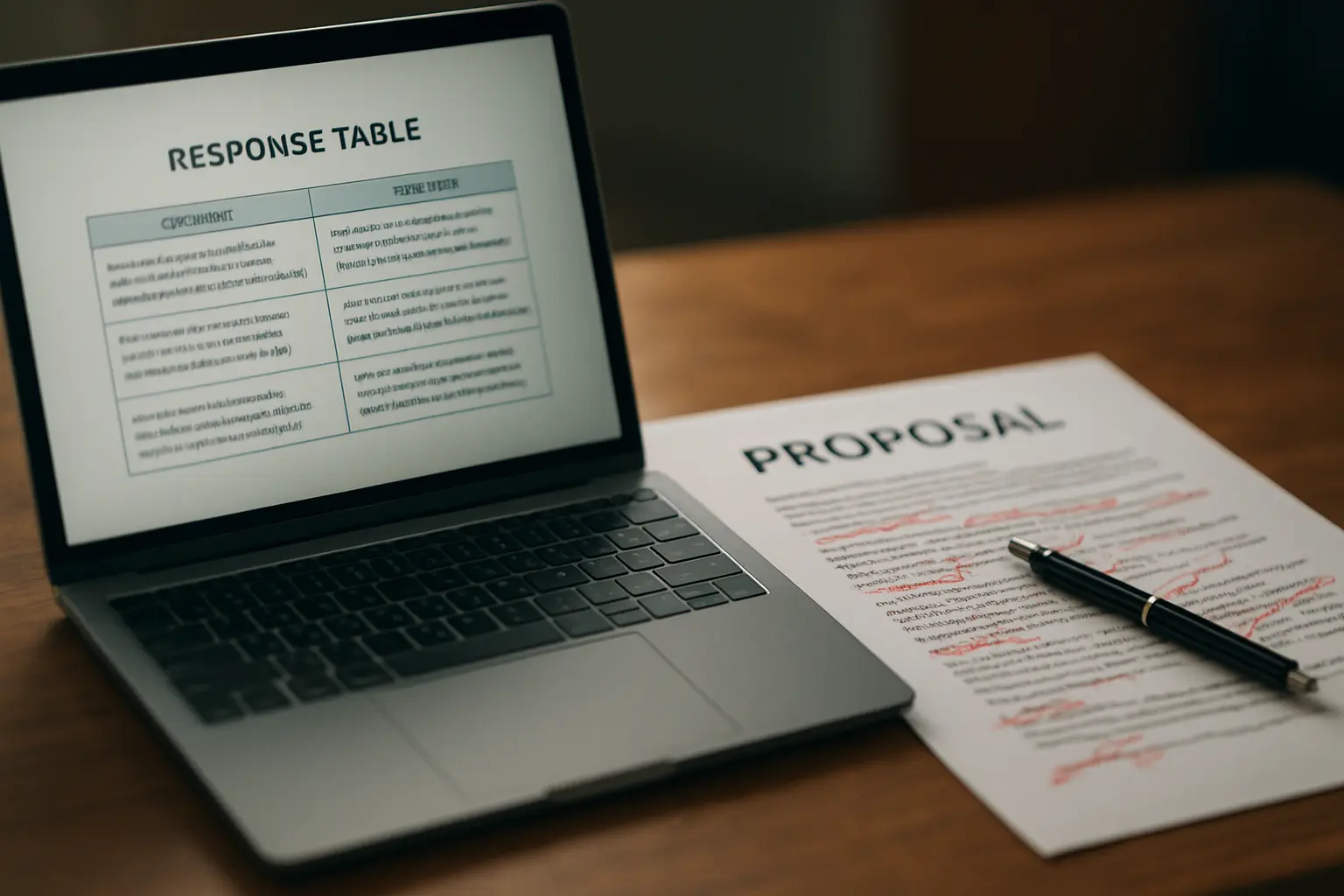
First, a response document. Include a short covering table listing each comment, what you changed, and where in the document the change appears. Committees reading a resubmission want to verify their concerns were addressed, not re-read the whole proposal hunting for changes.
Second, visible change. If the feedback said scope, the research question should look materially different. Cosmetic edits to a proposal that was rejected on substance read as non-compliance and reliably produce a second rejection.
Third, one voice. Proposals rebuilt in fragments over several weeks develop tonal seams — three different registers, inconsistent terminology, a literature review in one voice and a methodology in another. Read the whole document straight through before submitting.
How long should a resubmission take?
It depends entirely on the diagnosis. Feasibility and contribution rejections are often a week’s work. Scope and method rejections typically take two to four weeks. A gap rejection requires new reading and realistically takes four to eight weeks.
What consistently costs more time than any of these is the delay before starting — the fortnight spent avoiding the document. If the rejection has knocked your confidence, that reaction is normal and extremely common; our data on imposter syndrome among doctoral students puts it in perspective. For the practical restart, our guide to getting a thesis moving when you are behind covers rebuilding momentum, and our annotated proposal templates show what an approved proposal looks like structurally.
Frequently asked questions
Does a rejected proposal go on your academic record?
Generally no. Proposal review is a formative internal process at most institutions, and only the approved version is recorded. A failed formal progression review is different and may be recorded — check your institution’s research degree regulations for the distinction.
How many times can you resubmit a dissertation proposal?
Most institutions allow at least one resubmission, and many allow two. Regulations vary considerably, so read your programme handbook rather than relying on what a peer tells you. A second rejection typically triggers a formal review of the candidature.
Should I change my topic after a rejection?
Rarely. Only a “no gap” rejection genuinely challenges the topic itself, and even then the fix is usually a different angle on the same subject rather than a new field. Changing topic discards your reading and restarts the clock.
Can I appeal a rejected proposal?
Appeals normally exist for procedural irregularity rather than academic disagreement — that is, you can challenge how the decision was made, not the judgement itself. Resubmission is almost always faster and more productive than appeal.
Should I use AI to rewrite my proposal?
Use it for structure, clarity and consistency of voice, not for generating the research design or inventing literature. The intellectual decisions — the gap, the question, the method — must be yours, and every source must be one you have actually read. Declare AI assistance if your institution requires it.
What if my supervisor and the committee disagree?
Address the committee’s comments, since the committee approves the proposal. Where your supervisor disagrees with a comment, say so explicitly in the response document with a reasoned justification. Silent non-compliance reads very differently from a documented, argued position.
Rebuild the proposal faster
The hardest part of a resubmission is rewriting substantial sections while keeping one consistent academic voice across the whole document. Tesify helps you restructure chapters, tighten argumentation and keep every citation correctly formatted, so a rebuilt proposal reads as though it were written in one sitting.
Write your thesis with AI
Structure, draft, cite, and format your thesis faster with Tesify’s AI writing tools, automatic bibliography, and plagiarism checker. Free to start, no credit card required.




Leave a Reply