

How to Finish Your Thesis When You’re Months Behind: A 2026 Recovery Plan
Your submission deadline is ten weeks away. You have a methodology chapter that still needs significant work, a literature review that’s half-built, and a results section you’ve barely touched. If any version of that sentence describes where you are right now, you are not alone — and you are not out of options. Knowing how to finish your thesis when you’re behind is not about working harder through panic; it’s about working more deliberately through a recovery plan that prioritises completion over perfection.
This guide gives you six concrete moves — from triaging what actually needs to be written to having an honest conversation with your supervisor — so you can cross the submission line with a thesis you can defend.
Step 1: Audit Your Actual Position
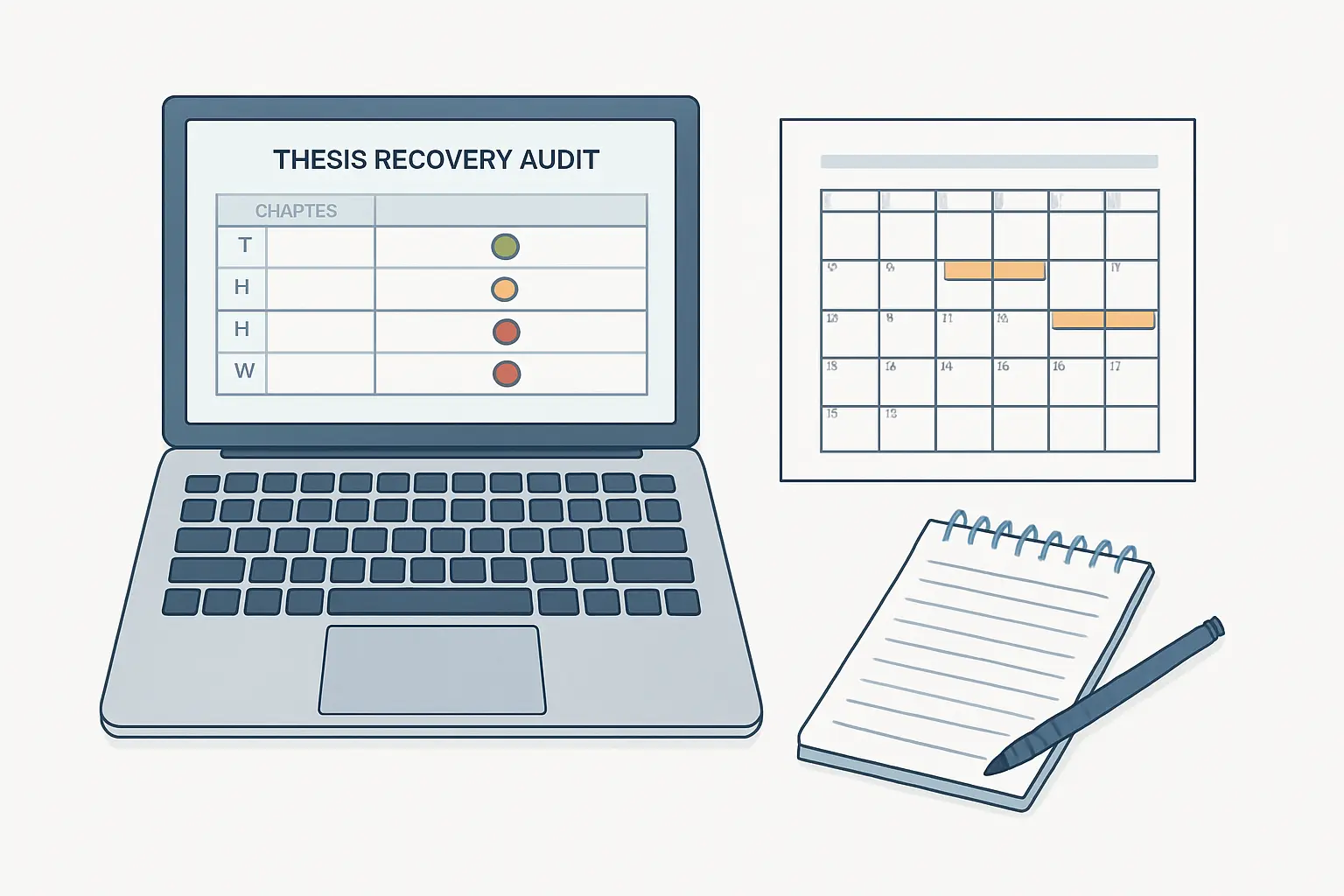
Panic compresses time perception — two months feels like two weeks when you’re behind. The first move is to replace that feeling with a factual map. Open a spreadsheet and list every remaining chapter and sub-section. Against each one, write one of three statuses: done, in progress, or not started. Then estimate the word count you still need to produce for each.
Most students at this stage discover the gap is smaller than their anxiety suggested — or that certain sections can be substantially shortened without harming the thesis’s core argument. Rebuild your timeline from today, working backwards from your submission date. A Gantt chart approach — even a simple one done in an afternoon — turns vague dread into a manageable week-by-week task list.
The audit also shows you which chapters are structurally essential and which sections have grown well beyond what your examiners need to see.
Step 2: Cut Scope Safely
Scope creep is one of the most common reasons students fall behind. A literature review that ballooned to 12,000 words, a methodology chapter that became a philosophical treatise, supplementary analyses nobody asked for — all of it drains the time you no longer have.
Safe scope cuts follow a simple test: does this section directly support your research question? If the answer is “not directly”, it’s a candidate for reduction or removal. The most common cuts that don’t damage a thesis:
- Literature review sub-themes: Consolidate two adjacent themes into one. Summarise rather than deep-dive on historical debates your research question doesn’t hinge on.
- Secondary analyses: If you ran additional tests or case comparisons out of curiosity, drop them unless they contradict your main findings. Flag them in your limitations as planned future work.
- Chapter introductions and conclusions: These are consistently over-long. A three-paragraph chapter intro and a two-paragraph chapter summary is almost always enough.
- Body text vs. appendices: Move detailed tables, full interview transcripts, coding trees, and survey instruments to appendices. This immediately reduces the word count you still need to write without removing any evidence your examiner needs.
Cut early, cut with confidence, and document your rationale. Examiners don’t penalise a focused thesis — they penalise an unfocused one.
Step 3: Talk to Your Supervisor Now
This is the step most behind-schedule students delay the longest, and the delay almost always makes things worse. Supervisors have seen students fall behind before. What they haven’t seen — and cannot help with — is a student who disappears and reappears two weeks before the deadline with a half-finished draft.
Email your supervisor today with three things: where you actually are, what you’ve already cut or adjusted, and what your revised timeline looks like. Most supervisors respond constructively to a student who brings a plan rather than just a problem. They may also know options you don’t: extension procedures, extenuating circumstances processes, or flexibility on interim deadlines that only become accessible once you’ve made contact.
A difficult conversation today prevents a catastrophic one six weeks from now.
Step 4: Set Daily Word Targets and Protect Them
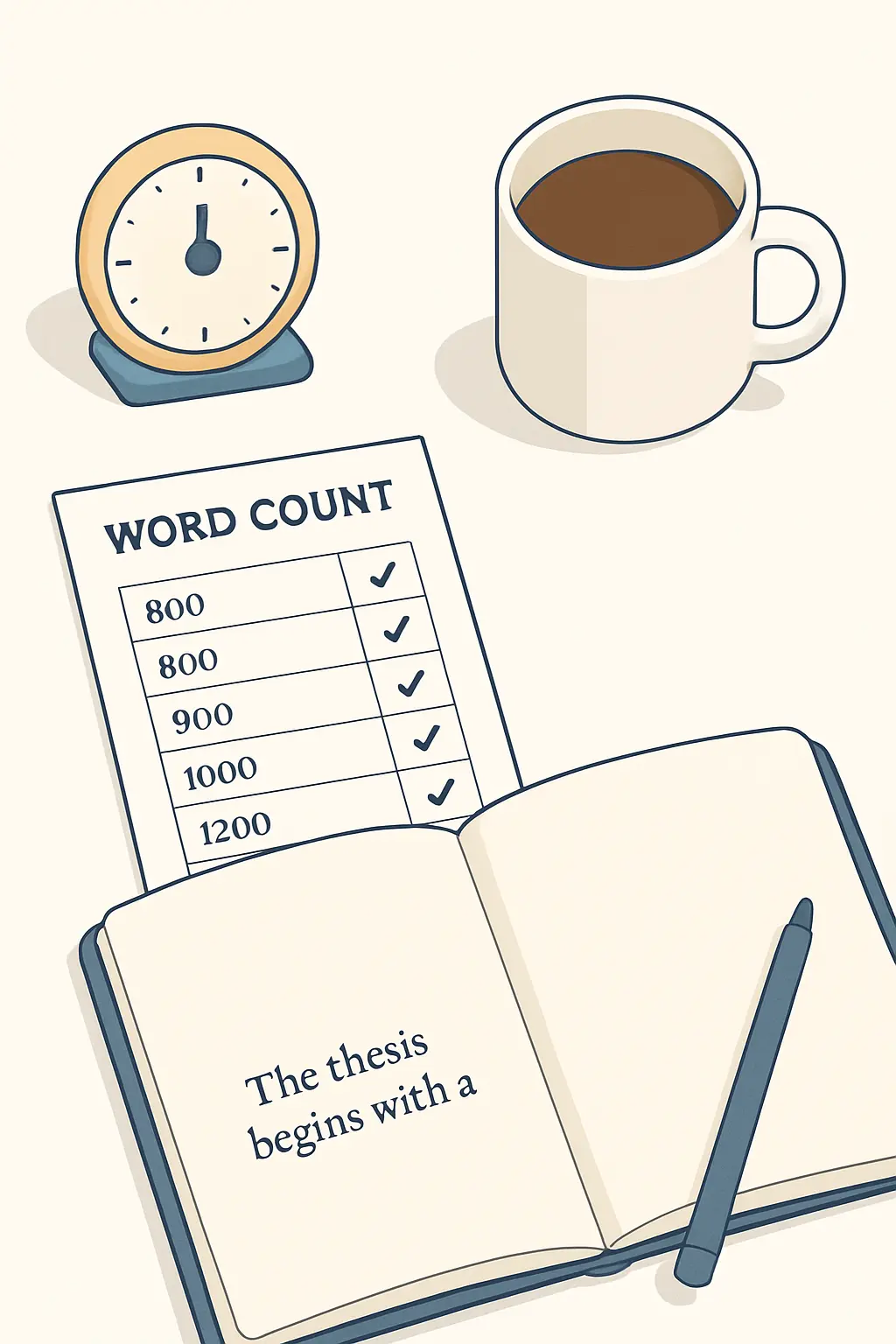
Vague intentions don’t produce theses. Specific commitments do. Divide your remaining word count by the number of writing days you have before your penultimate draft needs to exist — leaving at least two weeks for editing and formatting — and that number is your daily target.
For most students in recovery mode, a daily target of 800 to 1,200 words of new content (not editing) is both realistic and meaningful. Protect that writing block by:
- Scheduling it at the same time every day — morning sessions tend to be more reliable than evening ones
- Treating it as an unmovable appointment: no meetings, no email, no lectures during that block
- Ending each session by writing the first sentence of the next section, so you never start cold
- Tracking your actual daily output in a simple spreadsheet — seeing a streak builds its own momentum
Don’t aim for perfect prose on a first pass. Aim for complete sentences that capture your argument. Revision is fast; generation from nothing is slow.
Step 5: Use AI to Accelerate First Drafts
One of the main reasons behind-schedule students stay behind is the blank-page problem. Even when they know exactly what they need to write, generating an initial draft from notes and reading is slow and demoralising. This is where an AI writing tool, used responsibly, can recover meaningful time.
Tesify is built specifically for this workflow: you provide your research question, key sources, and the argument you want a section to make — and Tesify generates a structured first draft that you then verify, rewrite, and own. The critical distinction from ghostwriting is that you remain the author. You supply the intellectual content, the sources, and the analytical judgements; the AI removes the generation friction.
Applied section by section:
- Literature review: You almost certainly already have your sources gathered. Writing your literature review faster with AI turns a week of blank-page struggle into an afternoon of synthesis and refinement.
- Results chapter: Your data is collected and analysed — the bottleneck is narrating what it shows clearly. Getting your results chapter drafted faster frees your energy for the interpretive discussion section, which needs you most.
- Discussion chapter: Use AI for the scaffolding — section structure, transitions, and signposting — and write the analytical substance yourself. This is where your voice and judgement matter most to an examiner. For a detailed walkthrough of how a discussion chapter should be structured, this guide on tesify.pro pairs directly with this workflow.
Integrity note: every university’s AI policy differs in 2026. Check your institution’s guidance, declare AI assistance correctly, and never submit AI-generated text that hasn’t been thoroughly reviewed and reworked by you. The goal is a faster first draft, not a substituted analysis.
Step 6: Rebuild Momentum With Small Wins
The emotional side of falling behind is real and often underestimated. Prolonged stress around an overdue thesis frequently tips into avoidance — the project feels so large and compromised that opening the file feels worse than doing something else. Breaking this pattern is as important as any tactical adjustment.
Small wins rebuild momentum faster than large ones. Completing a single section — even a short one — and marking it done on your tracking sheet has a measurable effect on the energy you bring to the next session. Structure your recovery plan so you encounter completed tasks every day, not just when you finish a full chapter.
If the anxiety is more persistent, the pattern is recognisable: it often presents alongside imposter syndrome — a conviction that you’re uniquely underqualified or that your thesis is uniquely broken. It isn’t. Most students going through a difficult patch feel this. Most of them still submit.
Two practical commitments matter most: keep your daily writing block non-negotiable even on difficult days (200 words still counts), and stop revising completed sections until the full draft exists. Perpetual re-editing is the enemy of completion.
Frequently Asked Questions
Can I ask for a deadline extension when I’m this far behind?
Yes, in many cases. Most universities have extenuating or mitigating circumstances processes that allow extensions for documented personal or medical difficulties. The key is to apply before your deadline — not after. Contact your department administrator or student support office, with your supervisor already informed. Extensions granted retroactively are rare and significantly harder to obtain.
How do I prioritise which chapters to write first?
Write the chapter with the most complete notes first to build immediate momentum. Typically this is the methodology (since the research is done) or results (since the data exists). Save the introduction and abstract for last — they are substantially faster to write once the body chapters exist and you know exactly what your thesis argues.
Is 1,000 words per day a realistic thesis writing target?
For most students, yes — especially when writing from existing notes and sources rather than generating ideas from scratch. 1,000 words of first-draft content in a focused two-hour session is achievable. For analytically dense chapters like the discussion, 600–800 words per day may be more realistic without sacrificing the quality your examiner expects.
What if my supervisor reacts badly when I admit I’m behind?
Supervisors vary in how they respond. If you encounter an unsupportive reaction, document your communication in writing, keep your emails professional and solution-focused (here’s my plan, here’s my revised timeline), and escalate to a second supervisor or postgraduate director if the situation worsens. Most universities have student support structures specifically designed for supervision difficulties.
Can AI tools like Tesify help when I’m behind on my thesis?
Yes, if used correctly. Tesify accelerates the first-draft stage — the most time-consuming and demoralising part of catching up — by generating structured draft content from your research materials, arguments, and sources. You then revise, verify, and own the output. It doesn’t write your analysis; it eliminates blank-page friction. Always check your university’s AI use policy and declare AI assistance as required by your institution.
Stop Staring at a Blank Page
Tesify generates integrity-safe first drafts from your own research — section by section, chapter by chapter. You provide the intellectual content; Tesify removes the generation friction so you can spend your remaining time on analysis, revision, and submission. Free to start.
Write your thesis with AI
Structure, draft, cite, and format your thesis faster with Tesify’s AI writing tools, automatic bibliography, and plagiarism checker. Free to start, no credit card required.






Leave a Reply