
Mixed Methods Research: Design, Examples, and When to Use It (2026)
Mixed methods research has become one of the most widely adopted approaches in the social sciences, education, health sciences, and business research over the past two decades. By combining quantitative data (numbers, statistics, surveys) with qualitative data (interviews, observations, texts), mixed methods researchers can answer questions that neither approach alone can fully address. Yet despite their growing popularity, mixed methods designs remain poorly understood — and poorly executed — in many theses and research projects.
This guide explains what mixed methods research is, the four main design types with real examples, and how to decide whether your research question actually needs a mixed methods approach.
What Is Mixed Methods Research?
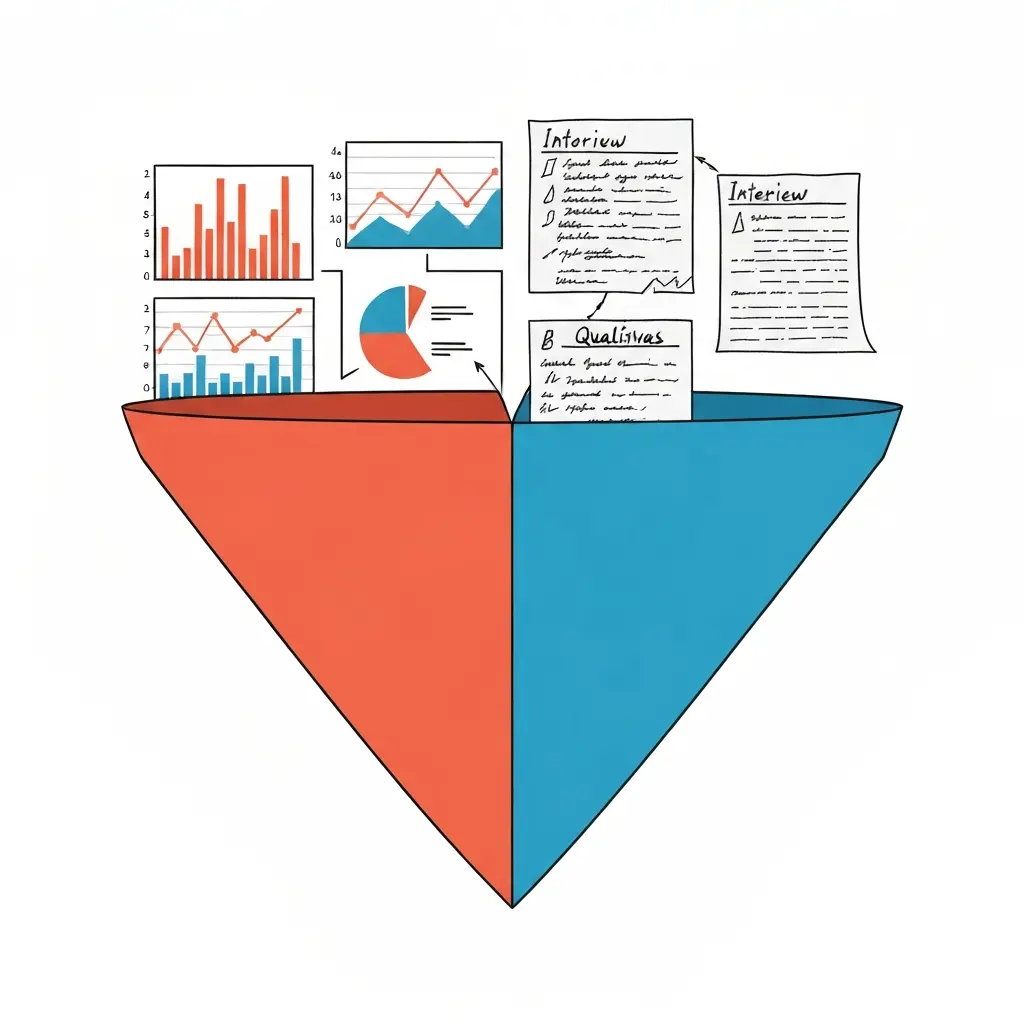
According to Creswell and Plano Clark, who are widely considered the leading theorists of mixed methods research, a mixed methods study is one in which the researcher collects and analyses both quantitative and qualitative data, integrates the two forms of data, and uses distinct designs that involve philosophical assumptions and theoretical frameworks. The key word is integration — simply running a survey and a few interviews in the same project is not mixed methods research unless the two strands are brought together analytically.
Mixed methods research is grounded in pragmatism — the philosophical position that the best research approach is whatever best answers the research question, rather than any ideological commitment to either quantitative (positivist) or qualitative (interpretivist) traditions.
When Is Mixed Methods Appropriate?
Mixed methods is not the right choice for every project. It is appropriate when:
- Corroboration is needed: You want to confirm findings from one data type with another (triangulation)
- Explanation is needed: Quantitative results are unexpected or incomplete, and qualitative data can explain them
- Instrument development is needed: Qualitative data informs the development of a survey or scale
- Generalisation is needed: Qualitative findings need to be tested quantitatively on a larger sample
- Complexity demands it: The research question cannot be answered by one approach alone
Mixed methods is often over-used as a strategy to appear comprehensive rather than because the research question genuinely requires it. Examiners will challenge any mixed methods design that does not have a clear rationale for why both strands were necessary.
Design 1: Convergent (Triangulation) Design
In a convergent design, quantitative and qualitative data are collected simultaneously and then compared to develop a comprehensive understanding. Both strands have equal priority.
Advantages: Time-efficient; captures breadth and depth simultaneously.
Challenges: Merging two datasets from different epistemological traditions is analytically complex.
Design 2: Explanatory Sequential Design
In an explanatory sequential design, quantitative data is collected first, analysed, and then qualitative data is collected to explain or elaborate on the quantitative findings. Quantitative has priority.
This is the most commonly used mixed methods design in health sciences and education research, because it follows a natural logical sequence: identify the pattern, then explain it.
Design 3: Exploratory Sequential Design
In an exploratory sequential design, qualitative data is collected first to explore a phenomenon, and the findings inform the development of a quantitative instrument that is then tested on a larger sample. Qualitative has priority.
This design is particularly useful when existing measurement tools are inadequate or when the research is entering unexplored territory where the relevant constructs are not yet well defined.
Design 4: Embedded Design
In an embedded design, one strand (usually qualitative) is embedded within a primarily quantitative study to provide supplementary insight. One strand clearly plays a secondary, supporting role.
Comparing the Four Designs
| Design | Sequence | Priority | Best for |
|---|---|---|---|
| Convergent | Simultaneous | Equal | Triangulation, comprehensive understanding |
| Explanatory Sequential | QUAN → QUAL | Quantitative | Explaining unexpected quantitative results |
| Exploratory Sequential | QUAL → QUAN | Qualitative | Instrument development, unexplored fields |
| Embedded | One inside the other | One strand dominant | Enriching primarily quantitative studies (e.g., RCTs) |
The Integration Challenge
Integration — the point where quantitative and qualitative findings are brought together — is the defining and most challenging characteristic of mixed methods research. Many theses labelled “mixed methods” actually present the two strands as separate, parallel studies with a brief note that both used the same participants. True integration requires:
- Discussion-level integration: The discussion chapter explicitly addresses what the two strands reveal together that neither reveals alone
- Analytical integration: In convergent designs, a joint display (e.g., a table comparing themes and statistical findings) makes integration visible
- Meta-inferences: Conclusions that draw explicitly on both forms of data and could not have been reached from either alone
Writing the Methodology Chapter
A mixed methods methodology chapter must justify three things: (1) why a mixed methods approach was necessary, (2) which of the four designs you used and why, and (3) how the two strands will be integrated. Structure it clearly using subheadings for each methodological strand, and include a visual diagram of your design sequence.
For broader methodology chapter guidance, see our research methodology chapter writing guide. For qualitative methods specifically, see our qualitative research methods guide and our quantitative research methods guide for the quantitative strand. Korean-language researchers will find equivalent mixed methods and design guidance in the Korean-language guide to research design at kr.tesify.pro.
Frequently Asked Questions
Is mixed methods research harder than qualitative or quantitative alone?
Generally yes — mixed methods research requires competency in both qualitative and quantitative methods, as well as the additional skill of integrating two epistemologically distinct strands. It also typically requires more data collection, more analysis time, and stronger methodological justification. For this reason, many supervisors caution master’s students against mixed methods unless the research question genuinely requires it, and the student has sufficient time and support.
Can I use mixed methods in a master’s thesis?
Yes, but it requires careful scoping. Given the time constraints of a master’s programme, mixed methods theses often use one of the sequential designs (explanatory or exploratory) with a relatively small qualitative strand rather than large parallel quantitative and qualitative studies. Discuss the feasibility with your supervisor early — they will advise whether your question genuinely requires mixed methods or whether a single-strand design would be more appropriate for your timeline.
What is the difference between triangulation and mixed methods?
Triangulation is one purpose for using mixed methods — specifically, using multiple data sources to corroborate findings (what Creswell calls the “convergent” design). However, mixed methods research has multiple purposes beyond triangulation, including explanation, instrument development, and generalisation. Not all mixed methods research involves triangulation, and triangulation can be achieved within a single-strand design by using multiple qualitative methods.
How do I cite mixed methods methodology in my thesis?
The primary references for mixed methods methodology are Creswell and Plano Clark (Designing and Conducting Mixed Methods Research, 3rd ed., 2018), Tashakkori and Teddlie (SAGE Handbook of Mixed Methods in Social and Behavioural Research), and Bryman (Social Research Methods, 5th ed., 2016). Reference the specific design type you used and cite the relevant author who defined it. For your citation formatting, see our APA citation format guide.
Structure Your Mixed Methods Thesis with Confidence
Tesify guides you through complex thesis structures — including mixed methods designs — with chapter-level templates, automated citation management, and AI-powered feedback on your methodological reasoning.
Write your thesis with AI
Structure, draft, cite, and format your thesis faster with Tesify’s AI writing tools, automatic bibliography, and plagiarism checker. Free to start, no credit card required.






Leave a Reply