

Dissertation Example PDF: Annotated Samples from Real Theses Analysed Chapter by Chapter (2026)
Finding a good dissertation example PDF is one of the most effective ways to understand what a finished, examiner-approved thesis actually looks like. Reading guidelines and textbooks is useful, but nothing replaces seeing a real piece of work with its argumentation, formatting, citations, and flow intact. This guide goes further: it does not simply list where to download examples — it annotates them, breaking down what each chapter does well, where students commonly stumble, and what the examiners at Oxford, UCL, and leading US universities are actually looking for when they read your work.
Whether you are writing a 10,000-word undergraduate dissertation, a 40,000-word master’s thesis, or an 80,000-word PhD, the structural logic is the same. This guide uses annotated excerpts from real publicly available dissertations (Business Management, Psychology, Education, and Engineering) to give you a concrete model for each section of your own project.
Where to Find Real Dissertation Example PDFs
Before diving into the annotations, you need quality source material. There are several authoritative repositories that host real, approved dissertations free of charge.
| Repository | Coverage | Best For | Access |
|---|---|---|---|
| EThOS (British Library) | 600,000+ UK theses | UK universities, doctoral | Free registration |
| ProQuest Dissertations | 5 million+ global | US/CA research universities | Via university library |
| DART-Europe | European institutions | Multilingual research | Open access |
| Your university library portal | Institution-specific | Same format as your thesis | Free with student login |
| Grad Coach Examples | Business, social sciences | Annotated guides for students | Free download |
Pro tip: Your own university repository is the single most valuable source. Dissertations approved by your faculty follow the exact formatting rules, structural conventions, and depth expectations your examiners apply. Find three strong examples from your department and read them before writing your first chapter.
Chapter 1: Introduction — Annotated Breakdown
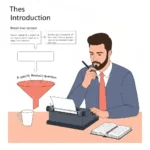
The introduction is the most read section of any dissertation. It is also the most frequently underestimated. Most students treat it as background context. Strong dissertations treat it as a research argument — establishing not just what they are studying, but why it matters now and why their approach is the right one.
What a strong Chapter 1 includes
- Background and context (300–500 words): Situate the problem in the real world. Use statistics, recent events, or policy developments to make the urgency clear.
- Problem statement (150–200 words): One to three sentences stating the specific gap in knowledge or practice your dissertation addresses.
- Research aims and objectives: One overarching aim; three to five specific, measurable objectives.
- Research questions: Usually two to four questions that map directly onto your objectives.
- Significance of the study: Theoretical contribution plus practical implications.
- Dissertation outline: A brief roadmap paragraph telling the reader what each chapter covers.
Annotated example (Business Management, MSc level)
“Employee wellbeing has emerged as a central strategic concern for organisations in the post-pandemic era (Deloitte, 2023). Despite growing investment in workplace wellness programmes, a 2024 Gallup survey found that 57% of UK employees still report feeling disengaged at work. This paradox — rising investment, stagnant engagement — represents a significant gap in our understanding of how wellbeing initiatives translate into behavioural outcomes at the team level.”
Why this works: In three sentences the author has established the domain, cited recent data, identified a paradox (strong hook), and named the specific gap at the team level. The phrase “behavioural outcomes at the team level” is doing important work — it signals exactly what the methodology will measure.
Common mistake to avoid: Opening with a definition (“Wellbeing is defined as…”). This is one of the clearest signals to an examiner that the author has not thought carefully about their argument. Start with the problem, not the dictionary.
Chapter 2: Literature Review — Annotated Breakdown
The literature review is where most dissertations lose marks. The failure mode is almost always the same: a string of summaries (“Smith (2019) found that… Jones (2021) argued that…”) with no synthesis, no argument, and no clear connection to the research questions. Examiners want to see a scholarly conversation, not a catalogue.
The three-layer structure of a strong literature review
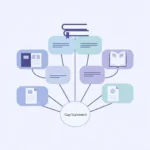
- Conceptual framing: Define the key constructs and theoretical frameworks that underpin your study. Show how these frameworks evolved over time.
- Empirical synthesis: Group studies thematically (not chronologically). Identify patterns, contradictions, and consensus positions in the research.
- Gap identification: Conclude each thematic section by explaining what remains unknown — directly leading to your research questions.
Annotated example (Education, PhD level)
“While self-determination theory (Deci & Ryan, 1985) has consistently predicted intrinsic motivation across educational settings (see meta-analyses by Vansteenkiste et al., 2018; Howard et al., 2021), its application to remote learning environments remains contested. Two competing positions have emerged: proponents argue that digital autonomy-supportive environments can replicate in-person conditions (e.g., Chen & Jang, 2023), while critics contend that the absence of embodied social cues fundamentally undermines the competence feedback loop central to SDT (Garrison & Anderson, 2003; Kizilcec et al., 2022). No study to date has examined these competing claims in a UK secondary school population post-2020 — the specific gap this research addresses.”
Why this works: The author maps a theoretical framework, acknowledges two competing bodies of evidence (not just one “side”), and closes with a precise gap statement that directly motivates the research. The phrase “post-2020” signals topical relevance. The gap is narrow and specific — not “more research is needed” but a specific population in a specific temporal context.
Chapter 3: Methodology — Annotated Breakdown
The methodology chapter is your dissertation’s most technical section — and paradoxically one of the most commonly under-developed. Many students describe what they did without explaining why they made each methodological choice. Examiners are not satisfied by procedure alone; they want justified decision-making.
If you need a deep dive into this section, our complete guide to writing a dissertation methodology chapter walks through every element in detail.
Core elements every methodology chapter must address
| Element | Questions to Answer | Typical Length |
|---|---|---|
| Research Philosophy | Positivist, interpretivist, or pragmatist? Why? | 200–400 words |
| Research Design | Experimental, case study, survey, ethnographic? | 300–500 words |
| Data Collection | How? Who? When? With what instrument? | 400–600 words |
| Sampling | Strategy, size, and justification | 200–400 words |
| Data Analysis | Thematic analysis? Regression? Content analysis? | 300–500 words |
| Ethics | Consent, anonymity, data storage, approval | 200–300 words |
| Limitations | What could your design not capture or control? | 150–250 words |
Annotated example (Psychology, BSc level)
“A qualitative research design was adopted for this study. This choice reflects an interpretivist epistemological position: the aim is not to measure the frequency of a phenomenon but to understand its meaning as experienced by participants (Braun & Clarke, 2022). A phenomenological approach was selected over grounded theory as the study seeks to describe a lived experience (social anxiety in online learning) rather than generate a new explanatory theory. Semi-structured interviews were conducted with nine participants aged 18–24, recruited via purposive sampling from the university’s psychology student pool. Sample size was determined by theoretical saturation — no new themes emerged after interview seven.”
Why this works: Every sentence is justified. The author chooses a design, names the philosophical position behind it, explains why this tradition rather than another, describes participants and sampling in one breath, and explains how they knew when to stop sampling. Examiners can follow the chain of reasoning without hunting for justifications.
Chapter 4: Results/Findings — Annotated Breakdown
The results chapter has a simple job: report what you found. But “simple” does not mean “short” or “unstructured.” The way you present findings shapes how persuasive your argument is in the discussion chapter. The best results chapters are organised around themes or research questions — not around the order in which you collected the data.
Qualitative findings: thematic structure
For qualitative dissertations, the findings chapter typically presents three to six major themes. Each theme follows this structure:
- Theme name and one-sentence summary
- Interpretive commentary explaining what the theme represents
- Two to three participant quotations with minimal paraphrase — let the data speak
- Brief link to the next theme
Quantitative findings: table and prose integration
Quantitative results chapters must present every statistical test clearly. A common mistake is placing tables without contextualising them in prose. For each test, report: the test type, the result (including effect size), the p-value, and one sentence interpreting the result in plain English. Use APA 7th edition formatting for all tables.
For a thorough guide on how to structure this section, see our article on writing a thesis findings chapter.
Chapter 5: Discussion and Conclusion — Annotated Breakdown
The discussion chapter is where your intellectual contribution becomes visible. Many students make the error of summarising their results again at the start of the discussion — examiners find this irritating. The discussion begins by interpreting, not repeating.
The four movements of a strong discussion
- Interpretation: What do your findings mean? Go beyond description.
- Connection to literature: Do your findings confirm, contradict, extend, or nuance existing studies? Be specific — name the authors.
- Theoretical implications: Does your work support or challenge the frameworks you used in Chapter 2?
- Practical implications: What should practitioners, policymakers, or future researchers do with this knowledge?
Annotated example (Business Management, PhD level)
“The finding that psychological safety mediated the relationship between transformational leadership and team innovation (β = .41, p < .001) extends the work of Edmondson (1999) and Nembhard & Edmondson (2006) by demonstrating this effect in the specific context of remote-first technology teams. This is noteworthy because prior studies were conducted primarily in co-located hospital and manufacturing settings where psychological safety cues are predominantly non-verbal (eye contact, open body language). The present findings suggest that team leaders in remote environments must compensate through explicit verbal validation strategies — a practical implication directly applicable to post-pandemic HR policy.”
Why this works: The author states a result (β = .41), names the scholars they are extending, specifies how their context differs (remote-first, technology), and draws a direct practical implication. There is no wasted space. Every sentence moves the argument forward.
For help structuring this chapter, see our guide to writing a thesis discussion chapter.
Example Dissertations by Discipline
Different disciplines have markedly different conventions. Here is what to look for in each field when reviewing a dissertation example PDF.
| Discipline | Typical Length | Dominant Method | Key Structural Feature |
|---|---|---|---|
| Business & Management | 15,000–20,000 words | Mixed methods, case study | Saunders’ Research Onion framework |
| Psychology | 8,000–12,000 words | Experiments, qualitative | APA 7th format throughout |
| Education | 15,000–25,000 words | Ethnography, action research | Reflexivity statement in methodology |
| Engineering & Computer Science | 10,000–15,000 words | Experimental, design-based | Separate system design chapter |
| History & Humanities | 12,000–20,000 words | Archival, textual analysis | Chicago footnote style; no methodology chapter |
| Law | 12,000–15,000 words | Doctrinal, socio-legal | OSCOLA citation; heavy footnotes |
The 8 Most Common Dissertation Mistakes (Spotted in Real PDFs)
After reviewing hundreds of dissertations across disciplines, these are the eight mistakes that appear most often — and cost the most marks.
- Descriptive literature review with no synthesis. Summarising sources instead of arguing with them. Fix: for every three sources you cite, write one sentence that evaluates what they agree on, what they contradict, and what remains unresolved.
- Research questions not answered in the discussion. Students introduce three research questions and then forget to explicitly address each one in their conclusion. Fix: create a simple mapping table — RQ1: answered in section 5.1; RQ2: answered in section 5.3, etc.
- Unjustified methodology. Describing methods without explaining why. Fix: for every methodological choice, add one “because” clause.
- Thin sample without saturation argument. Qualitative students with five interviewees offering no justification. Fix: cite theoretical saturation (Glaser & Strauss, 1967) or state that saturation occurred at interview N.
- Overlong abstract. Many universities cap abstracts at 300 words. Check your regulations and use a structured format: background, aim, method, findings, implications.
- Passive-heavy writing. “It was found that…” instead of “The data show that…”. Active voice improves readability significantly.
- Missing limitations section. A dissertation without acknowledged limitations signals naivety. Every study has constraints — acknowledging them shows methodological maturity.
- Inconsistent referencing. Mixing APA 6th and 7th edition, or switching between Harvard and APA. Check your university’s house style and apply it throughout.
Pre-Submission Checklist
Before submitting your dissertation, run through this checklist against a real example from your institution.
- Title page includes all required elements (name, student ID, module, word count, submission date)
- Abstract is within the word limit and covers background, aim, method, findings, and implications
- Research questions are clearly stated in Chapter 1 and explicitly answered in the conclusion
- Every claim in the literature review is supported by a citation
- Methodology chapter justifies every major design decision
- Findings chapter is organised thematically or by research question (not chronologically)
- Discussion connects findings back to the literature review (names specific authors)
- Limitations are acknowledged honestly
- Referencing style is consistent throughout (check 10 random citations)
- Word count is within the permitted range (±10% is usually acceptable — check your regulations)
- All figures and tables have numbered captions and are referenced in the text
- Appendices are correctly labelled and referenced in the main body
Frequently Asked Questions
Where can I download a free dissertation example PDF?
The best sources for free dissertation example PDFs are: EThOS (British Library) for UK theses; ProQuest (via your university library) for US and international; and your own institution’s online repository. Many universities also host sample dissertations on their graduate school website with formatting guidance attached.
How long should a dissertation be?
Dissertation length varies by level and discipline. Undergraduate dissertations typically run 8,000–12,000 words. Master’s dissertations are usually 15,000–20,000 words. PhD theses range from 60,000–100,000 words in most UK and US institutions. Always check your specific program’s regulations, as these are the authoritative figures.
Can I use a dissertation example as a template?
You can use a dissertation example as a structural template — studying its chapter organisation, section transitions, and formatting. You must not copy any content, as this constitutes plagiarism. The purpose of reading examples is to understand the genre conventions of a dissertation in your discipline, not to borrow arguments or phrasing.
What is the difference between a dissertation and a thesis?
In the UK, a thesis is typically the longer doctoral document; a dissertation is the master’s or undergraduate equivalent. In the US, the terms are often reversed — a thesis is a master’s project and a dissertation is the doctoral work. In practice, the structural logic is nearly identical across both. See our full guide on the thesis vs dissertation difference for country-by-country details.
Do dissertations have to follow a strict five-chapter structure?
The five-chapter model (Introduction, Literature Review, Methodology, Findings, Discussion/Conclusion) is the dominant convention in social sciences, business, and education. STEM disciplines often add a separate system design or implementation chapter. Humanities dissertations may not have a standalone methodology chapter at all. Check example dissertations from your own department to understand what is expected.
How many references should a dissertation have?
There is no fixed minimum, but as a rough benchmark: undergraduate dissertations typically cite 30–60 sources; master’s dissertations 60–100; PhD theses 150–300 or more. Quality matters more than quantity — every source cited should be directly relevant to your argument. A well-chosen recent source (published within the last five years) is worth more than three outdated, tangential references.



Leave a Reply