
How to Write a Thesis Findings Chapter: Step-by-Step Guide with Examples 2026
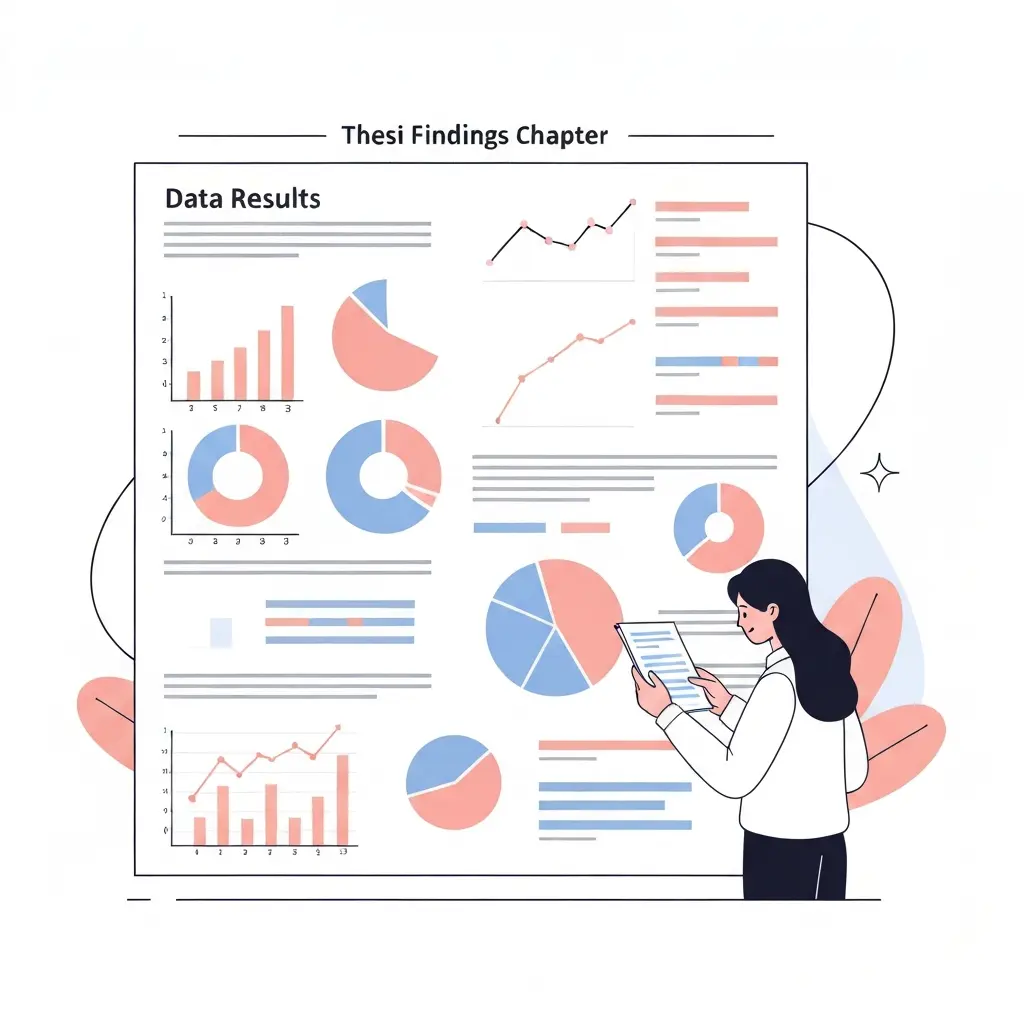
The findings chapter is where your research comes alive — it is the section where you present what you actually discovered, without interpretation (that comes in the discussion). Yet it is one of the most commonly miswritten sections of a thesis. Many students either include too much interpretation in findings or too little structure, leaving examiners struggling to see what the data shows. This step-by-step guide takes you through exactly how to write a findings chapter for qualitative, quantitative, and mixed methods theses, with worked examples from each approach.
Findings vs Discussion: What Is the Difference?
The single most important principle for writing a findings chapter is this: present, do not interpret. The findings chapter answers “What did I find?” The discussion chapter answers “What does it mean?”
Findings: “Participants who used structured writing plans completed their thesis chapters 34% faster than control participants (t(48) = 3.21, p = .002).”
Discussion (not in findings): “This 34% speed advantage likely reflects the cognitive load reduction that comes from pre-planned structure — consistent with cognitive load theory (Sweller, 1988)…”
In practice, the line is not always this clean. Qualitative research findings necessarily include some analytic framing when presenting themes. But the guiding principle remains: findings present the evidence; discussion interprets it. See our guide to thesis structure for how findings and discussion fit into the overall chapter sequence.
How to Structure Quantitative Findings
Structure your quantitative findings chapter in this order:
- Introduction paragraph: Briefly restate the research questions and outline how you will present the data (e.g., “This chapter presents the findings from the survey conducted with 412 participants. Results are organised by research question.”).
- Participant/sample description: Demographic breakdown, response rate, any missing data handling.
- Data quality checks: Reliability statistics (Cronbach’s alpha for scales), normality tests, outlier handling.
- Descriptive statistics: Means, standard deviations, frequencies for key variables.
- Inferential statistics by research question: Present each hypothesis test in turn — the statistical test, result, and effect size. Do not interpret here.
- Summary paragraph: A 2–3 sentence overview of the main patterns.
Standard format for reporting a t-test:
“Students who received structured supervision scored significantly higher on academic self-efficacy (M = 4.32, SD = 0.61) than those who received unstructured supervision (M = 3.88, SD = 0.74), t(98) = 2.87, p = .005, d = 0.57.”
Always report: the test used, the statistic, degrees of freedom, p-value, and effect size. APA 7 guidelines for statistics are covered in detail in our APA format guide.
How to Structure Qualitative Findings
Qualitative findings are structured around themes, not participants or questions. The standard approach:
- Introduction: Restate the research question(s) and explain your thematic framework (e.g., “Thematic analysis following Braun and Clarke (2022) identified four overarching themes…”).
- Each theme as a section: Name, description, supporting quotes, illustrative examples.
- Quote presentation: Use participant identifiers (e.g., “Participant 7, female, aged 24”) and present quotes indented or in block format for quotes over 40 words.
- Sub-themes: If themes have internal variation, present sub-themes within each section.
- Summary: Overview of how themes relate to each other.
Example qualitative theme presentation:
“Theme 1: Structural Uncertainty as a Barrier to Progress
A dominant theme across all 20 interviews was the experience of structural uncertainty — not knowing how to move from one section of the thesis to the next. Participant 7 described this as ‘just staring at the screen for hours because I had no idea what should come next.’ This sentiment was echoed by Participant 12: ‘My supervisor gave me feedback on individual chapters but never helped me see how it all connected.’ This theme was particularly prominent among first-year PhD students…”
For a detailed walkthrough of thematic analysis, see our complete guide to thematic analysis.
Mixed Methods Findings Structure
For mixed methods theses, you have two main structural options:
- Sequential presentation: Present quantitative findings first (Chapter 4), then qualitative findings (Chapter 5). This works well when each phase was conducted separately and the qual phase builds on the quant.
- Integrated presentation: Present findings from both strands together, organised by research question, using each strand to illuminate the other. This is more complex but more integrated — appropriate for convergent mixed methods designs.
Whichever you choose, be explicit in your introduction about your decision and why you made it.
Using Tables and Figures Effectively
Tables and figures in your findings chapter should add value, not just fill space. The APA 7 and SPSS conventions:
- Every table needs a title, number, and note: Table 1, Table 2… sequentially through the document.
- Refer to every table/figure in the text before it appears: “As shown in Table 3, the mean scores…”
- Tables for data comparisons: Use tables when you have multiple statistics to compare across groups.
- Figures for trends and relationships: Use bar charts, scatter plots, or line graphs for patterns over time or correlations.
- Qualitative tables: A table listing all themes with frequency counts and illustrative quotes is standard in thematic analysis presentations.
For step-by-step formatting guidance, see our how to format a thesis in APA style guide.
The 7 Most Common Findings Chapter Mistakes
- Interpreting as well as presenting — the most common error. Save the “this means…” for discussion.
- Organising by data collection method rather than research question — examinees want to see findings in relation to what you set out to investigate.
- Presenting all data regardless of relevance — include only findings that address your research questions. Appendices exist for supplementary data.
- Missing effect sizes for quantitative results — p-values alone do not convey practical significance. Report Cohen’s d, eta-squared, or odds ratios.
- Using all quotes of similar length — vary quote length. Short (1–2 sentence) quotes for specific points; longer block quotes for illustrative richness.
- Not explaining unexpected findings — if your data shows something you did not expect, note it here (briefly) and address it in discussion.
- Starting the chapter with no roadmap — begin with a paragraph telling the reader how the chapter is organised.
For the complete thesis structure including all chapters, see our complete guide to writing a thesis. For writing your discussion chapter after findings, see the methodology chapter guide.
If you are structuring your findings chapter and struggling to organise your data coherently, Tesify provides chapter-by-chapter AI-assisted drafting that can help you move from raw data to structured academic argument.
Frequently Asked Questions
What is the difference between findings and discussion in a thesis?
The findings chapter presents what you found — the data, themes, or results — without interpretation. The discussion chapter explains what the findings mean: how they relate to your literature review, what they contribute to knowledge, and what their implications are. In findings, you say “Participants scored significantly higher on…” — in discussion, you say “This finding suggests that… which is consistent with Smith’s (2024) theory…” The separation keeps each chapter focused and makes your thesis easier to examine.
How long should the findings chapter be in a thesis?
Findings chapters typically constitute 20–25% of the thesis word count, though this varies significantly by methodology. A quantitative findings chapter for a 20,000-word master’s dissertation might be 3,000–5,000 words. A qualitative thematic analysis chapter for a PhD might be 12,000–18,000 words given the space needed for quotes and theme development. Follow your supervisor’s guidance and check examples from completed theses at your institution.
How do you present qualitative findings in a thesis?
Organise qualitative findings by theme, not by participant or question. Each theme becomes a section with: a descriptive heading, a brief explanation of what the theme represents, supporting quotes from participants (with identifiers), and discussion of variation or sub-themes. Avoid summarising what every participant said — instead, build an analytical narrative that shows the pattern across participants, illustrated by representative quotes.
Should I include tables in my findings chapter?
Yes, for quantitative research. Tables are standard and expected for descriptive statistics, regression results, ANOVA tables, and correlation matrices. Every table needs a numbered title and must be referred to in the text before it appears. For qualitative research, summary tables listing themes, sub-themes, and frequency counts are helpful but not always required — check examples from your discipline and institution.
Can I combine findings and discussion in a thesis?
In some disciplines — particularly qualitative, interpretive research — a combined findings and discussion chapter (or separate chapters that are less clearly demarcated) is acceptable and sometimes preferred. In education, sociology, and some humanities disciplines, the separation between presenting data and interpreting it is less strict. Check your department’s norms, look at successfully examined theses from your supervisor’s previous students, and discuss the structure with your supervisor before writing.
Structure Your Findings Chapter with Tesify
Translating raw data into a clear, examiner-ready findings chapter is one of the hardest parts of thesis writing. Tesify guides you through each section with AI-assisted drafting — helping you present your data clearly, correctly, and in the structure your examiner expects.
Write your thesis with AI
Structure, draft, cite, and format your thesis faster with Tesify’s AI writing tools, automatic bibliography, and plagiarism checker. Free to start, no credit card required.



Leave a Reply