
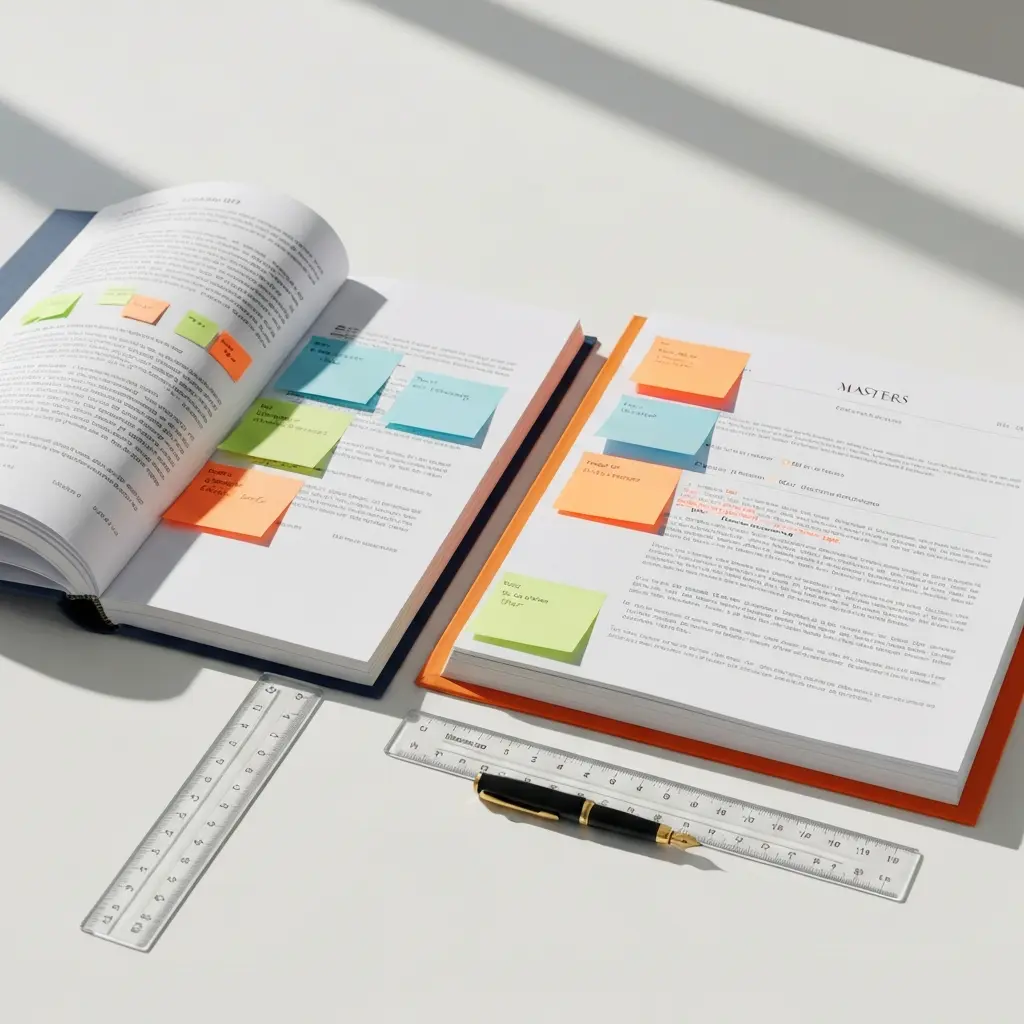
Dissertation Example: 2026 Annotated Walkthrough (PhD + Masters)
Finding a strong dissertation example is one of the most effective ways to understand what a finished, examiner-approved document actually looks like. You can read every writing guide available and still feel uncertain — until you see a real structure laid out in front of you, section by section, with commentary explaining why each decision was made. That is exactly what this page delivers: two synthesised, fully annotated dissertation examples — one PhD-level (quantitative, approximately 80,000 words) and one Masters-level (mixed-methods, approximately 20,000 words) — each broken down from title page to bibliography.
Both examples are synthesised composites modelled on successfully examined dissertations in their respective disciplines. They are clearly labelled as such throughout. The purpose is not to provide a template to copy — your institution’s requirements and your own research will always dictate your final structure — but to show you what good looks like and give you a concrete reference point at every stage of writing.
PhD Dissertation Example: Quantitative (~80,000 Words)
Synthesised example — social psychology, UK Russell Group university. Clearly labelled as a composite for illustrative purposes.
Title Page
Examining the Relationship Between Social Media Use Intensity and Anxiety Trajectories in UK University Students: A Four-Wave Longitudinal Study
Submitted by: [Candidate Name]
Department of Psychology, [University Name]
Thesis submitted for the degree of Doctor of Philosophy
Academic Year 2025–2026
Word Count: 79,840
Why it works: The title contains the research topic (social media use, anxiety), the population (UK university students), the design (four-wave longitudinal), and signals the scope (full PhD study). It is specific enough to communicate expertise without being so long it becomes unwieldy. The word count is stated upfront — many UK institutions require this on the title page itself.
Abstract (300–500 words)
“This thesis investigates the longitudinal relationship between passive social media use intensity and anxiety symptom trajectories among first-year university students (N = 847) over a 12-month period. Using a four-wave panel design, data were collected at matriculation (T1), end of first semester (T2), end of second semester (T3), and one year after enrolment (T4). Growth curve modelling revealed that students in the highest tertile of passive use at T1 showed significantly steeper anxiety trajectories across the study period (β = 0.34, p < .001) compared to low-use counterparts, after controlling for pre-existing anxiety, academic stress, and social support. Active use showed no significant independent relationship with anxiety trajectories. These findings extend passive-active use theory to a UK higher education context and have implications for university mental health services and digital wellbeing interventions.”
Why it works: This abstract follows the standard IMRaD summary structure: context → participants → design → key finding → significance. It includes the sample size (N = 847), the statistical method (growth curve modelling), a specific result with effect size, and a brief statement of contribution. Examiners and future researchers can evaluate relevance in under two minutes.
Introduction (5,000–7,000 words)
The introduction opens with a hook grounded in current data — a 2024 NHS Digital figure showing that 26% of UK university students report clinically significant anxiety — before narrowing to the specific gap: most existing research is cross-sectional, and most studies conflate passive and active social media use. The chapter closes with four clearly numbered research questions and a chapter-by-chapter roadmap of the thesis.
Why it works: The funnel structure (broad context → specific problem → gap → research questions) is the gold standard for PhD introductions. The research questions are written as questions, not statements, making them testable. The roadmap at the end is not padding — for an 80k-word document, examiners need an orientation map.
Literature Review (15,000–20,000 words)
Organised thematically rather than chronologically across five sections: (1) theories of social comparison online, (2) passive vs. active use — the conceptual debate, (3) anxiety and higher education transition, (4) longitudinal studies in digital psychology (critique of methodological limitations), (5) UK-specific context. Each section ends with a brief synthesis paragraph identifying the gap this thesis addresses.
Why it works: The literature review does not summarise papers one by one. It synthesises them into a coherent argument. The five-theme structure shows the examiner that the candidate understands the field’s architecture, not just its contents. The critique of prior longitudinal studies directly justifies the current study’s four-wave design.
Methodology (10,000–12,000 words)
Chapter 3 opens with a philosophical justification (post-positivist paradigm, ontological realism) before specifying the quantitative longitudinal design. It covers: sampling strategy (stratified random sample from four UK universities), instruments (Bergen Social Media Addiction Scale adapted for passive use; GAD-7 for anxiety), data collection procedures, ethical approval (reference included), and analytic strategy (growth curve modelling in R, with a subsection on model selection criteria).
Why it works: The philosophical preamble is not navel-gazing — it anchors all subsequent design decisions. A PhD examiner will ask “why this design over a qualitative approach?” The methodology chapter should answer that question before it is asked. Including the R code structure in an appendix (referenced here) shows transparency and reproducibility.
Findings (12,000–15,000 words)
Results are reported without interpretation, following APA 7 conventions. Key tables show descriptive statistics by time point, correlation matrices, and the growth curve model outputs. Each figure caption is self-contained. The chapter ends with a brief summary paragraph recapping which hypotheses were supported.
Why it works: Keeping findings and discussion separate is a PhD convention — it demonstrates that the candidate can distinguish between what the data shows and what it means. Examiners can read the findings independently and form their own interpretation before reading the discussion.
Discussion (12,000–15,000 words)
The discussion opens by restating the research questions and providing a one-sentence answer to each. It then works through the findings in order, connecting each back to specific theories and prior studies from the literature review. A standalone “Limitations” section (1,500 words) addresses attrition across waves, self-report bias, and platform heterogeneity. The chapter ends with a “Theoretical Contributions” subsection and a “Practical Implications” subsection targeting university counselling services.
Why it works: The mirror structure — discussion tracks the order of findings — makes the chapter easy to examine. The limitations section is candid rather than defensive; examiners respect intellectual honesty. The two-part ending (theory + practice) is required by most UK PhD programmes and shows the candidate has thought beyond the ivory tower.
Conclusion (3,000–5,000 words)
The conclusion synthesises the thesis’s contribution in three paragraphs, answers the overarching research question, and ends with a “Future Research Directions” section pointing to four specific follow-up studies this work makes possible.
Why it works: The conclusion is not a summary of the discussion. It zooms out to the level of the research questions and the field. The future research section demonstrates that the candidate sees their work as part of an ongoing scholarly conversation, not a terminal project.
Bibliography
265 references formatted in APA 7. All in-text citations have a corresponding entry; no entries without a citation. DOIs included for all journal articles.
Masters Dissertation Example: Mixed-Methods (~20,000 Words)
Synthesised example — Education Studies, post-92 UK university. Clearly labelled as a composite for illustrative purposes.
Title Page
Teacher Perceptions of AI Writing Tools in Secondary Classrooms: A Mixed-Methods Study
Submitted by: [Candidate Name]
Faculty of Education, [University Name]
Dissertation submitted in partial fulfilment of MA Education
Academic Year 2025–2026
Word Count: 19,874
Why it works: Masters titles are typically shorter than PhD titles. This one gives the topic (AI writing tools), the population (secondary school teachers), the method (mixed-methods), and the level (MA). The phrase “partial fulfilment” is standard UK wording for taught Masters programmes.
Abstract (150–250 words)
“This dissertation examines how secondary school teachers in England perceive AI writing tools following the widespread adoption of generative AI in 2023–2024. Using a sequential explanatory mixed-methods design, an online survey (n = 112) was followed by semi-structured interviews (n = 12). Quantitative findings indicate that 67% of respondents believe AI tools pose a moderate-to-high risk to student writing development, while qualitative themes reveal three distinct teacher archetypes: Resisters, Pragmatists, and Integrators. Findings suggest that current professional development provision is insufficient to support teachers in forming evidence-based positions on AI in their classrooms. Implications for initial teacher education and CPD policy are discussed.”
Why it works: At Masters level, a 200-word abstract is sufficient. This one presents the design (sequential explanatory mixed-methods), both strands of data (survey n = 112 + interviews n = 12), a headline quantitative finding (67%), a qualitative contribution (three archetypes), and a policy implication. It does not pad with background context — that is the introduction’s job.
Introduction (1,500–2,500 words)
The introduction contextualises the problem with reference to the 2023 DfE AI in education framework and reports from Ofsted on generative AI use in UK schools. It identifies the gap: studies have examined student AI use extensively, but teacher perception research in secondary UK contexts remains scarce as of 2026. Three research objectives are listed as bullet points, followed by a brief chapter overview.
Why it works: For a 20,000-word dissertation, the introduction does not need to be exhaustive — 2,000 words is appropriate. Research objectives (rather than research questions) signal a more exploratory, applied orientation appropriate for a taught Masters in Education.
Literature Review (4,000–5,000 words)
Structured in three sections: (1) AI writing tools — what they are and how they work, (2) teacher perceptions of technology adoption — theoretical frameworks (TAM, TPACK), (3) AI in education — current evidence and gaps. Each section is three to five paragraphs with synthesis sentences connecting the themes.
Why it works: At Masters level, the literature review establishes that the candidate understands the field rather than makes an original contribution to it. The use of established theoretical frameworks (TAM, TPACK) shows methodological literacy. The three-section structure keeps a 4,500-word chapter focused and examiner-friendly.
Methodology (2,500–3,500 words)
Justifies the sequential explanatory design: the survey maps the landscape quantitatively, then the interviews explain the patterns. Ethical considerations cover anonymity, data storage (GDPR-compliant), and informed consent. The sampling section explains the purposive selection of interview participants based on survey response patterns (selecting respondents from each of the three score bands identified in the survey).
Why it works: The integration rationale — explaining why the qualitative strand was added after, not alongside, the quantitative strand — is the most important sentence in a mixed-methods methodology chapter. This example makes it explicit, which is a common weakness in student dissertations.
Findings (4,000–5,000 words)
Divided into two subsections: quantitative findings (descriptive statistics, cross-tabulations by school type and years of experience) and qualitative findings (three themes with illustrative quotes, participant codes used throughout for anonymity). An integration section at the end of the chapter explains how the two strands relate.
Why it works: The integration section is what distinguishes a genuine mixed-methods study from two parallel mono-method studies stuck together. Presenting both strands in one chapter — rather than separate chapters — is the recommended approach for a 20,000-word dissertation where word count is at a premium.
Discussion and Conclusion (3,000–4,000 words)
At Masters level, discussion and conclusion are often combined. This chapter connects the three archetypes to the TAM framework, discusses policy implications for the DfE and school leaders, acknowledges limitations (non-probability sampling, single-region focus), and closes with three specific recommendations for future research.
Why it works: Combining discussion and conclusion is appropriate — even preferred — when the dissertation is under 25,000 words. The policy recommendations show applied thinking valued in an Education Masters. The limitations paragraph is honest without being self-defeating.
Bibliography
68 references in APA 7. All primary sources; no tertiary sources such as textbook summaries of original studies.
Section-by-Section Breakdown: What Every Chapter Must Do
Across both dissertation examples, every section performs a specific function. Understanding these functions helps you evaluate your own draft objectively. See the complete structural logic in our thesis structure guide.
| Section | Core Function | PhD Word Count | Masters Word Count |
|---|---|---|---|
| Title Page | Identify topic, level, institution, year | N/A | N/A |
| Abstract | Sell the thesis to a skimming reader in <500 words | 300–500 | 150–250 |
| Introduction | Establish problem, gap, questions, roadmap | 5,000–7,000 | 1,500–2,500 |
| Literature Review | Map the field; build the gap argument | 15,000–20,000 | 4,000–5,000 |
| Methodology | Justify every design decision | 10,000–12,000 | 2,500–3,500 |
| Findings | Report data without interpretation | 12,000–15,000 | 4,000–5,000 (combined) |
| Discussion | Interpret findings in light of literature | 12,000–15,000 | 3,000–4,000 (combined) |
| Conclusion | Answer research questions; future directions | 3,000–5,000 | Combined with discussion |
| Bibliography | Every source cited, consistently formatted | 200–300 refs | 50–100 refs |
Why These Examples Work
Both dissertation examples share four structural qualities that examiners consistently reward:
- Coherence across chapters. The gap identified in the introduction is the gap the literature review builds toward. The methodology directly addresses that gap. The discussion connects back to it. Every chapter speaks to the same central problem.
- Justified design decisions. Neither example assumes the reader will accept any methodological choice as self-evident. Every decision — from the use of growth curve modelling to the sequential mixed-methods design — is explained in terms of what it enables that alternatives would not.
- Honest limitations. Both examples include limitations sections that go beyond boilerplate (“future research could use a larger sample”). They identify specific threats to validity and explain why they were accepted rather than eliminated.
- Disciplinary conventions observed. The PhD example uses quantitative APA conventions (effect sizes, p-values, table formatting). The Masters example respects the discourse norms of Education Studies. You should always check your department’s preferred style guide — see our complete thesis writing guide for a full overview.
Common Mistakes in Each Section
Studying a dissertation example is most valuable when you know what failure looks like alongside success. These are the issues examiners flag most often, drawn from viva feedback reports and internal examiner guidelines across UK universities.
Introduction
- Vague research questions. “This thesis explores social media” is not a research question. Use “To what extent does passive social media use predict anxiety trajectories over 12 months?” — a question with a definable answer.
- No gap statement. Many introductions describe the field but never articulate what is missing. The gap is the whole reason the dissertation exists.
Literature Review
- Annotation rather than synthesis. A literature review is not an annotated bibliography. “Smith (2021) found X. Jones (2022) found Y. Brown (2023) found Z” is annotation. “Three studies found X, though all used cross-sectional designs that preclude causal inference” is synthesis.
- Missing critical engagement. Reporting what studies found without evaluating their methodological quality signals intellectual passivity. See our literature review guide for how to critique sources effectively.
Methodology
- Describing without justifying. “A survey was administered” describes. “A survey was chosen over interviews because the goal was to map the landscape quantitatively before identifying explanatory patterns” justifies.
- Absent ethical section. Ethics is not a formality. For any study involving human participants, the ethics section must address consent, data storage, and the right to withdraw.
Discussion
- Repeating findings instead of interpreting them. The discussion should begin “These findings suggest…” not “As shown in Chapter 4…”
- Ignoring non-significant results. If a hypothesis was not supported, the discussion must address why. Non-findings are findings.
Tools like Tesify can help you structure and review your draft against these criteria — providing targeted feedback on argument coherence, section transitions, and structural gaps before you submit.
Word Count and Structure at a Glance
| Level | Typical Total | Chapter Count | Key Requirement |
|---|---|---|---|
| Undergraduate | 8,000–12,000 | 5–6 | Demonstrated research competence |
| Masters | 15,000–25,000 | 5–7 | Independent research design & execution |
| PhD | 70,000–100,000 | 7–10 | Original contribution to knowledge |
For further reading on structuring individual chapters, see our guides on writing a thesis introduction step by step and how to do a literature review.
Frequently Asked Questions
What is a good dissertation example?
A good dissertation example demonstrates a clear research problem, a justified methodology, systematic data collection, and findings that directly answer the research questions. It also follows its institution’s formatting requirements and maintains an academic tone throughout. The best examples also show intellectual honesty in their limitations sections.
How long is a PhD dissertation?
Most PhD dissertations range from 70,000 to 100,000 words, with STEM disciplines typically at the lower end (70–80k) and humanities at the upper end (90–100k). Always check your university’s specific word limit requirements — some institutions set hard caps and others provide guidance ranges.
How long is a Masters dissertation?
A Masters dissertation is typically 15,000 to 25,000 words for a research-based degree. Taught Masters dissertations may be shorter (10,000–15,000 words). The exact requirement depends on your programme and institution — always confirm with your supervisor before you start writing.
What is the difference between a dissertation and a thesis?
In UK usage, a thesis usually refers to a PhD-level document and a dissertation to Masters or undergraduate work. In US usage the terms are often reversed — a thesis is Masters-level and a dissertation is PhD-level. Both describe an extended, independently researched academic document submitted for a degree.
Can I use a dissertation example as a template?
You can use a dissertation example to understand structure, formatting, and academic conventions, but you must never copy text — that is plagiarism. Use examples to benchmark quality and learn how experienced researchers frame arguments, then apply those structural lessons to your own original work.
Where can I find real dissertation examples?
Your university library is the best starting point — most institutions have a repository of past dissertations accessible to enrolled students. ProQuest Dissertations & Theses, EThOS (UK), and DART-Europe are open-access databases with thousands of searchable examples across every discipline.
Do PhD and Masters dissertations need different structures?
The core sequence (introduction → literature review → methodology → findings → discussion → conclusion) is the same at both levels. The main difference is depth and the requirement for originality: a PhD must make an original contribution to knowledge, while a Masters must demonstrate research competence and the ability to apply established methods independently.
Write Your Dissertation with Confidence
Studying examples is step one. The harder step is applying those lessons to your own topic, your own data, and your supervisor’s expectations. Tesify gives you AI-powered structural feedback on your draft — flagging where your argument loses coherence, where your literature review slides into annotation, and where your methodology chapter needs a stronger justification. Start your free review today and submit a dissertation that reads like it was written by someone who has done it before.
Write your thesis with AI
Structure, draft, cite, and format your thesis faster with Tesify’s AI writing tools, automatic bibliography, and plagiarism checker. Free to start, no credit card required.






Leave a Reply