
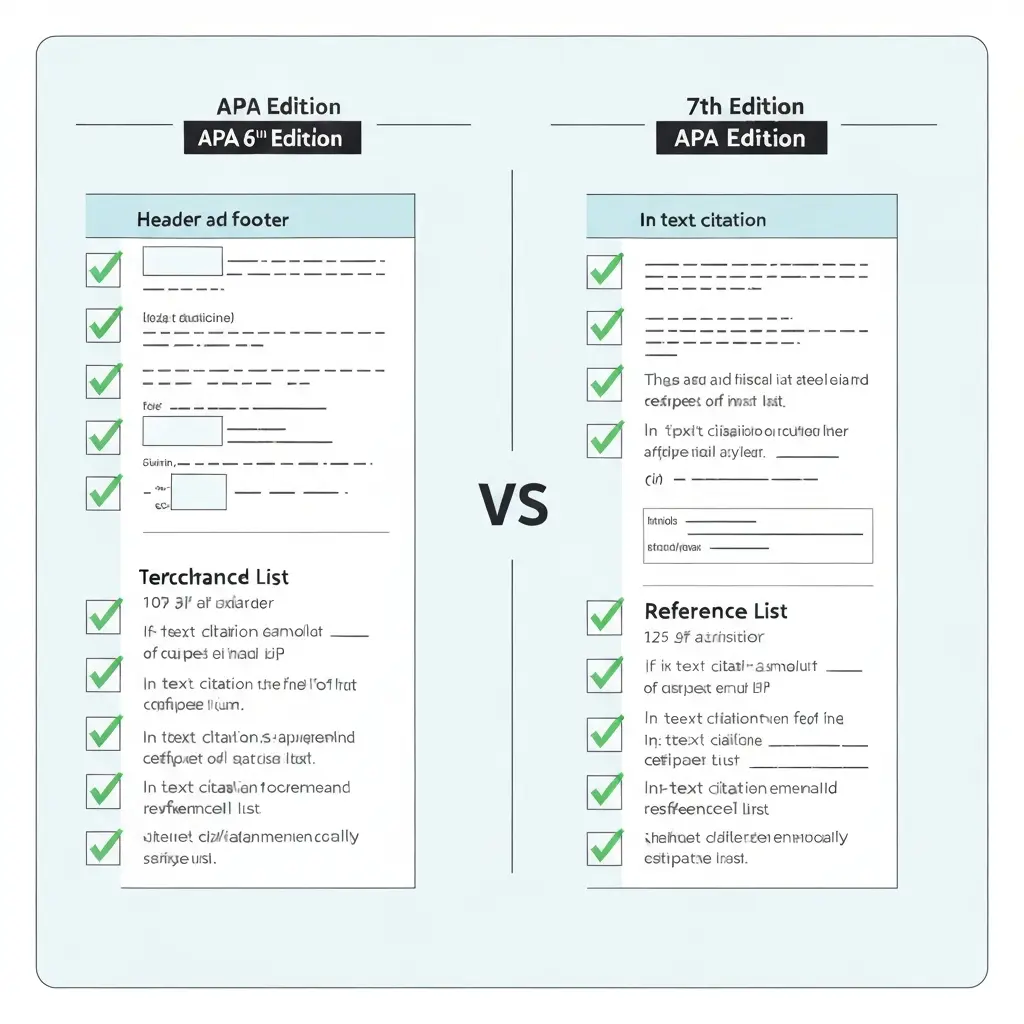
APA 7th Edition: Every Change You Need to Know (Updated 2026)
If you learned APA formatting in college before 2020, your mental rulebook has expired. The APA format 7th edition — published by the American Psychological Association in October 2019 and effective from 2020 — introduced 12 substantive changes that affect how you format papers, cite sources, list references, and even choose your words. Whether you are converting an old draft or starting fresh, this guide walks you through every change with concrete before-and-after examples.
What Changed in APA 7th Edition: Summary of 12 Key Changes
The 7th edition is the most comprehensive revision since the APA manual was first published in 1929. Here are all twelve substantive changes at a glance, before we examine each one in depth.
- Et al. rule — applies from 3 authors (not 6) in in-text citations, from the very first citation
- Publisher location removed — city and country/state are no longer included in book references
- DOI format standardised — presented as a hyperlink (
https://doi.org/xxxxx), no “DOI:” label - Running head simplified — removed entirely for student papers; required only on professional papers
- Author limit raised to 20 — list up to 20 authors before using an ellipsis; was 7 in the 6th edition
- Two title page formats — separate student and professional paper templates with different required fields
- Font flexibility — five acceptable fonts; Times New Roman 12pt is no longer the only option
- Heading levels 3–5 reformatted — all five levels now use title case; levels 3–5 no longer indented as in 6th edition
- Inclusive language guidelines expanded — singular “they” endorsed; extensive person-first and identity-affirming language guidance
- Tables and figures unified — both now follow the same structure: number above, title below number, notes below body
- Figures now require titles — previously only tables required titles; figures now match table formatting exactly
- References label bolded — the word “References” at the top of the reference list is now bold and centred
Each of these changes is explained with a before/after example in the sections below. For a complete introduction to the full system, see our APA citation format guide.
Et Al. Rule Changes
This is the change that catches most students off guard. In APA 6th edition, you wrote out all author names up to five authors in the first in-text citation, and only switched to “et al.” from the second citation onward. For six or more authors, “et al.” applied from the first citation. The 7th edition collapsed this into a single, simpler rule.
The New Rule
Three or more authors: use “et al.” from the very first in-text citation — no exceptions (unless doing so creates ambiguity with another citation).
Before and After Examples
| Scenario | APA 6th Edition | APA 7th Edition |
|---|---|---|
| 3 authors — first citation | Smith, Jones, and Brown (2018) | Smith et al. (2018) |
| 3 authors — subsequent citation | Smith et al. (2018) | Smith et al. (2018) |
| 5 authors — first citation | Smith, Jones, Brown, Davis, and Wilson (2018) | Smith et al. (2018) |
| 2 authors — first citation | Smith and Jones (2018) | Smith and Jones (2018) — unchanged |
Ambiguity Exception
If two cited works have the same first author and the same year, and both would shorten to the same “Author et al. (Year)” form, you must include enough additional names to distinguish them. For example:
- Smith, Jones, Brown, and Davis (2019) → Smith, Jones, et al. (2019)
- Smith, Jones, Wilson, and Lee (2019) → Smith, Jones, et al. (2019) — still ambiguous, so extend further
In practice, add as many names as needed until the two citations are distinguishable, then append “et al.”
Publisher Location Removed
APA 6th edition required you to include the city and country (or US state abbreviation) before the publisher name in book references. APA 7th edition removes this entirely — a welcome simplification that also reflects the increasingly global and digital nature of academic publishing.
Before and After
APA 6th:
Brown, J. D. (2015). Research methods in applied linguistics. Oxford, UK: Oxford University Press.
APA 7th:
Brown, J. D. (2015). Research methods in applied linguistics. Oxford University Press.
The rule applies to all book types: monographs, edited volumes, textbooks, and translated works. For chapters in edited books, remove the location from the publisher information in the same way.
DOI Format Standardised
In APA 6th edition, a DOI was formatted with the label “doi:” followed by the identifier string (e.g., doi:10.1037/0000165-000). In some style guides the full URL form was used; in others, just the string. This inconsistency is resolved in the 7th edition.
The New Rule
- Always present DOIs as full hyperlinks:
https://doi.org/10.xxxx/xxxxx - Remove the “doi:” or “DOI:” label entirely
- Remove “Retrieved from” before URLs unless a retrieval date is also needed
- If a source has both a DOI and a URL, use only the DOI
APA 6th:
doi:10.1037/0000165-000
APA 7th:
https://doi.org/10.1037/0000165-000
For sources without a DOI, include the URL of the journal homepage or database landing page — not the direct PDF link. The “Retrieved from” phrase is dropped unless the source content changes over time (e.g., a wiki or a report that is regularly updated), in which case a retrieval date is added.
Running Head Simplified
The running head was one of the most confusing requirements in APA 6th edition. It required a shortened version of the paper title (all caps, max 50 characters) to appear in the header of every page, preceded by the label “Running head:” on the title page only. The 7th edition cuts this requirement significantly.
The New Rule
- Student papers: no running head at all — remove it entirely
- Professional papers (submitted for publication): include a running head on every page, but drop the “Running head:” label — just the title in caps, left-aligned, up to 50 characters
APA 6th (title page header):
Running head: SOCIAL MEDIA AND STUDENT WELLBEING
APA 6th (all other pages):
SOCIAL MEDIA AND STUDENT WELLBEING
APA 7th (student paper):
[No running head]
APA 7th (professional paper, all pages):
SOCIAL MEDIA AND STUDENT WELLBEING
When writing your thesis abstract and title page, check with your institution first — some universities impose their own running head requirements that override APA defaults.
Author Limits Expanded to 20
APA 6th edition allowed a maximum of seven author names in a reference list entry. If a source had eight or more authors, you listed the first six, inserted an ellipsis (…), and then added the final author. The 7th edition raises this threshold to 20.
The New Rule
- Up to 20 authors: list all names in full
- 21 or more authors: list the first 19, insert an ellipsis (…), then list the final author’s name
APA 6th (8-author source):
Smith, A., Jones, B., Brown, C., Davis, D., Wilson, E., Lee, F., … Taylor, H. (2017).
APA 7th (8-author source):
Smith, A., Jones, B., Brown, C., Davis, D., Wilson, E., Lee, F., Martinez, G., & Taylor, H. (2017).
This change is particularly relevant in STEM fields where papers routinely list dozens of co-authors. The 21st author (and beyond) is represented by the final listed name after the ellipsis, ensuring the last author’s contribution is always credited.
Two Title Page Formats
APA 6th edition had one title page format. The 7th edition introduces two distinct templates: one for student papers and one for professional manuscripts being submitted for publication.
Student Paper Title Page (Required Fields)
- Paper title (bold, centred, 3–4 lines down from the top)
- Author name(s)
- Department and institution affiliation
- Course number and name
- Instructor name
- Assignment due date
- Page number (top right)
No running head. No author note.
Professional Paper Title Page (Required Fields)
- Paper title (bold, centred)
- Author name(s)
- Institutional affiliation(s)
- Author note (ORCID iDs, acknowledgements, contact information)
- Running head (shortened title, all caps, max 50 characters) — left-aligned in header
- Page number (top right)
For most students writing a thesis or coursework paper, the student template applies. The professional template is used when submitting to a journal. Your dissertation methodology chapter and other sections follow the same formatting rules as the rest of the student paper.
Font Flexibility
APA 6th edition effectively mandated Times New Roman 12pt. The 7th edition accepts five fonts, acknowledging that accessibility and readability vary by display medium.
Acceptable Fonts in APA 7th Edition
| Font | Size | Use Case |
|---|---|---|
| Times New Roman | 12pt | Traditional, widely accepted |
| Calibri | 11pt | Modern, clean, good for digital |
| Arial | 11pt | Accessible, good contrast on screen |
| Georgia | 11pt | Readable serif for digital reading |
| Lucida Sans Unicode | 10pt | Wide character support |
One important rule: whichever font you choose, use it consistently throughout the entire paper — body text, headings, references, figure captions, and all. Do not mix fonts. When in doubt, check your institution’s submission guidelines; many still specify Times New Roman 12pt explicitly.
Inclusive Language Guidelines
The 7th edition devotes an entire chapter to bias-free and inclusive language — a significant expansion of the brief guidance in the 6th edition. These are not optional style preferences; they are part of APA standards.
Singular “They”
APA 7th edition officially endorses singular “they” as a gender-neutral third-person pronoun for individuals whose gender is unknown, irrelevant, or who use “they/them” pronouns.
APA 6th (workaround): “Each participant completed his or her survey.”
APA 7th: “Each participant completed their survey.”
Person-First Language
Put the person before the condition or characteristic. Avoid using adjectives as nouns to describe groups of people.
Avoid: “the diabetics in the study,” “the schizophrenics,” “the poor”
Prefer: “participants with diabetes,” “people diagnosed with schizophrenia,” “people living in poverty”
Age, Race, and Disability Language
- Age: Use specific age ranges rather than vague terms. Prefer “adults aged 65–80” over “the elderly.” Avoid “senior citizens” in formal academic writing.
- Race and ethnicity: Capitalise racial and ethnic group names (Black, White, Indigenous, Latino). Avoid “minority” as a standalone noun; use “racially marginalised groups” or the specific group name.
- Disability: Follow the preference of the community being described. Many disability communities prefer identity-first language (“autistic person”) while others prefer person-first (“person with autism”). When uncertain, use person-first as the default.
For research that directly measures or examines population characteristics relating to research methodology, these language choices should also be reflected in your methods section when describing participants.
Tables and Figures Unified Format
APA 6th edition had separate formatting conventions for tables (which required titles) and figures (which used captions placed below the image). The 7th edition unifies these: both tables and figures now follow the same four-part structure.
The Unified Structure
- Number — bold, above the element (e.g., Table 1 or Figure 1), left-aligned
- Title — one double-spaced line below the number; italic title case; brief and descriptive
- Body — the table data or figure image itself
- Note — begins with the word Note. in italics, followed by a period; contains general notes, specific notes, and probability notes
APA 6th Figure caption (below image):
Figure 1. Percentage of participants reporting high stress levels by year.
APA 7th Figure (title above, note below):
Figure 1
Percentage of Participants Reporting High Stress Levels by Year
[figure image]
Note. Data from the Annual Student Wellbeing Survey (Smith et al., 2022).
You may now also embed tables and figures within the body text, near the first mention of them — rather than placing them all at the end of the paper. This is the preferred format for student papers; end-of-paper placement remains acceptable for professional manuscripts submitted to journals.
How to Update an APA 6th Paper to 7th Edition
If you have an existing paper written in APA 6th edition, here is a systematic checklist for converting it to the 7th edition. Work through these in order to avoid missing anything.
Title Page
- Remove the running head from the header (student paper) or remove the “Running head:” label (professional paper)
- Add course name, course number, instructor name, and due date (student paper)
- Bold the paper title
In-Text Citations
- Find every citation with 3 or more authors and shorten to “First Author et al.” from the first occurrence
- Check for ambiguous et al. citations and extend as needed
Reference List
- Bold the “References” heading
- Remove publisher locations from all book entries
- Convert all DOIs to full hyperlink format:
https://doi.org/xxxxx— remove “doi:” label - Remove “Retrieved from” before URLs (unless a retrieval date is needed)
- Expand author lists: entries with 8–20 authors should now list all names
- For entries with 21+ authors: keep 19, add ellipsis, add final author
Headings
- Convert heading levels 3, 4, and 5 to the new format (title case, different indentation rules)
- Ensure all five heading levels use title case
Tables and Figures
- Move figure captions from below the image to above (as titles), following the figure number
- Reformat figure labels to bold (e.g., Figure 1)
- Convert any “Figure X.” labels to “Figure X” (no period after the number)
- Reformat notes to start with italicised Note.
Language
- Replace “he or she” / “his or her” with “they” / “their” where gender is unknown
- Review group descriptors: convert adjectival group labels to person-first noun phrases
Font
- If you used Times New Roman 12pt, no change needed — it remains acceptable
- If switching fonts, change consistently throughout the entire document
Side-by-Side Formatting Comparison: APA 6th vs 7th Edition
Use this reference table to check any formatting rule at a glance.
| Element | APA 6th Edition | APA 7th Edition |
|---|---|---|
| Et al. threshold | 6+ authors; after 1st citation for 3–5 authors | 3+ authors, always from 1st citation |
| Max authors in reference | 7 (then ellipsis + last author) | 20 (then ellipsis + last author) |
| Running head (student) | Required (with “Running head:” on title page) | Not required |
| Publisher location | Required (City, State/Country: Publisher) | Omitted entirely |
| DOI format | doi:10.xxxx/xxxxx | https://doi.org/10.xxxx/xxxxx |
| Title page | One format (institutional) | Two formats: student and professional |
| Accepted fonts | Times New Roman 12pt (standard) | 5 fonts: TNR 12, Calibri 11, Arial 11, Georgia 11, Lucida 10 |
| Figure titles | Caption below image; no title above | Number + title above image; note below |
| “References” label | Centred, not bold | Centred and bold |
| Singular “they” | Not endorsed | Officially endorsed |
| Table/figure placement | End of paper only | In-text (near first mention) or end of paper |
| “Retrieved from” | Required before most URLs | Only when a retrieval date is also needed |
Frequently Asked Questions
Is APA 7th edition still current in 2026?
Yes. APA 7th edition, published in October 2019, remains the current and authoritative edition as of 2026. The APA has not announced a new edition. All academic journals and universities that require APA style use the 7th edition. If you are starting a new paper or updating an old one, use APA 7th edition rules.
When did APA 7th edition replace the 6th edition?
The 7th edition of the Publication Manual of the American Psychological Association was published on 1 October 2019 and came into full effect in 2020. Most universities and journals transitioned to the 7th edition during the 2019–2020 academic year. If you began a paper before 2020 under 6th edition guidelines, you should convert it to 7th edition before submission.
Do I need a running head in APA 7th edition?
It depends on your paper type. For student papers (coursework, theses, dissertations), you do not include a running head in APA 7th edition. For professional papers being submitted to a journal for publication, you do include a running head — but without the old “Running head:” label. Just the shortened title in all capitals, left-aligned in the header of every page.
How many authors do I list before using et al. in APA 7th edition?
In APA 7th edition in-text citations, use “et al.” for any source with three or more authors — and apply it from the very first citation. You never write out all three or more names. In the reference list, however, list all authors up to 20 names in full. Only use an ellipsis for sources with 21 or more authors (list the first 19, add “…”, then add the final author’s name).
Does APA 7th edition require a DOI?
You should include a DOI whenever one is available. In APA 7th edition, the DOI is formatted as a full hyperlink: https://doi.org/10.xxxx/xxxxx. There is no “doi:” or “DOI:” label. If a source does not have a DOI, include the URL of the journal or publisher webpage. If a source has both a DOI and a URL, include only the DOI — it takes precedence.
What fonts are acceptable in APA 7th edition?
APA 7th edition accepts five fonts: Times New Roman 12pt, Calibri 11pt, Arial 11pt, Georgia 11pt, and Lucida Sans Unicode 10pt. Use any one of them consistently throughout your entire paper. Times New Roman 12pt was effectively mandatory in the 6th edition; the 7th edition broadens this to reflect modern digital publishing and accessibility needs.
Where do I put the publisher location in APA 7th edition references?
Nowhere — publisher location is completely removed in APA 7th edition. In APA 6th edition, you listed the city and country (or US state abbreviation) before the publisher name (e.g., “New York, NY: Routledge”). In the 7th edition, you simply list the publisher name with no location: just “Routledge.” This applies to all book types including edited volumes and textbooks.
What changed in APA 7th edition for figures?
The biggest change for figures is that they now require a title placed above the figure — just like tables. Previously, figures used a caption placed below the image. In APA 7th edition, both tables and figures follow the same structure: bold number above, italic title below the number, the body (data or image), and then a note beginning with “Note.” in italics. Figures can also now be placed within the text near their first mention, rather than at the end of the paper.
Is singular “they” accepted in APA academic writing?
Yes, and it is actually endorsed by APA 7th edition as the preferred gender-neutral singular pronoun. Use “they/their” when referring to a person whose gender is unknown or irrelevant, or who uses “they/them” pronouns. For example: “Each student submitted their assignment on time.” This replaces the older constructions “his or her” and “he or she,” which are considered unnecessarily binary in APA 7th edition.
My university still uses APA 6th edition — what should I do?
Follow your institution’s explicit instructions. APA itself has moved to the 7th edition, but some departments, professors, or journals may still require the 6th edition. When in doubt, ask your supervisor or check the submission guidelines. If no edition is specified, default to APA 7th edition — it is the current standard. If you need to switch between editions, the side-by-side comparison table in this guide lists every affected rule.
Write Your Thesis Without the Formatting Headaches
Tesify handles APA 7th edition formatting automatically — citations, reference lists, DOIs, author limits, and bibliography generation. No more checklists, no more version confusion.
Write your thesis with AI
Structure, draft, cite, and format your thesis faster with Tesify’s AI writing tools, automatic bibliography, and plagiarism checker. Free to start, no credit card required.





Leave a Reply