
Thesis Abstract Example: Draft 200 Words in 2 Hours
Writing a thesis abstract feels disproportionately hard for something that’s only 200 words long. You’ve spent months — sometimes years — on your research, and now you’re supposed to compress it into a single paragraph? No wonder so many students stare at a blank page for hours.
Here’s the thing most students don’t realise: the abstract isn’t a summary you write after you finish. It’s a structured argument you build from five specific components. Once you know the formula, you can draft a solid 200-word thesis abstract in under two hours — no exaggeration.
This guide gives you real thesis abstract examples, a sentence-by-sentence template, and a timed two-hour drafting process. Whether you’re writing an undergraduate dissertation, a master’s thesis, or a PhD abstract, the same framework applies.
A thesis abstract should be 150–300 words covering five elements: the research problem, your aims/objectives, the methodology used, the key findings, and the main conclusion or implication. Write one to three sentences per element in that order. Use active voice, past tense for your research actions, and avoid citations or undefined abbreviations.
What Is a Thesis Abstract? Definition and Purpose
The abstract is arguably the most-read section of your entire dissertation. It appears before the introduction, before the methodology, before everything — and for most readers (including your examiners), it’s the first real impression of your research quality.
A thesis abstract is a concise, standalone summary of a dissertation or research thesis, typically 150–300 words. It states the research problem, objectives, methodology, key findings, and conclusions in a single, structured paragraph. It is read independently of the full thesis and must be self-contained and fully intelligible without reference to the wider document.
Think of it this way: a professor at a conference scans abstracts to decide which papers to read in full. Your abstract has to do the same work for your examiners, your institution’s library, and any future researcher who might cite your work.
According to the National Center for Science and Engineering Statistics (NCSES) Survey of Earned Doctorates 2023, over 55,000 research doctorates are awarded annually in the US alone. Every single one requires a well-crafted abstract deposited in institutional and national repositories. Your abstract is the public face of your research, permanently.
Descriptive vs. Informative Abstracts: Which Does Your Thesis Need?
There are technically two types of abstract. Most students only ever need one of them.
| Type | What It Includes | When It’s Used | Typical Length |
|---|---|---|---|
| Descriptive | Topic, purpose, scope — but NOT findings or conclusions | Shorter papers, book chapters, some conference abstracts | 75–150 words |
| Informative | Problem, aims, methods, findings, AND conclusions | Dissertations, theses, journal articles, research reports | 150–300 words |
| Structured | Same as informative but divided under labelled headings (Background, Methods, Results, Conclusions) | Medical, health, and some social science journals | 200–350 words |
For almost all university dissertations and theses, you need an informative abstract. It must include your actual findings — not just a promise that you investigated something.
The 5-Part Structure Every Thesis Abstract Needs
Here’s where most dissertation writing guides go wrong: they tell you what to include but not how much space each element gets. That’s why students write three sentences about their background and forget to mention their findings.
The most reliable approach is to treat each of these five components as a dedicated slot with a rough word budget:
- Research Problem / Background (25–35 words): Why does this research matter? What gap or issue prompted it?
- Aims and Objectives (25–35 words): What specifically did you set out to do or investigate?
- Methodology (35–50 words): How did you conduct the research? What design, approach, and data?
- Key Findings (40–55 words): What did you actually discover? This is the heart of the abstract.
- Conclusions and Implications (25–40 words): What do the findings mean? What’s the broader contribution or recommendation?
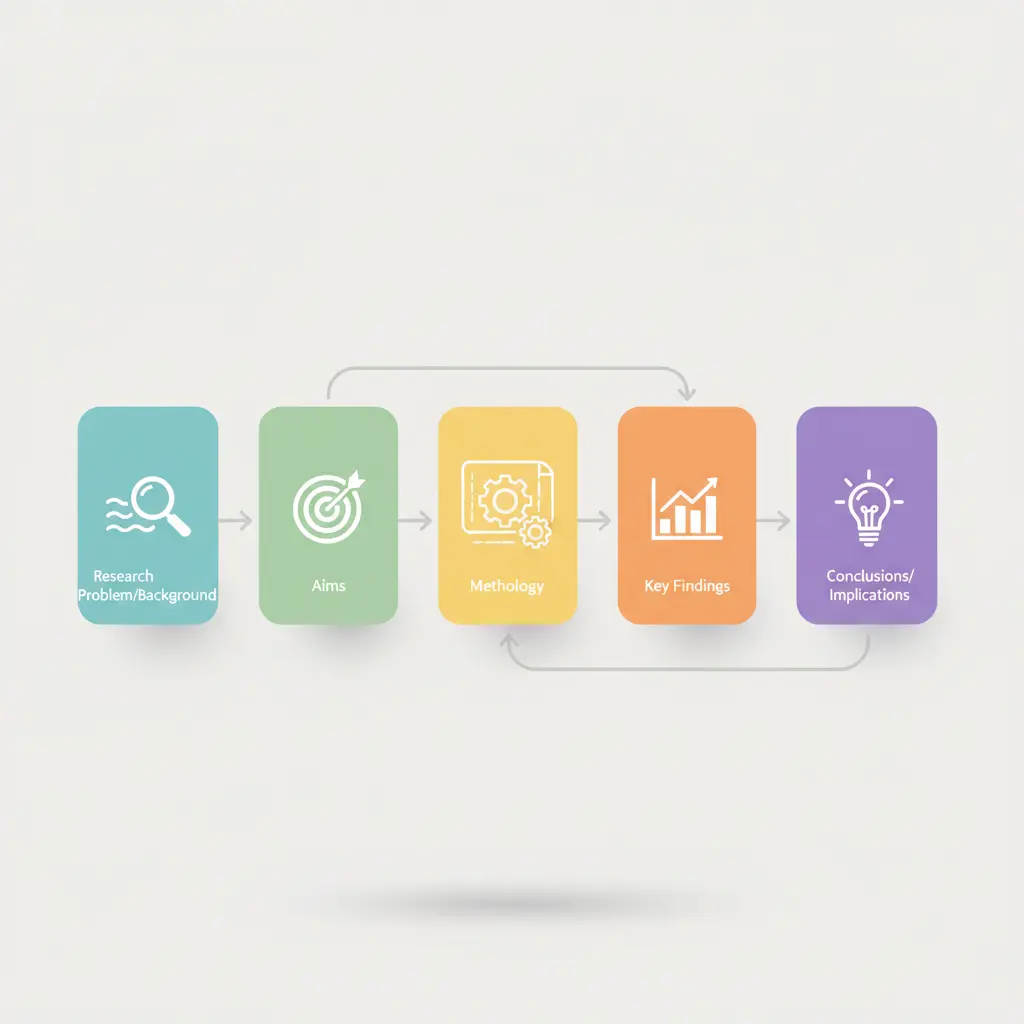
Most students under-write the findings section and over-write the background. Flip that instinct. Your examiner already knows the field context exists — they need to see what you found. Give findings the most words in your abstract.
Notice how this maps directly onto your dissertation chapters? Problem = Introduction. Aims = Introduction/Research Questions. Methodology = Methods chapter. Findings = Results chapter. Conclusions = Discussion/Conclusion chapter. If you’ve written those chapters (even roughly), you already have everything you need to draft the abstract.
For a deeper look at structuring your research design component, the Research Methodology Guide 2026 explains how to describe paradigms, sampling strategies, and data analysis approaches in just a few sentences — exactly what you need for the methodology slot in your abstract.
Sentence-by-Sentence Abstract Template
[Topic/phenomenon] poses a significant challenge in [field/context] because [reason/gap in knowledge].
[SENTENCE 2 — Aim, ~20 words]
This study aimed to [investigate/examine/explore/determine] [specific focus] in the context of [setting/population].
[SENTENCE 3-4 — Methodology, ~40 words]
A [qualitative/quantitative/mixed-methods] approach was adopted. Data were collected from [N participants/sources] using [instrument/method] and analysed through [technique, e.g., thematic analysis/regression/content analysis].
[SENTENCE 5-6 — Key Findings, ~45 words]
The findings revealed that [finding 1]. [Finding 2, with specific data point if possible]. [Finding 3 or nuance, if applicable].
[SENTENCE 7 — Conclusions/Implications, ~30 words]
These results suggest that [main conclusion]. The study contributes to [field] by [specific contribution], with implications for [practice/policy/future research].
That template will consistently land you between 155 and 210 words. It’s not the only way to write an abstract — but it’s the most reliable structure for a first draft under time pressure.
Real Thesis Abstract Examples (Annotated)
Abstract examples in textbooks are often generic. These illustrate the five-part structure across three disciplines — social science, STEM, and humanities — so you can see how the same framework adapts to different fields.
Example 1: Social Science Dissertation Abstract (Master’s Level)
Word count: 186. Notice how the findings section is the longest and includes an actual statistic. That’s not accidental — examiners and reviewers look for evidence that real data exists.
Example 2: STEM Thesis Abstract (Undergraduate Level)
Word count: 178. The STEM example uses precise numerical data throughout the findings. Even if you can’t do that (qualitative work, for instance), you should still be specific — name your themes, not just “themes emerged.”
Example 3: Humanities Dissertation Abstract (PhD Level)
Word count: 197. Humanities abstracts replace statistics with conceptual precision. The specific theoretical framework (Williams), archives used, and authors named all signal scholarly rigour without needing numerical data.
How to Write a Thesis Abstract Step-by-Step
Knowing the structure is one thing. Actually sitting down and writing it is another. Here’s the process that works — not just in theory, but when you’re staring at a deadline.
Step 1: Gather Your Source Material First
Don’t write the abstract from memory. Open these four documents before you type a single word:
- Your research questions or objectives (from your introduction)
- Your methodology section (or notes on your methods)
- Your results/findings chapter (or your key results table)
- The final paragraph of your conclusion
You’re not copying these sections — you’re mining them for the raw material you’ll compress and rewrite.
Step 2: Write One Rough Sentence Per Component
Don’t aim for perfect prose yet. Write one rough sentence for each of the five components. It will be clunky. That’s fine. You’re building a scaffold, not a finished product.
Aim for about 25–30 words per sentence at this stage. You’ll almost certainly end up with 130–150 words — slightly under target. Good. It’s easier to expand than cut.
Step 3: Expand the Findings Section
Go back to your findings. Add one more specific detail — a percentage, a theme name, a comparison that surprised you, an effect size. This is the section that separates a generic abstract from one that demonstrates real scholarly contribution.
Step 4: Tighten the Language
Read each sentence and ask: does this word earn its place? Cut prepositional clutter. Replace passive voice with active voice where possible. “The data were collected” becomes “I collected data” (or simply “Data collection involved…”). Swap “carried out an investigation into” for “investigated.”
Check your word count. If you’re over 300 words, trim background first. If you’re under 150, expand findings and implications.
Step 5: Check Against Your University’s Requirements
Word limits, tense conventions, and formatting rules vary significantly. Georgetown Graduate School’s thesis guidelines, for instance, specify distinct formatting requirements from Oxford’s Graduate School or UCL’s submission portal. Always check your specific institutional guidelines before finalising.
The 2-Hour Thesis Abstract Drafting Plan
Two hours is genuinely enough — if you’re structured about it. Here’s the exact plan, broken into focused time blocks. Set a timer for each.
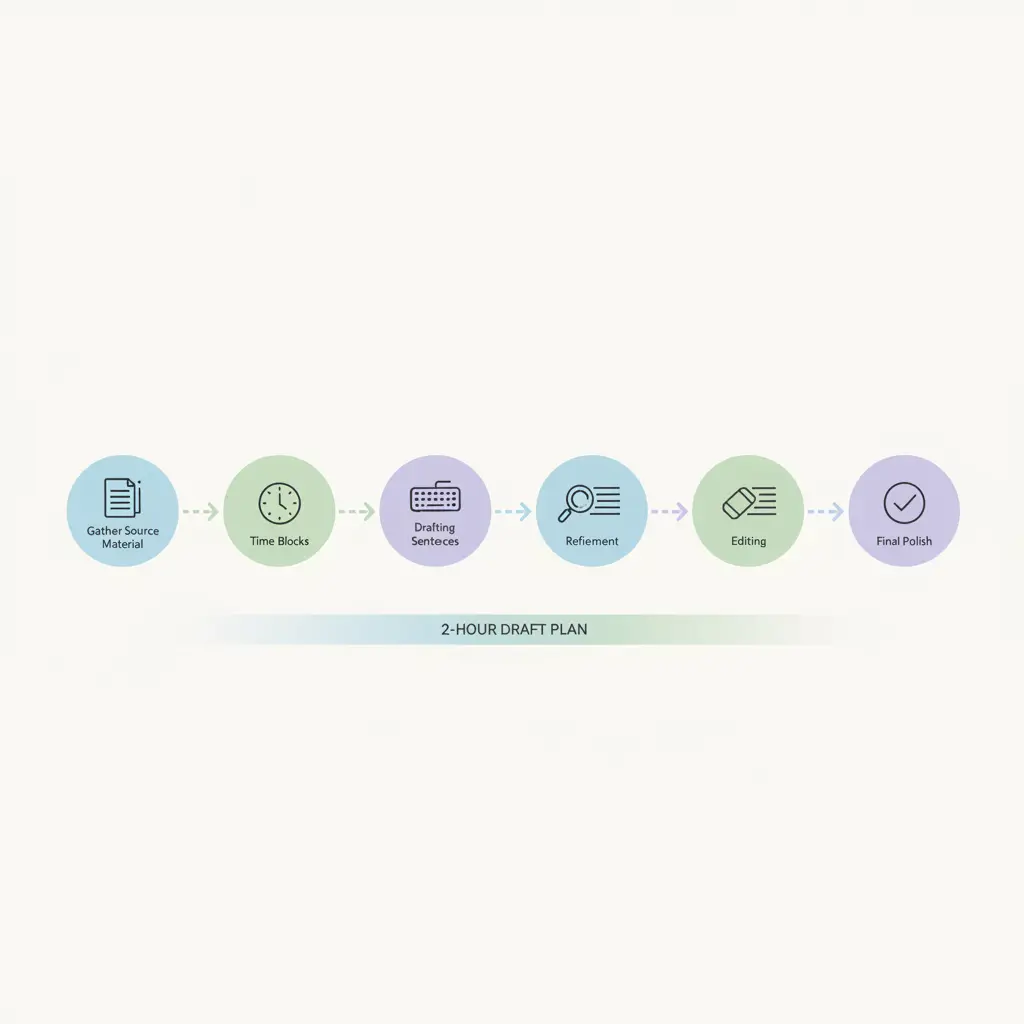
Fair warning: this takes actual focus, not passive reading. Close your email. Put your phone face-down. The two-hour plan only works if you treat those 120 minutes as protected writing time.
If you’re working on a tighter timeline for your full dissertation — not just the abstract — the guide on finishing your dissertation draft in 6 weeks uses a similar focused-session approach to break the entire document into manageable daily targets.
Abstract Word Count, Format and University Requirements
Word count limits for thesis abstracts are not suggestions. Submitting an abstract that’s 50 words over the limit at many institutions means your submission is returned for revision before it’s even assessed.
| Institution / Context | Word Limit | Format Notes |
|---|---|---|
| Oxford University (DPhil) | 300 words max | Single paragraph, no subheadings |
| UCL (PhD) | 300 words max | Bound with thesis; standalone page |
| Harvard (PhD dissertations) | 350 words max | ProQuest submission; no citations allowed |
| MIT (PhD thesis) | 350 words max | DSpace repository submission required |
| Most UK undergraduate dissertations | 150–250 words | Often optional; check module handbook |
| Most UK/US master’s dissertations | 200–300 words | Usually mandatory; single paragraph |
Abstract Placement and Formatting
The abstract page sits after the title page and before the acknowledgements (in most UK and US conventions). It should carry the heading “Abstract” — not “Executive Summary,” not “Overview.”
Standard formatting rules across most institutions:
- Single paragraph (no subheadings, no bullet points)
- Double-spaced or 1.5-spaced (follow your institution’s style guide)
- No citations or references
- No figures, tables, or images
- Abbreviations defined on first use only
- Keywords listed below (usually 4–6), if required by your department
If you’re using LaTeX for thesis formatting, the University of Minnesota thesis template on Overleaf includes a properly formatted abstract environment that handles placement and styling automatically.
7 Common Abstract Mistakes (and How to Fix Them)
These aren’t hypothetical errors. They’re the ones that consistently appear in first-draft abstracts, and they’re fixable once you know what to look for.
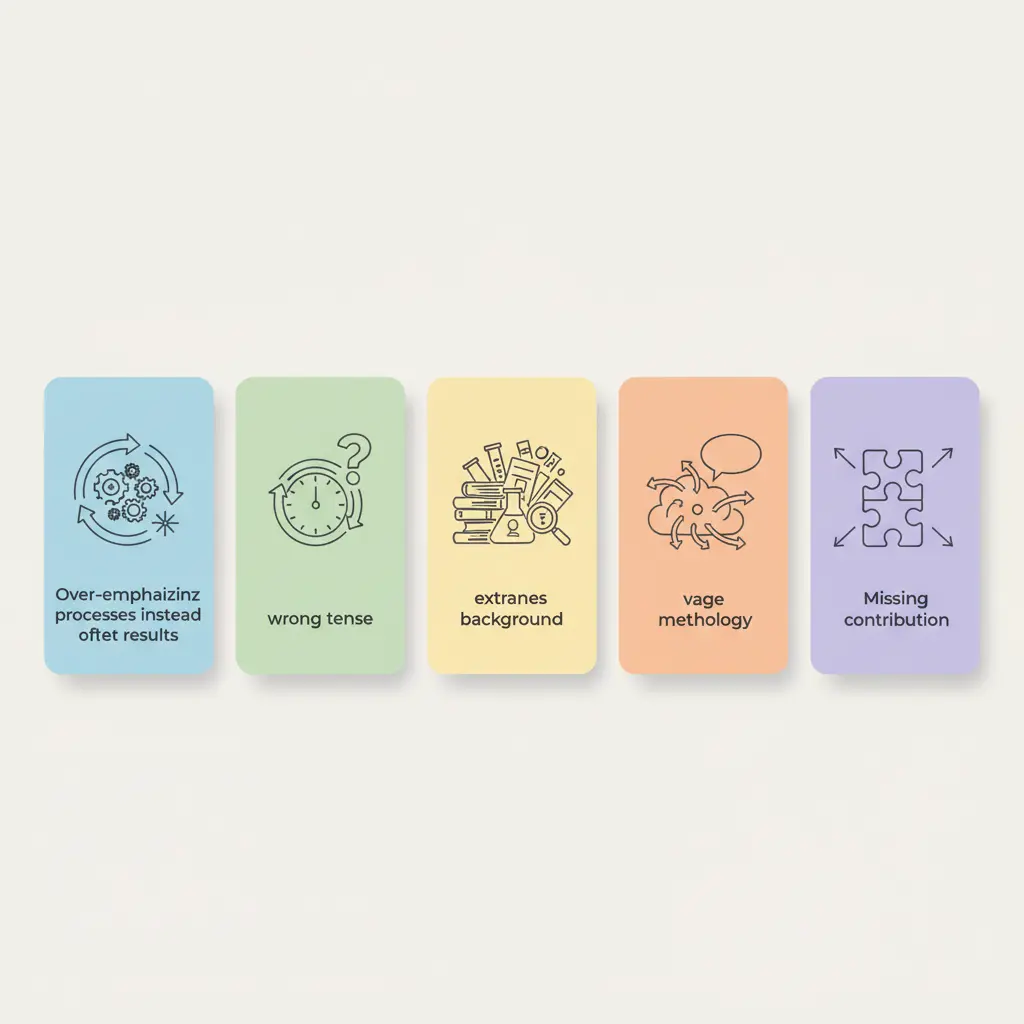
Mistake 1: Describing What You Did Instead of What You Found
“This study investigated the effects of social media on adolescent self-esteem” is a description of your aim, not a finding. Fix it: “Social media use exceeding two hours daily was significantly associated with lower self-esteem scores (r = −0.42).” Findings must report results.
Mistake 2: Writing in Future Tense
Beginners write “this study will examine” — as if the research hasn’t happened yet. It has. Use past tense for your research actions (“the study examined,” “data were collected,” “analysis revealed”) and present tense for established facts (“social media use is widespread”).
Mistake 3: Including Background That Belongs in the Introduction
If your abstract’s first three sentences are setting up why the topic matters historically, you’ve written an introduction, not an abstract. One sentence of context is enough. Get to your aims by sentence two.
Mistake 4: Vague or Missing Methodology
“A qualitative approach was used” tells an examiner almost nothing. Specify: what kind of qualitative approach (thematic analysis? grounded theory? discourse analysis?), how many participants, and how they were selected. That’s the information that lets a reader assess the validity of your findings.
Mistake 5: Over-Qualifying the Findings
Academic caution is good. Paralysing your abstract with hedges is not. “Some results may tentatively suggest the possibility that…” is painful to read. Use appropriate hedging (“findings suggest,” “results indicate”) but state your findings clearly.
Mistake 6: Burying the Contribution
Your final sentence should state explicitly what your research contributes. “Future research is needed” is not a contribution — it’s a placeholder. What does your study add to the field? Even a small, specific contribution is better than a vague call for further work.
Mistake 7: Going Over the Word Limit
This sounds obvious, but it happens constantly. Set your word processor to count only the abstract text, not the heading. Cut ruthlessly. Every word must justify its presence.
Abstract Writing Tips from Top University Guides
The Harvard College Writing Center’s guidance on developing a thesis emphasises that strong academic writing always makes its argument explicit. That principle applies directly to abstracts: your conclusions must be stated, not merely implied.
Here are the practical tips that hold up across disciplines and institution types:
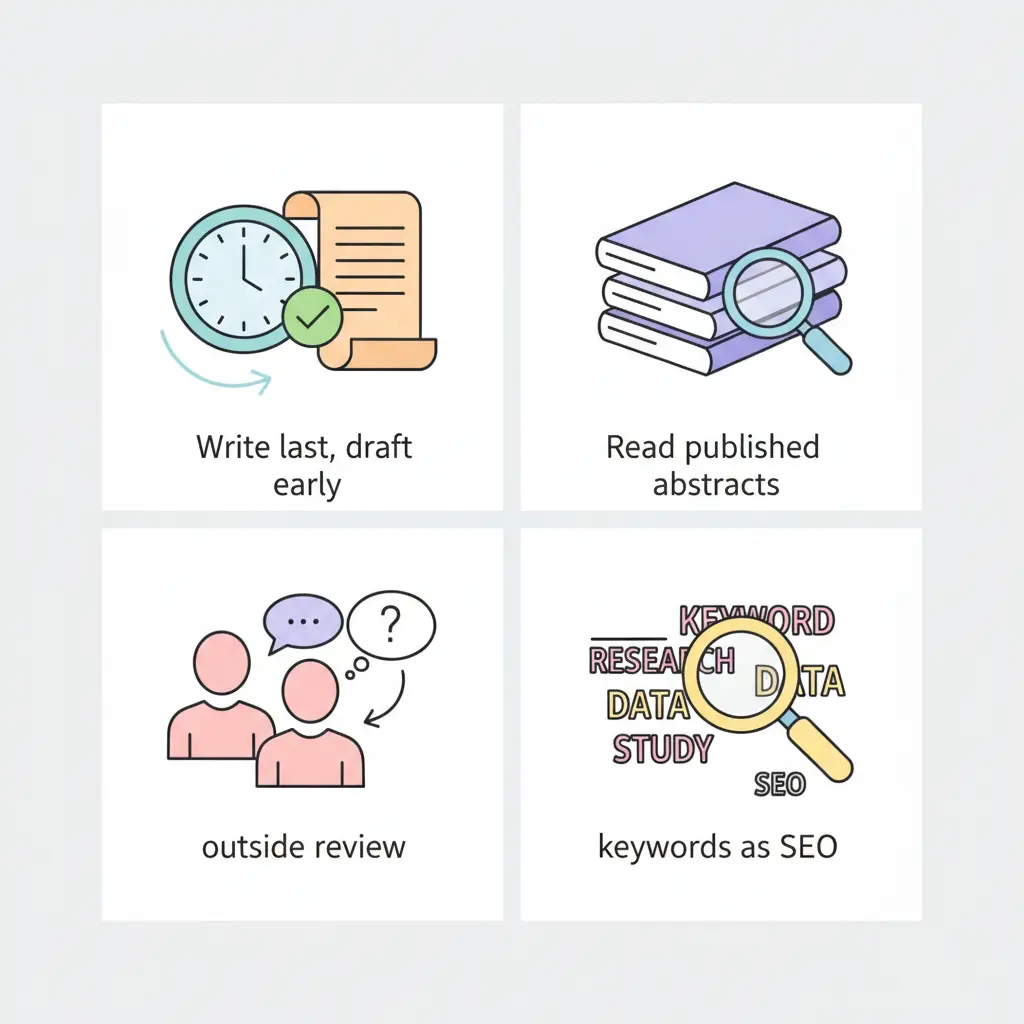
Write the Abstract Last — But Draft It Early
Here’s a counterintuitive approach that works well: write a rough draft of the abstract before you finish the dissertation. It forces you to articulate what you expect to find, which sharpens your research focus. Then rewrite it completely once the thesis is done. The second draft takes a fraction of the time because you know exactly what you’re summarising.
This approach fits naturally into an accelerated dissertation timeline. If you’re working toward a near-final draft, the guide on preparing a submission-ready dissertation in 4 weeks shows how to integrate abstract polishing into the final editing phase without losing momentum on the larger document.
Read Published Abstracts in Your Field
Your university library gives you access to thousands of published theses and dissertations. Read 10–15 abstracts in your specific field. Pay attention to: which tenses they use, how they describe methodology, how specific the findings language is. Pattern recognition from real examples is faster than any writing rule.
Get Someone Outside Your Field to Read It
This is the gold-standard test for a well-written abstract. If a friend studying a different subject can understand your research problem and findings after reading your abstract, it’s probably clear enough. If they need you to explain it, it’s not.
Keywords: The Hidden SEO of Academia
Many institutions and journals ask for 4–6 keywords below your abstract. These function exactly like SEO keywords — they determine whether your thesis appears in search results on ProQuest, EThOS, or your university repository. Choose terms that are specific enough to reach your audience but broad enough to be searchable. Your thesis title words are often good starting points, but add disciplinary terms that other researchers in your field would actually search for.
Frequently Asked Questions About Writing a Thesis Abstract
How long should a thesis abstract be?
Most university thesis abstracts should be between 150 and 300 words. Undergraduate dissertations often require 150–200 words; master’s theses typically 200–300 words; PhD theses up to 300–350 words depending on institution. Always check your specific department or institution’s submission guidelines, as word limits are strictly enforced at many universities.
Should an abstract include references or citations?
No. Thesis abstracts should not include citations, references, or footnotes. The abstract must be entirely self-contained and intelligible without reference to any other source. If you find yourself wanting to cite something, rephrase the sentence so the idea stands on its own — the abstract reports your findings, not others’ work.
Can I write the abstract before finishing my dissertation?
You can write an early draft of your abstract to help focus your research, but the final version must be written after the dissertation is complete. The abstract needs to accurately report your actual findings and conclusions — information you can only confirm once the research is done. Most academics write or substantially rewrite the abstract last.
What tense should I use in a thesis abstract?
Use past tense for actions you carried out (e.g., “the study examined,” “data were collected,” “analysis revealed”) and present tense for established facts or the paper’s own content (e.g., “this thesis argues,” “the findings suggest”). Avoid future tense entirely — your research is complete by the time the abstract is written.
<div class="
Write your thesis with AI
Structure, draft, cite, and format your thesis faster with Tesify’s AI writing tools, automatic bibliography, and plagiarism checker. Free to start, no credit card required.





Leave a Reply