

What Do You Do When Your Results Are Not Significant? (2026)
A non-significant result is a finding, not a failure. Report it exactly as you planned to report a significant one: the test, the effect size and its confidence interval, and an honest discussion of whether the study could have detected the effect. You do not change your hypothesis, drop the analysis, or hunt for a subgroup that works — and no examiner expects p < .05 to pass.

Does a non-significant result mean my dissertation has failed?
No. You are marked on the quality of your research question, your design, your execution and your interpretation — not on the direction of your p value. A well-designed study that finds nothing demonstrates every skill the degree is testing.
The belief that it does fail is worth naming, because it is the belief that produces academic misconduct. Almost every questionable research practice — dropping inconvenient cases, testing extra outcomes until one works, rewriting the hypothesis afterwards — starts with a student who thinks a null result is unmarkable. It is not, and the practices used to avoid it genuinely are.
What does “not significant” actually mean?
It means your data are not surprising enough under the null hypothesis to cross the threshold you set in advance. That is a statement about the strength of your evidence, not proof that the effect is zero.
This is the single most important distinction in the whole topic: absence of evidence is not evidence of absence. A non-significant result is consistent with a real effect that your study was too small to detect, with a real effect measured too noisily to see, and with no effect at all. The test alone cannot tell you which.
So the wording matters. Write “no statistically significant difference was found” or “the study did not detect an effect”. Do not write “there was no difference”, “the groups were the same”, or “the intervention had no effect” — those claim more than a p value can support.
What should I look at instead of the p value?
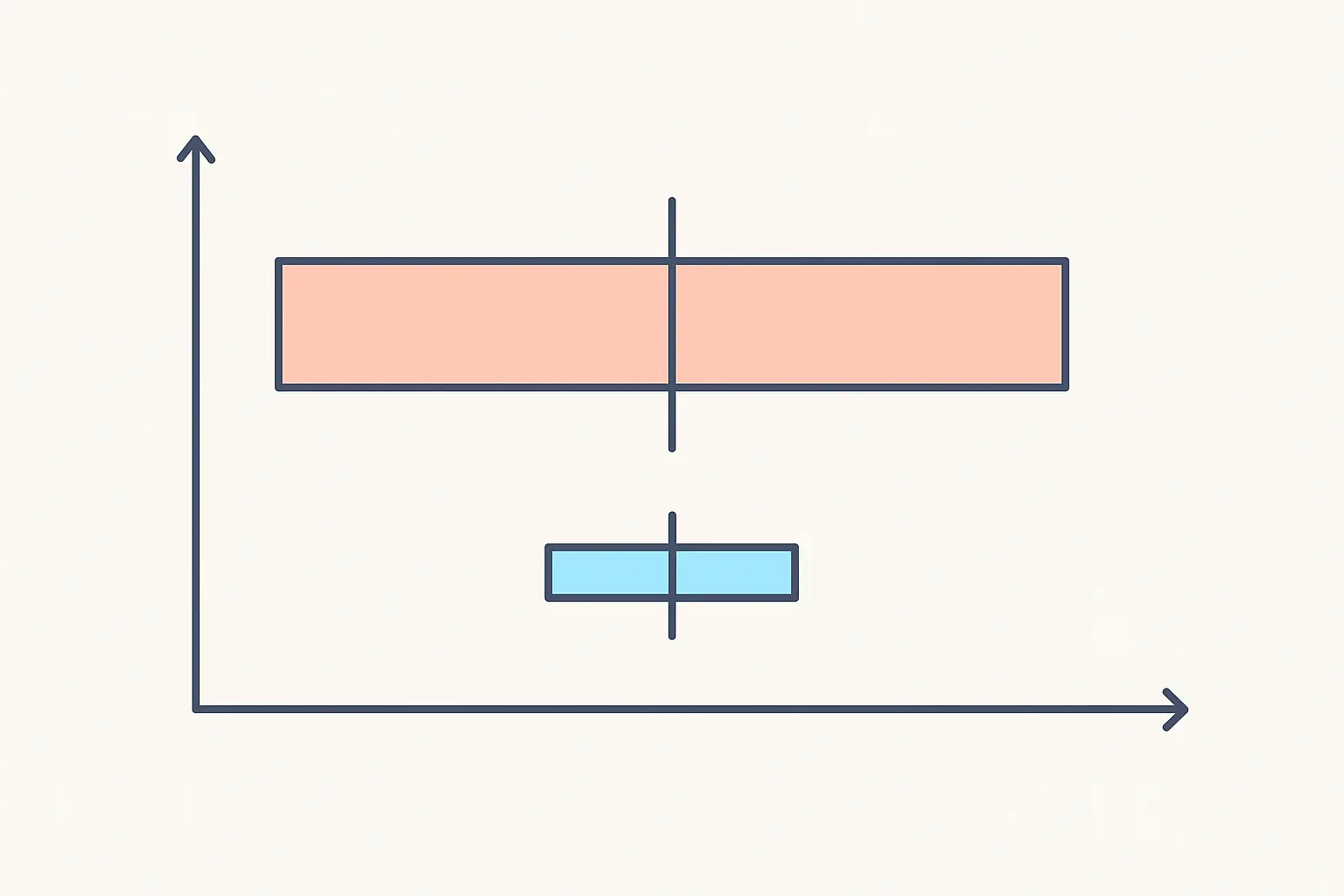
The effect size and its confidence interval. This is what turns an apparently empty result into an interpretable one, and it is the part most students omit precisely when it matters most.
Consider two non-significant findings. In the first, the standardised difference is 0.05 with a 95% confidence interval from −0.10 to 0.20. That interval excludes every effect large enough to matter, so you can say something genuinely informative: if an effect exists, it is too small to be practically important. In the second, the difference is 0.45 with an interval from −0.15 to 1.05. That is compatible with anything from a small negative effect to a very large positive one. Both have p > .05; only the first supports any conclusion.
Reporting the interval therefore converts “we found nothing” into either “we have ruled out a meaningful effect” or “our study was too imprecise to decide” — and those are different findings with different implications. Our guides to effect sizes and confidence intervals and interpreting confidence intervals cover the mechanics.
Was my study simply underpowered?
Very often, yes — and saying so is a legitimate and expected part of the discussion. Student projects are typically constrained by recruitment, and a study powered to detect a large effect will routinely miss a real medium-sized one.
The honest way to address this is with the power analysis you ran before collecting data: state the effect size you designed to detect and note that effects smaller than that were unlikely to reach significance. If you have a target sample size you did not reach, say what you achieved and what that cost you. Our sample size and power analysis guide covers the calculation.
One thing to avoid: post-hoc or “observed” power, calculated from the effect size you actually found. It is a direct mathematical function of your p value, so it always tells you that a non-significant result had low power. It adds no information and statisticians treat it as a red flag. Report the confidence interval instead — it answers the same question properly.
Should I change my hypothesis or my analysis?
No. Changing a hypothesis after seeing the results, and then presenting it as though it had been predicted, is the practice known as HARKing, and it invalidates the inference. The same applies to switching to a different test because the first one did not produce the answer you wanted, or quietly excluding participants until it does.
There is one legitimate move here, and it is a matter of labelling. You may absolutely explore your data further — but report that exploration as exploratory, in its own clearly marked section, framed as a hypothesis for future work rather than as a result. A clearly labelled exploratory analysis is good science. The same analysis presented as confirmatory is not.
There is also a genuine distinction between changing an analysis to chase significance and correcting one that was wrong. If you discover you ran a between-subjects test on repeated measures, or ignored a violated assumption, fixing that is required regardless of which direction the fix moves your p value — and you should document that you found and corrected it. Our comparison of which ANOVA suits which design covers the most common version of that error.
Could something technical be hiding a real effect?
Before you accept the result, rule out four mechanical problems that suppress genuine effects.
Reverse-scored items left unreversed in a composite scale, which destroys its internal consistency and attenuates every correlation it enters. Unchecked assumptions, where severe non-normality or heteroscedasticity has cost you power that a robust or non-parametric alternative would recover. Restricted range, where a ceiling or floor effect means almost everyone scored the same and there is little variance left to correlate. And unreliable measurement — a scale with poor reliability attenuates observed relationships, which is why you report reliability before you report the test.
Checking these is not fishing, because you are checking whether the analysis was executed correctly, not selecting among results. Do it before you interpret, and say that you did.
How do I write up a null result in the discussion?
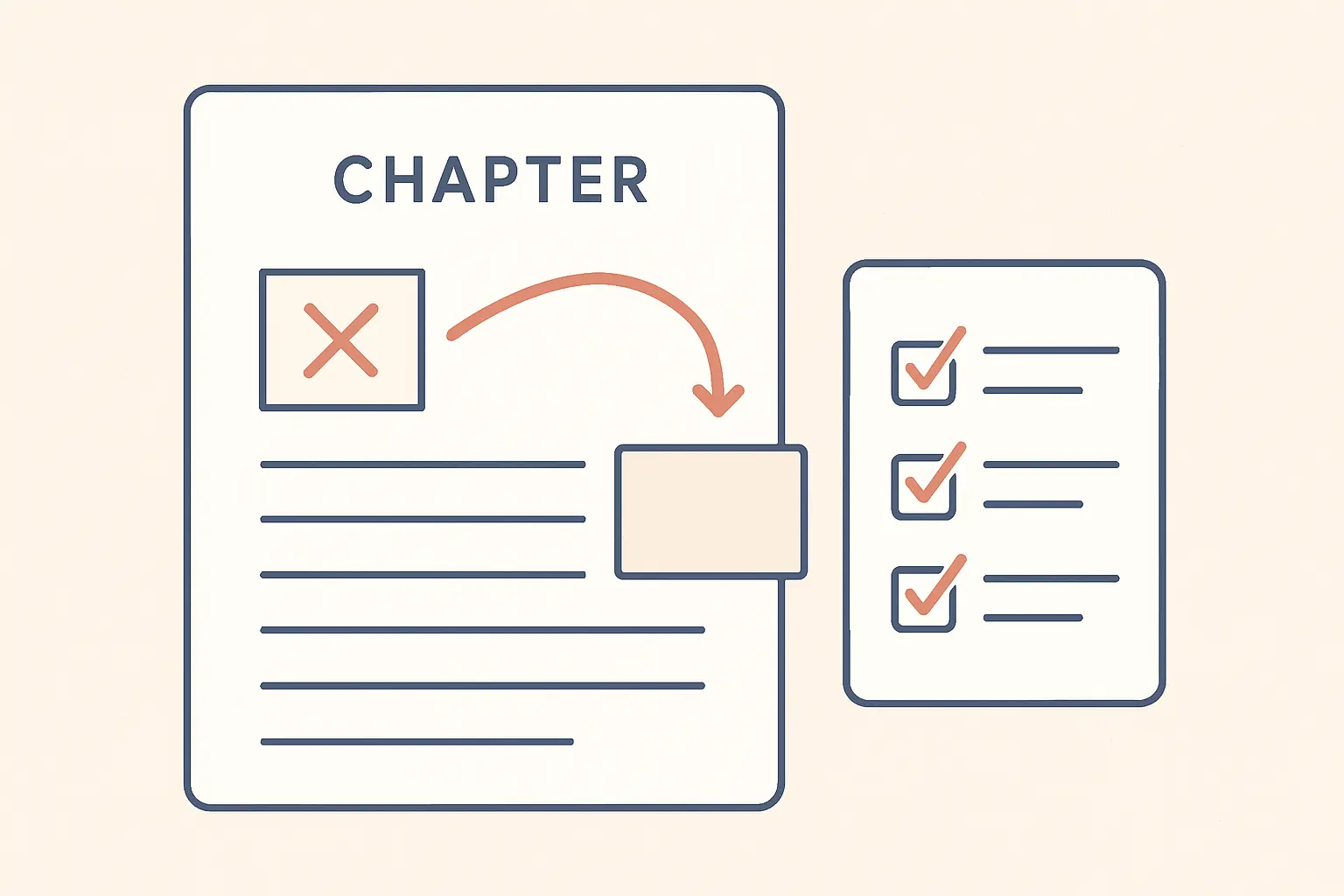
Structure it exactly as you would a positive finding, in five moves.
State it plainly. “The analysis did not detect a significant difference between conditions.” Give the numbers — test statistic, degrees of freedom, p, effect size and interval — in the results chapter, with the conventions described in our guide to writing the results chapter. Interpret the interval: does it rule out a meaningful effect, or is the study inconclusive? Situate it in the literature: does your result contradict published findings, or align with other studies that also found nothing? A null finding that conflicts with a widely cited effect is genuinely interesting, particularly given how much of the published record is shaped by the tendency to publish positive results. Then explain it — power, measurement, sample characteristics, context — and separate those explanations from your limitations section, which handles design constraints more broadly.
What this must not become is a paragraph of apology. “Unfortunately, the results were not significant” is the wrong register. The result is your evidence; report it with the same confidence you would have used had it gone the other way.
Frequently asked questions
Can you fail a dissertation for non-significant results?
Not for the result itself. Marking criteria assess the research question, design, execution, analysis and interpretation. You can lose marks for interpreting a null result badly — claiming the effect is zero, or omitting the effect size — but not for finding one.
Should I report the exact p value if it is not significant?
Yes. Report the exact value to three decimal places, for example p = .214, rather than only “n.s.” or “p > .05″. Exact values let readers assess your evidence and let your study contribute to any future meta-analysis.
Is p = .06 significant?
Not at a threshold of .05. Do not describe it as “approaching significance”, “marginally significant”, or “trending towards significance” — the threshold was set in advance and either was or was not crossed. Report the value and interpret the effect size and its interval.
Can I just remove the outliers to get significance?
Only if you have a pre-specified, principled rule applied before you looked at the outcome, and you report the analysis both with and without the excluded cases. Removing cases because it changes the p value is data manipulation.
What is post-hoc power and why should I avoid it?
Power calculated from your observed effect size. It is a deterministic function of your p value, so a non-significant result always yields low observed power, and it therefore adds nothing. Report the confidence interval instead.
My supervisor says to “find something in the data” — what do I do?
Explore freely, but report the exploration in a clearly labelled exploratory section, framed as generating hypotheses rather than testing them. Keep your pre-specified analysis reported in full and unchanged.
Does a wide confidence interval mean my result is useless?
It means your study was imprecise, which is itself worth reporting — it tells future researchers what sample size the question needs. An inconclusive study honestly labelled as inconclusive is a legitimate contribution.
Should I still discuss the theory if my hypothesis was not supported?
Yes, and this is often the strongest part of a null-result discussion. Ask what your finding implies for the theory: whether it fails in your population or context, whether a boundary condition applies, or whether your study lacked the sensitivity to test it fairly.
Can I publish or present a non-significant finding?
Yes. Journals and registered-report formats increasingly welcome well-powered null results precisely because their historical absence has distorted the literature. A pre-registered study reporting a null finding is a valuable contribution.
Write the null result up with the same rigour
The difference between a null result that reads as a failure and one that reads as a finding is entirely in the write-up: the effect size, the interval, the power reasoning, and the discipline not to rewrite the hypothesis. Tesify helps you build the results and discussion chapters around what you actually found — 100% written by you.
Write your thesis with AI
Structure, draft, cite, and format your thesis faster with Tesify’s AI writing tools, automatic bibliography, and plagiarism checker. Free to start, no credit card required.






Leave a Reply