
Thesis vs Dissertation: What Is the Difference in 2026?
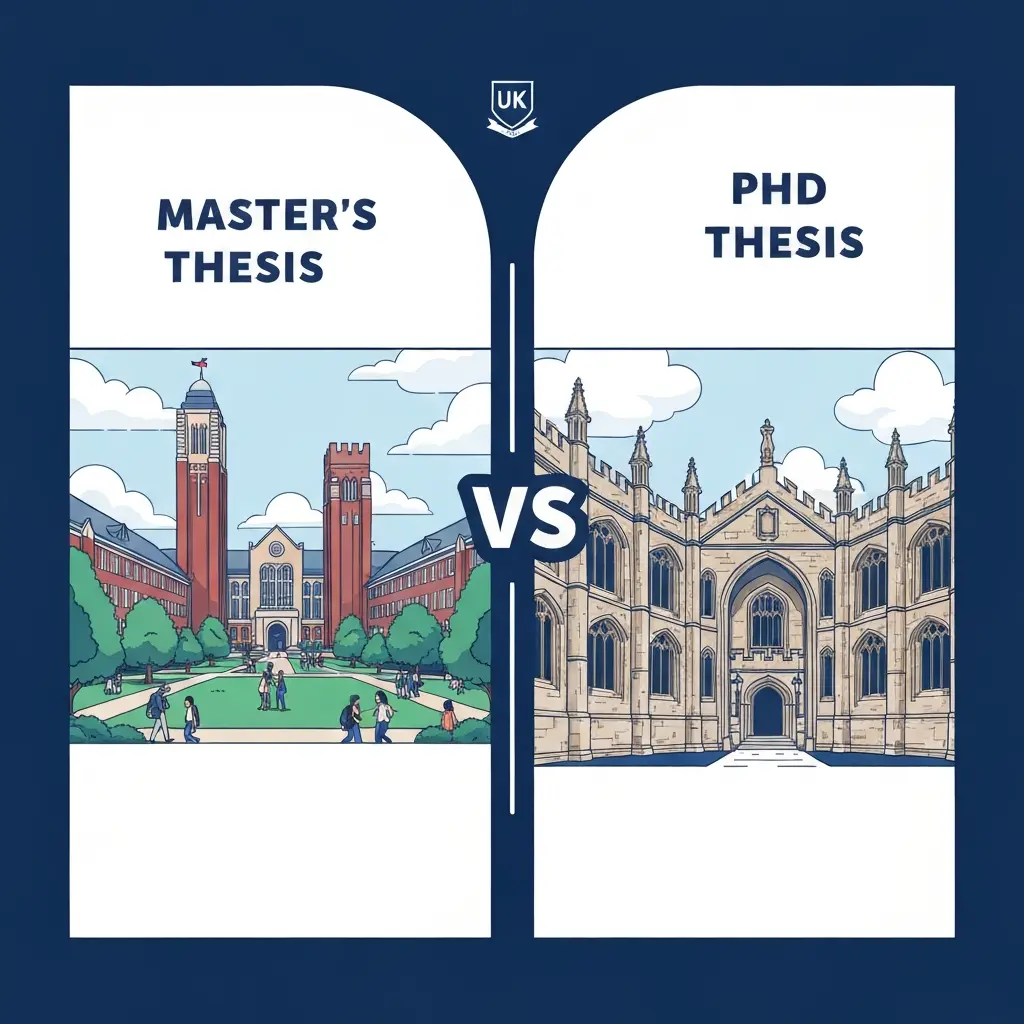
If you’re applying to graduate school or just starting your research degree, you’ve almost certainly wondered about the difference between a thesis and a dissertation. The answer depends almost entirely on which country you’re in — and getting the terminology wrong can genuinely confuse supervisors, admissions officers, and future employers. In the United States, a thesis is the capstone document for a master’s degree, while a dissertation is required for a doctoral (PhD) degree. Cross the Atlantic to the United Kingdom, and the labels flip: a dissertation is typically a final-year undergraduate or master’s project, while a thesis refers to the original research document submitted for a doctorate. Understanding what is the difference between a thesis and a dissertation — and which convention applies to your institution — is the first step toward writing one successfully.
This guide unpacks every meaningful dimension of that difference: degree level, word count, expected original contribution, timeline, structure, and the format of your oral defense. Whether you’re a US master’s student, a UK PhD candidate, or an international student navigating both systems, the breakdown below gives you a clear, accurate picture for 2026.
US vs UK Terminology: Why the Confusion Exists
The terminological split between the US and UK traces back to diverging academic traditions in the 19th century. American universities, influenced heavily by the German research university model, reserved the word “dissertation” (from the Latin dissertatio, meaning “discussion”) for the highest-level independent research document: the PhD. Master’s programs, which were designed to extend and synthesise existing knowledge rather than generate new primary research, adopted “thesis” as the descriptor for their capstone requirement.
British universities followed a different path. The word “dissertation” became the standard term for the extended essay submitted at the end of an undergraduate degree or a taught master’s program — a piece of work based primarily on secondary sources and structured argument. The doctoral document, which represents a genuine contribution to the field’s knowledge base, retained the name “thesis.”
Today, neither system is perfectly consistent. Some US universities use “dissertation” for both levels. Some UK institutions call a master’s document a “thesis.” Australian universities largely follow the UK model. Canadian institutions are split roughly 60/40 between US and UK conventions. Always verify terminology with your specific institution’s postgraduate handbook before you begin writing.
Degree Level and Purpose
The most reliable way to distinguish the two documents is by degree level and expected purpose, not terminology alone.
United States
- Thesis: Submitted at the end of a master’s program (MA, MS, MEd, MFA, etc.). The purpose is to demonstrate mastery of a field through an extended, rigorously argued piece of research or creative work. It typically reviews and synthesises existing literature rather than generating entirely new primary research, though quantitative thesis projects do collect original data.
- Dissertation: Submitted at the end of a doctoral program (PhD, EdD, PsyD, etc.). The purpose is to make a substantial, original contribution to the body of knowledge in the discipline. A dissertation must present research that has not been published or argued before in exactly the same way.
United Kingdom and Australia
- Dissertation: Submitted at the end of an undergraduate final year or a taught postgraduate master’s (MSc, MA, LLM, etc.). It is an extended piece of research or analytical writing — typically the longest and most independently conceived work at that level, but still primarily built on existing scholarship.
- Thesis: Submitted at the end of a research doctorate (PhD, DPhil, MD, EngD, etc.). The expectation of original contribution is absolute: examiners must be satisfied the work advances knowledge in a way that merits publication.
Word Count and Length Requirements
Word count expectations vary by institution and discipline, but the patterns below represent the norms across major English-speaking university systems in 2026.
| Document | System | Typical Word Count | Degree Level |
|---|---|---|---|
| Thesis | US/Canada | 15,000–50,000 | Master’s |
| Dissertation | US/Canada | 80,000–100,000 | Doctoral (PhD) |
| Dissertation | UK | 10,000–20,000 | UG / Taught Master’s |
| Thesis | UK/Australia | 70,000–100,000 | Doctoral (PhD/DPhil) |
STEM dissertations and theses sometimes run shorter than humanities equivalents because data tables and figures carry significant informational weight. An engineering PhD thesis in the UK, for instance, may be accepted at 60,000 words where a history PhD thesis could run to 120,000. Always check your institution’s specific regulations — they override any general guide.
Original Contribution: How Much Is Required?
The degree of expected original contribution is the most substantive difference between the two documents, regardless of which terminology your institution uses.
A master’s thesis (US) or undergraduate/master’s dissertation (UK) typically requires: a clearly defined research question, a thorough literature review that situates the work within existing scholarship, a rigorous methodology, and findings that are interpreted thoughtfully. Original data collection is common in the sciences and social sciences, but is not universally required. A purely analytical or interpretive piece based on secondary sources is acceptable in many humanities programs.
A doctoral dissertation (US) or doctoral thesis (UK) has a higher bar. The work must be original — the candidate must demonstrate that the central finding, argument, or creative contribution did not exist in the literature before. In many countries, doctoral candidates are expected to have at least one publication from their doctoral work before submitting. According to data from the Council of Graduate Schools (2025), around 57% of PhD students who enroll in STEM programs in the US complete within ten years, highlighting that the original-contribution requirement genuinely filters candidates over time. For more on this, see the thesis completion rates statistics breakdown.
Structure and Chapter Format
Both documents follow a broadly similar chapter sequence, but the depth and scope of each section differs markedly.
Standard Master’s Thesis Structure (US)
- Abstract (150–300 words)
- Introduction — background, research question, significance
- Literature Review — comprehensive review of prior scholarship
- Methodology — research design, data sources, analysis approach
- Results / Findings
- Discussion — interpretation and implications
- Conclusion — summary and future directions
- References / Bibliography
- Appendices (if applicable)
Standard Doctoral Dissertation / PhD Thesis Structure
At doctoral level, many STEM and social science programs now use a paper-based or publication-based format, where three to five peer-reviewed articles (published or in press) are bundled with an overarching introduction and synthesis chapter. The traditional monograph format — a single, book-length argument — remains dominant in the humanities.
- Abstract
- Introduction and Research Context
- Comprehensive Literature Review
- Theoretical / Conceptual Framework
- Methodology
- Chapter per Study / Data Set / Theme (often 3–4 chapters)
- Synthesis and Discussion
- Conclusion and Contributions to Knowledge
- References
- Appendices
If you’re working on a thesis introduction right now, the how to write a thesis introduction step by step guide walks through each component with annotated examples.
Timeline: How Long Does Each Take?
Timeline expectations differ substantially because the scope of work differs substantially.
Master’s Thesis (US)
Most master’s programs in the US run 1.5 to 2 years. The thesis component typically occupies the final two semesters (approximately 8–12 months), running parallel to coursework in some programs or as a standalone final year in research-intensive programs. A well-organised student who begins their literature review in month one, collects or processes data in months three to five, and writes continuously from month four onward can submit in 9–10 months.
Doctoral Dissertation (US) / PhD Thesis (UK)
Doctoral programs in the US take an average of 5.8 years to complete, per NSF Survey of Earned Doctorates data (2024). UK PhD programs are funded for three to four years and are formally registered for three years, though many students submit in year four. The research, writing, and revision of the doctoral document alone — excluding coursework and qualifying exams — typically spans two to three years.
The how to write a dissertation: 12-month roadmap covers a compressed timeline strategy for candidates aiming to submit in their funded period.
Defense Format and Oral Examination
Both documents conclude with an oral examination, but the format, stakes, and typical outcome differ considerably.
Master’s Thesis Defense (US)
The master’s thesis defense is typically a 45–90 minute session with a committee of two to four faculty members. The student presents the work for 20–30 minutes, then answers questions. The committee may request minor revisions, but outright failure (requiring a full resubmission) is uncommon. The vast majority of students who reach the defense stage pass.
Doctoral Dissertation Defense (US)
A doctoral dissertation defense in the US runs 90–180 minutes. The committee of four to five members (including an external examiner at some institutions) questions the candidate on methodology, theoretical grounding, implications, and the limits of the research. Outcomes range from pass with no revisions to pass with major revisions to fail and resubmit. In practice, most candidates who reach the defense with committee approval pass with minor to moderate revisions.
PhD Viva Voce (UK)
The UK viva is a private oral examination, typically two to four hours long, conducted by two examiners — one internal and one external to the university. There is no public presentation component. The examiners can ask about any aspect of the thesis and routinely probe inconsistencies or methodological choices in depth. Possible outcomes include: pass with no corrections, pass with minor corrections (typically 3–6 months), pass with major corrections (up to 12 months), referral for a new viva, or outright fail. The referral outcome is relatively rare but not exceptional — around 5–10% of UK vivas result in a request for major corrections or referral.
Full Comparison Table
| Feature | US Thesis (Master’s) | US Dissertation (PhD) | UK Dissertation (UG/Master’s) | UK Thesis (PhD) |
|---|---|---|---|---|
| Degree level | Master’s | Doctoral | UG / Taught Master’s | Doctoral |
| Word count | 15,000–50,000 | 80,000–100,000 | 10,000–20,000 | 70,000–100,000 |
| Original contribution required | Partial (synthesis) | Substantial (new knowledge) | Limited (analytical) | Substantial (new knowledge) |
| Timeline | 9–12 months | 2–4 years | 3–6 months | 3–4 years |
| Oral defense | 45–90 min, committee | 90–180 min, committee | Often none (some courses) | 2–4 hr viva voce |
| Publication expectation | Rare | Common (1–3 papers) | None | Common (1–3 papers) |
| Supervisor role | Advisory | Intensive mentorship | Advisory | Intensive mentorship |
Using AI Tools to Write Either Document
AI writing assistants have become a standard part of the academic writing toolkit in 2026. The critical distinction is between tools that help you write better (structuring arguments, paraphrasing for clarity, generating citation drafts) and tools that write for you (which violates academic integrity policies at virtually every institution).
For both a master’s thesis and a doctoral dissertation, the most valuable AI applications are: literature mapping (identifying gaps and clusters in a field), outline generation, first-draft structuring of methods sections, and citation formatting. Tesify is purpose-built for exactly this workflow — it respects academic integrity guidelines, supports APA 7, MLA 9, and Harvard styles natively, and flags AI-generated passages so you can rewrite them in your own voice before submission. To see how it compares with general-purpose tools, read the best AI tool for writing a thesis guide.
According to a 2025 survey by the Higher Education Policy Institute (HEPI), 74% of UK undergraduates and 68% of postgraduate students now use AI tools regularly for academic writing. Institutional policies have evolved significantly: most universities now permit AI for planning, paraphrasing, and grammar checking while prohibiting its use for generating substantive academic argument. Always check your institution’s current AI use policy — it may have changed since the start of your program.
Frequently Asked Questions
Is a dissertation harder than a thesis?
In the US system, yes: a dissertation (PhD) is substantially more demanding than a master’s thesis. A dissertation requires an original contribution to knowledge, typically takes 2–4 years of full-time research, and concludes with a rigorous oral defense. A master’s thesis synthesises existing research over 9–12 months. In the UK system, the same logic applies: a PhD thesis is far more demanding than an undergraduate or master’s dissertation.
Can a master’s student write a dissertation instead of a thesis?
Some US master’s programs offer a non-thesis track where students complete a capstone project, comprehensive exam, or an extended paper sometimes called a dissertation or practicum. The terminology varies by institution. If your program offers both options, the thesis track is generally preferred for students considering doctoral study, as it provides research training and committee relationships that support PhD applications.
How long does it take to write a master’s thesis vs a PhD dissertation?
A master’s thesis typically takes 9–12 months to research and write, usually concurrent with the final stage of a 1.5–2 year program. A doctoral dissertation takes 2–4 years as the primary activity of a 4–6 year PhD program. The writing phase alone for a dissertation — drafting, revising, and incorporating committee feedback — often takes 12–18 months.
What is the word count difference between a thesis and a dissertation?
In the US, a master’s thesis is typically 15,000–50,000 words, while a doctoral dissertation runs 80,000–100,000 words. In the UK, a master’s dissertation is typically 10,000–20,000 words, while a PhD thesis is 70,000–100,000 words. STEM documents sometimes run shorter because data tables and figures carry substantial informational weight. Always verify your institution’s specific word count regulations.
Do you have to defend a master’s thesis the same way as a PhD dissertation?
No. A master’s thesis defense in the US is typically a 45–90 minute session with a small faculty committee, and failure at this stage is rare. A doctoral dissertation defense runs 90–180 minutes and involves more intensive questioning. In the UK, PhD candidates face a viva voce of 2–4 hours with internal and external examiners, with outcomes ranging from minor corrections to referral for a new viva.
Why do the UK and US use opposite terminology?
The divergence stems from different academic traditions in the 19th century. American universities, influenced by the German research university model, used “dissertation” for the highest-level doctoral document. British institutions, following their own conventions, used “dissertation” for extended essays at undergraduate and master’s level, reserving “thesis” for the doctoral document. Neither system has a monopoly on correct usage — it is simply a matter of convention.
Is a thesis published after completion?
Doctoral theses and dissertations are typically deposited in the institution’s repository and made publicly available (often via ProQuest in the US or EThOS in the UK). Master’s theses are sometimes deposited but are not always publicly available. Journal articles derived from doctoral work are published separately through the peer review process. Having doctoral work published as journal articles before or alongside submission has become increasingly common.
Can AI help me write my thesis or dissertation?
AI tools can legally and ethically assist with literature mapping, outline creation, citation formatting, paraphrasing for clarity, and grammar checking — provided your institution permits such use and you disclose it where required. AI tools must not generate the substantive academic argument, original analysis, or findings for you. Tools like Tesify are designed for academic compliance, helping you stay within institutional AI use policies while still benefiting from AI-assisted writing support.
Ready to start writing?
Whether you’re working on a master’s thesis or a doctoral dissertation, Tesify gives you an AI-powered academic writing environment that respects citation standards, supports APA 7, MLA 9, and Harvard styles, and keeps your work within your institution’s academic integrity policy. Start drafting your first chapter today — no credit card required.
Write your thesis with AI
Structure, draft, cite, and format your thesis faster with Tesify’s AI writing tools, automatic bibliography, and plagiarism checker. Free to start, no credit card required.





Leave a Reply