
Thesis Introduction Example: Complete 5-Step Writing Roadmap
Most students spend hours staring at a blank page when it’s time to write their thesis introduction — and most of those same students end up submitting something that buries the real argument in paragraph three. Sound familiar? The introduction is the one chapter your committee reads twice: once before your defence and once during. Getting it wrong costs you credibility before you’ve even presented your evidence.
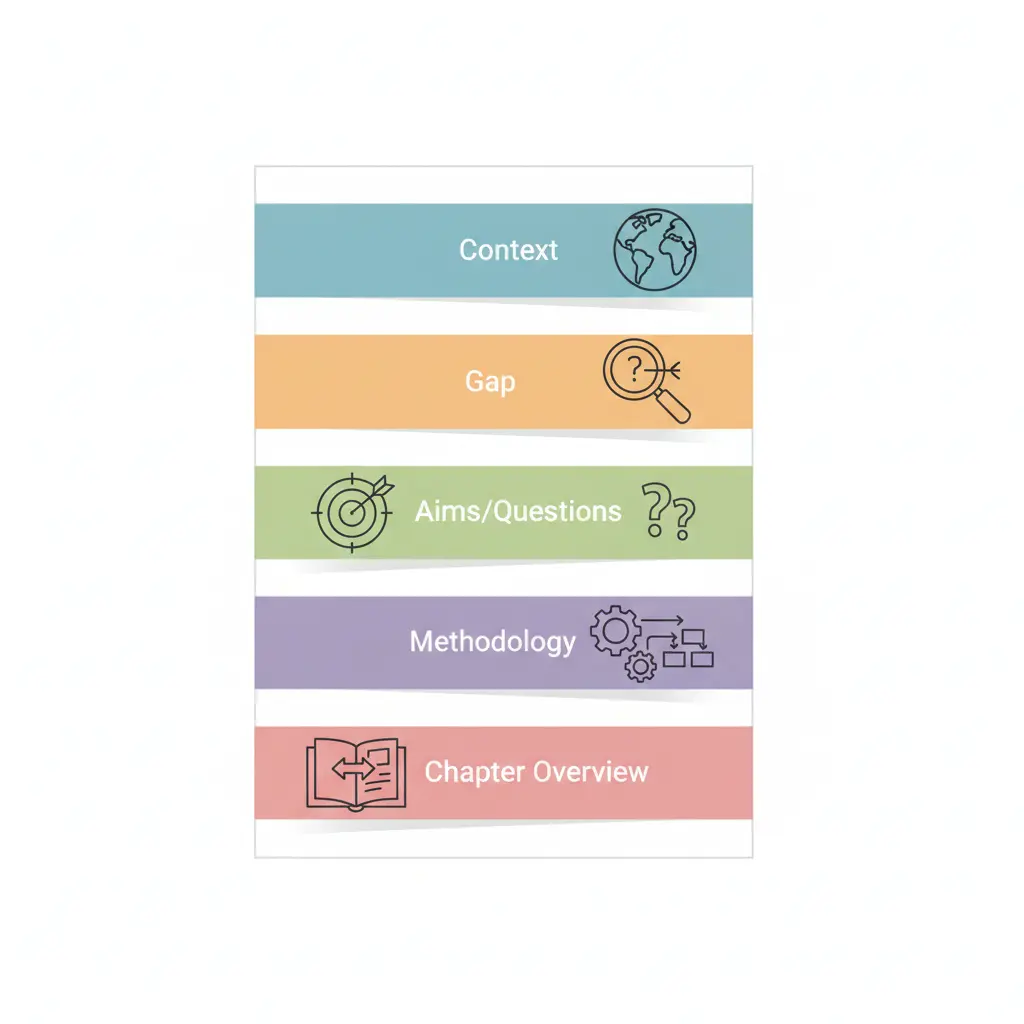
The good news is that a strong thesis introduction doesn’t require genius. It follows a proven structure — and once you understand each component, writing one becomes far less intimidating. This guide gives you a complete 5-step roadmap, real thesis introduction examples drawn from the academic conventions at universities like Oxford, Harvard, and UCL, and practical templates you can adapt today.
What a Thesis Introduction Actually Does
Here’s where most students get confused: the introduction is not a summary of your dissertation. It’s an argument for why your research needs to exist.
Think of it like the opening statement of a legal case. You’re not presenting all the evidence yet — you’re telling the jury what the case is about, why it matters, and how you’re going to prove it. The actual evidence comes later, in your literature review, methodology, and findings chapters.
Definition
Thesis Introduction: The opening chapter of a dissertation or thesis that contextualises the research problem, identifies a gap in existing knowledge, presents the study’s aims and research questions, briefly describes the methodological approach, and maps out the structure of the rest of the work. It typically accounts for 8–10% of the total word count.
According to the Purdue OWL Graduate Writing resources, one of the most common weaknesses in dissertation introductions is failing to establish “so what?” — the significance of the research. Your introduction must answer that question before the reader turns to Chapter 2.
The introduction also does something underappreciated: it signals to your examiner that you understand your field. A well-constructed research context paragraph shows you’ve read the right literature. A sharp problem statement shows you can think critically. A clear aims section shows you understand scope. Done well, the introduction creates trust before the substance begins.
Thesis vs Dissertation Introduction: Key Differences
Before writing a single word, it’s worth knowing whether your introduction conventions differ based on the type of work you’re producing. The terms “thesis” and “dissertation” are used differently across countries, and the structural expectations can vary accordingly.
For a fuller breakdown, see our guide on dissertation and thesis writing conventions — but the table below captures the key differences that directly affect your introduction.
| Feature | Master’s Thesis Introduction | PhD Dissertation Introduction | Undergraduate Dissertation Introduction |
|---|---|---|---|
| Typical length | 800–1,500 words | 1,500–3,000 words | 500–1,000 words |
| Research gap depth | Moderate — synthesise existing gaps | Deep — must demonstrate original contribution | Light — contextual positioning sufficient |
| Originality claim | Encouraged but not mandatory | Essential — must state “contribution to knowledge” | Not required |
| Research questions | 1–3 focused questions | 1–2 primary + sub-questions | 1–2 clearly scoped questions |
| Methodology mention | Brief overview (2–4 sentences) | Paragraph-length justification | One sentence is usually enough |
| Chapter roadmap | Required | Required and detailed | Recommended |
The Complete 5-Step Thesis Introduction Writing Roadmap
Every excellent thesis introduction covers these five components. Not all in equal depth — your discipline and level matter — but all five need to be present. What most guides miss is the order and the transitions between each step. Here’s exactly how to build each one.
1 Establish Research Context
Start broad, but not too broad. A common mistake is opening with a grandiose statement about the history of humanity — your examiner has read that opener a hundred times. Instead, open with the specific scholarly or real-world context that makes your topic relevant right now.
Think of it like zooming into a map. You start at the country level, move to the city, then zoom in on the exact neighbourhood your research lives in. By the end of this first section, the reader should understand the field, why it’s active, and what the major debates or tensions currently are.
What to include:
- A brief overview of the research domain (2–3 sentences)
- Key statistics, trends, or events that signal the topic’s importance
- Reference to 3–5 foundational or recent key sources
- Any relevant disciplinary debates or tensions in the literature
“Mental health service demand in the United Kingdom has increased by 24% since 2017, placing unprecedented strain on NHS community provision (NHS Digital, 2023). Despite extensive policy reform under the NHS Long Term Plan, significant disparities in access persist across socioeconomic groups (King’s Fund, 2022). This study examines how digital mental health interventions mediate access inequalities in low-income urban communities.”
Notice what that example does: it opens with a concrete statistic, names a relevant policy context, and immediately signals the study’s terrain — without dumping the entire literature review into the first paragraph.
2 Identify the Research Gap
This is the most critical — and most frequently underdeveloped — part of any thesis introduction. The research gap is your justification for existing. Without it, your examiner is left wondering: why does this study need to happen?
A strong research gap isn’t just “this hasn’t been studied before.” It’s a precise articulation of what the existing literature fails to address and why that failure matters.
Three types of research gaps you can identify:
- Empirical gap: The topic hasn’t been studied in a specific population, geography, or time period.
- Theoretical gap: Existing theories don’t adequately explain a phenomenon; a new framework is needed.
- Methodological gap: Previous studies used flawed or limited methods; a different approach yields different (and more valid) results.
“While numerous studies have examined battery degradation in electric vehicle systems operating in temperate climates (Chen et al., 2021; Williams & Park, 2022), comparatively little empirical work has addressed degradation rates in sub-Arctic conditions. This represents a significant gap given the rapid expansion of EV infrastructure in Nordic countries and Northern Canada.”
The University of Manchester Academic Phrasebank is genuinely useful here — it provides discipline-neutral language for signalling gaps, critiquing existing literature, and positioning your contribution. Bookmark it.
3 State Aims, Research Questions, and Objectives
Here is where it gets interesting — many students conflate aims, objectives, and research questions as if they’re the same thing. They’re not, and getting this distinction right matters for both your introduction and your entire dissertation structure.
| Element | Definition | Example |
|---|---|---|
| Aim | The overarching purpose — what the study seeks to achieve overall | “This study aims to investigate the relationship between remote working and employee wellbeing in UK SMEs.” |
| Objectives | The specific, measurable steps taken to reach the aim | “To measure self-reported wellbeing scores across three remote-working models”; “To identify key stressors reported by employees in fully remote roles” |
| Research Questions | The precise questions the study answers | “To what extent does remote working frequency predict employee wellbeing scores, controlling for sociodemographic variables?” |
Most master’s dissertations need one clear aim, three to five objectives, and one to three research questions. PhD dissertations often use one primary research question with sub-questions. Whatever format you use, be consistent — your methodology, findings, and conclusion must all explicitly address these.
4 Outline Your Methodology Briefly
Your methodology chapter will cover this in full depth. The introduction only needs a short overview — enough to tell the reader how you’ll answer your research questions without front-loading the whole design.
Keep this section to a short paragraph (2–5 sentences). Cover: the overall research design (qualitative, quantitative, or mixed), the data collection method (surveys, interviews, experiments, archival analysis), and the analytical approach (thematic analysis, regression modelling, etc.).
“This study adopts a mixed-methods design. Quantitative data were collected via a validated survey instrument administered to 312 secondary school teachers across three local education authorities in England. Qualitative data were gathered through semi-structured interviews with twelve purposively sampled participants, analysed using reflexive thematic analysis (Braun & Clarke, 2021).”
If you want to see how methodology sections are framed more broadly, the Scribbr video guide on how to write a research methodology in four steps is one of the clearest free resources available — worth watching before you write Chapter 3.
5 Provide a Chapter Overview
The chapter overview (also called a “chapter outline” or “signposting section”) is often treated as an afterthought. That’s a mistake. Done well, it shows your examiner that you have architectural control over your argument — that each chapter serves a purpose and that they build logically on each other.
Write one to three sentences per chapter. Describe what each chapter does, not just what it’s called.
“Chapter Two reviews the existing literature on digital health intervention models, with particular attention to access theory and digital inclusion frameworks. Chapter Three justifies the mixed-methods design and details the sampling strategy, data collection instruments, and analytical procedures. Chapter Four presents the findings from both quantitative and qualitative phases. Chapter Five discusses these findings in relation to the theoretical framework and existing evidence base. The concluding chapter addresses the study’s contributions, limitations, and implications for policy and practice.”
Notice the language: “reviews,” “justifies,” “presents,” “discusses.” Action verbs signal function. They tell your reader exactly what intellectual work each chapter performs.
For help planning your full chapter structure before you write, our guide on planning and structuring your dissertation with intelligent tools walks through how to map your chapters strategically before you start drafting.
Real Thesis Introduction Examples (with Analysis)
Reading completed introductions is genuinely one of the best ways to internalise the structure. Below are two annotated examples — one from a social science dissertation, one from a science/engineering thesis — showing how each of the five steps appears in practice.
Example A: Social Science Dissertation Introduction (Master’s Level)
[Context] Climate migration has emerged as one of the defining policy challenges of the early twenty-first century, with the Internal Displacement Monitoring Centre (2023) estimating that 32.6 million people were internally displaced by weather-related events in 2022 alone.
[Research Gap] While substantial scholarship addresses climate migration at the macro-level — focusing on regional patterns and state policy responses — comparatively little attention has been paid to the lived experiences and identity negotiation processes of internally displaced persons (IDPs) in low-income urban resettlement zones.
[Aims and Questions] This dissertation investigates how IDPs in two resettlement communities in coastal Bangladesh construct and maintain place identity following displacement. The central research question is: how do climate-displaced residents narrate belonging and home in temporary resettlement settings?
[Methodology] An ethnographic approach was adopted, combining participant observation over six months with thirty semi-structured narrative interviews. Data were analysed using Interpretive Phenomenological Analysis (IPA).
[Chapter Overview] Chapter Two surveys the theoretical literature on place identity and displacement. Chapter Three details the methodological design and ethical considerations. Chapters Four and Five present and discuss the findings thematically. Chapter Six concludes with theoretical and policy implications.
What works: Each step is clearly demarcated without being mechanical. The research gap is specific (not just “under-studied” but under-studied in a particular population and dimension). The research question is answerable, not encyclopaedic.
Example B: STEM Dissertation Introduction (PhD Level)
[Context] The global push toward net-zero energy systems has accelerated investment in offshore wind infrastructure, with the International Energy Agency (IEA, 2024) projecting 380 GW of installed offshore capacity by 2030. Structural integrity monitoring of turbine foundations is critical to operational safety and cost efficiency.
[Research Gap] Existing structural health monitoring (SHM) systems predominantly rely on wired sensor arrays, which present significant limitations in harsh marine environments, including high maintenance costs and data latency. Wireless distributed sensor networks offer a theoretically superior alternative, yet no validated real-world deployment framework currently exists for monopile foundations in water depths exceeding 40 metres.
[Aims and Questions] This thesis aims to develop and validate a wireless SHM framework suitable for deep-water monopile applications. The primary research question is: to what extent can a distributed wireless sensor network reliably detect structural anomalies in monopile foundations at depths of 40–80 metres under operational loading conditions?
[Methodology] A combined experimental and computational approach was adopted. Physical testing was conducted using a 1:20 scale model in the University’s marine testing facility, with results validated against finite element simulations in ANSYS Mechanical.
[Chapter Overview] Chapter Two reviews SHM literature with focus on offshore applications. Chapter Three presents the experimental design and computational modelling approach. Chapters Four and Five report experimental results and their validation against simulated data respectively. Chapter Six discusses the findings’ implications for offshore SHM system design and identifies directions for future research.
7 Common Thesis Introduction Mistakes to Avoid
These aren’t abstract warnings — they’re the specific errors examiners flag repeatedly in feedback reports.
- Starting too broadly. “Since the dawn of human civilisation…” is a cliché that wastes the reader’s time. Start in the field, not in history.
- No clear research gap. Stating that a topic is “interesting” or “important” is not a gap. You need to show what the current literature fails to do.
- Vague research questions. “How does social media affect society?” is not a research question — it’s a topic. A research question should be specific, focused, and answerable within your study’s scope.
- Confusing aims and objectives. As shown above, these are distinct. Merging them signals conceptual confusion to your examiner.
- Front-loading the literature review. Your introduction should reference key sources, but the deep critical synthesis belongs in Chapter 2. Don’t write your literature review twice.
- Missing the chapter overview. This section is non-negotiable for most institutions. Skipping it makes your introduction feel incomplete.
- Writing the introduction first — and leaving it there. Many experienced academics write — or substantially rewrite — the introduction last. Once you’ve written the whole dissertation, you know exactly what it needs to introduce. A first draft is fine, but plan to revise it after completion.
Word Count, Timing, and Drafting Strategy
Students often ask: how long should my introduction actually be? The honest answer is “it depends” — but here are the working guidelines used across most institutions.
| Degree Level | Total Dissertation Length | Introduction Target Length | When to Write (Final Draft) |
|---|---|---|---|
| Undergraduate | 8,000–12,000 words | 700–1,000 words | After completing main body chapters |
| Master’s | 15,000–20,000 words | 1,200–2,000 words | After Chapter 2 is drafted; revise at end |
| PhD | 60,000–100,000 words | 4,000–8,000 words | Outline early; final version written last |
The National Science Foundation’s Survey of Earned Doctorates (2024) reports that the median time to complete a doctoral degree in the US is 5.9 years. A significant portion of that time is consumed by revision — which is exactly why having a clear introduction structure from the start saves time down the line. A well-planned roadmap reduces the need for wholesale redrafting.
If you’re working against a tight deadline, our guide on finishing your dissertation draft efficiently includes a week-by-week writing schedule you can adapt to fit your chapter completion timeline.
Practical Drafting Strategy
Here’s the approach that actually works for most students:
- Write a rough 500-word sketch of your introduction before starting your literature review. This clarifies your thinking and gives you a direction — even if you bin 80% of it later.
- Pin your research questions on a sticky note above your desk. Every chapter you write should connect back to those questions.
- After completing Chapter 4 or 5, return to your introduction sketch and rewrite it properly. The language will come much more naturally the second time.
- Before final submission, read only the introduction and then your conclusion. They should feel like bookends — the same argument, opened and then resolved.
For building out your full dissertation structure, including how each chapter connects to the introduction’s aims, our intelligent dissertation structuring guide is worth bookmarking as a companion resource.
Frequently Asked Questions About Thesis Introductions
How long should a thesis introduction be?
A thesis introduction should typically be 8–10% of your total word count. For a 15,000-word master’s dissertation that means roughly 1,200–1,500 words. For a 60,000–80,000-word PhD thesis, you’re looking at 4,000–6,000 words. Always check your institution’s specific guidelines first, as some departments impose precise chapter length requirements.
What is the difference between a thesis introduction and an abstract?
An abstract is a standalone summary of the entire dissertation — typically 150–300 words — designed to help readers decide whether to read the full work. The introduction is the first full chapter, providing context, a research gap, aims, methodology overview, and chapter roadmap in depth. The abstract summarises; the introduction launches the argument.
Should I write my thesis introduction first or last?
Write a rough draft first to clarify your thinking, but write the polished final version last. Most experienced researchers and supervisors recommend revisiting the introduction once all other chapters are complete — only then do you know exactly what your research has achieved, making it possible to introduce it with full precision and confidence.
How many research questions should a thesis introduction include?
Most master’s dissertations include one to three research questions. PhD theses typically present one primary research question, sometimes supported by two to four sub-questions. The key principle is that every research question must be answerable within the scope of your study — if you can’t directly answer it in your findings chapter, revise the question, not the findings.
Do I need to include citations in my thesis introduction?
Yes — citations are expected in your introduction, particularly in the context and research gap sections. You should reference 5–15 sources in a master’s introduction and 15–30+ in a PhD introduction. Use citations to establish the scholarly conversation your study joins, not to replace your own argument. The in-depth engagement with those sources belongs in Chapter 2.
What is a research gap and how do I identify one?
A research gap is a specific limitation, absence, or inconsistency in the existing literature that your study addresses. Identify one by critically reading 20–30 sources in your area and noting what population, context, timeframe, or methodological approach has been neglected or insufficiently addressed. Gaps can be empirical (not studied here), theoretical (existing frameworks don’t explain this), or methodological (previous methods had limitations your study resolves).
Ready to Write Your Thesis Introduction?
You’ve got the 5-step roadmap — now you need the right tools to put it into action. Explore our step-by-step dissertation writing guides, chapter templates, and planning resources at Tesify.
Putting It All Together
A strong thesis introduction isn’t written in one sitting. It’s built across your research process — sketched at the start, refined as your argument develops, and polished after your final chapter is done.
The 5-step roadmap — context, gap, aims and questions, methodology overview, chapter outline — gives you a clear architectural plan. Use the example introductions above as reference points, not templates to copy verbatim. Your introduction needs to reflect your specific research problem, your discipline’s conventions, and the argument that runs through every chapter that follows.
The students who write the strongest thesis introductions aren’t necessarily the most talented writers. They’re the ones who understand what each element needs to do — and who give themselves permission to revise it once the rest of the work is done. Start with a sketch, keep your research questions in view at every stage, and return to this roadmap when you sit down for the final draft.
For more guidance on structuring every chapter of your dissertation — from the literature review through to the conclusion — explore the full range of <a href="https://tesify.app
Write your thesis with AI
Structure, draft, cite, and format your thesis faster with Tesify’s AI writing tools, automatic bibliography, and plagiarism checker. Free to start, no credit card required.






Leave a Reply