

Thesis Submission Deadline Extension Statistics 2026: How Often Extensions Are Granted by Country
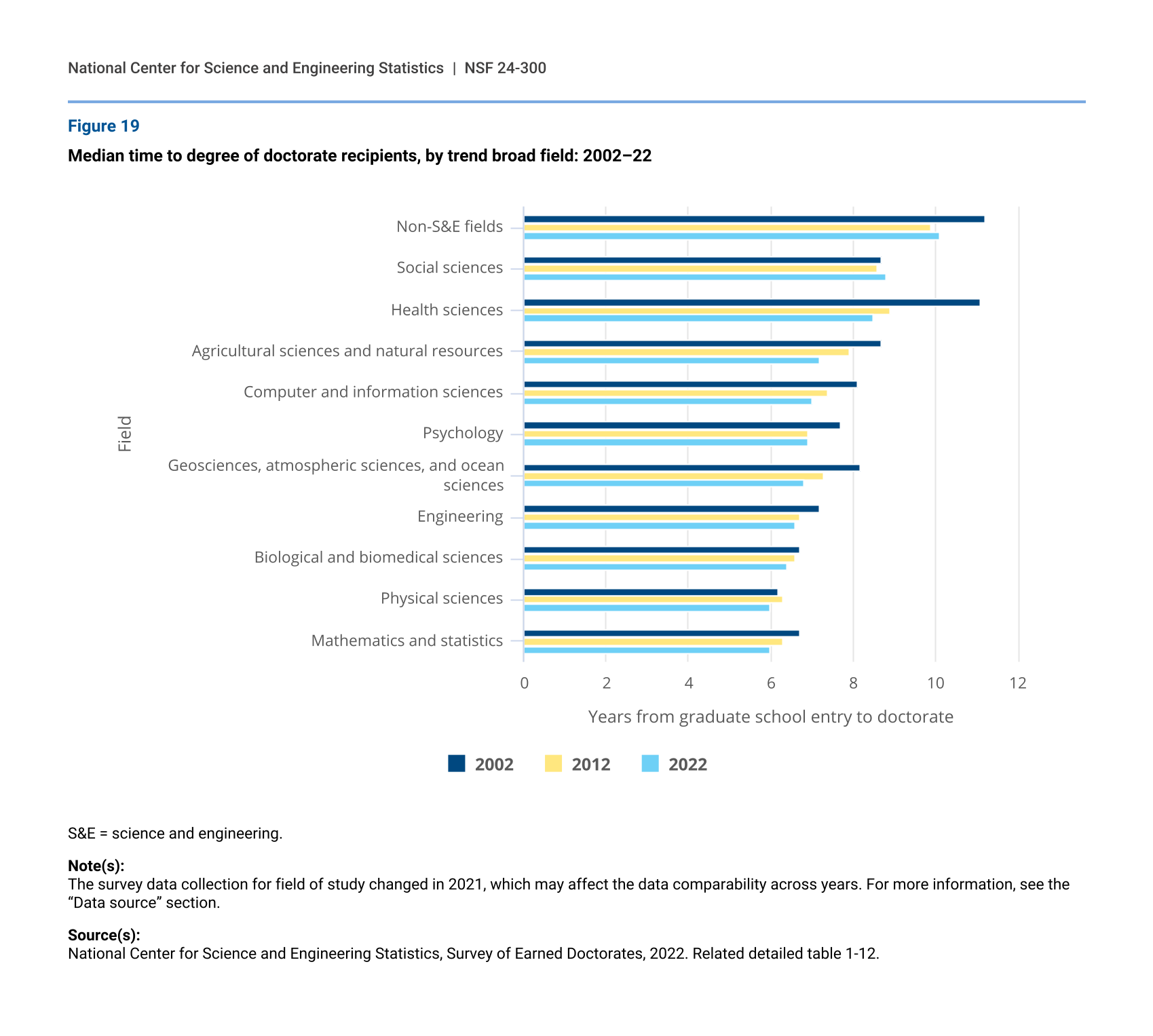
The funded PhD period is designed to be completed in three to four years — yet data consistently shows that the majority of doctoral candidates take longer. According to the NSF’s 2023 Survey of Earned Doctorates, the median time US doctoral graduates spent in their programme was 5.7 years, rising to 7.2 years of total time in graduate school. In the UK, HEFCE projected that around 73% of students who started full-time research degrees in English institutions in 2010–11 would qualify within seven years — meaning more than one in four will eventually need more time than the system assumes. For humanities and arts PhDs specifically, the median time in programme has been 6.8 years or longer for every cohort from 2003 to 2020 (American Academy of Arts and Sciences). These numbers make thesis extension statistics far more than a bureaucratic footnote: for hundreds of thousands of doctoral candidates each year, understanding how extensions work, how often they are approved, and what grounds succeed is a practical necessity.
This data roundup examines thesis extension and deferral statistics for the UK, US, Australia, and Canada. It draws on official university policy documents, HEFCE and HESA reports, NSF survey data, Council of Graduate Schools research, and peer-reviewed studies on doctoral delay. Where aggregate approval-rate data does not exist in the public domain — because most universities do not publish it — this article reports what is known from institutional policy and cross-national research so that candidates can plan accordingly.
- Median US PhD time in programme: 5.7 years (NSF SED 2023) against a typical 4-year funded period.
- Around 38% of final-year Dutch doctoral candidates in one PLOS ONE study expected to have difficulty finishing on time.
- Average delay for those who did run late: approximately 9–10 months beyond the planned completion date.
- UK institutions typically cap cumulative extensions at 12–24 months over the whole degree; Australia allows up to three 6-month extensions at institutions such as Melbourne.
- In a 2020 CGS survey, 47% of US and Canadian graduate schools were granting COVID-19 extensions on a case-by-case basis; 14% had introduced automatic extensions.
- No aggregate approval-rate figure is published by HESA, HEFCE, CGS, or any national body — extensions are adjudicated individually and institution-by-institution.
How Common Are PhD Delays and Extensions?
Any honest account of thesis extension statistics must begin with one uncomfortable fact: delays are the norm, not the exception. Research synthesised from studies conducted across the Netherlands, the UK, the US, and Australia between 2008 and 2017 consistently shows that the majority of doctoral candidates take longer than their programme’s funded period (Tress Academic, citing ESF 2017; HEFCE 2010; CGS 2010).
The most granular study available is a 2013 PLOS ONE investigation by van de Schoot, Yerkes, Mouw, and Sonneveld, which tracked doctoral candidates in the Netherlands. Their findings:
- Among PhD candidates in their final year, 38% expected to experience difficulty finishing on time (88 out of 232 surveyed candidates).
- Across all surveyed candidates, 27.5% anticipated problems completing on time, while 60.5% expected to finish within schedule.
- For those who did run late, the average overrun was 9.52 months for women and 10.11 months for men.
- The Dutch system’s average doctoral completion rate was approximately 75%.
These figures align with UK data. The UK’s former higher education funding body HEFCE projected in its qualification rates reports that approximately 73% of full-time doctoral students starting in 2010–11 at English institutions would qualify within seven years. Importantly, the average actual completion time in the UK is around 3 years and 8 months against a funded norm of 3 years, meaning the vast majority of UK PhD students are already working beyond the funded window even before a formal extension is required. For students weighing whether to request a formal extension or submit late, our guide to thesis late submission rules, extensions, and academic penalties in 2026 covers the full range of institutional policies and how to navigate them.
Australian data tells a similar story. Between 2010 and 2016, 437,030 domestic and international students enrolled in postgraduate research programmes at Australian public universities, but only 65,101 completed within the same six-year window — a figure that does not represent the eventual completion rate but does illustrate that multi-year delays are structurally embedded in the system. For scholarship holders, the average time between commencement and completion was 4.7 years against a funded minimum of 3 years.
In the US, the NSF’s 2023 Survey of Earned Doctorates — the most comprehensive annual census of doctoral graduates in any country — reported that the median time in programme for all doctorate recipients was 5.7 years, with total elapsed time from bachelor’s degree reaching a median of 8.6 years. Humanities and arts programmes consistently take longer: the American Academy of Arts and Sciences reports that for every cohort from 2003 to 2020, the median time humanities PhD recipients spent in their programmes was 6.8 years or longer, down from 7.5 years in 2003. This structural overshoot means that extension requests are not aberrations — they are a predictable feature of doctoral education.
For context on how extensions interact with broader doctoral attrition and completion data, see thesis completion rates statistics covering institutional data from across the UK, US, and Australia.
Students who have missed or are close to missing their submission window will find practical guidance in what happens if you miss your thesis deadline, which covers the immediate consequences and steps to take at UK, US, and Australian institutions.
If your extension is approved but errors are discovered after submission, understanding how to formally document corrections is equally important — see the guide to how to write a thesis errata sheet for the process at UK and Australian institutions.
Most Common Reasons Extensions Are Requested
Formal extension policies across the UK, Australia, and North America converge on a well-defined set of accepted grounds. The van de Schoot 2013 PLOS ONE study identified four main categories driving PhD delays in its qualitative analysis:
- Practical research setbacks — the most frequently reported cause, encompassing equipment failure, data access problems, delayed ethical approval, and fieldwork disruption.
- Not adhering to the original thesis plan — scope creep, chapter restructuring, and supervisor feedback requiring substantial revision.
- Supervisor-related problems — change of supervisor, periods of supervisor unavailability, or disagreements over thesis direction.
- Personal circumstances — health conditions (physical and mental), caring responsibilities, bereavement, and life events.
When mapped against what university policy documents in 2024–2026 explicitly accept, the picture is consistent:
| Ground cited | Generally accepted? | Documentation typically required |
|---|---|---|
| Serious illness or injury (student) | Yes | Medical certificate from qualified practitioner |
| Mental health condition with clinical evidence | Yes | Clinician letter; may require occupational health referral |
| Disability-related adjustments | Yes (often longer allowance) | Disability services assessment |
| Maternity / paternity / adoption leave | Yes | Formal leave record; UKRI/RTP entitlements apply automatically |
| Death or serious illness of close family member | Yes | Supporting documentation (e.g. death certificate, medical evidence) |
| Equipment failure or lab relocation | Yes | Supervisor confirmation; departmental correspondence |
| Delayed ethical approval (IRB/ethics committee) | Yes | Ethics committee correspondence |
| Serious fieldwork difficulty (access denied, conflict, disaster) | Yes | Supervisor letter; supporting correspondence from field site or consulate |
| Extended jury service or military service | Yes | Official court or military documentation |
| Poor planning or slow progress without other cause | No | N/A — explicitly rejected at most institutions |
| Employment (paid or voluntary) during funded period | No | N/A — often disqualifies UKRI/RTP stipend extension |
| Visa problems or immigration delays | No (Cambridge explicitly excludes) | N/A |
| Wanting more time to improve quality | No | N/A — no exceptional circumstance |
The consistent thread across all institutions is that extensions are granted for circumstances beyond the student’s control that have a demonstrable and documented impact on the research itself. A health crisis that kept a student from the lab for three months is extensible; a general sense of being behind schedule is not.
UK: Extension Policies by Institution
The UK has no single national policy governing thesis extensions. Each university sets its own rules within the broader framework set by the Quality Assurance Agency (QAA) and, for funded students, UK Research and Innovation (UKRI). The following summarises verified policy data from leading UK institutions.
University of Cambridge
Cambridge allows extensions for unavoidable delays, medical issues, disability, and pandemic/conflict impact. Students must apply 3–6 months before the deadline. Medical extensions require “sufficiently detailed contemporary evidence from a medically qualified practitioner.” Extensions for academic reasons alone are limited to approximately one month. The maximum is typically three to four months for full-time students, with longer adjustments possible for disability. Extensions for visa issues, conference attendance, publication, employment, or wanting to improve the thesis are explicitly refused.
University of Oxford
Oxford’s DPhil regulations permit extensions of up to six terms total (roughly two years), but no more than three terms at a time, with divisional policy in practice approving one term at a time to maintain close oversight. Applications must be made via the GSO.15 online form with full supervisor and college support. Both the current state of the thesis and a new timetable must be included. Extensions to UKRI funding and to submission deadlines for leave-related absences (maternity, paternity, medical) are administered separately by the university and the DTP.
University of Manchester
Manchester caps the total extension period at 12 months across the full degree, with any extension beyond 12 months permitted only under the “most exceptional circumstances.” Four extension types are available: programme extension, submission-pending extension, minor corrections extension, and re-submission extension. Applications without a supervisor support letter, a completion plan, and supporting evidence are considered incomplete and not processed. Processing takes up to five weeks.
University of Edinburgh
Edinburgh permits a minimum of one month and a maximum cumulative total of 24 months of extension, with no more than 12 months requested at one time. Interruptions of study (formal “time off”) are capped at 100% of the prescribed full-time period across the whole studentship. The two mechanisms — interruption and extension — serve distinct purposes and cannot be used interchangeably.
University of Nottingham
Nottingham’s thesis-pending period policy lists normally approved grounds as: illness/hospitalisation/accident, maternity/paternity leave, death of a close relative where the student was primary caregiver, extended jury service, and military service. Paid employment during the thesis-pending period is listed as a normally rejected ground. Applications must be submitted at least three months before the period ends, with supervisor backing and a chapter-by-chapter completion plan.
UKRI-Funded Students (All Institutions)
For students funded by UKRI (which includes ESRC, AHRC, BBSRC, EPSRC, MRC, and other councils), extensions to submission dates are permitted only where an approved leave of absence has been taken. UKRI explicitly states that extensions will not be granted for difficulties arising during the continuation period unless under exceptional circumstances, and not retrospectively for absences not notified at the time. Taking up employment during the funded period disqualifies a student from a stipend extension. The total cumulative paid medical leave entitlement within a UKRI award is 28 weeks within any 12-month period; maternity entitlement is 52 weeks.
US: Extension Policies and COVID Legacy
US graduate schools operate with even greater institutional variation than their UK counterparts. There is no federal framework equivalent to UKRI setting minimum extension terms; each graduate school sets its own policy. Some universities — including Texas A&M and Emory — use formal extension signature forms for dissertation/thesis hold or submission deadline extensions. Others administer extensions through the graduate school dean’s office on an entirely ad hoc basis.
What the US data does show is that extensions are structurally necessary given doctoral timelines. NSF data shows that US doctoral students spend a median of 5.7 years in their programme against a typical funded period of 4–5 years in most STEM fields and 5–6 years in humanities. Humanities and arts programmes see medians of 6.8 years or longer — well beyond the end of most fellowship or assistantship funding.
COVID-19 Extensions in the US
The pandemic produced the most documented wave of US thesis extension data available. A May 2020 survey by the Council of Graduate Schools (CGS), covering 201 responses from 456 US and Canadian member institutions (44% response rate), found:
- 47% of graduate deans reported granting extensions on a case-by-case basis due to COVID-19.
- 14% had either granted automatic extensions or were doing so case-by-case beyond their standard policy.
- 18% did not anticipate any changes to current extension policies.
By late 2020 and into 2021, multiple institutions — including MIT, Stanford, Harvard, and large state university systems — had introduced emergency no-fault extension or suspension-of-clock mechanisms for doctoral students, particularly those whose field research or laboratory access was interrupted by campus closures. These provisions typically added one or two semesters to the maximum time-to-degree clock without penalty and without requiring students to demonstrate individual hardship.
The pandemic extensions have now largely expired, but they established policy precedents. Universities that had previously adjudicated all extensions as individual exceptions now have formal frameworks for population-level deferrals in force majeure events.
How international students experienced these pressures is covered in the broader data roundup on international student statistics 2026.
Australia: RTP Extensions and COVID Provisions
Australian doctoral programmes are governed at the institutional level, with the federal government’s Research Training Program (RTP) setting the financial framework for domestic candidate stipends. The standard RTP PhD funding period is 3 years (full-time), extendable to 4 years at institutional discretion.
Australian National University (ANU)
ANU permits PhD candidates to apply for extensions of six months (full-time) or 12 months (part-time) per application. Extensions are considered only on academic grounds — meaning the delay must relate to the progress of the research itself. Scholarship extensions require demonstrating that the research was delayed by circumstances beyond the student’s control that are related to the research rather than personal factors. Candidates must also have completed all relevant progress milestones to date.
University of Melbourne
Melbourne’s standard PhD candidature maximum is four years (full-time) or nine years (part-time). Up to three 6-month extensions (or three 12-month extensions for part-time students) are available beyond the standard maximum. As a COVID-19 specific measure, Melbourne automatically extended the maximum course duration of all enrolled PhD candidates by six months (bringing the maximum to four years and six months) for candidates who had not yet reached their maximum by 1 March 2020. Additionally, COVID-stipend extensions of up to 26 weeks (full-time equivalent) were available where the project was “profoundly affected by COVID-19 to the extent that a major restructure or re-conception of the project” was required. Applications for this specific provision closed on 31 January 2023.
University of South Australia (UniSA)
UniSA operated a similar “Extraordinary COVID-19 Scholarship Extension” scheme for research degree students. These programmes required submission of a COVID-19 Research Impact Record form completed prior to the institutional deadline, documenting which specific research activities were disrupted and how the disruption caused delay.
The Australian pattern reveals an important structural feature: extensions in Australia are more likely to be formally codified (with specific durations and forms) than in the US, and the COVID-19 response demonstrated that the RTP framework can accommodate population-level extension mechanisms rapidly when federal and institutional priorities align.
Canada: Institutional Approaches
Canadian doctoral programmes are funded through a mix of federal tri-council scholarships (CIHR, NSERC, SSHRC), provincial programmes, and institutional funding. Like the US, there is no single national extension policy. Statistics Canada tracks doctoral persistence and graduation, but publicly available data tables from its “Persistence and graduation of doctoral degree students” dataset (Table 37-10-0136-05) do not yet show an aggregate figure on extensions specifically.
What Canadian university policies consistently show — at institutions such as UBC, University of Toronto, and University of Alberta — is that:
- Extensions to thesis submission deadlines are available for documented medical, personal, or research-related reasons.
- Tri-council scholarship holders (CIHR, NSERC, SSHRC) must adhere to their specific award’s terms for any extension; funding bodies have different windows for leave and exceptional-circumstance extensions.
- The total number of terms of enrolment permitted before a student must submit varies by institution but is generally equivalent to UK and Australian maximums.
Canada’s tri-council CIHR Doctoral Research Award, for example, provides funding for up to four years. Students who require additional time beyond this window must complete their degree without tri-council stipend support, relying on institutional funding, teaching assistantships, or self-funding.
Country-by-Country Comparison Table
| Country | Standard funded PhD duration | Typical max cumulative extension | Extension framework | COVID-19 provisions introduced |
|---|---|---|---|---|
| UK | 3–3.5 years (UKRI-funded) | 12–24 months (institution-dependent) | Institutional; UKRI rules apply to funded students | Yes — widespread; case-by-case and automatic at many institutions |
| US | 4–6 years (varies by field/funding) | Varies; no federal maximum | Entirely institutional; case-by-case at graduate school level | Yes — 47% case-by-case; 14% automatic (CGS May 2020) |
| Australia | 3 years RTP minimum; up to 4 years | Up to three 6-month increments (Melbourne); 6–12 months per application (ANU) | Institutional within RTP framework; research-related grounds required for scholarship extensions | Yes — Melbourne auto-extended by 6 months; stipend extensions up to 26 weeks |
| Canada | 4 years (tri-council typical max) | Institutional; stipend support typically ends at award maximum | Entirely institutional; tri-council award terms apply | Varied by institution; no single federal framework |
| Ireland | 4 years standard | Institutional; UCD permits extensions on documented grounds | Institutional; Graduate Studies Office adjudicates | Limited public documentation |
What Gets Rejected: Common Grounds That Fail
Across all four countries, a remarkably consistent set of grounds is explicitly named as unacceptable in institutional policy documentation. Understanding what fails is as important as knowing what succeeds.
- Poor planning or slow progress without documented exceptional cause. Every major UK institution explicitly refuses extensions based on the student simply not being finished. Manchester, Cambridge, Oxford, Nottingham, and Edinburgh all name this category in their refusal criteria.
- Wanting to improve thesis quality — explicitly rejected at Cambridge. Unless there is a genuine exceptional circumstance, a desire for a better thesis is not grounds.
- Employment during the funded period. Taking up paid work during the funded PhD period disqualifies students from UKRI stipend extensions and is rejected at most Australian institutions for scholarship extensions.
- Visa problems or immigration delays. Cambridge explicitly names this as an invalid ground. Visa issues are considered administrative matters outside the university’s control over the research.
- Conference attendance, paper submission, or publications. Conference prep, journal submission rounds, and peer review timelines are not considered exceptional circumstances at any major institution reviewed here.
- English language difficulties where IT alternatives exist (Manchester).
- Speculative “just in case” requests — Cambridge explicitly names these as invalid.
- Volunteer work during the thesis-pending period (Nottingham).
- Pregnancy — unless there are specific medical circumstances attached. Maternity leave itself triggers a separate entitlement; pregnancy per se is not treated as an extension ground outside of medical complications.
The practical consequence is that students approaching a deadline with general progress concerns have very limited options under formal extension policy. The recommended path in that scenario is proactive supervisor engagement, a revised completion plan, and — if the work is substantially complete — a submission pending extension to convert research time to write-up time.
How to Maximise Your Chance of Approval
Drawing on the published policy criteria across UK, Australian, US, and Canadian graduate schools, the following practices consistently appear in guidance for successful extension applications:
1. Apply early
The minimum lead time required before the deadline is 2–3 months at most UK institutions (Cambridge: 3–6 months; Nottingham: 3 months; Manchester: as early as practicable; Edinburgh: 2 months). Retrospective applications — submitted after the deadline has passed — are refused except in the most exceptional circumstances. Oxford’s DPhil regulations make no provision for late applications at all.
2. Submit complete documentation from day one
Manchester explicitly states that incomplete applications are not processed — they are simply returned. Required components almost universally include:
- A supervisor support letter (confirming the grounds and endorsing the extension period requested).
- A completion plan detailing which chapters are done, which are in progress, and a realistic timeline to submission.
- Independent evidence of the cited circumstances — a medical certificate dated contemporaneously with the problem period, ethics committee correspondence, or laboratory confirmation of equipment failure.
3. Request a realistic, specific duration
Graduate schools across the board respond better to well-costed, bounded requests than open-ended ones. “I need three months to complete the analysis chapter and revise the literature review, which the illness period set back” is a stronger framing than “I need more time.” Oxford’s policy specifies that the extension must come with a new, specific submission date.
4. Ensure the circumstances are clearly research-related
At ANU and under UKRI rules, the connection between the cited circumstance and a delay in the research itself must be explicit. A health condition that caused three months of leave is an extensible research delay. General wellbeing stress from the PhD is not, in the absence of clinical evidence.
5. Apply once — apply correctly
Queen Mary University of London specifies that “normally only one application is permitted” unless the reason relates to COVID-19 or other exceptional ongoing circumstances. Applying twice for the same unresolved issue risks having both applications refused.
Students navigating the doctoral process with tight deadlines may also find it useful to review peer review time statistics, which offer relevant context for those planning to incorporate publication timelines into their completion plan. The data in journal peer review time statistics 2026 is particularly relevant for students seeking extensions partly because a submitted paper has not yet returned from review.
COVID-19 and the Extension Landscape in 2026
The COVID-19 pandemic was the largest single disruption to doctoral timelines in the modern era of graduate education. Its impact on thesis extension statistics is measurable in several ways.
In the immediate period (2020–2022), the CGS survey data shows that the majority of US and Canadian graduate institutions activated extension frameworks of one kind or another. University of York in the UK introduced an optional COVID-19 impact statement allowing students to inform examiners how their project had changed, without being disadvantaged for adaptations made under pandemic constraints. The University of Melbourne’s automatic 6-month extension of maximum candidature duration applied to all enrolled PhD and doctoral candidates at scale — an unprecedented population-level deferral.
By 2023–2024, most pandemic-specific provisions had expired. The University of Melbourne’s extraordinary COVID stipend extensions closed to new applications in January 2023. UK institutions wound back blanket COVID accommodations and returned to case-by-case adjudication. The CGS, in its broader research, has noted that while degree completions did not dramatically decline during the pandemic period, time-to-degree data from the NSF SED and other surveys is expected to show elongated median times for cohorts that commenced between 2018 and 2022 — the cohort effect of widespread pandemic delay will appear in completion data over the next several years.
In 2026, the principal COVID legacy for extension policy is institutional infrastructure. Universities that had never codified population-level extension mechanisms now have the policy, administrative, and ethical frameworks in place to do so again. The precedent that doctoral timelines can be adjusted at the institutional level in response to force majeure events is now established in policy at most research-intensive universities across the English-speaking world.
For students who received pandemic extensions and are now approaching a second deadline, the standard individual-circumstances process applies. There is no remaining blanket provision, and institutions are not treating COVID as an ongoing exceptional circumstance for applications filed in 2025 or 2026.
Understanding how extension pressures interact with broader PhD completion data is valuable for anyone planning their doctoral timeline. The data in thesis completion rates statistics provides the wider completion-rate context within which extension requests sit.
Students who are working to stay on schedule — or who need to produce their thesis more efficiently after an approved extension — can use Tesify’s AI thesis writing tools to structure chapters, manage citations, and accelerate the write-up process.
Frequently Asked Questions
How often are PhD thesis extensions granted in the UK?
UK universities consider thesis extensions on a case-by-case basis and no institution publishes an aggregate approval rate. Cambridge, Oxford, Manchester, Edinburgh, and Nottingham all grant extensions, but only for documented exceptional circumstances — primarily illness, caring responsibilities, equipment failure, delayed ethical approval, or disability-related adjustments. Applications filed with full documentation and supervisor support well before the deadline are considered more favourably than those filed without evidence or at the last minute. UKRI-funded students face an additional constraint: extensions to the submission date are only available where an approved leave of absence has been taken.
What is the most common reason PhD students request a thesis extension?
Research consistently identifies practical research setbacks, illness, and failure to adhere to the original thesis plan as the leading causes of PhD delay and extension requests. A 2013 PLOS ONE study of Dutch doctoral candidates found that 38% of final-year students expected difficulty completing on time, with practical setbacks and deviation from the original thesis plan cited most frequently. Personal health issues, supervisor problems, and combining doctoral work with employment obligations also feature prominently across cross-national studies.
How long can a thesis extension be?
Extension lengths vary by institution and country. UK universities typically grant extensions of 1–6 months for standard circumstances, with a maximum cumulative cap of 12–24 months across the full degree (Manchester caps total extensions at 12 months; Edinburgh allows up to 24 months in 12-month increments; Oxford allows up to six terms total). Australian universities such as Melbourne allow up to three 6-month extensions beyond the standard 4-year maximum. UKRI-funded UK students generally qualify for extensions only when an approved leave of absence has been taken; open-ended or speculative extensions are not granted.
Did COVID-19 change how extensions are granted?
Yes, substantially. A 2020 CGS survey of 201 US and Canadian graduate schools found that 47% were granting COVID-19 extensions on a case-by-case basis and 14% had granted automatic extensions. The University of Melbourne extended all enrolled PhD candidates’ maximum course duration by 6 months automatically, and offered additional stipend extensions of up to 26 weeks where research was profoundly disrupted. Most pandemic provisions have now expired, but universities retain the policy infrastructure to activate similar frameworks for future emergencies.
Can UKRI-funded PhD students get an extension?
Yes, but under strict conditions. UKRI-funded students may have their submission date extended to account for an approved leave of absence — for example, medical leave, maternity or paternity leave, or disability adjustments. Extensions are not granted for poor planning, employment, or general writing difficulties. ESRC and AHRC-funded students should consult their Doctoral Training Partnership, as each DTP administers the policy within UKRI’s framework. Taking up paid employment during the funded period disqualifies a student from a stipend extension.
What reasons will be rejected for a thesis extension request?
Most UK, Australian, and North American universities explicitly refuse extensions for: poor time management or poor planning, wanting to improve thesis quality without exceptional cause, employment during the funded period (voluntary or paid), visa issues, conference preparation, English language difficulties where IT alternatives exist, and speculative requests. Personal circumstances that were foreseeable at the start of the programme also tend to be declined unless they involve a sudden unexpected deterioration in circumstances.
How do I maximise my chances of a thesis extension being approved?
Apply at least 2–3 months before your deadline — most universities require this lead time and refuse retrospective applications. Submit complete documentation: a supervisor support letter, a detailed completion plan showing chapters completed and remaining, and independent evidence of the cited circumstances (medical certificate, ethics committee correspondence, equipment failure confirmation). Request a realistic timeframe — short, bounded extensions with a clear completion plan are approved far more often than open-ended requests. Frame the request around the impact on the research itself, not general inconvenience.
Write your thesis with AI
Structure, draft, cite, and format your thesis faster with Tesify’s AI writing tools, automatic bibliography, and plagiarism checker. Free to start, no credit card required.






Leave a Reply