

Thesis Conclusion Example vs Abstract: Which Actually Works?
Most students write their abstract and conclusion within 48 hours of submission — exhausted, caffeinated, and frankly guessing. That’s a problem, because these two sections are the most read parts of your entire thesis. Your examiner may read nothing else in full. Your conclusion isn’t a formality, and your abstract isn’t just a summary — but here’s the catch: almost every student confuses what each one is actually supposed to do.
So which one matters more? Which one is harder to write? And when you look at a real thesis conclusion example next to a real abstract, what’s the actual difference? This guide settles it — with real examples, a side-by-side comparison, and a clear framework you can apply today.
Abstract vs Conclusion: The Core Difference in Thesis & Dissertation Writing
Here’s where most students go wrong: they write both sections as if they’re the same thing wearing different hats. They’re not. The abstract and the conclusion have fundamentally different jobs, different audiences, and different structural rules.
A thesis abstract is a concise, standalone summary (typically 150–300 words) placed at the front of your dissertation. It describes your research problem, methodology, key findings, and conclusions — written so that a reader can understand your entire project without reading a single other page.
A thesis conclusion is a full chapter (usually 1,000–2,500 words) that synthesises your findings, answers your research questions, reflects on limitations, discusses implications, and proposes future research directions. It’s the intellectual endpoint of your argument.
Think of it this way: the abstract is your thesis’s elevator pitch. The conclusion is your thesis’s last chapter — and the place where you finally get to say, “Here’s what it all means.”
According to a 2022 NSF/NCSES report on Doctorate Recipients from U.S. Universities, over 55,000 doctoral degrees are awarded annually in the US alone. Every single one of those theses contains both an abstract and a conclusion — yet remarkably few students receive explicit instruction on how to differentiate them.
The abstract lives at the front of your thesis and is often the only thing indexed by databases like ProQuest, DART-Europe, or the British Library EThOS. The conclusion sits at the back and signals your scholarly maturity to your examiner. One is public-facing; the other is examiners-facing. Get that distinction wrong, and both sections suffer.
For a deeper look at how these conventions shift depending on degree type and country, check out our guide on dissertation vs thesis conventions — because what’s expected at a UK master’s level looks quite different from a US doctoral thesis.
What a Thesis Abstract Must Include (With a Real Example)
The abstract is brutal to write well precisely because it demands that you compress months — sometimes years — of work into 250 words without losing the essence. It’s not a teaser. It’s a complete micro-thesis.
The Five Components of a Strong Abstract
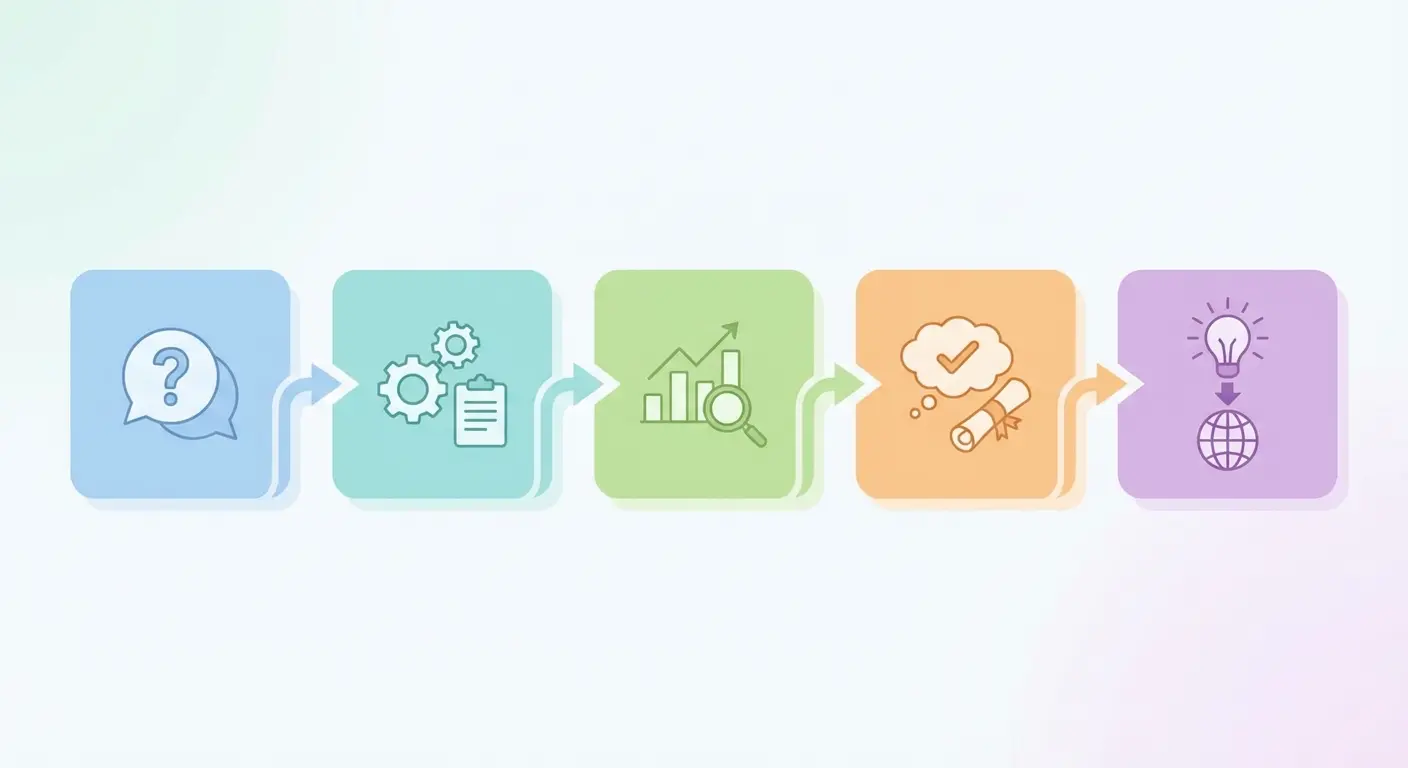
- The Research Problem: What gap, question, or issue does your study address? One to two sentences, maximum.
- The Methodology: How did you investigate it? Quantitative, qualitative, mixed methods? What was your sample or dataset?
- Key Findings: What did you actually discover? Be specific — numbers, patterns, or qualitative themes.
- Conclusions: What do these findings mean? What answer do they provide to your research question?
- Implications or Significance: Why should anyone care? One sentence on why your contribution matters.
Real Abstract Example (Social Sciences, Master’s Level)
“This study examines the relationship between social media use and academic procrastination among undergraduate students at three UK universities (n=412). Using a mixed-methods design combining a validated procrastination scale with semi-structured interviews, the research found that students who used social media for more than three hours daily reported procrastination scores 34% higher than low-use peers. Qualitative data revealed that notification-driven interruptions — rather than passive browsing — were the primary driver of task avoidance. These findings suggest that digital wellbeing interventions should target notification management rather than blanket screen-time reduction. Implications for university support services and app design are discussed.”
Notice what that abstract does: it answers the who, what, how, found, and so what — all in under 130 words. That’s the target. Clear, specific, and completely self-contained.
What most people miss is that your abstract should be written last, even though it appears first. Only once your conclusion chapter is final will you know exactly what your abstract needs to say. The Purdue OWL Thesis & Dissertation Overview makes this point clearly: the abstract is a distillation, not a draft.
Thesis Conclusion Example and Structure: What Examiners Actually Want
Your conclusion chapter is where you stop reporting and start thinking. This distinction is everything. Students who write weak conclusions typically do one of two things: they summarise findings they’ve already summarised in the discussion chapter, or they trail off into vague future-research platitudes. Neither impresses an examiner.
The Core Structure of a Thesis Conclusion Chapter
- Opening that Reminds the Reader of the Purpose: Briefly restate your research aim and questions — not copy-paste from Chapter 1, but a refined restatement that reflects what you now know.
- Summary of Key Findings: A concise synthesis (not repetition) of what you found across your chapters. This is 200–400 words at most.
- Answers to Research Questions: Go through each research question and explicitly answer it. This is the single most important structural element most students skip.
- Theoretical and Practical Contributions: What does your work add to existing knowledge? What can practitioners actually do with your findings?
- Limitations: Honest, specific, and not catastrophising. Limitations show intellectual maturity, not weakness.
- Recommendations for Future Research: Specific, grounded suggestions — not generic “more research is needed” filler.
- Closing Statement: A memorable final thought that returns to the significance of your work.
Real Thesis Conclusion Example (Opening Paragraph)
“This thesis set out to investigate whether notification-driven social media use significantly predicts academic procrastination among UK undergraduates — a question motivated by the gap between existing screen-time research and students’ lived digital experiences. The findings confirm this relationship with statistical significance (β=0.47, p<0.001), and qualitative evidence reveals the mechanism: it is the anticipatory pull of notifications, not passive content consumption, that disrupts sustained academic effort. These results have direct implications for both university digital wellbeing programmes and EdTech platform design.”
See the difference? That conclusion opener doesn’t just say “this study found X.” It reconnects the finding to the original question and immediately signals the contribution. That’s what examiners at institutions like UCL, Edinburgh, and the University of Melbourne are looking for.
The Thesis Whisperer — run by Professor Inger Mewburn of Australian National University — consistently emphasises one counterintuitive point: a conclusion that admits what it didn’t find is often stronger than one that overclaims. Intellectual honesty isn’t a weakness in your conclusion; it’s a signal of scholarly confidence.
If you want to see how the conclusion fits into a complete drafting workflow, our 6-week dissertation draft plan walks you through exactly when to write each section — and why leaving the conclusion until week five is actually the right call.
Side-by-Side Comparison: Thesis Abstract vs Conclusion
Still not sure which section needs what? This table makes the answer unavoidable.
| Feature | Thesis Abstract | Thesis Conclusion |
|---|---|---|
| Position in thesis | Front matter (before Chapter 1) | Final chapter (after Discussion) |
| Typical word count | 150–300 words | 1,000–2,500 words |
| Primary audience | Database users, future researchers, admissions | Thesis examiners, supervisors |
| Main purpose | Discoverability & first impressions | Synthesis, interpretation, contribution |
| Covers limitations? | Rarely (only if space allows) | Yes — essential component |
| References/citations | None | Minimal — synthesises, doesn’t re-argue |
| Future research | One sentence maximum | Full section with specific recommendations |
| Written when? | After the conclusion is finalised | After the discussion chapter is complete |
| Standalone? | Yes — must make sense without the thesis | No — assumes reader has read previous chapters |
| Tense | Mixed (past for methods, present for conclusions) | Past for findings, present for implications |
Common Mistakes Students Make in Thesis & Dissertation Writing
Fair warning: this section might sting a little. These are the mistakes that appear in submitted theses at universities across the UK, US, and Australia every single year — caught too late to fix properly.
Mistakes in the Abstract
- Writing the abstract first. It sounds efficient. It isn’t. Your abstract can only be accurate once your conclusions are finalised — which is the last thing you write.
- Being vague about methodology. “A qualitative approach was used” tells the reader almost nothing. Specify your design, your sample size, and your analytical method.
- Treating it as an introduction. The abstract is not the place to explain your motivation or background context. Every word must pull weight — findings and conclusions first.
- Exceeding the word limit. Most institutions specify 300 words maximum. Going over signals that you can’t synthesise — which is exactly the skill the abstract is meant to demonstrate.
Mistakes in the Conclusion
- Copying the discussion chapter. If your conclusion reads like a longer version of your discussion, something has gone wrong. The conclusion synthesises; the discussion analyses.
- Skipping the explicit answers to research questions. This is the most common examiner complaint. Go through each research question one by one and state — directly — what your findings revealed.
- Generic limitations. “The sample size was small” is a start, but what specifically does that mean for the generalisability of your findings? Be precise.
- Ending weakly. Your final paragraph is the last thing your examiner reads. Don’t let it drift into vague hope for future work. Make a clear, confident statement about what your research contributes.
Examiners at institutions like Oxford and Harvard are not looking for perfection — they’re looking for awareness. Knowing the limits of your work is a sign of stronger scholarship than pretending those limits don’t exist.
To fix structural problems before they reach the examiner, our guide on how to improve your thesis writing covers seven practical revision strategies — including a checklist specifically for conclusion and abstract chapters.
Step-by-Step Framework for Writing Both Sections in Your Thesis
Here’s where the theory becomes action. This framework works whether you’re finishing an undergraduate dissertation, a master’s thesis, or a PhD. Follow the sequence — the order genuinely matters.
Phase 1: Write Your Conclusion First (Yes, Really)
- List your research questions. Open a blank document. Copy each research question verbatim from Chapter 1.
- Answer each question in 2–3 sentences. Draw only from your findings and discussion — don’t introduce new arguments here.
- Write your contributions paragraph. Ask yourself: What does the academic field now know that it didn’t before my study? What can practitioners do differently?
- Draft your limitations section. Aim for three to five specific, honest limitations. For each one, briefly note what future research could address it.
- Write your future research recommendations. Be specific. Don’t say “more research is needed.” Say: “A longitudinal study tracking the same cohort over 24 months would…”
- Craft your closing statement. Return to the big picture — why does your research matter beyond the immediate field? One powerful paragraph.
- Write a brief opening paragraph that restates the aim and signals where you’re going in the chapter.
Phase 2: Extract Your Abstract From the Conclusion
- Take one sentence from each conclusion component: research problem, methodology, key finding(s), conclusion, and implication.
- Assemble and edit them into a coherent paragraph. They should flow — not read like a list of disconnected sentences.
- Check the word count. Most UK institutions require 250–300 words. US institutions vary, but 150–250 is standard for master’s theses.
- Read it aloud. If any sentence could be removed without losing meaning, cut it. Every word must earn its place.
- Check for jargon. Your abstract may be indexed by researchers outside your subfield. Acronyms should be spelled out; technical terms should be used only where necessary.
- ✅ Abstract is under your institution’s word limit
- ✅ Abstract contains no citations or references
- ✅ Conclusion explicitly answers each research question
- ✅ Limitations are specific, not generic
- ✅ Future research recommendations are concrete
- ✅ Conclusion does not introduce new findings or literature
- ✅ Abstract is written in the correct tense (past for methods/findings, present for conclusions)
- ✅ Both sections have been proofread in isolation — not just as part of the whole document
For broader structural guidance on thesis and dissertation writing — including how methodological choices affect your conclusion and abstract — the team at Grad Coach has put together an excellent foundational resource worth bookmarking.
And if you’re still at the early stages and wondering how these final sections connect to everything that came before them, the Purdue OWL’s dissertation getting started guide gives you a strong structural overview to work backwards from.
Frequently Asked Questions
What is the difference between a thesis abstract and a thesis conclusion?
A thesis abstract is a short, standalone summary (150–300 words) placed before your thesis begins, designed for discoverability and first impressions. A thesis conclusion is a full chapter (1,000–2,500 words) at the end of your thesis that synthesises findings, answers research questions, discusses limitations, and proposes future directions. They serve different readers and different purposes entirely.
Should I write the abstract or the conclusion first?
Always write your conclusion first. Your abstract should be extracted directly from your conclusion once it’s finalised — it’s a compressed version of what you’ve already articulated in full. Writing the abstract first leads to inaccuracies, vague claims, and misalignment between the front and back of your thesis.
How long should a thesis conclusion be?
For most master’s dissertations, a conclusion chapter runs between 1,000 and 1,500 words. For PhD theses, 1,500 to 2,500 words is standard. The exact length depends on your institution’s guidelines and the complexity of your research questions — always check your student handbook first.
Can a thesis conclusion include new information?
No — introducing new findings, arguments, or literature in your conclusion is one of the most common examiner criticisms. Your conclusion synthesises and interprets what has already been established in your results and discussion chapters. New citations or data points belong in the body of the thesis, not the final chapter.
Does a thesis abstract need references?
No. A thesis abstract should contain no citations or references whatsoever. It must be completely self-contained and readable without any accompanying material. Including references in an abstract is considered a formatting error at most UK, US, Australian, and Canadian institutions.
How is a thesis conclusion different from a discussion chapter?
The discussion chapter analyses and interprets your findings in depth, often comparing them to existing literature. The conclusion chapter steps back and synthesises those interpretations into answers to your research questions, broader contributions, and future recommendations. Think of the discussion as the evidence and the conclusion as the verdict.
Keep Building Your Thesis Writing Skills
Getting your conclusion and abstract right is one piece of a much larger puzzle. If you want to tackle your thesis structure systematically — without the last-minute panic — here are three resources to keep you moving:
- Understand how abstract and conclusion conventions vary by country and degree type: dissertation vs thesis conventions explained
- Fix structural and writing problems before submission: improve your thesis writing with 7 proven steps
- Get a realistic timeline that accounts for redrafting both sections: follow a 6‑week dissertation draft plan
And if you’re looking for a community, templates, and tools — Grad Coach’s Free Dissertation Toolkit is one of the most genuinely useful free resources available to students right now.
Write your thesis with AI
Structure, draft, cite, and format your thesis faster with Tesify’s AI writing tools, automatic bibliography, and plagiarism checker. Free to start, no credit card required.





Leave a Reply