

Research Methodology Types: The Complete 2026 Guide
Here’s the thing nobody tells you when you sit down to write your thesis: picking the wrong research methodology doesn’t just cost you marks — it can invalidate your entire study. Supervisors at Oxford, Harvard, and UCL report it as one of the most common dissertation failures. And yet, most students spend less than a day deciding which approach to use.
If you’ve stared at the words “quantitative,” “qualitative,” and “mixed methods” and felt a cold sweat, you’re not alone. This guide cuts through the confusion. By the end, you’ll know exactly which research methodology type fits your research question — and how to defend that choice confidently in front of any academic panel.
What Is Research Methodology (and Why It Matters for Your Thesis)
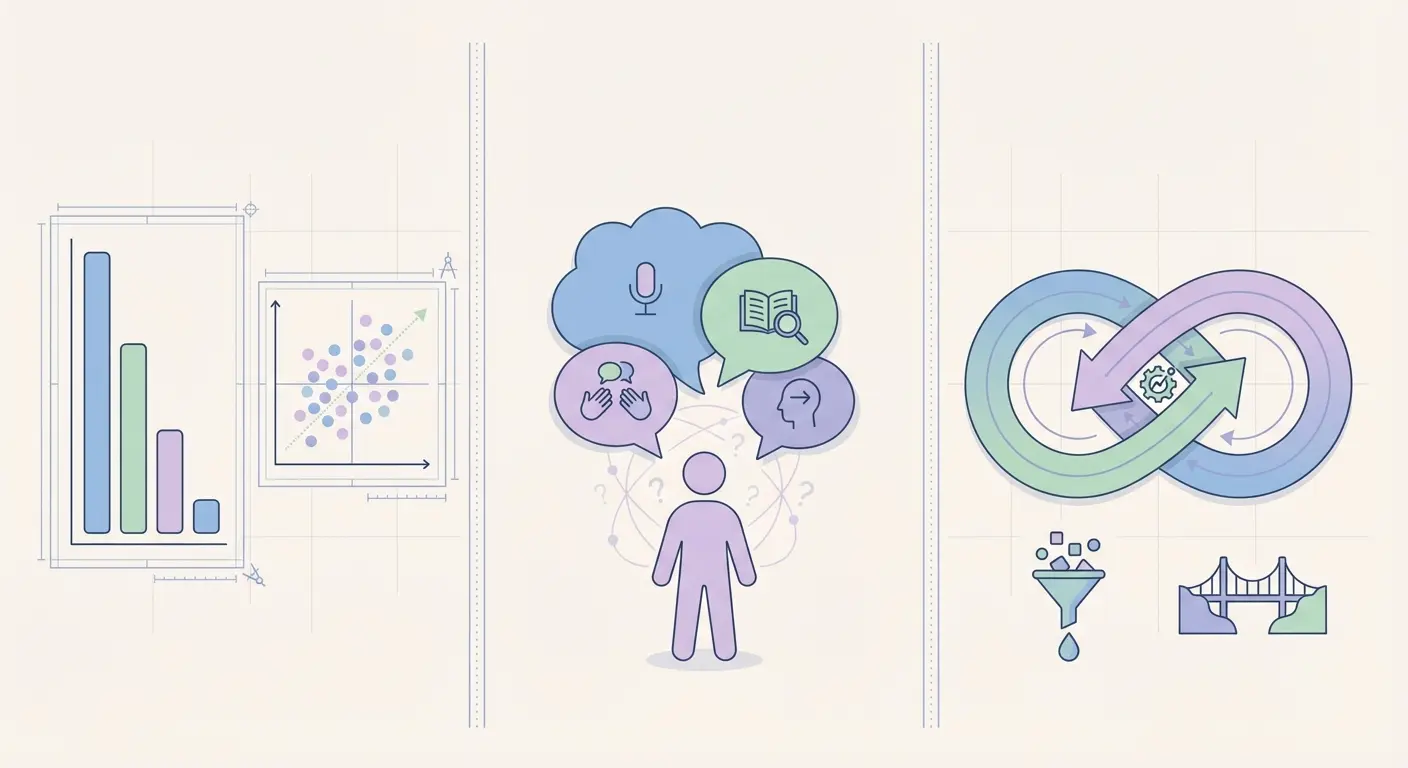
Think of methodology as the architecture of your research. The research question is what you want to build; the methodology is the blueprint that makes it structurally sound. Without a coherent methodology, your findings — however interesting — can’t be trusted, replicated, or published.
According to a 2024 analysis in PLOS Computational Biology, methodological clarity is one of the top predictors of thesis project success, particularly for students working in computational and data-heavy fields. And it’s not just the sciences — humanities and social science supervisors consistently flag “unjustified methodology” as a primary cause of revisions and resubmissions.
What most students miss is the difference between methodology (the overarching framework) and methods (the specific tools, like surveys or interviews). You need both — but they sit at different levels of abstraction. Your methodology explains why you chose to do what you did; your methods describe what you actually did.

Research Philosophy: Where Methodology Begins
Before you choose between a survey and an interview, you need to answer a deeper question: what do you believe about the nature of knowledge? This isn’t philosophy for philosophy’s sake — examiners at Cambridge, LSE, and MIT explicitly expect you to articulate your epistemological position.
Ontology and Epistemology: A Quick Primer
Ontology asks: what is the nature of reality? Is there one objective truth, or are realities socially constructed? Epistemology asks: how do we come to know that truth? These two positions directly shape which methodology is appropriate for your study.
- Positivism — Reality is objective and measurable. Knowledge comes from empirical observation. Favours quantitative methods.
- Interpretivism — Reality is subjective and socially constructed. Favours qualitative methods and seeks to understand meaning.
- Pragmatism — Truth is what works. Favours mixed methods; less concerned with philosophical purity, more concerned with solving problems.
- Critical Realism — Reality exists independently but our knowledge of it is always partial. Often used in social sciences combining both method types.
Here’s where it gets interesting: many students choose their data collection method first and then reverse-engineer a philosophical justification. Don’t. Examiners can spot this instantly. Instead, start with your research question and let your philosophy emerge naturally from what you’re actually trying to find out.
For a structured overview of how these paradigms connect to full research designs, the Research Methodology Guide 2026: Complete Overview is an excellent next read — it maps paradigms to methodology types with worked examples from across disciplines.
Quantitative Research Methods Explained
Quantitative research is built on numbers. It tests hypotheses, measures variables, and produces findings that can be generalised to a broader population — at least in theory.
Core Characteristics of Quantitative Research
- Structured data collection (surveys, experiments, secondary datasets)
- Statistical analysis (regression, ANOVA, chi-square, t-tests)
- Large sample sizes for statistical power
- Replicability — another researcher should be able to repeat your study
- Deductive reasoning — you start with a hypothesis and test it
When to Choose Quantitative Methods
Choose quantitative methods when you’re asking “how much,” “how many,” or “is there a relationship between X and Y?” Classic thesis examples include: measuring the effect of a drug on blood pressure, analysing the correlation between study hours and exam performance, or testing whether customer satisfaction scores differ between two retail formats.
A critical insight that textbooks rarely emphasise: quantitative methods are only as good as your measurement instruments. A poorly designed Likert scale or a biased sampling frame will produce precise-looking numbers that mean very little. Validity and reliability of your instruments must be justified explicitly — not assumed.
Common Quantitative Data Collection Methods
- Structured surveys / questionnaires — Fast, scalable, but limited in depth
- Experiments (RCTs) — Gold standard for causality; harder to achieve in real-world settings
- Quasi-experiments — No random assignment; more feasible for student research
- Secondary data analysis — Using existing datasets (ONS, OECD, Statista, NHS Digital)
- Observational studies — Systematic observation with numerical coding
Qualitative Research Methods Explained
Qualitative research explores meaning. It asks not just what is happening, but why — and how people make sense of their experiences. If quantitative research is about breadth, qualitative research is about depth.
Core Characteristics of Qualitative Research
- Inductive reasoning — patterns and theories emerge from the data
- Small, purposive samples rather than random large ones
- Non-numerical data: interviews, focus groups, documents, observations
- Researcher as the primary instrument of data collection
- Findings that are context-specific rather than universally generalisable
Qualitative Research Designs
The five major qualitative research designs you’ll encounter in thesis writing are:
- Phenomenology — Explores lived experiences. Common in nursing, psychology, education. Example: “What is the lived experience of first-generation students at Russell Group universities?”
- Grounded Theory — Builds theory from data. Useful when theory is underdeveloped. Involves theoretical sampling and constant comparison.
- Ethnography — Immersive observation of a culture or group over time. Rare in undergraduate dissertations; more common at PhD level.
- Case Study — In-depth investigation of a single case (person, organisation, event). Very common in business and social science dissertations.
- Narrative Inquiry — Analyses stories and personal accounts. Used in education, sociology, and history.
Qualitative Data Collection Methods
- Semi-structured interviews — Most popular in student dissertations; flexible yet guided
- Focus groups — Good for exploring shared perceptions; harder to facilitate
- Document analysis — Policy documents, social media, historical records
- Participant observation — Researcher participates in the setting being studied
- Visual methods — Photo elicitation, video analysis
What most guides don’t tell you: qualitative research isn’t “easier” than quantitative. Thematic analysis of 20 hour-long interview transcripts is an enormous analytical undertaking. Plan your time accordingly — and use tools like NVivo or ATLAS.ti to manage your data.
Mixed Methods Research: When to Combine Approaches
Mixed methods research doesn’t just combine quantitative and qualitative data — it integrates them to answer questions that neither approach could answer alone.
The three core mixed methods designs are:
- Explanatory Sequential — Quantitative first, qualitative second. You collect numbers, find something surprising, then interview people to understand why. Great for dissertation writers who start with survey data and want to dig deeper.
- Exploratory Sequential — Qualitative first, quantitative second. You explore a phenomenon through interviews, then test what you found at scale with a survey. Useful when the literature is sparse.
- Convergent Parallel — Both strands collected simultaneously and merged. More complex; often recommended for PhD-level rather than master’s dissertations.
Fair warning: mixed methods research requires you to be competent in both analytical traditions. It’s the most demanding design for a student researcher. Unless your research question genuinely requires it — and you have the time and supervisor support — think carefully before choosing this route.
Head-to-Head Comparison: Which Methodology Is Right for You?
This table gives you a clear, scannable comparison so you can match your research question to the right approach.
| Feature | Quantitative | Qualitative | Mixed Methods |
|---|---|---|---|
| Primary Goal | Test hypotheses, measure relationships | Explore meaning, understand experience | Complement both; answer complex questions |
| Data Type | Numbers, statistics | Words, images, themes | Both |
| Reasoning | Deductive | Inductive | Both (abductive) |
| Sample Size | Large (100+) | Small (8–30 typical) | Varies by design |
| Philosophical Basis | Positivism | Interpretivism | Pragmatism / Critical Realism |
| Typical Analysis | SPSS, R, Stata | Thematic, discourse, narrative | Both integrated |
| Generalisability | High (with valid sampling) | Low (context-specific) | Moderate |
| Best For | STEM, economics, psychology, business | Social science, education, health, humanities | Complex social/health research, PhD studies |
| Time Required | Medium (data collection fast; analysis medium) | High (transcription + analysis intensive) | Very High |
Research Design Types Within Each Methodology
Methodology and research design are related but distinct. Your methodology is the broad framework; your research design is the specific blueprint for achieving your aims within that framework.
Key Quantitative Research Designs
- Descriptive — Describes characteristics of a population. No manipulation. Example: a survey of study habits among UK undergraduates.
- Correlational — Examines relationships between variables without implying causation.
- Experimental (RCT) — Randomly assigns participants to conditions to establish causality.
- Quasi-experimental — Tests causal relationships without full randomisation (e.g., pre/post test designs).
- Longitudinal — Follows the same subjects over time. Powerful but time-intensive.
- Cross-sectional — Snapshot at one point in time. Most feasible for student research.
Key Qualitative Research Designs
- Phenomenological — Lived experience at the centre
- Grounded Theory — Theory-generating from data
- Ethnographic — Cultural immersion
- Case Study — Bounded, in-depth unit of analysis
- Action Research — Researcher and participants work together to solve a problem; common in education and nursing
To ensure your chosen design meets reproducibility standards — something examiners increasingly scrutinise — the Research Methodology Tips for Reproducibility 2024 guide offers a practical checklist for making your methods transparent and replicable.
How to Choose Your Research Methodology (Step-by-Step)
Choosing a methodology isn’t guesswork — there’s a logical sequence you can follow to arrive at a defensible decision.
-
Start with your research question.
Is it asking “how much” or “how many”? Go quantitative. Is it asking “what does it mean” or “how does this work”? Go qualitative. Is it asking both? Consider mixed methods. -
Identify your research aims and objectives.
If you’re aiming to “measure,” “compare,” or “test,” you’re in quantitative territory. If you’re aiming to “explore,” “understand,” or “interpret,” qualitative is your fit. -
Review what the existing literature uses.
What methodology dominates your field? While you don’t have to follow the herd, diverging significantly requires strong justification. Check 10–15 recent papers in your area. -
Consider your practical constraints.
Do you have access to 200 survey respondents? Or can you realistically recruit 12 interview participants? Time, budget, and ethics approval windows matter enormously at undergraduate and master’s level. -
Align with your philosophical position.
Once you’ve worked out what you believe about knowledge (positivist? interpretivist?), your methodology should flow naturally from that. -
Discuss with your supervisor before finalising.
This sounds obvious. Yet a surprising number of students choose their entire methodology before their first supervision meeting. Your supervisor may have strong views — and access to datasets or participant networks that could shape your design.
Writing Your Methodology Chapter: Practical Tips
Knowing your methodology is one thing. Writing a chapter that convinces your examiner is another — and it’s a skill in itself.
The Core Structure of a Methodology Chapter
- Research Philosophy — Ontology, epistemology, and your chosen paradigm
- Research Approach — Inductive, deductive, or abductive
- Research Design — Your specific design type and why it fits your aims
- Data Collection Methods — Instruments, procedures, sample size, and recruitment
- Sampling Strategy — Probability or non-probability; specific type (purposive, snowball, stratified, etc.)
- Data Analysis — How you’ll actually analyse your data (thematic analysis, regression, content analysis)
- Ethical Considerations — Consent, anonymity, data storage, potential harms
- Limitations — Every methodology has weaknesses; acknowledge them honestly
The Biggest Mistake Students Make
Describing your methods without justifying them. Examiners don’t just want to know what you did — they want to know why. Every methodological choice needs a rationale. “I chose semi-structured interviews because they allow for flexible, in-depth exploration of participants’ perspectives, which aligns with my interpretivist stance” is good. “I did interviews” is not.
Referencing Your Methodology
Your methodology chapter needs citations. Creswell (2018), Bryman (2016), and Saunders, Lewis & Thornhill (2019) — the “Research Onion” authors — are the most commonly cited methodology texts in UK universities. Always cite the specific edition your institution recommends.
For consistent citation formatting across your methods chapter and bibliography, see our guide on Research Methodology: Standardize Citations 2025 — particularly useful if you’re juggling APA, Harvard, and Chicago across different sections.
The Purdue OWL’s Thesis and Dissertation Overview is also a reliable, freely accessible reference point for structural conventions, particularly for North American institutions.
Tools That Make Your Life Easier
- Zotero — Free reference manager that handles APA, Harvard, Chicago, and more. Saves hours on formatting.
- SPSS / R / Stata — Quantitative analysis tools; R is free and increasingly expected in academic settings
- NVivo / ATLAS.ti / MAXQDA — Qualitative data analysis software
- Overleaf — If your institution uses LaTeX, Overleaf’s thesis template library has formats for dozens of universities
If you learn better through video, Scribbr’s How to Write a Research Methodology in 4 Steps is an excellent 10-minute walkthrough. For broader dissertation structure, the Times Higher Education step-by-step PhD thesis guide is worth bookmarking — even if you’re at master’s level, the structural logic applies.
Frequently Asked Questions
What is the most common research methodology for a master’s dissertation?
The most common methodology at master’s level is qualitative research using semi-structured interviews or thematic analysis, particularly in social sciences, education, and business. Quantitative surveys are the second most common choice, especially in psychology, health sciences, and economics. Mixed methods, while valued, are less frequent at master’s level due to time and complexity constraints.
How long should the methodology chapter be in a dissertation?
For most master’s dissertations (15,000–20,000 words), the methodology chapter typically runs 2,000–3,500 words — roughly 15–20% of total word count. At undergraduate level (8,000–12,000 words), aim for 1,000–2,000 words. PhD theses vary widely, but a methodology chapter of 5,000–8,000 words is common. Always check your institution’s specific guidelines and ask your supervisor.
Can I change my research methodology after starting data collection?
Changing methodology mid-study is possible but risky. If your initial approach clearly isn’t answering your research question, speak to your supervisor immediately. Minor adjustments (e.g., adding a follow-up interview round) are manageable. Wholesale changes (switching from quantitative to qualitative) typically require ethics re-approval and will impact your timeline significantly. Prevention is always better — invest time in your methodology design upfront.
What’s the difference between research methodology and research methods?
Research methodology is the overarching framework — the philosophical and strategic approach to your study. Research methods are the specific tools you use within that framework, such as surveys, interviews, or experiments. Think of methodology as the “why and how you approach the study” and methods as the “what you actually do to collect data.”
Is qualitative or quantitative research better for a dissertation?
Neither is objectively “better” — the right choice depends entirely on your research question and aims. Quantitative methods are stronger for testing hypotheses and measuring relationships at scale. Qualitative methods are stronger for exploring complex, context-dependent phenomena in depth. The best methodology is the one that most appropriately and rigorously answers your specific research question.
Do I need to cite my methodology choices in a dissertation?
Yes — absolutely. Every methodological decision should be justified with reference to academic literature. Key texts include Creswell’s Research Design (2018), Bryman’s Social Research Methods (2016), and Saunders et al.’s Research Methods for Business Students (2019). Failing to cite your methodology choices is one of the most common reasons for examiner feedback requesting revisions.
Choosing Your Research Methodology: The Final Word
Research methodology types aren’t abstract academic concepts — they’re practical decisions with real consequences for the quality and credibility of your thesis. Get this right, and your entire dissertation rests on a solid foundation. Get it wrong, and even brilliant findings can be dismissed.
The process doesn’t have to be overwhelming. Start with your research question. Identify what kind of knowledge you’re trying to produce. Match your philosophy to your approach. Justify every choice. And don’t leave the methodology chapter as an afterthought — it’s often what separates a distinction from a merit.
For the full taxonomy of research paradigms, design strategies, and sampling approaches, the Research Methodology Guide 2026: Complete Overview is your next stop. Built specifically for dissertation and thesis writers who need a structured, current reference — not another textbook.
Explore these related guides on Tesify:
→ Research Methodology Guide 2026: Complete Overview
→ Research Methodology Tips for Reproducibility 2024
→ Research Methodology: Standardize Citations 2025
Write your thesis with AI
Structure, draft, cite, and format your thesis faster with Tesify’s AI writing tools, automatic bibliography, and plagiarism checker. Free to start, no credit card required.






Leave a Reply