
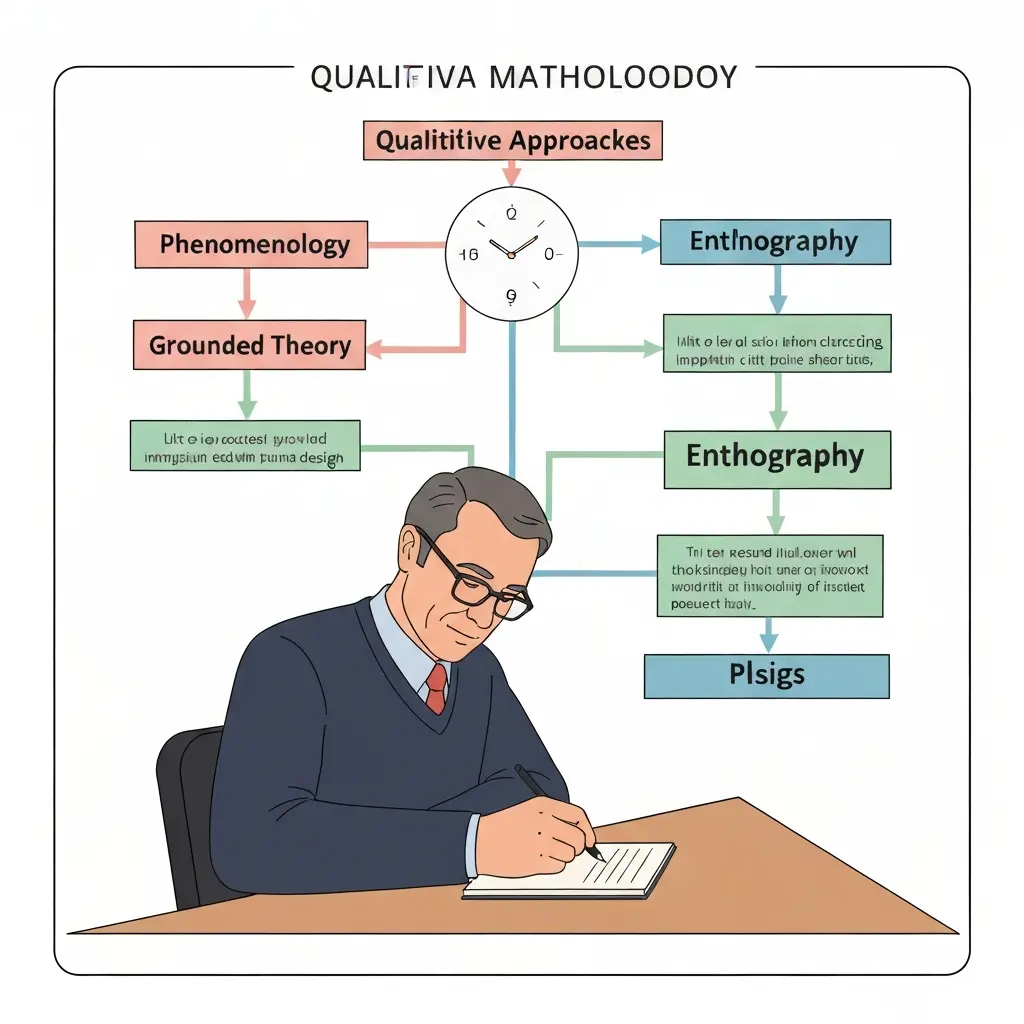
Qualitative Research Methods: The Complete Guide 2026
Choosing the right qualitative research methods is one of the most consequential decisions you will make in your thesis or dissertation. Choose phenomenology when you should have used grounded theory, and your methodology chapter will be incoherent — no matter how good the data collection is. This guide covers all five major qualitative traditions, explains when each is appropriate, provides examples from real research, and gives you a decision framework to select the right approach for your own study in 2026.
Qualitative research explores meaning, experience, and interpretation rather than numerical patterns. It is the appropriate choice when your research questions ask “how,” “what does it mean,” or “why” about lived human experience. Quantitative methods answer “how many” and “how much.” Knowing which family of questions your thesis asks determines whether qualitative research is the right paradigm before you commit to any specific tradition.
What Is Qualitative Research?
Qualitative research is a family of methodological approaches that seek to understand how people experience, interpret, and give meaning to their social worlds. Unlike quantitative research — which converts observations into numbers for statistical analysis — qualitative research works with language, images, actions, and artefacts to generate rich, contextual understanding.
Key characteristics of qualitative research:
- Naturalistic inquiry — data collected in real-world settings, not laboratory conditions
- Interpretive analysis — the researcher is the primary instrument of data collection and analysis
- Inductive reasoning — patterns and theories emerge from data rather than being tested against hypotheses
- Rich, thick description — context and detail are valued over generalisability
- Reflexivity — researchers actively reflect on how their own position influences interpretation
The Five Main Qualitative Traditions
1. Phenomenology
Phenomenology investigates the lived experience of a particular phenomenon from the perspective of those who have experienced it. Rooted in Husserl’s philosophy and developed by Heidegger, Merleau-Ponty, and others, phenomenological research asks: “What is it like to experience X?”
When to use it: When your research question concerns the meaning or essence of an experience — e.g., “What is the lived experience of doctoral students experiencing imposter syndrome?”
Two main variants:
- Descriptive (Husserlian) phenomenology — brackets the researcher’s assumptions (epoché) to describe the essence of experience
- Interpretive (hermeneutic) phenomenology — explores how people interpret their experiences within their historical context
Typical sample size: 5–25 participants. Depth over breadth is the principle — 8–10 interviews is common.
Analysis: Interpretative Phenomenological Analysis (IPA), developed by Jonathan Smith, is the most widely used framework. It involves close reading of transcripts, identifying experiential themes, and constructing a coherent interpretation of shared meanings.
2. Grounded Theory
Grounded theory, developed by Glaser and Strauss (1967), aims to generate theory directly from data rather than testing existing theory. The researcher enters the field with minimal preconceptions and allows a substantive theory of the studied phenomenon to emerge through systematic comparative analysis.
When to use it: When little theory exists to explain a phenomenon, or when you want to develop a new theoretical model of a social process — e.g., “How do junior doctors develop professional identity in the first year of practice?”
Key features:
- Theoretical sampling — participants are selected to develop emerging theory, not for representativeness
- Constant comparative method — each new piece of data is compared against all prior data
- Saturation — data collection stops when new data no longer produces new theoretical insights
- Memo writing — the researcher’s analytical notes form an essential part of the methodology
Note on Glaserian vs Straussian variants: Glaser’s approach is more inductive and emergent; Strauss and Corbin’s approach is more structured, using open, axial, and selective coding. Charmaz’s constructivist grounded theory (2006) is now dominant in social science and healthcare research.
3. Ethnography
Ethnography seeks to understand culture and social practices from the inside, typically through extended fieldwork in which the researcher immerses themselves in the community being studied. Rooted in anthropology, ethnography focuses on the shared meanings, practices, and values of a group.
When to use it: When your research question requires understanding cultural context and social practices in situ — e.g., “How do hedge fund analysts construct risk in their daily trading practice?”
Key data sources:
- Participant observation — the researcher takes part in activities while systematically observing
- Field notes — detailed accounts of observations written contemporaneously
- Interviews — formal and informal conversations with community members
- Artefact analysis — documents, objects, and other material culture
Duration: Traditional ethnography requires extended fieldwork (months to years). Focused ethnography, increasingly common in professional and organisational settings, may involve intensive shorter periods (weeks to months).
4. Case Study
Case study research provides an in-depth investigation of a bounded system — a single case or small number of cases — within its real-world context. Robert Yin (2018) defines the case study as appropriate when “how” and “why” questions are posed and when the investigator has little control over events.
When to use it: When you need to understand a complex phenomenon in context and single or multiple bounded examples can illuminate it — e.g., “How did one NHS Trust respond to a major data breach? What can this tell us about organisational crisis communication?”
Types of case study design:
- Single case study — one intensive, bounded case; ideal for unique or critical cases
- Multiple case study — 2–6 cases; enables cross-case comparison for pattern replication or contrast
- Holistic — whole case as the unit of analysis
- Embedded — multiple units of analysis within one case
5. Narrative Inquiry
Narrative inquiry examines how people construct meaning through stories. Developed by Clandinin and Connelly (2000), it treats narrative — the stories people tell about their lives and experiences — as both the method and the phenomenon under study.
When to use it: When your research question concerns how individuals make sense of significant life events, transitions, or identities — e.g., “How do first-generation university students narrate their educational journey?”
Data collection: In-depth biographical interviews, often multiple sessions; personal documents, diaries, and photographs may also be used.
Analysis: Narrative analysis attends to the structure, content, and performance of stories. Labov’s structural analysis, thematic narrative analysis, and dialogical analysis are three common approaches.
Data Collection Methods in Qualitative Research
| Method | Best For | Typical Traditions |
|---|---|---|
| Semi-structured interviews | Exploring individual perspectives in depth | Phenomenology, Grounded Theory, Case Study |
| Focus groups | Group dynamics, shared meanings, consensus and conflict | Ethnography, Case Study |
| Participant observation | Social practices in natural settings | Ethnography |
| Document analysis | Institutional practices, historical processes | Case Study, Ethnography |
| Biographical/life history interviews | Identity, life transitions, personal meaning-making | Narrative Inquiry, Phenomenology |
| Visual and creative methods | Embodied, non-verbal, and pre-reflective experience | Ethnography, Narrative Inquiry |
Analysis Methods: How to Make Sense of Qualitative Data
The choice of analysis method must align with your tradition and research questions:
- Thematic Analysis (Braun & Clarke) — flexible, widely applicable; identifies patterns of meaning across a dataset; six-phase process. Suitable for most traditions. See our full thematic analysis guide for the complete framework.
- Interpretative Phenomenological Analysis (IPA) — for phenomenology; close reading of individual transcripts; group-level convergences and divergences across participants.
- Grounded Theory Coding — open coding (conceptualising data), focused coding (developing categories), axial coding (relating categories), theoretical coding (integrating into a theory).
- Ethnographic Analysis — iterative; field notes and interviews analysed together; thick description; emic vs etic distinctions.
- Narrative Analysis — structural analysis (orientation, complication, resolution), thematic analysis, performative analysis.
- Discourse Analysis — focuses on how language constructs reality; appropriate when language itself is the object of inquiry.
Trustworthiness and Rigour in Qualitative Research
Rather than validity and reliability (quantitative criteria), qualitative research uses Lincoln and Guba’s (1985) trustworthiness framework:
| Trustworthiness Criterion | Quantitative Equivalent | How to Demonstrate It |
|---|---|---|
| Credibility | Internal validity | Member checking, prolonged engagement, peer debriefing |
| Transferability | External validity | Thick description; reader judges fit to their context |
| Dependability | Reliability | Audit trail; detailed methodology; process documentation |
| Confirmability | Objectivity | Reflexivity; reflexive journal; triangulation |
Decision Framework: Which Method for Which Question?
| If your research question asks… | Consider… | Example |
|---|---|---|
| What is the lived experience of X? | Phenomenology (IPA or descriptive) | Experience of chronic illness in working adults |
| How does X process unfold / what theory explains X? | Grounded Theory | How new managers develop leadership identity |
| How do people within X culture/group practise Y? | Ethnography | How A&E nurses manage emotional labour |
| What can we learn from in-depth study of this specific case? | Case Study | How one school implemented inclusive education reform |
| How do people narrate and make meaning of X? | Narrative Inquiry | How refugees construct identity in host country |
Frequently Asked Questions
What is the difference between qualitative and quantitative research?
Qualitative research explores meaning, experience, and interpretation through words, observations, and narratives. It is inductive (theory emerges from data) and context-specific. Quantitative research measures variables numerically, tests hypotheses statistically, and aims for generalisable findings. Mixed methods combines both. The choice depends on your research question: “what does it mean?” requires qualitative; “how many?” requires quantitative.
How many participants do I need for qualitative research?
It depends on the tradition. Phenomenology typically uses 5–25 participants. Grounded theory uses 20–30+ interviews, stopping at theoretical saturation. Ethnography may involve prolonged immersion in a community with dozens of participants. Case study may involve one organisation with multiple data sources. There is no universal minimum — the aim is depth and richness, not representativeness.
What is thematic analysis and when should I use it?
Thematic analysis (Braun & Clarke, 2006) is a flexible method for identifying, analysing, and reporting patterns of meaning across a qualitative dataset. It is not tradition-specific — it can be used with phenomenological, grounded theory, case study, or narrative data. Use it when your primary aim is to identify what themes are present across your data, rather than to generate a theory or describe an essence.
What is positionality in qualitative research?
Positionality refers to how your social identity, values, and prior experiences influence your research design, data collection, and analysis. In qualitative research, the researcher is the instrument — acknowledging positionality demonstrates rigour, not weakness. A reflexivity statement in your methodology chapter describes who you are in relation to the research, and how you managed potential biases.
Can qualitative research be used in a STEM thesis?
Yes, particularly in applied STEM fields and science education research. A medical thesis might use qualitative interviews to understand patient experience alongside quantitative trial data. Science education research frequently uses ethnographic or case study methods. Engineering design research uses qualitative methods to study design decision-making. The question is always: does your research question require understanding of meaning, experience, or process?
Further reading
- Qualitative Research Methods: Full Guide with Examples 2026
- Thematic Analysis: Braun & Clarke’s 6-Step Framework
- Research Methodology Types: Choosing the Right Approach
- Literature Review Methodology 2026
- Research Ethics Guidelines 2026
Cross-platform
For a German-language guide to qualitative methodology, see tesify.io’s Leitfaden zur qualitativen Forschung.
Write your thesis with AI
Structure, draft, cite, and format your thesis faster with Tesify’s AI writing tools, automatic bibliography, and plagiarism checker. Free to start, no credit card required.






Leave a Reply