

PhD Thesis Structure at UK Universities: Oxford, Cambridge & UCL (2026)
PhD thesis structure at UK universities follows a broadly similar shape — introduction, literature review, methodology, results or argument chapters, discussion, and conclusion — but the fine print differs meaningfully between institutions, particularly on word limits and how they are counted. Oxford, Cambridge, and UCL each publish their own examination regulations, and a thesis that complies with one university’s rules could exceed another’s by tens of thousands of words.
Understanding these differences matters most for two groups of students: those choosing between universities for a doctorate, and those partway through a thesis trying to plan chapter lengths against a hard institutional ceiling. This guide compares the official word limits and structural conventions at Oxford, Cambridge, and UCL, using each university’s published examination regulations, and explains how the viva voce examination process fits around the final thesis at each institution.
Quick answer: Oxford DPhil theses are generally capped at 100,000 words (including notes and appendices, excluding bibliography). Cambridge sets limits by Degree Committee, typically around 80,000 words for humanities/social sciences and around 60,000 words for sciences. UCL’s standard PhD maximum is 100,000 words, including footnotes and figures but excluding bibliography and appendices. All three expect a similar core chapter structure but always defer to your specific faculty’s or Degree Committee’s published regulations, since exact limits and inclusions vary by subject.
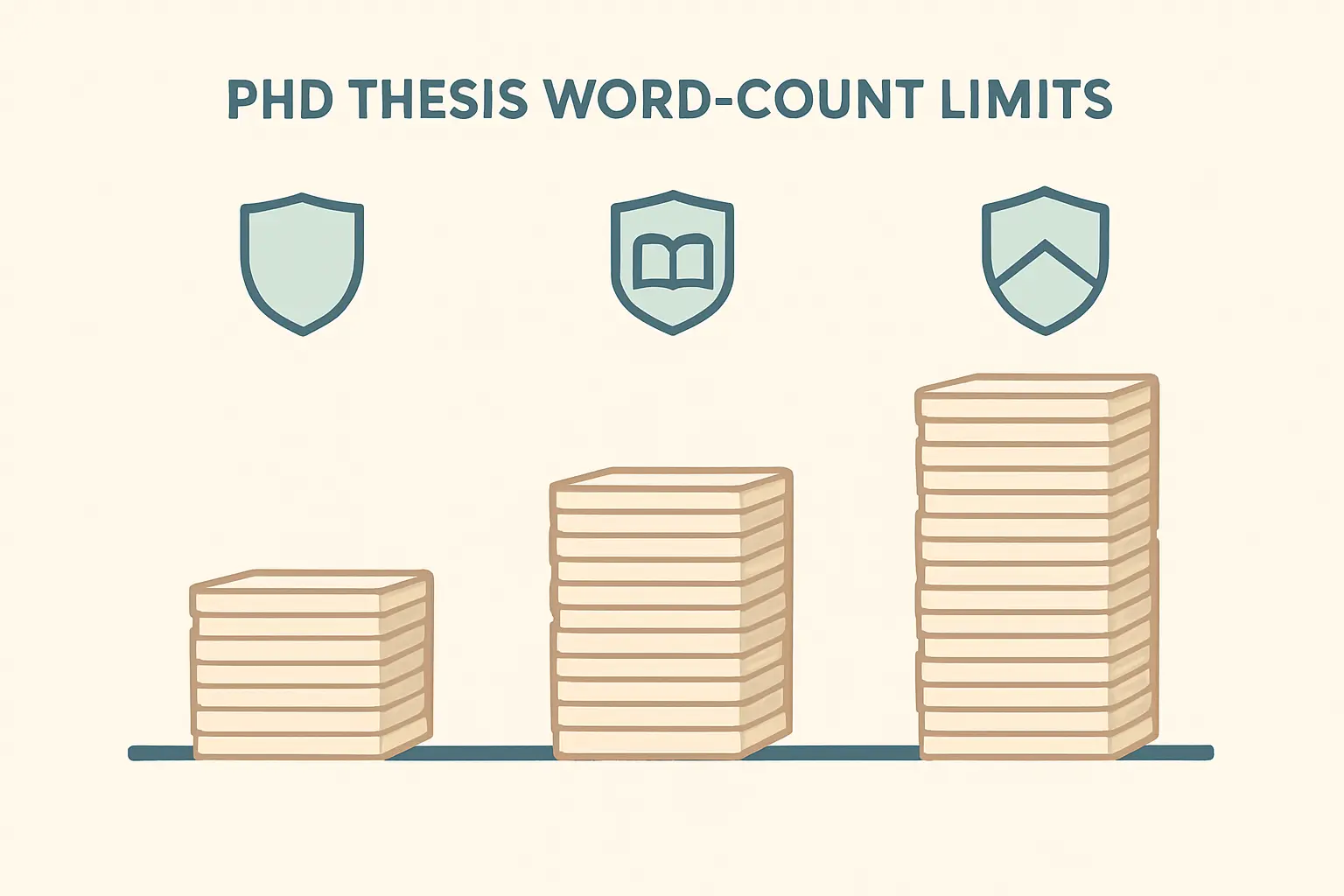
Word Limits Compared: Oxford, Cambridge, UCL
The table below summarises the headline word limits published by each university. Always verify the current figure against your specific faculty’s or Degree Committee’s regulations, since these are reviewed and can change between academic years, and different departments within the same university sometimes set stricter limits than the university-wide maximum.
| University | Degree | Typical Word Limit | What’s Included |
|---|---|---|---|
| Oxford | DPhil | 100,000 words | Abstract, notes, appendices; excludes bibliography |
| Cambridge | PhD | ~80,000 words (humanities/social sciences); ~60,000 words (sciences) | Notes and appendices; excludes bibliography — varies by Degree Committee |
| UCL | PhD | 100,000 words | Footnotes, tables, figures; excludes bibliography, appendices, supporting data |
Oxford DPhil Thesis Structure
Oxford uses “DPhil” rather than “PhD” as its doctoral degree title, though the two are equivalent. Oxford’s examination regulations, published separately for each subject area at examregs.admin.ox.ac.uk, generally set a 100,000-word ceiling that applies to law, social sciences, geography, and most humanities subjects, with the limit typically including the abstract, all notes, and appendices, but excluding the bibliography. A thesis exceeding the limit is liable to be rejected unless the Graduate Studies Committee has granted prior dispensation, so students planning to exceed the limit — for example when a thesis includes a substantial text edition — need to apply for an exemption well before submission, not after.
Cambridge PhD Thesis Structure
Cambridge does not set a single university-wide word limit; instead, each subject’s Degree Committee prescribes its own limit and stylistic requirements, published on department pages linked from cambridgestudents.cam.ac.uk. As a general pattern, humanities and social science PhDs tend to sit around an 80,000-word ceiling, while STEM PhDs tend to sit lower, often around 60,000 words, reflecting the more compressed, results-focused structure common in science theses. Cambridge is strict about this: a thesis exceeding its Degree Committee’s limit may not be examined until it is brought into compliance, and any application to exceed the limit must be submitted at least three months before the intended submission date, supported by a letter from the supervisor.
UCL PhD Thesis Structure
UCL’s PhD thesis framework, set out in the UCL Academic Manual’s research degrees chapter, sets a standard maximum of 100,000 words, a figure that includes footnotes, tables, and figures, but excludes the bibliography, appendices, and supporting data. UCL guidance is explicit that this is a maximum, not a target: supervisors may recommend a considerably shorter length depending on the subject area, and students are advised to agree an expected length with their supervisor early rather than writing toward the ceiling by default.
Core Chapter Structure Common to All Three
Despite differing word limits, Oxford, Cambridge, and UCL doctoral theses generally follow a recognisable core structure:
- Abstract — a short summary of the research question, methods, and findings, typically 300-500 words.
- Introduction — states the research problem, questions, and the thesis’s contribution to the field.
- Literature review — situates the research within existing scholarship, often combined with a historiography or theoretical framework chapter in humanities theses.
- Methodology — explains and justifies the research design, data collection, and analytical approach.
- Results/argument chapters — presents findings (sciences) or develops the central argument across thematic chapters (humanities).
- Discussion — interprets the findings or argument in relation to the wider field and its limitations.
- Conclusion — summarises the contribution and suggests directions for future research.
Humanities vs Sciences: Structural Differences
The clearest structural divide is not between universities but between disciplines. Science and some social science theses tend to follow an IMRaD-style structure (Introduction, Methods, Results, and Discussion), often split across several self-contained results chapters that mirror published or publishable papers. Humanities theses more commonly use thematic chapters that build a sustained argument across the whole thesis rather than reporting discrete results, which is one reason humanities word limits at Cambridge tend to run higher than science limits — a longer, cumulative argument needs more space than a tightly reported experimental result. Students writing a history thesis specifically may find it useful to see how this plays out in practice in a dedicated guide to writing a history dissertation, including how a historiography chapter fits within a thematic humanities structure — a skill covered in more depth in a guide to writing a historiography essay.
The Viva Voce Examination
All three universities require a viva voce (Latin for “by live voice”), an oral examination held after thesis submission in which two examiners — typically one internal and one external to the university — question the candidate on their research and its contribution. Outcomes generally range from an outright pass, to minor corrections (often with a matter of weeks to complete), to major corrections (which can require several months of additional work), to the rare outcomes of resubmission or, exceptionally, a lower degree such as an MPhil. Preparing thoroughly for this stage matters as much as the writing itself; a guide to thesis defence preparation and common questions covers how to anticipate examiner questions regardless of which UK university you are examined at.

Planning Chapter Lengths Against Your Word Limit
Once you know your institution’s word limit, working backward into a chapter-by-chapter budget early avoids a painful cutting exercise in the final months. A common approach is to allocate roughly 10% to the introduction, 15-20% to the literature review or theoretical framework, 10-15% to methodology, 40-50% split across results or argument chapters, and 10% to the discussion and conclusion combined — then adjust based on your specific discipline’s conventions and your supervisor’s guidance. Because the methodology chapter is one of the most commonly underestimated sections, a dedicated guide to writing a dissertation methodology chapter is worth reviewing early, before you commit to a chapter budget that leaves too little room for justifying your research design.
FAQ
What is the word limit for an Oxford DPhil thesis?
Oxford DPhil theses generally must not exceed 100,000 words, a limit that typically includes the abstract, notes, and appendices but excludes the bibliography. This applies broadly across humanities, social sciences, and law faculties, though students should always confirm the exact wording with their subject’s examination regulations, since the definition of what counts toward the limit can vary slightly by faculty.
What is the word limit for a Cambridge PhD thesis?
Cambridge sets word limits through individual Degree Committees rather than one university-wide figure. As a general guide, humanities and social science PhDs are typically capped around 80,000 words, while science PhDs are typically capped lower, often around 60,000 words, but candidates must check their specific Degree Committee’s published limit before submission.
What is the word limit for a UCL PhD thesis?
UCL’s standard maximum for a PhD thesis is 100,000 words, a figure that includes footnotes, tables, and figures but excludes the bibliography, appendices, and supporting data. Supervisors may recommend a shorter length for a specific subject area, so students should discuss expected length directly with their supervisor.
Do Oxford, Cambridge, and UCL use the same thesis chapter structure?
All three broadly expect an introduction, literature review, methodology, results or argument chapters, discussion, and conclusion, but exact requirements vary by department and discipline. Humanities theses are often structured as thematic chapters rather than a strict IMRaD (introduction, methods, results, discussion) format used more commonly in sciences.
What is a viva voce examination?
A viva voce (Latin for “by live voice”), often shortened to viva, is the oral examination all PhD and DPhil candidates at Oxford, Cambridge, and UCL must pass after submitting their thesis. Two examiners, usually one internal and one external to the university, question the candidate on the thesis and can recommend outcomes ranging from a straight pass to minor corrections, major corrections, or in rare cases resubmission.
Where can I find the official thesis regulations for Oxford, Cambridge, and UCL?
Oxford publishes subject-specific examination regulations at examregs.admin.ox.ac.uk. Cambridge publishes word limits and requirements through each Degree Committee, summarised at cambridgestudents.cam.ac.uk. UCL publishes its research degrees framework in the UCL Academic Manual, available at ucl.ac.uk. Always check the current academic year’s version, since regulations are reviewed annually.
Sources: University of Oxford, Examination Regulations for Research Degrees; University of Cambridge, Word Limits and Requirements of Your Degree Committee; UCL Academic Manual, Research Degrees Framework.
Write your thesis with AI
Structure, draft, cite, and format your thesis faster with Tesify’s AI writing tools, automatic bibliography, and plagiarism checker. Free to start, no credit card required.






Leave a Reply