

How to Write a History Dissertation in 2026: Archival Research, Historiography, and Structure
Writing a history dissertation requires something most other academic projects do not: the ability to construct an original argument about the past from fragmentary evidence, working across a body of scholarship that has been debating the same events for decades. You are not running an experiment or distributing a questionnaire — you are making a historical case, defending it with primary sources, and situating it against the historiography. That distinction shapes everything from the archives you visit to the citation style your supervisor expects when you learn how to write a history dissertation.
This guide walks you through every stage of the process in 2026 — from framing your historiographical argument and navigating archives (physical and digitised) to structuring your chapters and citing sources correctly in Chicago Notes-Bibliography style.
How History Dissertations Differ from STEM and Social Science Projects
If you are coming to the history dissertation from a module that used quantitative methods or required you to design an experiment, the history dissertation will feel like a different discipline entirely — because it is. A few key distinctions to internalise before you begin:
- Argument-driven, not data-driven. A history dissertation advances a claim about the past and defends it with evidence. The evidence is real — primary sources — but the meaning you draw from it is contested and interpretive. Your job is to argue, not merely to describe.
- No methodology chapter in the IMRaD sense. You may have a section on your approach to sources or your historiographical positioning, but you will not describe a sample size or statistical test. Your methodology is historical: the selection and critique of sources, attention to context, and awareness of how your interpretation relates to the existing scholarship.
- The literature review is a historiographical essay. Rather than surveying research on a topic in the social-science sense, you map how historians have interpreted your question over time — identifying schools of thought, key debates, and the gaps your dissertation addresses.
- Word counts skew longer in humanities. A master’s history dissertation typically runs 15,000–20,000 words; a PhD thesis, 70,000–100,000 words. For a discipline-specific breakdown by degree level, our guide to average thesis word count by discipline covers the full range.
For a comprehensive guide to dissertation writing across all disciplines and degree levels — including the structural and process elements that history shares with other humanities and social science programmes — see the complete dissertation writing guide on Tesify.
Framing a Historiographical Argument
The historiographical argument is the intellectual core of your dissertation. It has two components: your thesis — the claim you are making about the past — and your historiographical position, meaning how your claim relates to what other historians have said.
Finding a genuine gap
Supervisors repeatedly encounter students who propose topics that are already well-covered in the literature. The strongest dissertations address questions that remain genuinely open: underdocumented actors, under-used archives, neglected regional or comparative perspectives, or interpretations that have been challenged by new evidence but not yet fully revised. The guiding question is: what does the existing scholarship get wrong, overlook, or leave unresolved?
Writing a historical thesis statement
A historical thesis is not a description (“This dissertation examines the causes of X”) but an argument (“X was driven primarily by Y rather than Z, as the correspondence held in [archive] reveals”). It must be debatable — a statement that a thoughtful historian could dispute — and testable against primary evidence. For strong examples across disciplines, our thesis statement examples guide includes annotated samples for humanities subjects.
Mapping the historiography
Your historiographical essay should identify the main interpretive traditions relevant to your topic — Whig history, social history, cultural history, postcolonial history, gender history, and so on — trace how the debate has shifted, and show precisely where your dissertation intervenes. This is not a chronological summary of everything written on the topic. It is an argument about the state of the field, demonstrating that your research fills a real scholarly need.
Primary vs Secondary Sources
The distinction between primary and secondary sources is foundational to historical method. Getting it right matters not just for your bibliography but for the intellectual credibility of every claim you make.
| Type | Definition | Examples |
|---|---|---|
| Primary | Produced at the time of the event, or by a direct participant | Government documents, diplomatic despatches, letters, diaries, newspapers, photographs, census records, court transcripts, parliamentary debates, trade ledgers |
| Secondary | Produced after the event, interpreting primary evidence | Scholarly monographs, peer-reviewed journal articles, edited volumes, published document collections with editorial apparatus |
| Tertiary | Compiled from secondary sources | Bibliographies, handbooks, encyclopaedias, survey textbooks |
Most history dissertations require a substantial body of primary evidence. The exact ratio of primary to secondary material depends on your period and topic: an early modern historian working with manuscript collections may rely more heavily on primary sources, while a dissertation on historiography itself may be primarily secondary. Discuss the expected balance with your supervisor before committing to a research plan.
Working in Archives and Digitised Collections
Archives — physical and digital — are the historian’s laboratory. Knowing which repositories to consult, and how to use them efficiently, is a core research skill that your dissertation should demonstrate.
Physical archives
Key repositories for English-language history dissertations include:
- The National Archives (UK), Kew — holds British government records from the Domesday Book to recent Cabinet papers, searchable via the free online catalogue Discovery.
- National Archives and Records Administration (NARA), USA — federal records from the founding era to the present, with a growing digitised component through the National Archives Catalog.
- University special collections — institutional records, personal papers, and rare books. Every major research university holds unique manuscript collections; contact the archivist well in advance of your intended visit.
- County record offices (England and Wales) — local government records, parish registers, estate papers, and regional material unavailable from national repositories.
Always book appointments in advance and confirm access conditions. Many repositories require a reader’s card, an institutional email address, or a formal letter of introduction from your supervisor.
Digitised collections
An enormous volume of primary source material is now accessible without travel, though coverage is uneven:
- British Newspaper Archive — millions of pages from UK newspapers dating back to the eighteenth century, fully text-searchable.
- ProQuest Historical Newspapers — US titles including the New York Times and Chicago Tribune from the nineteenth century onwards, plus regional papers.
- JSTOR — strongest for secondary sources (journals), but also hosts some primary collections through its Global Plants and Rare Books and Manuscripts initiatives.
- HathiTrust Digital Library — digitised books and serials, including out-of-copyright government documents and nineteenth-century monographs.
- Europeana — aggregates digitised cultural heritage from institutions across Europe, including photographs, manuscripts, and maps.
- National Archives Discovery (UK) — free digitised Cabinet Papers, wartime records, and correspondence, with some documents downloadable directly.
Source Criticism: Reading Evidence Critically
Source criticism is the disciplined practice of evaluating sources for authenticity, reliability, and evidential relevance. Historians traditionally distinguish two phases:
External criticism
External criticism asks: is this source what it purports to be? It checks authorship, date, place of production, and physical or textual integrity. A forged document, a misattributed pamphlet, or a transcription error introduced by a nineteenth-century editor all require external critical assessment before the source can be used as evidence.
Internal criticism
Internal criticism asks: given that the source is authentic, how reliable and useful is it? This involves considering:
- The author’s position, motives, and likely biases
- Whether the author was an eyewitness or working from hearsay or later memory
- The intended audience — a private diary entry differs in register and candour from a public parliamentary speech
- The time elapsed between event and recording
- Corroboration: does other independent evidence support or contradict this source?
Demonstrating source criticism explicitly in your dissertation — not merely using sources, but explaining why you trust them and where you are cautious — is one of the hallmarks that distinguishes a strong history thesis from a weak one. Examiners look for it.
Chicago Notes-Bibliography Style for Historians
History uses the Chicago Manual of Style (17th edition) Notes-Bibliography (NB) system almost universally in the UK, US, Australia, and most of the English-speaking world. If your department specifies a different style, follow their guidance — but for the majority of history students, Chicago NB is the expected default. For a full reference with formatted examples, see our Chicago citation style guide. The features most specific to historical research are as follows.
Footnotes, not parenthetical citations
Unlike APA or MLA, Chicago NB places citations in numbered footnotes (or endnotes). This allows you to include brief explanatory commentary alongside your reference — useful when a document requires context, or when you want to flag a secondary disagreement without interrupting the narrative flow of your prose. Historians use this latitude generously.
Citing archival documents
Individual documents — letters, memoranda, case files, despatch cables — are cited in footnotes with as much identifying information as the repository requires: author, recipient, date, document type, folder or box number, collection name, and repository. Your bibliography cites the collection as a whole, not individual items:
Winston Churchill to Clement Attlee, 12 May 1945, PREM 3/396/12, The National Archives, Kew.
Bibliography entry:
The National Archives, Kew. Prime Minister’s Office Records (PREM).
Shortened notes
After the first full footnote citation, subsequent references use a shortened form: author surname, abbreviated title, and page number. For archival items, repeat the document descriptor and date in a concise shortened note. Avoid “ibid.” unless consecutive footnotes refer to the same source — many style guides and supervisors now discourage its use.
Divided bibliography
Most history dissertations divide the bibliography into primary sources and secondary sources. Within the primary section, you may further sub-divide by repository or document type. This makes your evidential base transparent to examiners and future readers, which is especially important for dissertations that draw on unpublished materials.
Footnotes are cumulative in a history dissertation: a 20,000-word master’s thesis may carry two hundred or more footnotes. Since Chicago footnotes typically do not count toward the word limit at most institutions, it is worth clarifying the rule with your department before submission. Our guide to whether footnotes count toward your word count covers university-by-university variations.
Thematic and Chronological Chapter Structures
Unlike STEM dissertations, which follow IMRaD, history dissertations use either a thematic or a chronological chapter structure — or a hybrid of the two. The right choice depends on your argument.
Chronological structure
Each chapter covers a distinct period. This works well when your argument hinges on change over time — when the sequence of events matters causally. The risk is that it can devolve into narration (“and then, and then, and then”) rather than sustained argument. Every chapter must still advance your thesis rather than merely describing what happened next.
Thematic structure
Each chapter examines a distinct theme, interpretive lens, or causal factor. This is often more analytically forceful because it isolates the variables your argument depends on — political, economic, social, cultural, gendered, regional. The risk is losing chronological coherence; readers need enough narrative orientation to follow the argument.
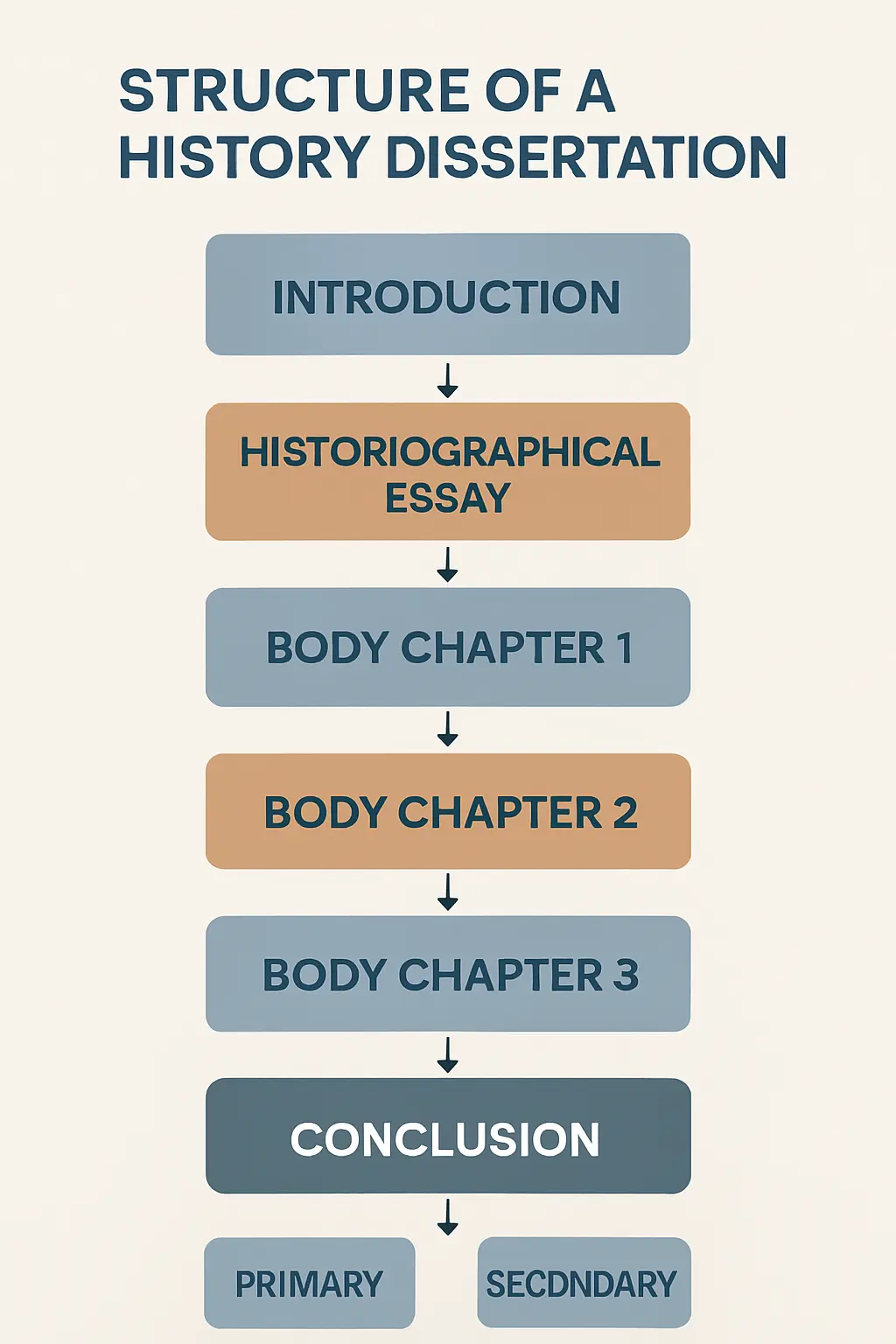
Typical chapter outline for a master’s history dissertation
- Introduction (10–15% of the total): research question, historiographical essay, argument, source base, chapter overview
- Body chapters 1–3 (or 4) (~60–70% total): each advancing one component of your argument with primary evidence and engagement with secondary scholarship
- Conclusion (8–12%): revisiting the argument, reflecting on the evidence, situating findings within the broader historiography, suggesting directions for further research
- Bibliography: divided into primary sources and secondary sources
If you are uncertain how many chapters to include, or how historians divide their structures compared with other disciplines, our chapter count guide has discipline-specific breakdowns for undergraduate, master’s, and PhD level.
Common Pitfalls and How to Avoid Them
| Pitfall | What it looks like | How to fix it |
|---|---|---|
| Descriptive narration | Chapters that summarise what happened without advancing a claim | Check that every paragraph ends with a sentence that contributes to your overarching argument |
| Anachronism | Judging historical actors by present-day moral or political standards | Contextualise decisions within the norms and knowledge available to actors at the time |
| Thin source base | Argument rests on three or four sources without corroboration | Use multiple independent sources to substantiate each key claim; triangulate across document types |
| Absent historiography | No engagement with what other historians have argued beyond the introduction | Make your conversation with the literature explicit throughout the body chapters, not only at the start |
| Teleology | Treating a historical outcome as inevitable from the outset | Acknowledge contingency; consider the alternatives that contemporary actors actually faced |
| Citation inconsistencies | Incomplete or inconsistent footnotes; bibliography not matching notes | Use a reference manager from the first day of research; audit every footnote against the bibliography before submission |
A Realistic Dissertation Timeline
Most master’s history dissertations span one academic year, with submission in late summer. The table below gives a rough monthly breakdown for a September deadline:
| Month | Main tasks |
|---|---|
| January–February | Topic proposal, initial secondary reading, mapping the historiography |
| March | Refine research question; identify primary source repositories; book archive visits |
| April | Archival research (physical and digital); note-taking and source transcription |
| May | Continue archival research; begin drafting chapter 1 and the introduction |
| June | Draft chapters 2 and 3; submit chapter 1 to supervisor for feedback |
| July | Revise chapter 1 based on feedback; complete remaining body chapters |
| August | Write conclusion; submit full draft to supervisor; proofread and format |
| September | Final revisions, bibliography audit, submission |
Archive visits in particular have long lead times: repositories often require advance booking, and digitisation projects sometimes take collections offline unexpectedly. Build at least two weeks of buffer around any planned visit. For a more granular planning tool, our step-by-step thesis timeline and Gantt chart guide helps you map every milestone to a date.
When you move into the drafting phase, many historians find it useful to sketch detailed chapter outlines before writing prose. Tesify can help you structure those outlines and auto-format Chicago footnotes as you write, reducing the administrative load so you can keep your attention on the argument.
Frequently Asked Questions
Do history dissertations need a methodology chapter?
Not in the IMRaD sense. History dissertations rarely include a standalone methodology chapter. Instead, your introduction includes a section on your approach to sources, your reasoning for selecting particular archives or collections, and your historiographical positioning. Some departments require a brief methodological discussion; check your programme handbook and confirm with your supervisor.
What is the difference between Chicago Author-Date and Notes-Bibliography?
Chicago Notes-Bibliography (NB) places citations in numbered footnotes or endnotes combined with a full bibliography — this is the system used in history, classics, and most humanities disciplines. Chicago Author-Date uses parenthetical in-text citations (Author Year) and a reference list, and is more common in the social sciences. For history dissertations, you almost always use Notes-Bibliography, unless your department explicitly specifies otherwise.
How many primary sources does a history dissertation need?
There is no universal minimum, and the number depends entirely on source type and topic. A dissertation on diplomatic history might rest on a well-documented treaty archive, while a social history dissertation on everyday life might draw on hundreds of brief newspaper items, census entries, and letters. What matters is that your primary source base is sufficient to support your argument. Your supervisor is the best guide to the expected scope for your specific project.
Can I write a history dissertation entirely on digitised sources?
Yes, for many topics — particularly twentieth-century subjects with strong digitisation coverage, or topics using newspapers, published official documents, and open-access collections such as HathiTrust or the British Newspaper Archive. However, for topics requiring manuscript collections, private papers, or undigitised local records, physical archive visits will be necessary. Identify your source base before committing to a research question, not after.
Should my history dissertation use thematic or chronological chapters?
It depends on your argument. If your thesis is about change over time — how policy evolved, how an institution transformed, how public opinion shifted — chronological chapters tend to work better. If your thesis isolates particular causal factors — economic incentives, gendered assumptions, colonial frameworks — thematic chapters are usually more analytically powerful. Many dissertations use a hybrid: a broadly chronological spine with thematically organised body chapters.
What is historiography and why does it matter?
Historiography is the study of how historians have interpreted a subject over time — the history of historical writing, in effect. In your dissertation, the historiographical essay (typically in the introduction) shows your examiner that you understand the existing scholarly conversation, can identify its limits, and are making a contribution that goes beyond what has already been argued. A dissertation without historiographical engagement reads as isolated from the discipline, and examiners penalise it accordingly.
Write your thesis with AI
Structure, draft, cite, and format your thesis faster with Tesify’s AI writing tools, automatic bibliography, and plagiarism checker. Free to start, no credit card required.






Leave a Reply