
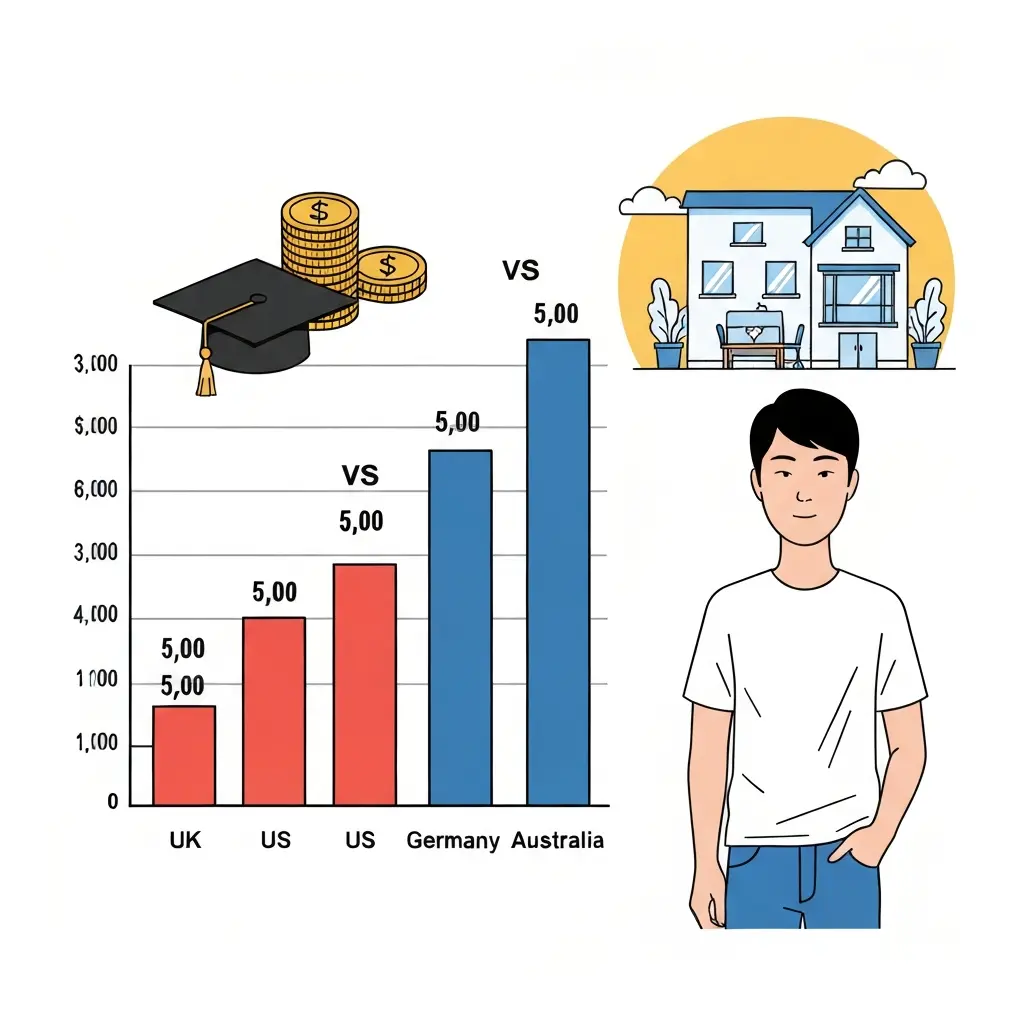
Grad Student Stipend Statistics 2026: The Cost-of-Living Gap by Country and Field
Across the UK, United States, Germany, and Australia, the gap between what doctoral students earn and what it costs to live is one of the most persistent structural problems in higher education. The UKRI’s landmark 8% stipend increase brought UK-funded PhD students to £20,780 for 2025–2026 — yet students’ unions at London institutions calculate that this figure still leaves funded researchers short of the capital’s true cost of living. In the United States, the NIH predoctoral NRSA stipend for FY2026 stands at $29,364 annually, a figure that places many graduate researchers below the local living wage in high-cost cities like Boston, San Francisco, and New York. These are not isolated complaints: grad student stipend statistics from 2026 paint a consistent picture of minimum rates that trail inflation, housing costs, and local poverty thresholds in nearly every major research economy.
Key Findings at a Glance
Video: Demystifying Grad School Funding: What You Need to Know — Professor Lace Padilla, Northeastern University (DrDataVIS, 2024)
- UKRI minimum stipend (2025–2026): £20,780/year (up 8% from prior year) — the largest real-terms increase since 2003, according to UKRI’s own announcement.
- UKRI London supplement: £22,780/year. Students’ unions argue an additional £4,540 on top of the standard rate would be needed to cover London living costs.
- NSF GRFP stipend (2026): $37,000/year plus a $16,000 Cost of Education allowance.
- NIH NRSA predoctoral stipend (FY2026): $29,364/year — significantly below the NSF GRFP rate and well below living wages in major US research cities.
- Australian RTP minimum (2026): AUD $37,010/year at QUT; AUD $39,069 at ANU; AUD $39,500 at the University of Melbourne.
- Canada: A May 2025 PLOS One study of 140 degree programs found only 2 met cost-of-living benchmarks after tuition deduction; the average net stipend was Can$16,528 — roughly Can$9,584 below the poverty threshold.
- Germany (DFG): DFG-funded PhD researchers are typically hired as Wissenschaftliche Mitarbeiter under the TV-L E13 pay scale at 65% full-time equivalent, yielding approximately €1,850–€2,080/month net depending on state and family status.
The stipend shortfall is one factor in a broader picture of academic publishing pressures that influence PhD completion timelines. Understanding how long peer review takes — and how those timelines interact with funding windows — is covered in our companion article on journal peer review time statistics for 2026, which documents first-decision timelines of 8–18 weeks by field and the full six-to-nine month submission-to-publication cycle.
UKRI (United Kingdom): £20,780 and the London Gap
The UK Research and Innovation body (UKRI) announced in early 2025 that the minimum doctoral stipend would rise to £20,780 from 1 October 2025, representing an 8% uplift. UKRI described the increase as “the largest real-terms increase in the stipend for UKRI-funded students since 2003,” and aligned it explicitly with the national living wage. The minimum fee contribution that research organisations can draw from UKRI grants also increased to £5,006 (a 4.6% rise).
For students based in London, the UKRI London supplement brings the total to £22,780. However, in a joint submission cited by Times Higher Education, students’ unions from five major London universities — Imperial College London, UCL, King’s College London, the London School of Economics, and Queen Mary University of London — argued that the London weighting “would need to be £4,540 per annum to account for the current cost of living,” implying the true figure required is closer to £25,320.
For an in-depth breakdown of how UKRI and other funders structure PhD awards in the UK, see the PhD Funding UK Guide 2026, which covers scholarship types, eligibility, and a strategic application framework.
UKRI Stipend History: Minimum Rate (Selected Years)
| Academic Year | Minimum Stipend (£) | Notes |
|---|---|---|
| 2023–2024 | 18,622 | Pre-uplift baseline |
| 2024–2025 | 19,237 | 3.3% increase |
| 2025–2026 | 20,780 | 8% increase — largest since 2003 |
Source: UKRI official announcement.
United States: NSF GRFP, NIH NRSA, and Institutional Variation
The United States has no single national PhD stipend floor. Instead, stipend levels are set by individual funders, and then universities themselves often layer institutional top-ups. The two most prominent federal stipend benchmarks are the NSF Graduate Research Fellowship Program (GRFP) and the NIH National Research Service Award (NRSA) for predoctoral trainees.
NSF GRFP
The NSF GRFP provides a $37,000 annual stipend alongside a $16,000 Cost of Education allowance, covering tuition and mandatory fees. The fellowship runs for three years across a five-year window, and fellows may defer it during institutional appointments. At $37,000, the NSF rate sits notably above the NIH predoctoral floor but can still fall short of living wages in high-cost metros.
NIH NRSA Predoctoral Stipend (FY2026)
Effective for awards made on or after 1 October 2025, the NIH set the predoctoral NRSA stipend at $29,364 per year ($2,447/month), as confirmed by the FY2026 updates announced via Boston University’s Office of Research. This figure applies uniformly regardless of location — meaning a PhD student in San Francisco on an NIH training grant receives the same gross stipend as one in a lower-cost midwestern city, despite dramatically different housing costs.
For comparison, NIH postdoctoral stipends begin at $63,480 at zero years of experience and rise to $77,076 at seven or more years — a gap that reflects the continuing undervaluation of predoctoral researchers relative to postdocs in the US funding structure.
US Stipend Comparison Table (2026)
| Funder / Category | Annual Stipend (USD) | Education Allowance |
|---|---|---|
| NIH NRSA Predoctoral (FY2026) | $29,364 | Separate tuition cap |
| NSF GRFP (2026) | $37,000 | $16,000/year |
| NIH NRSA Postdoc (0 yrs exp.) | $63,480 | N/A |
Sources: BU Office of Research — FY2026 NIH NRSA Update; NSF GRFP official page.
A survey-based database, PhD Stipends (phdstipends.com), aggregates self-reported data from over 18,000 entries and uses a living-wage ratio that normalises stipend data to local living wage, allowing you to compare pay across universities in different cost-of-living areas. The site’s methodology underscores the central problem: a flat federal rate is almost meaningless without local cost-of-living adjustment. Among surveyed US institutions, only a minority of programs were found to offer stipends that exceed the local living wage, and in a significant share of schools, doctoral students report earning less than half the local living wage for their county.
Germany: DFG, TVöD, and the Stipend vs Employment Divide
Germany’s doctoral funding landscape differs structurally from anglophone systems. Most DFG-funded PhD students are not scholarship recipients in the traditional sense; they are hired as Wissenschaftliche Mitarbeiter (academic staff) under employment contracts governed by the TV-L (collective agreement for public-sector employees in German states) or TVöD (federal equivalent) pay scales.
The standard configuration for a DFG-funded PhD position is 65% of the E13 TV-L salary grade. Depending on the German state, the experience step, and whether the researcher has dependants, this translates to approximately €1,850–€2,080/month net. This structure includes full social insurance contributions (health, pension, unemployment) — a meaningful difference from pure stipend models where these protections may not apply.
DAAD scholarships, which are separate from DFG employment contracts, offer a base stipend of €1,381/month for doctoral researchers, plus a health insurance subsidy and travel allowance. The Max Planck Society announced in 2022 that it would move all doctoral researchers to employment contracts at a minimum of 65% TVöD 13, removing the lower-paid pure-stipend category entirely.
Germany PhD Funding Overview (2025–2026)
| Funding Route | Monthly Net (Approx.) | Social Insurance? |
|---|---|---|
| DFG / University position (65% E13 TV-L) | €1,850–€2,080 | Yes (full contributions) |
| DAAD doctoral scholarship | €1,381 + allowances | Subsidy provided |
| Max Planck Society (minimum) | 65% TVöD 13 | Yes (employment) |
Sources: Max Planck Gesellschaft — Higher Pay for Doctoral Researchers; DAAD Scholarship Database.
Australia: RTP Minimum Rates and University Top-Ups
Australia’s primary doctoral funding vehicle is the Research Training Program (RTP) Stipend Scholarship, administered through individual universities using block grant funding from the Australian Government Department of Education. Unlike the UK and US systems, there is no single nationally-mandated stipend rate; instead, the government sets a base minimum and universities apply their own top-ups.
From 1 January 2026, the government-indexed minimum rate is AUD $37,010/year (confirmed at QUT). Individual universities set their own rates above this floor:
| Institution | 2026 RTP Stipend (AUD/year) |
|---|---|
| University of Melbourne | $39,500 |
| Australian National University (ANU) | $39,069 |
| University of Western Australia (UWA) | $38,110 |
| QUT (government indexed rate) | $37,010 |
The RTP stipend is tax-free for the first four years of a PhD, which improves its effective value. However, in cities such as Sydney and Melbourne — where median weekly rents for a single bedroom unit can exceed AUD $400 — the annualised stipend represents a tight budget, particularly for students with dependants or those ineligible for government concession cards.
Sources: ANU RTP Stipend page; QUT RTP Stipend page; University of Melbourne RTP Scholarship.
Canada: Below the Poverty Line
Canada’s doctoral funding situation is particularly acute. A peer-reviewed study published in PLOS One in May 2025, examining 140 degree programs at Canadian universities, found that only 2 of 140 programs offered stipends that met cost-of-living benchmarks once tuition and fees were deducted.
The research reported a mean gross minimum stipend of Can$23,933 across programs studied. After institutions reclaimed tuition — averaging approximately Can$7,405 for domestic students — the average net stipend fell to Can$16,528. This leaves students approximately Can$9,584 short of the Market Basket Measure (MBM) poverty threshold for domestic students. For international students, the shortfall reached approximately Can$16,953, with roughly 76% of their gross stipend consumed by tuition and fees.
The authors noted that Canada’s highest minimum stipend is “roughly equivalent or lower than the lowest stipend” found among US biology programs, and trails UK funding levels — placing Canada behind comparable research-intensive nations despite its significant public investment in university research infrastructure.
Source: PLOS One — Canadian natural science graduate stipends lie below the poverty line (2025).
Stipend Variation by Discipline
One of the most significant yet underreported aspects of grad student stipend statistics is the variation across academic disciplines within the same institution or country. STEM fields — particularly life sciences, chemistry, and engineering — typically attract higher stipends because research funding flows through large external grants. Humanities and social sciences, by contrast, often rely on teaching assistantships or departmental fellowships with lower and less consistent rates.
| Field | Typical US Range (USD/year) | Funding Source |
|---|---|---|
| Biomedical / Life Sciences | $30,000–$40,000+ | NIH T32, R01 PI-funded |
| Engineering / Computer Science | $28,000–$45,000 | NSF, industry grants |
| Physical / Earth Sciences | $25,000–$35,000 | NSF, departmental |
| Social Sciences | $18,000–$28,000 | Departmental fellowships, TAs |
| Humanities | $15,000–$25,000 | Departmental, university funds |
The Cost-of-Living Gap: Country Comparison Table
The table below compares the primary minimum stipend for each country with indicative annual living costs in a major research city. Living-cost figures are drawn from publicly available government and cost-of-living data; they should be treated as approximate benchmarks rather than precise individual budgets.
| Country / Funder | Min. Stipend (2026) | Reference City | Approx. Shortfall |
|---|---|---|---|
| UK — UKRI (outside London) | £20,780 | Manchester / Leeds | Near parity to NLW take-home |
| UK — UKRI London | £22,780 | London | ~£2,540 short of student union estimate |
| US — NIH NRSA Predoc | $29,364 | San Francisco / Boston | Significant gap in high-cost metros |
| US — NSF GRFP | $37,000 | National | Varies; adequate in mid-cost cities |
| Germany — DFG / TV-L E13 (65%) | ~€1,850–€2,080/mo net | Munich / Berlin | Tight in Munich; manageable in Berlin |
| Australia — RTP (minimum) | AUD $37,010 | Sydney / Melbourne | Gap widening with rental market |
| Canada — Typical domestic net | ~Can$16,528 net | Toronto / Vancouver | ~Can$9,584 below MBM poverty line |
Financial Stress and Researcher Wellbeing
The consequences of the stipend–living-wage gap extend well beyond personal finances. Financial stress is consistently identified as one of the primary drivers of poor mental health and elevated dropout risk among doctoral students globally. The data on this connection is robust and multi-sourced.
A 2026 survey conducted by Nature found that nearly half of responding scientists said they have or had second jobs during their PhD, indicating that a substantial share of doctoral researchers treat their stipend as insufficient income and seek supplemental employment — time that could otherwise be spent on research. This finding aligns with earlier reporting by Science (AAAS) and Nature from 2022–2023 documenting that graduate students across the US, UK, and Europe were demanding wage increases as living costs rose faster than stipend adjustments.
The financial dimension of PhD dropout risk is examined in depth in the PhD Dropout Rates Statistics by Country 2026 article, which documents US attrition at 40–50%, UK completion at 70–80%, and identifies funding insecurity as a consistent predictor of early departure across programs.
Food insecurity among graduate students is also a documented phenomenon. A study conducted at the University of Albany found that a majority of surveyed graduate students reported experiencing food insecurity, with correlated increases in anxiety, stress, and depression. A 2022 University of Maryland survey indicated that a substantial proportion of graduate students described themselves as cost-burdened — spending more than 30% of their gross stipend on housing alone.
The data reinforces a consistent pattern: stipend levels are a direct equity mechanism. Countries and institutions that set stipends below living wages effectively restrict doctoral participation to those with family wealth, savings, or a partner’s income — narrowing the talent pool for research and exacerbating representational imbalances across gender, socioeconomic background, and geography.
For researchers writing their thesis or dissertation while navigating financial constraints, graduate employability statistics for 2026 provide context on the return-on-investment of doctoral degrees by field and country, helping researchers assess the long-term financial trajectory of completing their PhD.
If you are currently working on your thesis and looking for tools to help maximise your writing time — particularly if you are balancing research with part-time work — Tesify — Write Your Thesis with AI (app.tesify.app) offers AI-assisted structure, citation management, and chapter drafting to help you write more efficiently without sacrificing academic rigour.
Frequently Asked Questions
What is the average PhD stipend in the UK in 2026?
The minimum UKRI-funded PhD stipend for 2025–2026 is £20,780 per year, following an 8% increase from 1 October 2025. Students based in London receive £22,780 due to the London weighting supplement. These rates apply to UKRI-funded studentships; some universities and charities offer higher stipends.
What is the NIH predoctoral stipend for 2026?
The NIH NRSA predoctoral stipend for FY2026 is $29,364 per year ($2,447/month), effective for awards made on or after 1 October 2025. This applies to students on NIH training grants. The NSF GRFP provides a higher rate of $37,000/year plus a $16,000 Cost of Education allowance.
Do PhD stipends cover the cost of living?
In most major research cities, minimum PhD stipends do not fully cover the local cost of living. A 2025 PLOS One study found that only 2 of 140 Canadian programs met living-cost benchmarks after tuition deduction. In London, students’ unions have argued that the UKRI rate falls approximately £2,540 short of what is needed. A 2026 Nature survey found that nearly half of PhD students reported holding second jobs to supplement their income.
How does the Australian RTP stipend compare internationally?
The 2026 Australian RTP minimum stipend is AUD $37,010/year (as at QUT), with top-up rates at leading universities reaching AUD $39,069 (ANU) and AUD $39,500 (University of Melbourne). The stipend is tax-free for the first four years of enrolment, improving its effective value. In absolute terms it is higher than UK and Canadian minima, but Sydney and Melbourne rental costs are among the highest in the world, narrowing the practical advantage.
What do German PhD students earn?
Most DFG-funded PhD students in Germany are employed as Wissenschaftliche Mitarbeiter at 65% of the TV-L E13 pay scale, which yields approximately €1,850–€2,080/month net depending on the state, experience step, and family situation. This is an employment contract with full social insurance. DAAD scholarship holders receive a monthly stipend of €1,381 plus a health insurance subsidy.
Which field has the highest PhD stipends?
In the United States and UK, STEM fields — particularly biomedical sciences, engineering, and computer science — typically command the highest PhD stipends, often ranging from $30,000 to $45,000+ per year in the US. Humanities and qualitative social sciences tend to receive lower funding, with many students relying on teaching assistantships rather than research grants. Germany and Australia have less pronounced field-level variation because pay scales (TV-L in Germany) or government minimum rates (RTP in Australia) set more uniform floors.
References
- UKRI. UKRI is increasing PhD stipends and improving student support. ukri.org, 2025.
- Boston University Office of Research. NIH, AHRQ, and HRSA Announce FY 2026 Updates to NRSA Stipends. bu.edu, 2026.
- NSF. Graduate Research Fellowship Program (GRFP). nsf.gov, 2026.
- PLOS One. Canadian natural science graduate stipends lie below the poverty line. journals.plos.org, 2025.
- ANU. Australian Government Research Training Program (RTP) Stipend Scholarship. study.anu.edu.au, 2026.
- QUT. Research Training Program (RTP) Stipend Scholarship. qut.edu.au, 2026.
- Max Planck Gesellschaft. Higher Pay for Doctoral Researchers. mpg.de, 2022.
- DAAD. German Research Foundation (DFG) Scholarship Database. daad.de, 2025.
- Nature. Cost-of-living crisis pushing PhD students to get second incomes. nature.com, 2026.
- University of Melbourne. Research Training Program Scholarship. scholarships.unimelb.edu.au, 2026.
Write your thesis with AI
Structure, draft, cite, and format your thesis faster with Tesify’s AI writing tools, automatic bibliography, and plagiarism checker. Free to start, no credit card required.




Leave a Reply