

PhD Funding UK 2026: The Complete Guide for Applicants
PhD funding in the UK is genuinely confusing — and that’s not an exaggeration. Stipend rates changed again for 2025/26, AHRC student-led places are being slashed by at least 60%, and international applicants face a funding landscape that looks completely different from what it did even two years ago. If you’re applying for a funded doctorate starting in 2026, the stakes are high and the margins for error are slim.
This guide cuts through the noise. Whether you’re chasing a UKRI studentship, an institutional scholarship, a charity grant, or building a self-funding strategy, every major route to PhD funding in the UK is mapped here — with real numbers, honest trade-offs, and a step-by-step application plan you can actually use.
The main routes to funded PhD study in the UK are UKRI Research Council studentships (paying a 2025/26 stipend of £20,780/year tax-free), university scholarships, charity and trust grants, and industry-sponsored fellowships. International students have fewer automatic routes but can access specific Research Council and university-funded awards. Deadlines typically fall between November 2025 and February 2026 for October 2026 starts.
What Is PhD Funding in the UK?
PhD funding in the UK refers to financial support that covers tuition fees and/or living costs for doctoral researchers. It typically takes the form of a studentship — a package combining fee payment and a tax-free maintenance stipend — awarded by Research Councils, universities, charities, or industry partners, usually for three to four years.
The distinction between a funded and an unfunded PhD is enormous in practice. A fully funded place means your fees are paid and you receive a stipend — that’s a combined value of roughly £30,000–£40,000 per year when you account for both elements. An unfunded place means you’re covering all of that yourself.
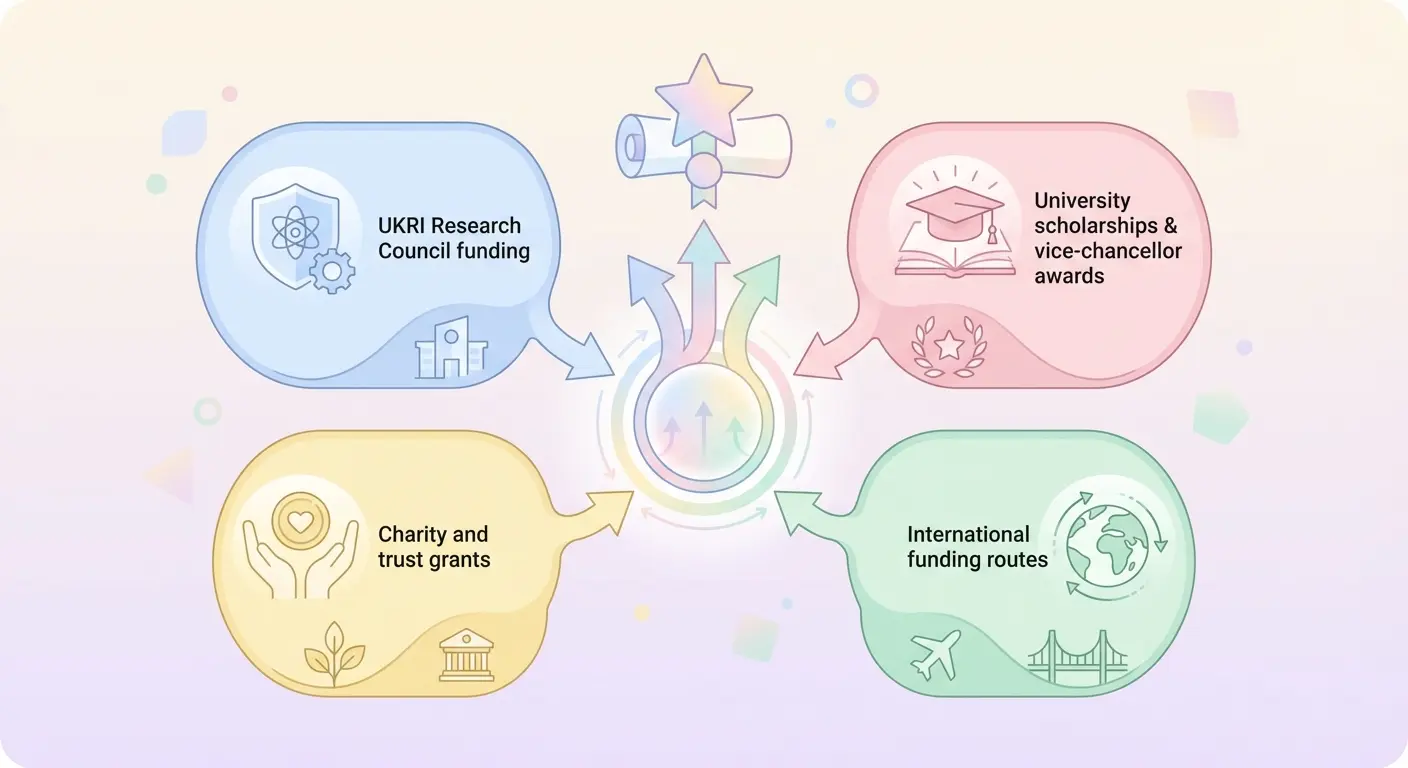
Funding sources in the UK sit in several distinct layers. At the top sits UK Research and Innovation (UKRI), the umbrella body that distributes government research funding through nine Research Councils. Below that are universities themselves, which hold blocks of studentship allocation. Then there are charitable trusts, industry partners, and — for specific cohorts — international fellowship programmes.
What most applicants miss is that “funded PhD” doesn’t always mean 100% funded. Some awards cover fees but not maintenance. Others cover maintenance but only at home-student fee rates, leaving international students with a shortfall. Reading the small print on any award is non-negotiable.
UKRI Studentships 2026: Stipends, Councils, and How They Work
UKRI studentships are the gold standard of UK PhD funding — and for good reason. They’re competitive, well-resourced, and backed by institutional prestige that opens doors after graduation.
The 2025/26 UKRI Stipend Rate
For the 2025/26 academic year, the UKRI minimum stipend is £20,780 per year (tax-free). This is up from £19,237 in 2024/25 — a rise of roughly 8%, which UKRI introduced partly in response to a 2025 London Economics study commissioned by UKRI itself, which found that stipend levels were affecting who applied for and accepted studentships, with lower-income and older applicants particularly deterred.
Many universities top up the minimum. Imperial College London, for example, has been known to add £5,000+ for studentships in engineering and physical sciences. Always check the specific award, not just the UKRI floor rate.
For 2026 entry, expect the stipend to rise again — UKRI has committed to annual uplifts, though the exact figure for 2026/27 won’t be confirmed until late 2025.
How UKRI Distributes Studentships
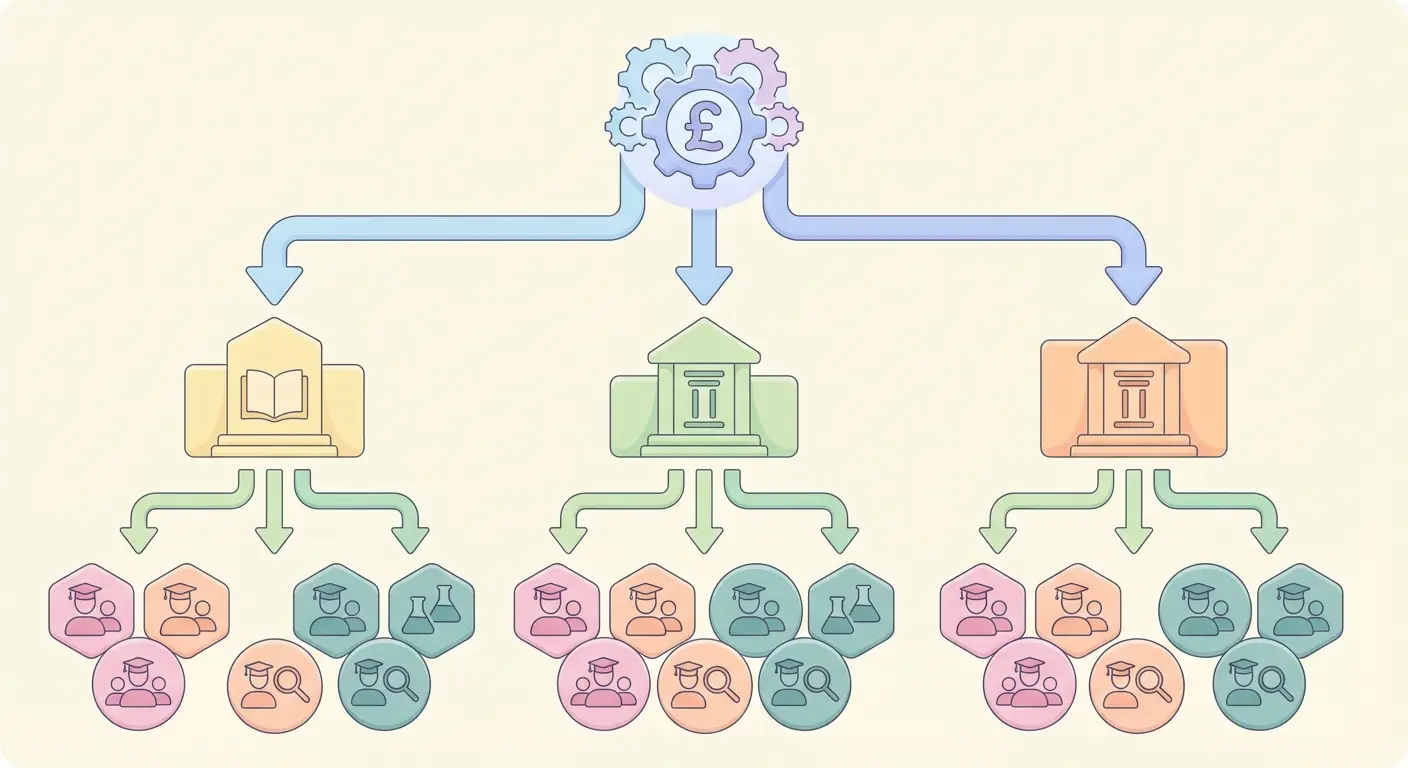
UKRI doesn’t usually fund individual PhD students directly. Instead, it allocates blocks of studentships to universities and Doctoral Training Programmes (DTPs) and Centres for Doctoral Training (CDTs). The university or CDT then runs its own competitive selection process.
This means two things for applicants: first, you often apply to the university or CDT rather than to UKRI directly; second, the competition is fierce at the institutional level before you even get to the Research Council’s books.
According to UKRI’s official guidance on studentships, the main routes are: DTPs (thematic groupings across multiple universities), CDTs (cohort-based, often industry-linked), and Open Competition awards for self-proposed projects. The Open Competition route is rarer but exists in some councils.
UKRI Research Council Comparison Table
| Research Council | Disciplines | Key Funding Route | 2026 Notes |
|---|---|---|---|
| AHRC | Arts, Humanities | DTPs, Block Grant | Student-led places cut ≥60% from 2025 |
| BBSRC | Biosciences | DTPs, CDTs | Strong industrial CASE awards |
| EPSRC | Engineering, Physical Sciences | CDTs (large cohorts) | Largest number of PhD places |
| ESRC | Social Sciences, Economics | DTPs | Advanced Quantitative Methods top-up available |
| MRC | Medical Research | CDTs, Clinical PhD Fellowships | Separate clinical routes for MBPhD |
| NERC | Environment, Earth, Ocean | DTPs (CASE partnerships) | Strong field-work funding add-ons |
| STFC | Astronomy, Particle Physics | CDTs, Direct Studentships | Few places but well-funded per student |
| Innovate UK | Applied/Industry R&D | KTP PhD, iCASE | Includes salary-level enhancements |
The AHRC situation deserves a flag. Times Higher Education reported in 2025 that student-led AHRC-funded PhD places will fall by at least 60%, as AHRC shifts toward supervisor-led and collaborative awards. If you’re in the humanities, this is a significant structural shift — plan accordingly and look hard at university-funded options as a primary route.
7 Types of PhD Funding Available in the UK
Here’s where most guides fail applicants: they treat PhD funding as a single category. It’s not. There are at least seven distinct funding structures, and each has different eligibility rules, application processes, and trade-offs.

-
1. UKRI Research Council Studentships
What it is: The government-backed gold standard, covering full UK fees plus the £20,780 stipend (2025/26). Awarded through DTPs, CDTs, or occasionally direct competition.
Practical tip: Search CDT websites directly — many have rolling deadlines or second-round processes if initial places go unfilled. EPSRC CDTs in particular often recruit into January and February for October starts.
-
2. University Scholarships and Vice-Chancellor Awards
What it is: Institutions fund their own PhD studentships from endowments, research income, and strategic budgets. These vary wildly — some match UKRI rates exactly, others are partial awards covering fees only.
Practical tip: The Russell Group universities (Oxford, Cambridge, UCL, Edinburgh, Manchester, etc.) have the deepest scholarship pools. Check each university’s postgraduate funding database, not just the department page — many awards are buried in institutional portals.
-
3. Industrial CASE (iCASE) Awards
What it is: Industry-partnered studentships where a company co-funds the PhD and the student works partly with the industrial partner. The stipend enhancement is usually £1,000–£6,000/year on top of the UKRI minimum, and you get genuine industry experience.
Practical tip: iCASE projects are often posted on FindAPhD’s database of funded PhD projects with “CASE” or “iCASE” in the title. The trade-off is that your research agenda is partly shaped by the company’s priorities — worth weighing carefully.
-
4. Charity and Trust Grants
What it is: Over 3,000 charitable trusts in the UK fund postgraduate research. The Wellcome Trust, Leverhulme Trust, Nuffield Foundation, and Wolfson Foundation are among the largest. Awards range from modest top-ups to full studentship-equivalent packages.
Practical tip: Many charity funders are subject- or identity-specific. The Wellcome Trust funds biomedical and health research. The Gerda Henkel Foundation supports humanities. The Royal Commission for the Exhibition of 1851 funds STEM. Start with your subject area and work outward.
-
5. Commonwealth Scholarships
What it is: The Commonwealth Scholarship Commission funds PhD study in the UK for citizens of Commonwealth countries who cannot afford to study here otherwise. Awards cover fees, return flights, and a living allowance.
Practical tip: Applications go through your home country’s nominating agency, not directly to a UK university. Deadlines are typically in October/November for October starts the following year — earlier than most routes.
-
6. Fee Waivers and Tuition Discounts
What it is: Some universities offer partial funding as a fee waiver rather than a stipend — your fees are reduced or eliminated but you receive no living cost support. Common as a secondary award on top of other funding.
Practical tip: Don’t overlook these as supplementary. If you have partial self-funding, a fee waiver can be the piece that makes the whole plan viable.
-
7. Teaching Assistantships (GTAs)
What it is: Graduate Teaching Assistantships combine a funded PhD place with contracted undergraduate teaching duties, usually 150–200 hours per year. Payment may come as a stipend top-up or a separate salary.
Practical tip: GTA arrangements are common in social sciences and humanities, where UKRI funding is thinner. They build your CV for academic careers but can slow thesis completion if the teaching load isn’t managed carefully — see our guide on dissertation writing and timely completion for strategies that apply directly here.
PhD Funding by Subject Area and Research Council
Your discipline shapes your funding reality more than almost any other factor. A STEM PhD student and a humanities PhD student in the UK in 2026 are operating in fundamentally different funding environments.
STEM and Engineering
EPSRC is the largest funder of doctoral students in the UK and runs over 70 CDTs across engineering, physical sciences, and mathematics. Places are plentiful relative to other councils. BBSRC and MRC cover biosciences and medical research with strong industrial collaboration options. If you’re in STEM, your primary concern shouldn’t be whether funding exists — it’s about finding the right CDT and supervisor combination.
Social Sciences and Economics
ESRC DTPs are the main route. The ESRC also funds an Advanced Quantitative Methods (AQM) pathway with an additional £10,000 training grant for students who commit to quantitative approaches — genuinely worth pursuing if your methods are even partly quantitative. Competition is high; most DTPs make fewer than 20 awards per year across the whole partnership.
Arts and Humanities
This is the toughest terrain in 2026. The AHRC cuts to student-led places (that ≥60% reduction) mean university-funded options, charity awards, and teaching assistantships are now primary routes rather than fallbacks. Oxford’s Clarendon Fund, Cambridge’s Arts and Humanities Research Fund, and the Leverhulme Trust Doctoral Scholarships are among the most competitive non-AHRC routes worth pursuing.
Health Professions and Clinical Research
The NIHR (National Institute for Health and Care Research) funds clinical doctoral fellowships outside the UKRI structure. These are competitive and structured differently — often requiring NHS affiliation. The MRC also runs clinical research training fellowships. For clinicians, this dual-route landscape (UKRI + NIHR) is important to map early.
International Students: PhD Funding Options in the UK
Here’s the honest picture for international applicants: most UKRI studentships are restricted to UK home students (or EU students with settled/pre-settled status in certain cases). That’s a hard structural barrier. But it’s not the whole story.
Routes That Are Open to International Students
- University global scholarships — Oxford’s Clarendon, Cambridge’s Gates Cambridge, UCL’s Overseas Research Scholarship, Edinburgh Global Scholarships. Fully funded, highly competitive, genuinely open internationally.
- Commonwealth Scholarships — for Commonwealth country nationals (as described above).
- Research Council exemptions — some CDTs explicitly include international studentship allocations. EPSRC and MRC CDTs are most likely to have these. Always read the eligibility section carefully.
- GREAT Scholarships — run in partnership with the British Council, covering specific countries. Check if your country is included.
- Newton Fund and similar bilateral programmes — country-specific agreements between the UK and partner nations. The Newton Fund operates in around 17 countries.
- Erasmus+ (where applicable) — while the UK left Erasmus+, some UK-EU collaboration programmes exist at university level.
- Self-funding with partial institutional support — many international PhD students combine home-country scholarships (like Fulbright, DAAD, or national government awards) with partial UK university awards.
One counterintuitive tip: some international applicants find the fee gap more manageable than expected when they account for the lower cost of living outside London, part-time teaching income, and partial scholarships stacked together. It’s not easy, but it’s not always impossible.
Self-Funding a PhD in the UK: What It Really Costs
Self-funding is more common than the funding guides suggest. Around 30–40% of UK PhD students are self-funded to some degree. That doesn’t mean it’s comfortable — but it does mean the numbers are knowable.
PhD Cost Breakdown 2025/26
| Cost Element | Home Student | International Student |
|---|---|---|
| Annual Tuition Fees | £4,786 (UKRI rate) | £18,000–£35,000+ |
| Living Costs (London) | £18,000–£24,000/yr | £18,000–£24,000/yr |
| Living Costs (outside London) | £12,000–£16,000/yr | £12,000–£16,000/yr |
| Research/Field Work Budget | £500–£5,000/yr | £500–£5,000/yr |
| Conference and Travel | £500–£2,000/yr | £500–£2,000/yr |
| Estimated Total (3 years, outside London, home) | ~£60,000–£75,000 | ~£100,000–£130,000+ |
The GOV.UK student finance calculator can help you model postgraduate loan entitlements — the Postgraduate Doctoral Loan (currently up to £29,390 for the whole course) is available to home students under 60 for doctoral study. That won’t cover total costs but can plug a significant gap.
One thing that often surprises self-funders: part-time PhD routes exist and are increasingly common. A part-time PhD takes 5–7 years but allows you to work alongside study — sometimes in roles directly adjacent to your research. This isn’t the fastest path, but for many people it’s the only financially viable one.
How to Apply for PhD Funding: 10-Step Application Plan
Getting funded isn’t about luck — it’s about strategy and sequencing. Here’s the framework that works, laid out in order.
-
Step 1: Define Your Research Question with Precision
Funding panels don’t fund vague interests. They fund specific, original, feasible research questions. Before you write a single application word, nail your question. It should be answerable, significant, and clearly positioned within the existing literature. Our guide on proving originality in doctoral dissertations covers exactly how funding panels assess novelty — worth reading before you draft your proposal.
-
Step 2: Map Every Relevant Funding Route for Your Subject
Use the Research Council table in this guide as your starting point. Then add university scholarships, charitable trusts, and any subject-specific awards. Build a spreadsheet: funder, eligibility, award value, deadline, and required documents. You’ll typically be tracking 5–10 potential sources simultaneously.
-
Step 3: Secure a Supervisor Before Most Deadlines
This is the step most guides bury at the end. For the majority of funded PhDs in the UK, you need a supervisor’s agreement before the formal application closes. Email potential supervisors 3–6 months before the deadline. Keep the initial email to 3 short paragraphs: who you are, your research idea, why them specifically.
-
Step 4: Write a Research Proposal That Funders Actually Want
A research proposal for funding is different from an academic essay. It needs to communicate significance (why does this matter?), originality (what doesn’t exist yet?), methodology (how will you do it?), and feasibility (can you deliver this in 3–4 years?). The Research Methodology Guide 2026 is an excellent resource for structuring the methodology section — funders read that section closely, and weak methodology is the most common reason for rejection.
-
Step 5: Tailor Every Application to the Specific Funder
ESRC cares about societal impact and public engagement. BBSRC wants to see industrial relevance pathways. The Wellcome Trust asks about public health implications. One generic proposal sent to five funders will likely fail all five. Each application needs at least a re-framed introduction and tailored impact statement.
-
Step 6: Prepare for the Interview Round
Most competitive studentship applications include an interview. Expect questions about your research question, your methodology, your contingency plans if your approach doesn’t work, and your long-term career goals. Practise with your supervisor or a trusted peer. Record yourself. It’s uncomfortable but invaluable.
-
Step 7: Address the Originality Requirement Directly
Every funder is asking one underlying question: has this been done before, and if not, why are you the person to do it? Don’t leave originality implied — state it explicitly. “This study will be the first to examine X using Y approach in Z context” is a sentence pattern that works. Back it up with brief literature positioning.
-
Step 8: Request References at Least 6 Weeks Ahead
Weak references — or late references — can sink a strong application. Ask your referees early, give them your research proposal and a brief note on what the funder is looking for, and send a polite reminder 10 days before the deadline. Don’t assume they’ve remembered.
-
Step 9: Check Your Academic Writing for Plagiarism Before Submission
Research proposals are academic documents and some funders now run them through plagiarism detection software. More importantly, your proposal may be read by people who know the literature intimately — inadvertent similarity to published work (even your own previous work) can raise flags. Tools like Tesify’s plagiarism checker, which compares against JSTOR, ProQuest, EThOS, and Google Scholar, can catch issues before they become problems.
-
Step 10: Apply to Multiple Routes Simultaneously
Funded PhD places are competitive enough that applying to a single route is a high-risk strategy. Most successful candidates apply to 3–6 funding routes and 2–4 universities in the same cycle. This is exhausting but it’s how the numbers work. Build your master application document first, then adapt rather than starting from scratch for each submission.

Key PhD Funding Deadlines for 2026 Entry
Deadlines cluster in a surprisingly tight window. Miss the January rush and many routes are simply gone for that cycle.
| Funding Route | Typical Deadline (2026 Entry) | Result Timeline |
|---|---|---|
| Gates Cambridge Scholarship | Early December 2025 (US); Early January 2026 (non-US) | April 2026 |
| Commonwealth Scholarships | October/November 2025 (via home agency) | April–May 2026 |
| Oxford Clarendon Fund | January 2026 (via Oxford course applications) | March–May 2026 |
| UKRI DTP/CDT (most) | December 2025 – February 2026 | March–April 2026 |
| University Scholarships (Russell Group) | January – March 2026 | April–June 2026 |
| Leverhulme Doctoral Scholarships | Varies by host institution (usually Feb–March 2026) | May–June 2026 |
| NIHR Doctoral Fellowships | Multiple rounds; check NIHR website directly | Varies |
| Graduate Teaching Assistantships | February – May 2026 (department-level) | Ongoing |
Use FindAPhD’s PhD funding guide to track live opportunities by deadline — it’s one of the most regularly updated public databases of funded UK PhD places.
5 Mistakes That Kill PhD Funding Applications
Having reviewed what makes applications fail — based on published feedback from CDT panels, university scholarship committees, and supervisor accounts — five patterns come up repeatedly.
-
Mistake 1: Proposing Too Broad a Research Question
“I want to research climate change and policy” will not get funded. “An analysis of the distributional effects of carbon pricing on low-income households in post-industrial English cities, 2015–2025” might. Specificity signals intellectual maturity and practical feasibility. Funders need to believe you can finish in 3–4 years.
-
Mistake 2: Ignoring the Funder’s Own Priorities
Every funder publishes its strategic priorities. ESRC publishes a Delivery Plan. BBSRC publishes strategic priorities. The Wellcome Trust publishes its research strategy. Read them. Frame your research in that language. This isn’t cynical — it’s communicating effectively with a specific audience.
-
Mistake 3: Underestimating the Methodology Section
Many applicants treat methodology as a formality — a couple of sentences naming their methods. Funders treat it as a primary quality indicator. They want to see that you understand why you’ve chosen your approach, what the limitations are, and what you’ll do if your primary approach hits obstacles. Review the 2026 research methodology guide before writing this section.
-
Mistake 4: Not Contacting a Supervisor First
Applying to a department without supervisor buy-in is usually a waste of time. Many programmes require named supervisor support before the application is processed. Even where it’s not formally required, a supervisory conversation gives you insider knowledge about what the panel is looking for and whether your project fits the department’s current research direction.
-
Mistake 5: Missing the Impact Statement
UK research funders — especially UKRI ones — explicitly require a “Pathways to Impact” or equivalent section. This is distinct from the research significance statement. It asks: who benefits from this research beyond academia, and how will you make sure they can access it? Skimping on this section is surprisingly common and costs candidates who are otherwise strong.
The common thread across all five mistakes is the same: applicants treat the process as purely academic when funders are also running an administrative and strategic assessment. Understanding that dual nature is what separates funded students from unfunded ones.
If you’re in the final stages of building your PhD proposal or thesis, Tesify’s AI-assisted thesis writing platform — used by over 9,000 students — can help you structure your writing, manage citations in APA, MLA, Chicago or Vancouver, and run plagiarism checks against the same databases funding panels may use. It’s not a shortcut; it’s a serious tool for serious researchers.
PhD Funding Application Checklist: Are You Ready?
Run through this before you hit submit on any funded PhD application.
- ☐ Research question is specific, original, and answerable within the funding period
- ☐ Literature review positions the project against the last 5 years of published work
- ☐ Methodology section explains the choice of method and its limitations
- ☐ Timeline is realistic — use a proven dissertation planning framework to validate it
- ☐ Impact statement covers non-academic audiences specifically
- ☐ Named supervisor has confirmed support in writing
- ☐ References requested at least 6 weeks before deadline
- ☐ Application language matches the funder’s published strategic priorities
- ☐ Proposal checked for plagiarism against academic databases
- ☐ Budget (if required) is itemised and justified, not estimated in round numbers
- ☐ All sections are within word limits — not close to them
- ☐ Read by at least one person outside your immediate research area (for clarity)
FAQ: PhD Funding UK 2026
What is the UKRI PhD stipend for 2025/26?
The UKRI minimum doctoral stipend for 2025/26 is £20,780 per year, paid tax-free. This is up from £19,237 in 2024/25. Many universities top up the UKRI minimum — particularly in STEM fields — so the actual stipend on a specific project may be higher. The 2026/27 rate has not been confirmed at time of publication but is expected to rise again in line with UKRI’s commitment to annual uplifts.
Can international students get PhD funding in the UK?
Yes, though most UKRI studentships are restricted to UK home students. International students should target university global scholarships (Gates Cambridge, Clarendon, Edinburgh Global), Commonwealth Scholarships, and home-country government awards that partner with UK institutions. Some CDTs have been granted permission to fund international candidates — always check eligibility on individual listings.
What are the main PhD funding deadlines for 2026 entry?
Most major PhD funding deadlines for October 2026 entry fall between November 2025 and March 2026. UKRI DTP and CDT applications typically close in December–February. Commonwealth Scholarships close in October–November 2025. University-specific scholarships may open in October and close by January. Begin researching deadlines at least 12 months before your intended start date.
Is a PhD in the UK fully funded?
Not automatically — you must apply for funding. A fully funded PhD covers both tuition fees and a living stipend. Competitive studentships through UKRI, university scholarships, and major fellowships are fully funded. Partial awards (fees only, or bursaries below living cost) are common, particularly in humanities. Self-funded PhDs are also possible, with the government Doctoral Loan offering up to £29,390 toward costs.
How do I choose between a DTP and a CDT?
A Doctoral Training Partnership (DTP) pairs you with an individual supervisor from the start and offers more independence. A Centre for Doctoral Training (CDT) provides a cohort-based experience with shared training and often a taught first year. CDTs are more structured and frequently include industry partnerships with enhanced stipends. Choose based on whether you prefer autonomy or a collaborative training environment, and whether your research fits a CDT’s thematic focus.
What makes a PhD funding application stand out?
The strongest applications combine a precisely framed research question, a realistic and well-structured methodology, a clear statement of original contribution, and a credible timeline. Panellists also look for evidence that the applicant understands the funder’s strategic priorities. Tailoring your proposal language to the specific council or trust — and securing an enthusiastic, well-briefed supervisor reference — are the two factors that most consistently differentiate funded from unfunded applications.





Leave a Reply