
Data Saturation in Qualitative Research: How to Know When to Stop Collecting Data (2026)
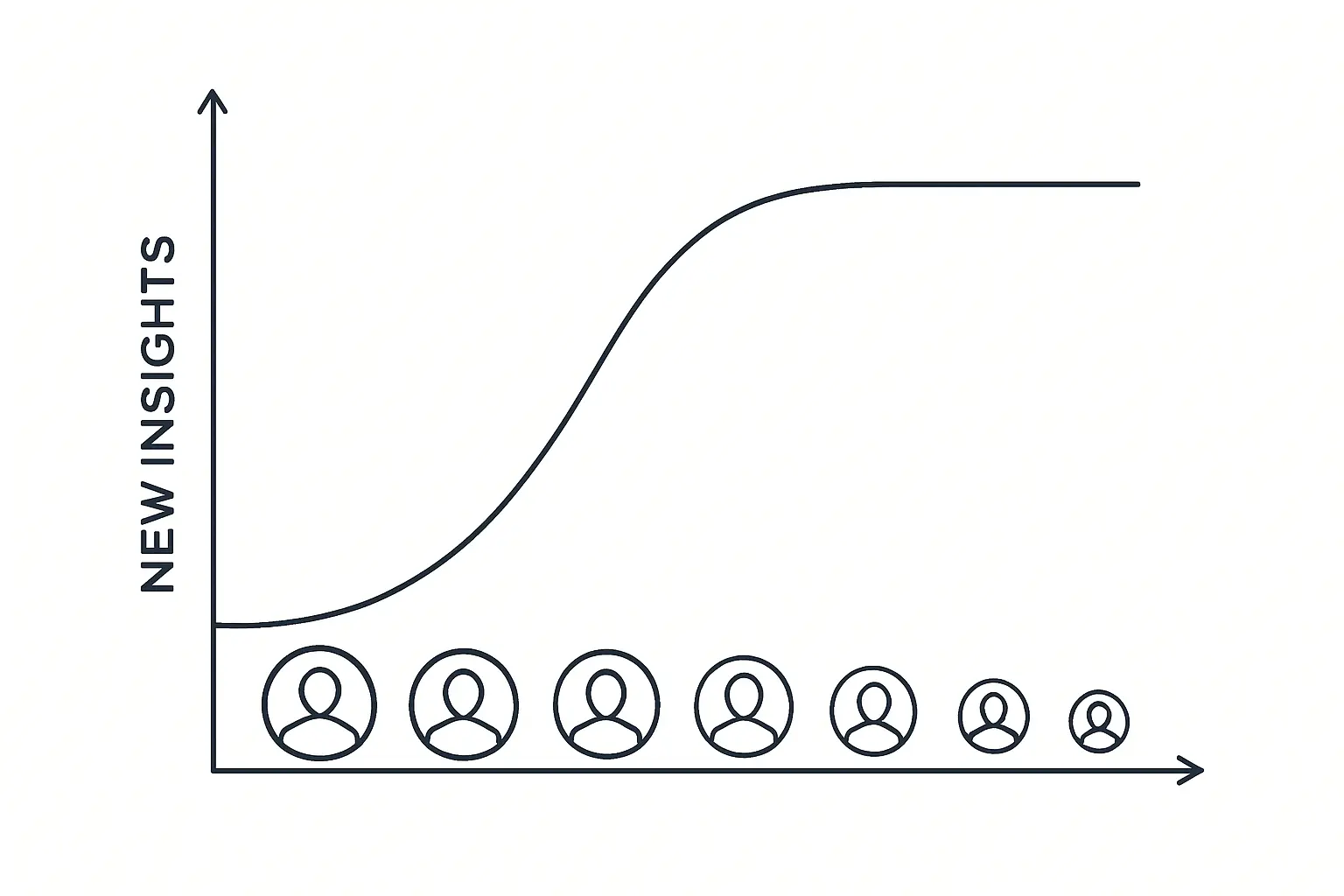
Data saturation is the point in a qualitative study at which additional data collection stops generating new codes, themes, or insights, signalling that the sample is sufficient to answer the research question. It is the qualitative equivalent of a quantitative power calculation, except it can’t be computed in advance with a formula — it has to be recognised as it happens, which is exactly why so many dissertation students struggle to justify it convincingly to their examiners.
The stakes of getting this wrong are real. Stop collecting data too early and an examiner will ask whether your findings are actually representative of the phenomenon you claim to have captured. Keep collecting indefinitely and you burn months of fieldwork time chasing a threshold that was never clearly defined. This guide lays out what the evidence actually says about saturation, how to track it during fieldwork, and how to write a defensible saturation statement in your methodology chapter.
What Is Data Saturation?
The concept originates in grounded theory, where saturation traditionally meant that no new properties, dimensions, or relationships were emerging from continued data collection and analysis. It has since been adopted much more broadly across qualitative traditions, including thematic analysis and case study research, as the standard justification for sample size. Importantly, saturation is not simply “the researcher got tired of interviewing” — it requires ongoing, concurrent analysis during data collection, so that you can actually observe when new interviews stop adding anything.

What the Evidence Actually Says
The most frequently cited empirical study on this question is Guest, Bunce and Johnson (2006), published in Field Methods. The researchers conducted 60 in-depth interviews with women in two West African countries and systematically tracked how many new codes each successive interview introduced. They found that basic thematic elements were present after as few as six interviews, and that saturation for their relatively homogeneous sample was effectively reached at interview 12 — after that point, additional interviews added negligible new thematic content.
This finding is frequently misquoted as “12 interviews is always enough,” which is not what the study concluded. The sample used was demographically homogeneous, the research questions were narrowly scoped, and the interview guide was highly structured — all factors that push saturation earlier. Later methodological work, including a 2017 re-analysis published via ERIC examining metathemes in multisited and cross-cultural research, found that heterogeneous or multi-site samples typically require more interviews before saturation is reached, because the diversity within the sample itself increases the range of codes that can emerge.
Code Saturation vs Meaning Saturation
A useful distinction, developed in later saturation research (notably Hennink, Kaiser, and Marconi), separates two levels of saturation that are easy to conflate:
| Saturation type | What it means | Typical interview count |
|---|---|---|
| Code saturation | No new codes are being generated by the coding process | Often around 9 interviews |
| Meaning saturation | Full understanding of the nuance, dimensions, and depth behind each code | Often 16–24 interviews |
This distinction matters because a study that stops at code saturation may have identified all the relevant categories without fully understanding what each one means to participants. If your research question is exploratory and descriptive, code saturation may be a defensible stopping point. If your research question requires deep interpretive understanding — the kind expected in an interpretative phenomenological or grounded theory design — you should be aiming for meaning saturation, which will require a larger sample.
How to Track Saturation During Fieldwork
Saturation cannot be assessed retroactively with any credibility — you need concurrent data collection and analysis. The most defensible approach follows these steps:
- Analyse as you go. Code each interview transcript shortly after it is conducted rather than waiting until fieldwork finishes.
- Keep a running saturation log. For each interview, record how many entirely new codes it introduced compared with the cumulative codebook so far.
- Set a stopping rule in advance. A common and citable rule, proposed by Francis et al. (2010), is to conduct an initial analysis after roughly 10 interviews, then continue for a further three “stopping criterion” interviews; if no new codes emerge across those three, saturation is considered reached.
- Document the point of saturation explicitly. Note the interview number at which no new codes appeared, and report this transparently in your methodology chapter rather than simply stating a final sample size.
A Worked Example: Tracking Saturation Across 14 Interviews
The figures below are an illustrative example to demonstrate how a saturation log works in practice, not data from a published study. Imagine a study on postgraduate students’ experiences of remote supervision. The researcher logs the number of new codes introduced by each interview alongside the running total:
| Interview number | New codes introduced | Cumulative codebook size |
|---|---|---|
| 1–3 | 6–9 per interview | 24 |
| 4–8 | 2–4 per interview | 39 |
| 9–11 | 1 per interview | 42 |
| 12–14 | 0 | 42 |
In this illustrative example, the researcher would report saturation as reached at interview 11, with interviews 12 through 14 serving as the “stopping criterion” confirmation interviews recommended by Francis et al. This kind of table, included as an appendix, is exactly the evidence examiners are looking for when a methodology chapter claims saturation was achieved.

What Affects How Many Interviews You’ll Need
The number of interviews required to reach saturation is not fixed — it depends heavily on the scope and structure of the study. Key factors include:
- Sample homogeneity. A narrowly defined, homogeneous population (e.g., final-year nursing students at one university) reaches saturation faster than a heterogeneous or multi-site sample.
- Interview structure. Highly structured interview guides with a narrow scope tend to reach saturation sooner than loosely structured, exploratory interviews.
- Research question breadth. A tightly scoped question converges on saturation faster than a broad, multi-dimensional one.
- Analytic depth required. Studies aiming for meaning saturation, rather than code saturation alone, require a larger sample.
How to Write a Saturation Statement in Your Methodology Chapter
Examiners are increasingly sceptical of methodology chapters that state a sample size and simply assert “saturation was reached” without evidence. A defensible saturation statement should include: the total number of interviews conducted, the point at which new codes stopped emerging (with a reference to your saturation log), whether you were targeting code saturation or meaning saturation, and an acknowledgement of the sample characteristics that make the reported saturation point plausible for your specific population. Pairing this with a clear account of your sampling strategy gives examiners the full picture of why your final sample size is defensible rather than arbitrary.
FAQ
How many interviews are needed to reach data saturation?
There is no universal number. Guest, Bunce and Johnson (2006) found saturation at around 12 interviews for a homogeneous sample with a narrow research focus, but code saturation is often reported around 9 interviews and full meaning saturation may require 16 to 24, depending on sample diversity and research scope.
Is data saturation the same as sample size justification?
Saturation is one common way to justify sample size in qualitative research, but it is not the only one. Some designs justify sample size through information power, theoretical sampling logic, or resource constraints instead. What matters is that whichever justification you use is stated explicitly and applied consistently.
Can you claim saturation with fewer than 10 interviews?
It is possible in narrowly scoped, homogeneous studies, but you must demonstrate it with evidence — a saturation log showing no new codes across the final several interviews — rather than simply asserting it. Claims of saturation with very small samples attract closer scrutiny from examiners and reviewers.
Does data saturation apply to focus groups as well as interviews?
Yes, the same logic applies, though the unit tracked is usually the number of focus group sessions rather than individual participants, since group dynamics generate data collectively rather than one person at a time.
What is the difference between saturation and redundancy?
The terms are often used interchangeably, but some methodologists reserve “redundancy” for the observation that new data repeats existing codes, while “saturation” refers to the broader judgement that the categories are fully developed in depth and dimension, not just repeated in frequency.
Saturation is ultimately a judgement call backed by a documented process, not a number you can look up in advance. The strongest methodology chapters treat it that way — showing the evidence trail rather than quoting a single figure from a fifteen-year-old study and hoping it goes unquestioned.
Write your thesis with AI
Structure, draft, cite, and format your thesis faster with Tesify’s AI writing tools, automatic bibliography, and plagiarism checker. Free to start, no credit card required.




Leave a Reply