
PhD Salary by Field 2026: How Much Doctorate Holders Actually Earn (Data by Discipline)
A doctorate is one of the most demanding academic commitments a person can make — typically four to six years of intensive research before most students ever see a full professional salary. Yet the earnings gap between disciplines is enormous: a freshly minted computer science PhD entering the technology industry can expect a median offer close to $180,000, while a psychology or humanities PhD entering a postdoctoral position may be looking at stipends below $60,000. The field you choose shapes your earning trajectory more than almost any other variable. This data roundup draws exclusively on verified, publicly accessible sources — the NSF Survey of Earned Doctorates 2024, the US Bureau of Labor Statistics, the HESA Graduate Outcomes 2022/23, and the American Academy of Arts and Sciences Humanities Indicators — to give you the clearest possible picture of PhD salary by field in 2026.
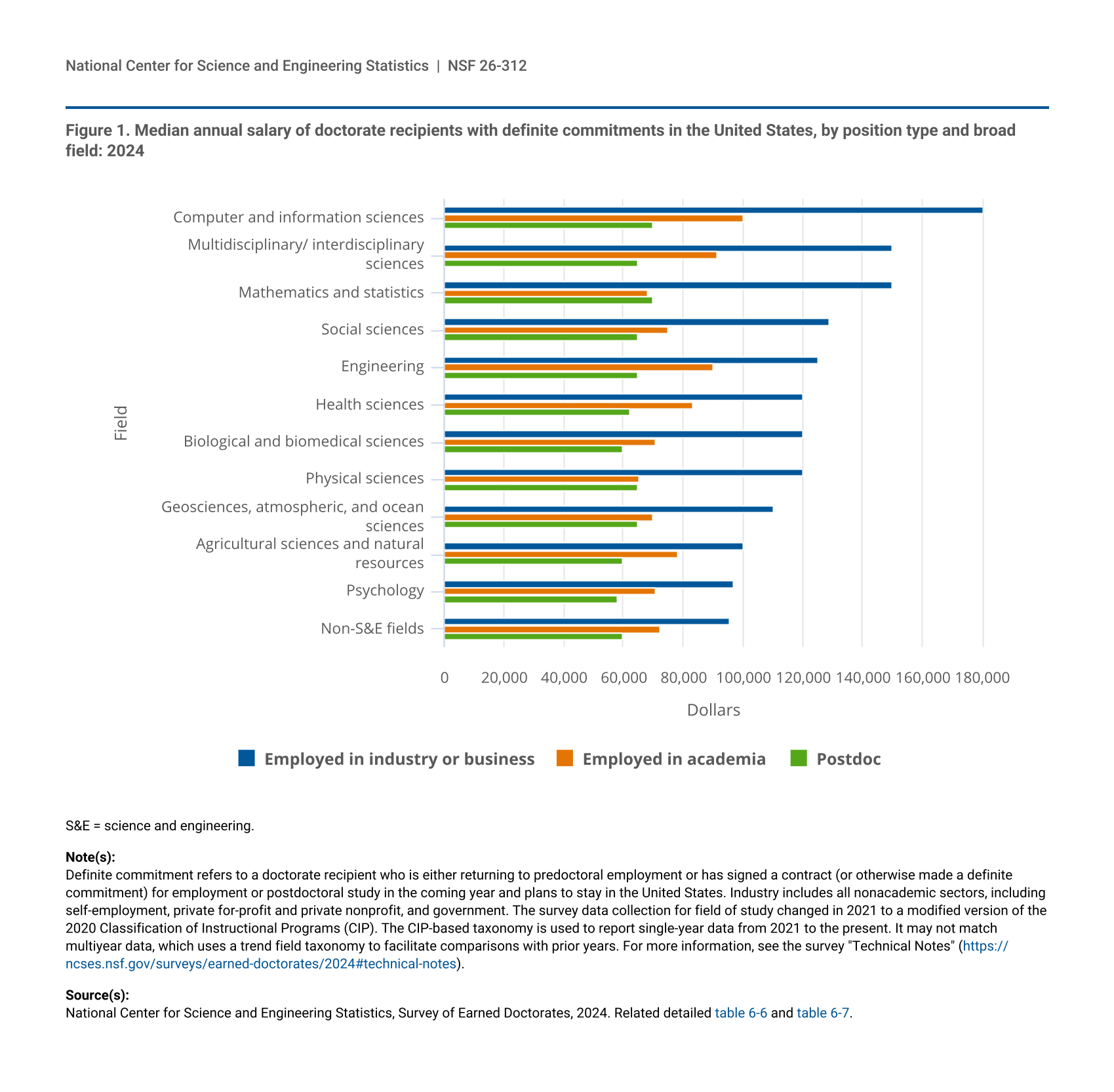
Based on the NSF Survey of Earned Doctorates 2024, doctorate holders entering industry earn a median of $97,000–$180,000 depending on field, compared to $65,000–$100,000 in non-postdoc academic positions. Computer science and engineering lead; psychology and humanities trail. The industry–academia salary gap exceeds $50,000 in most STEM disciplines. UK PhD graduates earn a median of around £41,200 five years after graduation, versus £36,100 for master’s holders, per HESA 2025 data.
Key Findings at a Glance
- Computer and information sciences PhDs entering industry have a median expected salary of $180,000 — the highest of any broad field in the 2024 NSF SED data.
- Psychology PhDs in industry have the lowest expected median of any science and engineering field at $97,000; Non-S&E fields sit at $95,625.
- In academia (non-postdoc), the range runs from $65,140 (physical sciences) to $100,000 (computer and information sciences).
- BLS data puts the median weekly earnings for doctoral degree holders at $2,278 in 2024, equivalent to roughly $118,456 annually — well above the $1,533 weekly median for bachelor’s degree holders.
- Humanities PhDs in the US earned a median of $80,000 in the most recent American Academy of Arts and Sciences data — a $24,000 gap versus the all-PhD median of $104,000.
- UK PhD graduates earn a median of £41,200 five years after graduation, versus £36,100 for master’s graduates, per HESA Graduate Outcomes 2022/23 (published July 2025).
- Postdoctoral salaries are the most compressed: the range across all fields runs from just $58,000 (psychology) to $70,000 (computer science and mathematics/statistics).
US PhD Salary by Field: NSF Survey of Earned Doctorates 2024 Data
The NSF Survey of Earned Doctorates 2024 is the most authoritative US source for early-career PhD salary data. It captures expected median salaries reported at the point of graduation — the salary committed to, not projected — broken down by broad field and employment sector. The figures below are drawn directly from the NSF 26-312 data brief, which covers 2024 doctoral cohort commitments.
Video: PhD earnings broken down by industry and major — data from Michigan State University career resources. Source: Peaceful Progress on YouTube.
| Broad Field | Industry | Academia (non-postdoc) | Postdoc |
|---|---|---|---|
| Computer & Information Sciences | $180,000 | $100,000 | $70,000 |
| Multidisciplinary / Interdisciplinary | $150,000 | $91,500 | $65,000 |
| Mathematics & Statistics | $150,000 | $68,000 | $70,000 |
| Social Sciences | $129,000 | $75,000 | $65,000 |
| Engineering | $125,000 | $90,000 | $65,000 |
| Health Sciences | $120,000 | $83,000 | $61,934 |
| Biological & Biomedical Sciences | $120,000 | $71,000 | $60,000 |
| Physical Sciences | $120,000 | $65,140 | $65,000 |
| Geosciences, Atmospheric & Ocean Sciences | $110,000 | $70,000 | $65,000 |
| Agricultural Sciences & Natural Resources | $100,000 | $78,000 | $60,000 |
| Psychology | $97,000 | $71,000 | $58,000 |
| Non-S&E Fields (incl. Humanities, Education) | $95,625 | $72,000 | $60,000 |
Source: NSF NCSES, NSF 26-312 — Expected Median Salaries for Doctorate Recipients (2024 SED cohort). Figures represent expected median salaries at the point of doctoral graduation for those committing to non-postdoc employment or a postdoc position.
Several patterns emerge immediately. Computer science maintains a commanding lead in every sector category — its industry median of $180,000 is nearly double that of psychology ($97,000) and non-S&E fields ($95,625). Mathematics and statistics show a distinctive pattern: postdoc pay ($70,000) actually ties or exceeds non-postdoc academic pay ($68,000), reflecting the premium paid for mathematical expertise in research environments and the strong pipeline into quantitative finance roles. Engineering PhDs enjoy the narrowest industry-to-academia gap in relative terms, partly because engineering faculty salaries are boosted by consulting income and industry grants.
Academia vs Industry: The Earnings Gap
The sector you enter after your doctorate is the single biggest lever on your starting earnings. Across every field captured by the NSF SED 2024 data, industry salaries dominate — sometimes by a factor of nearly two. This gap does not close evenly as careers progress. According to NSF reporting, the range of expected median salaries across broad fields is widest in industry and narrowest among postdoctoral positions, suggesting that private-sector employers apply a sharper premium for specialist expertise than universities do.
| Field | Industry Median | Academia Median | Gap |
|---|---|---|---|
| Computer & Information Sciences | $180,000 | $100,000 | $80,000 |
| Mathematics & Statistics | $150,000 | $68,000 | $82,000 |
| Biological & Biomedical Sciences | $120,000 | $71,000 | $49,000 |
| Engineering | $125,000 | $90,000 | $35,000 |
| Social Sciences | $129,000 | $75,000 | $54,000 |
| Psychology | $97,000 | $71,000 | $26,000 |
Source: NSF NCSES NSF 26-312, 2024 SED cohort.
The mathematics and statistics gap ($82,000) is particularly striking: the field’s academic entry salaries are relatively modest, yet its industry demand from technology, finance, and data-science sectors drives some of the highest private-sector offers of any discipline. Biological and biomedical sciences show the opposite dynamic — industry offers are high ($120,000) but academia is substantially lower ($71,000), reflecting the well-documented phenomenon of long postdoctoral holding patterns in the life sciences before tenure-track positions materialise. For context on how long PhD programmes themselves take and how submission timelines vary, see the data in thesis extension and deferral statistics for 2026.
Engineering shows the narrowest absolute gap ($35,000), largely because US engineering faculty salaries are bolstered by industry grants, consulting arrangements, and nine-month contract structures that allow summer income supplements — mechanisms less available in humanities or life-science departments.
Humanities and Social Sciences in Detail
The non-S&E category in NSF data bundles together humanities, education, and other non-science fields. For a finer-grained view, the American Academy of Arts and Sciences Humanities Indicators — drawing on the National Survey of College Graduates — provide the most granular published figures. Full-time workers holding a humanities PhD had a median annual income of $80,000, compared to $104,000 for all PhD holders and $145,000 for engineering and business doctorates.
The earnings distribution within humanities is also unusually wide: the 25th percentile sits at $60,000, while the 75th percentile reaches $105,000 — a $45,000 range driven primarily by sector. Humanities PhDs who move into consulting, government policy, publishing management, or technology companies (in roles drawing on language, analysis, and communication skills) substantially outperform those who remain in postsecondary faculty positions. The humanities salary challenge is partly structural: the field concentrates a disproportionate share of its graduates in university teaching roles, where faculty salaries across all ranks fall below the disciplinary median in other fields.
Social science PhDs occupy a middle position — the NSF SED places them at $129,000 in industry and $75,000 in academia. Economists who transition into data science, policy analysis, or financial-sector roles frequently command salaries at or above the computer science benchmark, because quantitative economics training is directly applicable to industry problems. Sociologists, political scientists, and anthropologists entering academia typically land closer to the $65,000–$80,000 academic range. For advice on navigating the supervisor relationship during your doctoral programme — which shapes your network and job-market readiness — see the guide on managing your supervisor relationship through your thesis.
UK PhD Earnings: HESA and Vitae Data
The UK picture comes primarily from two sources: the HESA Graduate Outcomes survey (2022/23 cohort, published July 2025), which tracks graduates 15 months after completing their degrees, and the Vitae study What Do Researchers Do?, which follows doctoral graduates over longer time horizons. The table below summarises the headline figures for doctoral graduates.
| Group / Stage | Median Annual Salary | Source |
|---|---|---|
| PhD graduates (5 years post-completion) | £41,200 | HESA Graduate Outcomes 2022/23 |
| Master’s graduates (5 years post-completion) | £36,100 | HESA Graduate Outcomes 2022/23 |
| Medicine & Dentistry graduates (all levels, 15 months) | £37,924 | HESA SB272, 2025 |
| Social Sciences graduates (all levels, 15 months) | £30,000 | HESA SB272, 2025 |
| PhD — higher education research roles (15 months) | ~£35,000 | HESA Graduate Outcomes (destination cluster) |
| UKRI PhD stipend (2025–26, outside London) | £21,805 | UKRI 2025 |
Sources: HESA Graduate Outcomes 2022/23 (published July 2025); UKRI stipend guidance 2025–26.
The UK STEM premium mirrors the US pattern, though the absolute salary figures are lower and the academic pay structure is governed by the Higher Education Role Analysis (HERA) framework, which caps lecturer-grade positions in the low-to-mid £40,000s at most institutions. STEM PhDs moving into technology, engineering, or pharmaceutical-sector roles in the UK typically reach £50,000–£70,000 within three years of graduating — comparable, in purchasing-power terms, to academic positions several rungs higher. UK humanities PhDs entering higher education research or publishing typically fall in the £28,000–£38,000 range in early career, reflecting both the salary scales of higher education employers and the competitive bottleneck for permanent positions. Understanding how data-sharing norms differ by discipline — which directly affects career competitiveness and grant prospects — is documented in the research data sharing statistics by field for 2026.
The PhD Earnings Premium Over Lower Degrees
A consistent finding across both US and UK datasets is that a doctorate commands a meaningful earnings premium over a master’s or bachelor’s degree — but the size of that premium varies by field and sector. In the US, BLS data for 2024 shows median weekly earnings of $2,278 for doctoral degree holders, compared to $1,833 for professional degree holders (a category that includes MDs and JDs, which can skew higher), $1,737 for master’s degree holders, and $1,543 for bachelor’s degree holders. The doctoral premium over a bachelor’s degree is approximately $38,000 per year in median terms — substantial, though it must be weighed against the opportunity cost of four to six additional years in training.
In the UK, HESA data places the five-year-out median for PhD graduates at £41,200 versus £36,100 for master’s graduates — a premium of roughly £5,100 annually at the population-median level. That premium is larger in STEM fields and smaller in humanities, but it tends to grow with career progression as doctoral holders move into senior research, leadership, and specialist consulting roles that explicitly require a doctorate as a credential. Doctoral holders also benefit from lower unemployment rates: the BLS reports a 1.5% unemployment rate for doctoral degree holders in 2024, against 2.1% for professional degree holders and 2.8% for master’s holders.
It is worth noting that the doctoral earnings premium looks different depending on the counterfactual. If a biology PhD would otherwise have entered medicine as an MD/PhD, the financial calculus changes significantly. If they would have entered the workforce directly from a master’s programme, the premium accrues quickly once the industry salary trajectory begins. For practical support during the writing-up phase — which is often when PhD students most feel the financial pressure of stipend living — the guide on surviving your final year as a PhD student offers a grounded overview of common challenges.
Postdoctoral Salaries by Field
Postdoctoral positions represent a distinct salary band that sits below industry entry-level and, in many fields, below non-postdoc academic salaries as well. NSF SED 2024 data shows postdoc expected median salaries ranging from $58,000 (psychology) to $70,000 (computer science and mathematics/statistics). Notably, this is the narrowest salary band across all sectors — industry salaries vary by $84,375 across fields, postdoc salaries vary by only $12,000.
NIH announced updated postdoctoral stipend levels effective March 2026, raising the base for NRSA (National Research Service Award) fellows — a move that typically benchmarks institutional postdoc pay across US research universities. The NIH’s direct influence on postdoc compensation means that biology, chemistry, and health-sciences postdocs are more standardised in their pay structure than, say, humanities or social-science postdocs, which are governed more by individual institution budgets.
For researchers weighing whether to do a postdoc before industry, the salary data suggests that for most fields outside computer science and mathematics, a direct industry transition yields an immediate $30,000–$60,000 salary advantage over a postdoctoral position. The counterargument — that postdoc experience is essential for a tenure-track academic career — has become harder to make as academic job market contraction has accelerated. For a curated list of funded postdoctoral opportunities that offer competitive stipends, see the ranked guide to the best postdoc fellowships in 2026.
What Shapes Your PhD Salary Beyond Field
Field is the largest single variable, but several other factors interact with it meaningfully:
Institution and Advisor Network
Where you complete your PhD matters beyond prestige. Graduates from research-intensive R1 universities in the US and Russell Group institutions in the UK enter job markets with stronger alumni networks, more industry partnerships, and higher placement rates into competitive positions. The quality and breadth of your advisor’s professional network is a proxy for the placement opportunities you will access. How frequently you meet your supervisor and the depth of those meetings — documented in the supervisor meeting frequency statistics for 2026 — correlates with dissertation quality and time-to-completion, both of which affect employability signals.
Geographic Market
US technology hub salaries (San Francisco Bay Area, Seattle, New York) add significant location premiums on top of the field-level medians reported by NSF. A computer science PhD entering a Bay Area technology company may see offers considerably above the $180,000 national median, reflecting local cost-of-living adjustments and competitive bidding. UK PhD graduates based in London consistently outperform the national median: HESA data notes that graduates in London earn substantially above the UK median across all degree levels.
Sector Within Industry
Even within “industry,” the sub-sector matters. For engineering and physical science PhDs, the pharmaceutical, semiconductor, and defence sectors offer substantially different pay scales. For social science PhDs, management consulting and financial-sector roles typically outperform government or non-profit positions by a wide margin. The open-access publishing and academic communication landscape is also reshaping which skills are valued — field-specific familiarity with data-sharing mandates and repository norms, tracked in our open peer review adoption statistics, is increasingly relevant to researchers navigating both academic and industry career tracks.
Time Since Graduation
The NSF SED figures represent expected salaries at the point of graduation — they are not mid-career snapshots. Salary trajectories diverge significantly over the first decade. Computer science and engineering PhDs in industry tend to compound their starting salaries rapidly through stock compensation, promotion cycles, and specialist demand. Humanities and social science PhDs in academia move through a slower, more structured progression tied to rank advancement (postdoc → lecturer/assistant professor → associate → full professor).
Frequently Asked Questions
What is the average PhD salary in the US in 2026?
BLS data for 2024 places the median weekly earnings for doctoral degree holders at $2,278, equivalent to roughly $118,456 annually. However, this overall figure masks substantial variation: computer science PhDs in industry can expect a median around $180,000 at graduation, while psychology or humanities PhDs may be closer to $70,000–$80,000. The median is also pulled upward by high-earning professional fields bundled into “doctoral” categories.
Which PhD pays the most?
Among broad academic fields tracked by the NSF SED 2024, computer and information sciences PhDs have the highest expected median salary in every sector category: $180,000 in industry, $100,000 in non-postdoc academia, and $70,000 in postdoctoral positions. Mathematics, statistics, and engineering PhDs are close runners-up in the private sector. Business and financial economics PhDs are not tracked as a separate category in NSF SED but typically earn comparably to or above computer science in industry roles.
How much do humanities PhDs earn compared to STEM PhDs?
According to American Academy of Arts and Sciences Humanities Indicators data, full-time workers with a humanities PhD earn a median of $80,000 annually — $24,000 below the all-PhD median of $104,000 and $65,000 below engineering and business PhDs at $145,000. NSF SED 2024 places the non-S&E industry median at $95,625, compared to $180,000 for computer science. The gap reflects both lower academic pay scales in humanities departments and lower rates of transition into high-paying private-sector roles.
Is a PhD worth it financially?
The financial return on a PhD depends heavily on field and sector. In computer science, engineering, and quantitative fields, the doctoral salary premium over a master’s degree is large and accumulates quickly in industry. In humanities and some social sciences, the earnings premium over a master’s degree is modest — HESA data suggests roughly £5,100 per year at the population median in the UK — and must be weighed against four to six years of stipend-level income. The PhD is most financially compelling when it opens roles that are categorically inaccessible without one (e.g., R&D leadership, academic positions, highly regulated professional research roles).
What do postdocs earn by field in the US?
NSF SED 2024 data shows postdoc expected median salaries ranging from $58,000 (psychology) to $70,000 (computer and information sciences; mathematics and statistics). Biological and biomedical sciences, physical sciences, geosciences, and agricultural sciences postdocs cluster around $60,000–$65,000. Health sciences postdocs report a median of $61,934. NIH raised its NRSA postdoc stipend benchmarks in March 2026, and most US research universities adjust institutional minimums to match or exceed NIH levels.
How much do UK PhD graduates earn?
HESA Graduate Outcomes 2022/23 data (published July 2025) places the median salary for PhD graduates at £41,200 five years after graduation, compared to £36,100 for master’s graduates. Fifteen months after graduation, those in higher education research roles earn around £35,000. STEM PhDs entering the private sector (technology, pharmaceuticals, engineering) typically exceed the national median within two to three years. UKRI PhD stipends for 2025–26 are set at a minimum of £21,805 outside London and £23,805 in London.
Does the university you attend affect your PhD salary?
Yes, though the mechanism is indirect. Graduates from research-intensive R1 (US) or Russell Group (UK) universities tend to have stronger placement rates into competitive industry and faculty positions, partly through alumni networks and partly through institutional prestige signals. However, the discipline-level salary data from NSF and HESA represents population-wide medians; individual outcomes within any field vary widely based on advisor networks, internship or industry experience during the PhD, geographic flexibility, and the specific sub-specialisation chosen.
How does PhD salary compare to going straight into industry after a master’s?
In most fields, a master’s graduate entering industry will earn their first salary three to five years before a PhD graduate doing the same. At the point of PhD graduation, BLS data shows doctoral holders earn a weekly median of $2,278 versus $1,737 for master’s holders — a premium of roughly $28,000 annually. In STEM fields, the PhD premium in industry is often larger still. However, the compounded opportunity cost of lower stipend income during the doctorate years means the financial break-even can take a decade or more to reach in lower-earning fields.
What are the highest-paying non-STEM PhD careers?
Social science PhDs entering private-sector roles — particularly economics PhDs moving into finance, consulting, and technology firms in data and strategy roles — can match or exceed STEM salary benchmarks. American Academy of Arts and Sciences data places business and economics PhDs at a $145,000 median. Law-adjacent social science doctorates (e.g., criminology, public policy) command premiums in government and regulatory agencies. Communication and media studies PhDs with quantitative skills are increasingly sought in digital advertising and platform analytics roles.
Write your thesis with AI
Structure, draft, cite, and format your thesis faster with Tesify’s AI writing tools, automatic bibliography, and plagiarism checker. Free to start, no credit card required.




Leave a Reply