

How to Write the Literature Review of an MBA Dissertation (2026): Seminal Journals, Structuring the Synthesis and How Long It Should Be
An MBA literature review is judged on a narrower, more practical standard than a PhD literature review in the same field: you are not expected to map an entire theoretical tradition, but you are expected to show you know where management research actually gets published, which theories and authors a reviewer in your sub-field would recognise immediately, and how to synthesise that literature into an argument that justifies your own study rather than simply summarising what you read.
1. The Journals a Management Reviewer Expects to See Cited
A management dissertation examiner forms an impression of your literature review within the first page of your reference list, before reading a word of the prose. Certain journals function as the field’s recognised core, and citing at least some of them signals that you have engaged with the discipline’s actual research conversation rather than relying entirely on textbooks or consultancy white papers:
- Academy of Management Journal — empirical management research across every sub-field
- Academy of Management Review — theory-building and conceptual contributions
- Strategic Management Journal — strategy, competitive advantage, corporate-level decisions
- Journal of Management — broad management and organisational behaviour research
- Administrative Science Quarterly — organisational theory, often more sociologically grounded
- Journal of International Business Studies — international strategy, cross-border management
- Journal of Marketing and Journal of Marketing Research — for marketing-concentration topics
- Journal of Applied Psychology — for organisational behaviour and HR-adjacent topics
This is not an exhaustive list, and a strong sub-field-specific journal your supervisor names will often matter more than a generalist one — the point is to demonstrate familiarity with the tier of journal your specific topic actually gets published in, not to force citations from a fixed list regardless of fit.
2. Where to Search: Databases and Journal Rankings
Business school libraries typically provide access to Business Source Complete (EBSCO) and ABI/INFORM (ProQuest), the two databases built specifically for management and business research, alongside general-purpose tools like Google Scholar and Scopus. Many UK and European business schools also reference the Chartered Association of Business Schools’ Academic Journal Guide when judging journal quality — checking where a candidate source sits on your school’s recognised ranking list before relying heavily on it is a quick way to avoid building your review around a predatory or low-credibility outlet without realising it.
3. Organise by Theme, Not by Author or Date
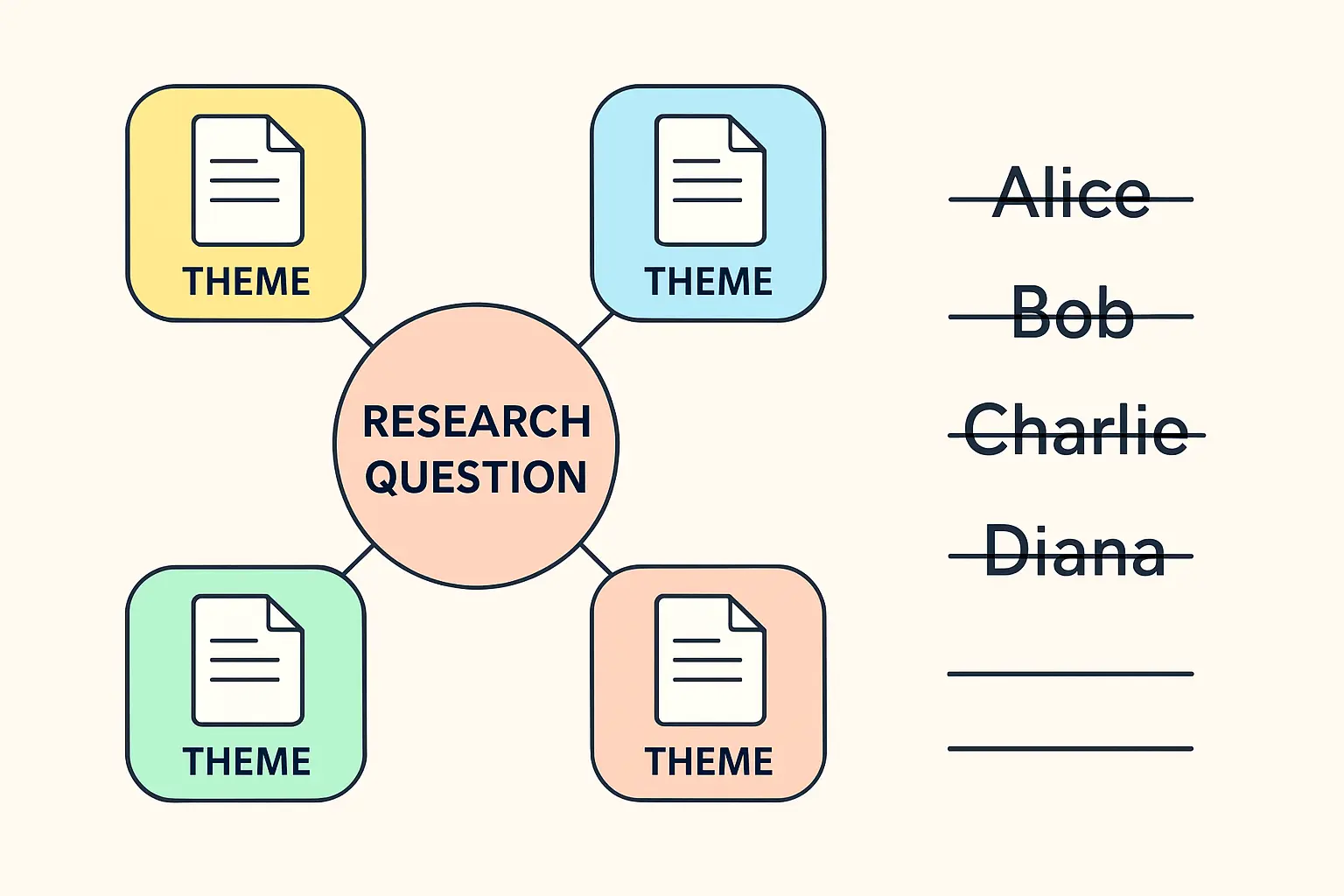
The single most common structural mistake in an MBA literature review is organising it as a list — “Smith (2019) found X. Jones (2021) found Y. Lee (2022) found Z.” — rather than as an argument. A thematic structure instead groups sources around the constructs your research question actually depends on. For a dissertation on remote-work policy and employee retention, for example, the review might organise into: (1) theoretical foundations of employee retention, (2) empirical evidence on remote and hybrid work arrangements, (3) moderating factors (job type, seniority, national context), and (4) gaps in how these two literatures have been connected. Each theme synthesises multiple sources in conversation with each other, agreeing, disagreeing or building on one another, rather than presenting them as an unconnected sequence.
4. What Synthesis Actually Means Here
Synthesis means your own analytical voice organises the material, not the chronological order in which you happened to read it. A synthesised paragraph names the pattern across several sources, notes where they disagree and why, and states what the disagreement or gap implies for your own study — not simply “several studies have examined this topic (Smith, 2019; Jones, 2021).” Concretely: after presenting three studies on a construct, ask yourself what claim you can make that none of the three studies makes individually. That claim, defensible only because you have read all three together, is the synthesis an examiner is looking for.
Worked Example: A Summary Paragraph vs a Synthesised Paragraph
Summary (weak): “Smith (2019) found that hybrid work increased reported job satisfaction. Jones (2021) studied remote work and found mixed effects on retention. Lee (2022) examined flexible scheduling and found positive effects on tenure.” This lists three studies without relating them to each other.
Synthesis (strong): “Evidence on flexible work arrangements and retention is more consistent for scheduling flexibility (Lee, 2022) than for full remote arrangements, where Jones (2021) found effects varied by seniority and job type — a moderation the satisfaction-focused literature (Smith, 2019) does not address, since satisfaction and retention are conceptually distinct outcomes. This inconsistency suggests that studies treating ‘flexible work’ as a single construct may be masking meaningfully different retention mechanisms across its sub-types, a gap this dissertation addresses directly.” This version makes a claim only visible from reading all three studies together.
5. Closing With the Gap Statement
The literature review chapter should end with an explicit paragraph stating the specific gap your dissertation addresses — not a vague “more research is needed” but a precise claim: which construct, relationship, context or population the existing literature has not yet examined, and why that gap matters practically to the kind of organisation your dissertation studies. This gap statement is what your introduction’s research question should visibly answer, and what your discussion chapter should return to when interpreting your findings — the literature review is not a standalone chapter but the argument that the rest of the dissertation is answering.
6. How Long It Should Be
For a taught master’s MBA dissertation (typically 12,000–20,000 words total), the literature review chapter is commonly in the 3,000–5,000 word range — substantial enough to demonstrate genuine engagement with the field, but proportioned against a methodology, findings and discussion chapter that also need adequate space. Check your own programme handbook for the specific chapter-length guidance, since allocations vary by school and by whether your dissertation is a traditional academic study or a consultancy-style applied project with a shorter review expected.
7. How the Reading List Shifts by MBA Concentration

| Concentration | Journals/sources to prioritise |
|---|---|
| Strategy | Strategic Management Journal, Academy of Management Journal, Long Range Planning |
| Marketing | Journal of Marketing, Journal of Marketing Research, Journal of Consumer Research |
| Organisational behaviour / HR | Journal of Applied Psychology, Journal of Organizational Behavior, Personnel Psychology |
| Finance | Journal of Finance, Journal of Financial Economics, Review of Financial Studies |
| International business | Journal of International Business Studies, International Business Review |
Your supervisor’s own recent publications and reading-list recommendations should still take priority over any generic list — sub-field conventions shift, and a supervisor working actively in your concentration knows the current core reading better than any general guide.
8. Common Mistakes
- Leaning entirely on textbooks and consultancy reports (McKinsey, Deloitte, HBR articles) instead of peer-reviewed journal sources — useful for context and practitioner relevance, but not sufficient as the scholarly backbone of the chapter.
- Author-by-author summary instead of thematic synthesis — the single most common structural weakness described above.
- No explicit gap statement — leaving the reader to infer why the dissertation’s research question matters.
- Citing outdated foundational theory without acknowledging newer critique or extension — management theory moves; a review that treats a 1990s framework as the field’s current consensus without engaging more recent work reads as under-researched.
For the surrounding methodology-chapter conventions your literature review sets up, see our guide on writing a research methodology chapter for your thesis, and for the fuller MBA dissertation structure this chapter sits within, see our step-by-step guide to writing an MBA dissertation. For the wider business-management dissertation process beyond an MBA specifically — topic selection, methodology choice and chapter structure — see our complete guide to writing a business management dissertation, and for a worked, annotated model of what a distinction-level review actually looks like, see our literature review example with step-by-step analysis and templates.
Frequently Asked Questions
Can I cite Harvard Business Review or McKinsey reports in my MBA literature review?
Yes, as supporting practitioner context, but not as the scholarly backbone. Peer-reviewed journal articles should carry the theoretical weight of the review; practitioner sources are useful for demonstrating real-world relevance and current industry framing alongside the academic literature, not instead of it.
How many sources should an MBA literature review cite?
There is no fixed number — quality and relevance to your specific research question matter more than count. As a rough guide, a 3,000–5,000 word MBA literature review typically engages substantively with 30–60 sources, weighted toward the peer-reviewed journals central to your concentration.
Should I organise my literature review chronologically or thematically?
Thematically, in almost all cases. A chronological or author-by-author structure tends to read as a summary rather than an argument. Organise around the constructs and relationships your research question depends on, synthesising multiple sources within each theme.
What is a gap statement, and do I need one?
Yes. A gap statement is a precise closing claim about what the existing literature has not yet examined — the specific construct, relationship, context or population your dissertation addresses. It is what justifies your research question and what your discussion chapter returns to when interpreting your findings.
Does my literature review need its own theoretical framework section?
Many MBA programmes expect the literature review to build toward, or explicitly include, the theoretical or conceptual framework the rest of the dissertation applies. Check your own programme’s chapter template — some place the framework as a distinct sub-section at the end of the literature review, others as a short separate chapter immediately after it.
Write Your Literature Review With Confidence
Tesify’s AI-powered academic writing tool helps MBA students structure a thematic literature review, synthesise sources, and build a clear gap statement that sets up the rest of the dissertation.
Write your thesis with AI
Structure, draft, cite, and format your thesis faster with Tesify’s AI writing tools, automatic bibliography, and plagiarism checker. Free to start, no credit card required.






Leave a Reply