
How to Write a List of Abbreviations for Your Thesis (2026)
A list of abbreviations is a two-column reference in your thesis front matter that pairs each abbreviation with its full term, listed alphabetically. It goes after the table of contents and lists of figures and tables, and before the introduction. You need one when your thesis uses roughly five or more abbreviations, and it never replaces defining each term at its first use in the text.
It is a small section, but a badly handled one signals carelessness to an examiner — and a well-handled one makes a technical thesis genuinely easier to read. This guide covers placement, formatting, when a list is actually required, and the in-text rules that go alongside it.
What Is a List of Abbreviations?
A list of abbreviations (sometimes called a list of acronyms, glossary of terms, or nomenclature, depending on discipline) is a reference table that lets a reader look up any shortened form used in your thesis. It matters most in fields dense with acronyms — medicine, engineering, the sciences, and policy research — where a reader who has forgotten what “PLS-SEM” or “NICE” stands for can check without hunting back through the text. Its job is purely navigational: to remove friction for the examiner.
Where Does It Go?
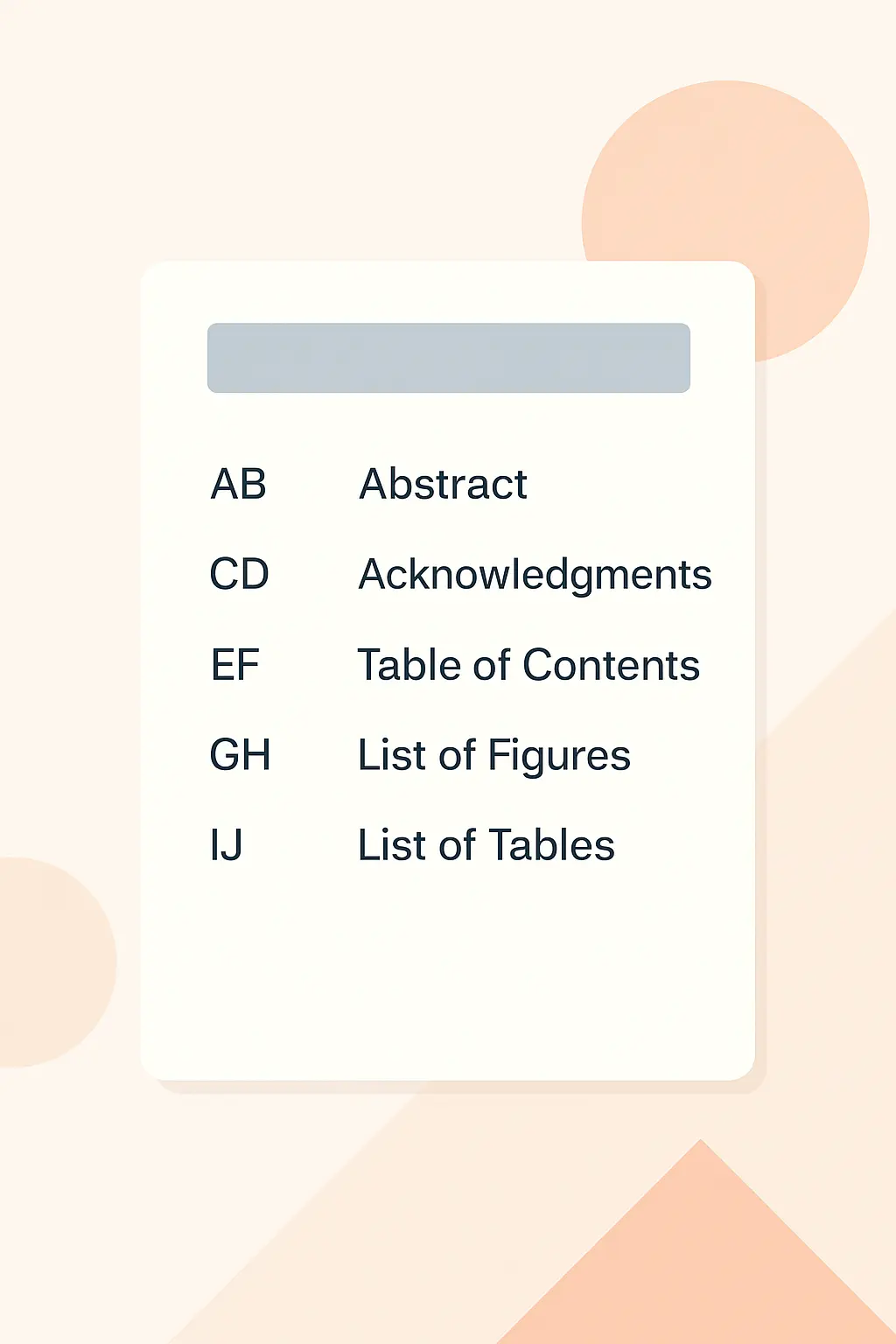
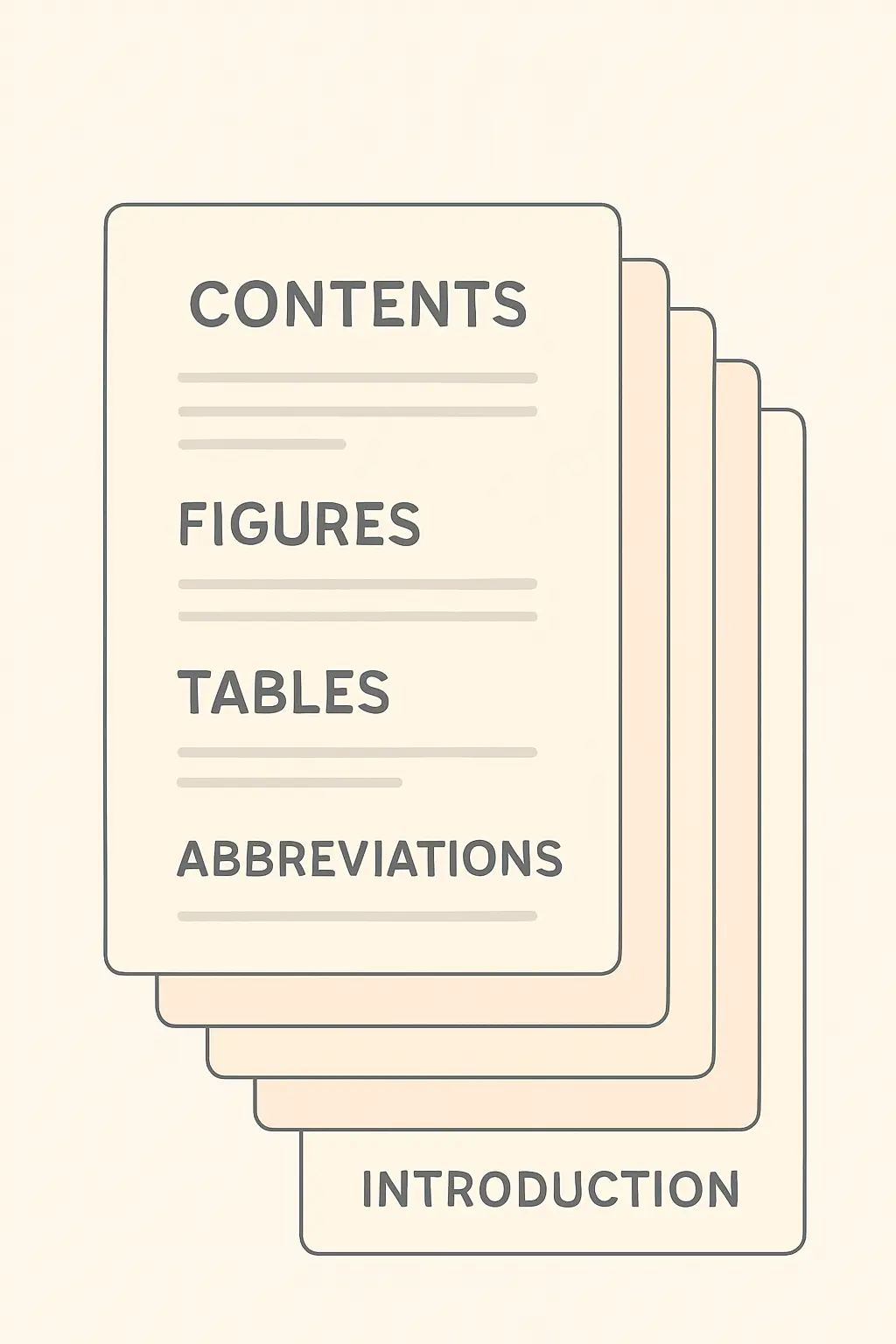
The list belongs in the preliminary pages, in a conventional order. A typical front-matter sequence runs: title page, abstract, acknowledgements, table of contents, list of figures, list of tables, and then the list of abbreviations, immediately before the main introduction. These preliminary pages usually carry lowercase Roman numerals (i, ii, iii), switching to Arabic numbers when the main text begins. It sits naturally alongside your list of figures and tables and your table of contents, and should be formatted consistently with them.
Do You Actually Need One?
Not every thesis requires a list of abbreviations. The common convention is that a separate list becomes worthwhile once you use around five or more abbreviations. Below that, defining each term in the text at first use is sufficient and a standalone list looks like padding.
| Situation | Recommendation |
|---|---|
| Fewer than ~5 abbreviations | Define in text only; no separate list |
| ~5 or more abbreviations | Include a list of abbreviations |
| Many technical symbols too | Consider a separate list of symbols / nomenclature |
| University specifies a rule | Follow the institutional guideline over any rule of thumb |
The five-abbreviation threshold is a widely used convention, not a fixed rule; your university’s thesis formatting guidelines take precedence.
How Do You Format It?
- Two columns. Put the abbreviation on the left and the full term on the right.
- Alphabetical order by abbreviation, so readers can find any entry quickly.
- Consistent capitalisation of the full terms — match how they appear in your text and your discipline’s conventions.
- Clean alignment. Use a table or tab stops so the two columns line up; ragged spacing looks unprofessional.
- Separate symbols if needed. Greek letters and mathematical symbols are often given their own list rather than mixed with lettered abbreviations.
A short worked example: ANOVA — Analysis of Variance; GDP — Gross Domestic Product; WHO — World Health Organization, each on its own row, in alphabetical order. Keeping this consistent with the rest of your front matter is part of the same attention to formatting covered in our full dissertation writing guide.
What Are the In-Text Rules?
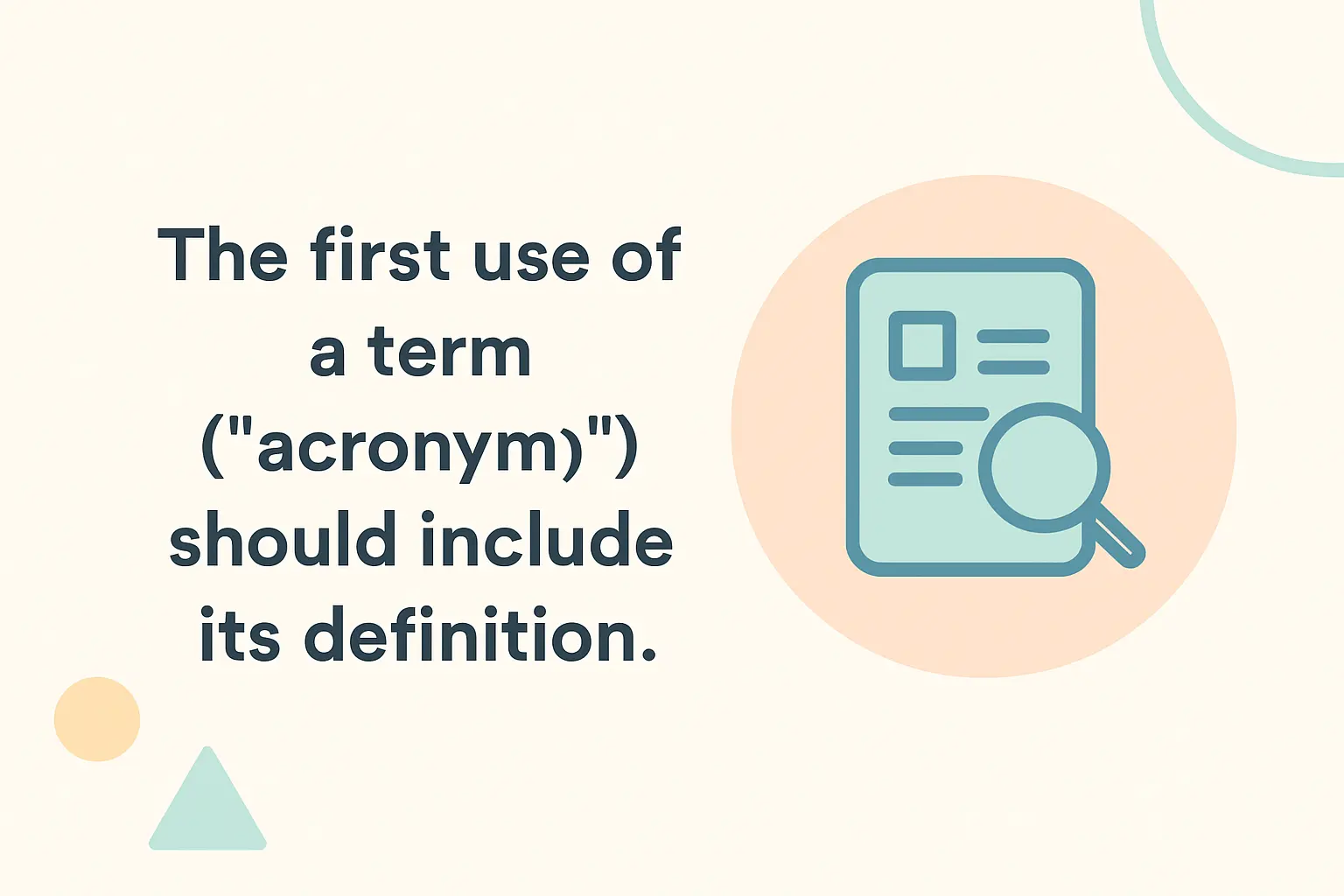
A list of abbreviations does not exempt you from defining terms in the running text. The universal rule is: spell out the full term at first use, followed by the abbreviation in brackets, then use the abbreviation from then on. For example, “the World Health Organization (WHO) reported…” on first mention, and “WHO” thereafter. A few further points:
- Do not abbreviate a term used only once — there is no reader benefit.
- Do not start a sentence with an abbreviation where it reads awkwardly; rephrase or spell it out.
- Very well-known abbreviations (such as UK or USA) may not need spelling out, depending on your style guide.
- Be consistent — once you introduce an abbreviation, use it every time rather than alternating with the full term.
Handled together, a clean list and disciplined first-use definitions make even an acronym-heavy thesis effortless to read — which is exactly the impression you want to give an examiner. The same care applies to related sections like the thesis appendix, where consistency and clear labelling do the quiet work of signalling rigour.
FAQ
Where does the list of abbreviations go in a thesis?
The list of abbreviations sits in the front matter, after the table of contents and any list of figures and tables, and before the main introduction. It is part of the preliminary pages, which usually carry lowercase Roman numeral page numbers rather than the Arabic numbering of the main text.
Do you need a list of abbreviations in a thesis?
You need one when your thesis uses a substantial number of abbreviations, acronyms, or symbols — a common rule of thumb is around five or more. If you use only one or two abbreviations, defining them in the text at first use is enough and a separate list is unnecessary. Always check your university’s formatting guidelines.
How do you format a list of abbreviations?
Use two columns: the abbreviation on the left and its full term on the right, listed in alphabetical order by abbreviation. Keep formatting consistent, align the columns cleanly, and match the style your university requires. Symbols are sometimes given their own separate list.
Do you still define abbreviations in the text if you have a list?
Yes. A list of abbreviations does not replace defining each term at its first use in the main text. Write the full term followed by the abbreviation in brackets the first time it appears, then use the abbreviation thereafter. The list is a reference aid, not a substitute for in-text definition.
Related Reading
Write your thesis with AI
Structure, draft, cite, and format your thesis faster with Tesify’s AI writing tools, automatic bibliography, and plagiarism checker. Free to start, no credit card required.






Leave a Reply