
How to Write an Engineering Thesis: The Complete Discipline Guide (2026)
Your supervisor reviews your circuit diagrams before your bibliography, and your examiner understands load-path analysis better than narrative argument. Knowing how to write an engineering thesis puts you in a fundamentally different position from humanities or social science students — the generic guides online were not written for you. Your chapter structure is shaped by whether you built a prototype, ran a finite element simulation, or designed and tested a physical experiment, and each of those paths follows distinct conventions for methodology chapters, results reporting, and figures.
This guide covers the discipline-specific decisions that separate a pass from a distinction in 2026: how to choose and label your project type, how to adapt IMRaD to engineering chapter sequences, how to write a methodology chapter that satisfies a technical examiner, and how to handle results that did not behave the way your model predicted.
1. Engineering Project Types: Design/Build, Simulation, Experimental
Before you write a single chapter, you need to identify the type of project you are conducting — because the project type determines which chapters your thesis requires and how those chapters are structured. Most engineering theses at master’s and final-year undergraduate level fall into one of three categories:
| Project type | What you produce | Core chapter focus | Common disciplines |
|---|---|---|---|
| Design/Build | Physical artefact, device, or system | Design rationale, fabrication, performance testing | Mechanical, civil, electrical, biomedical |
| Simulation | Computational model and its outputs | Model derivation, solver settings, mesh independence, validation | Aerospace, structural, chemical, materials |
| Experimental | Dataset from controlled physical tests | Apparatus, protocol, measurements, uncertainty analysis | Thermal, fluid, materials, environmental |
Some theses combine types — a design/build project that includes a CFD validation study, for example. If that applies to you, flag both in your introduction so the examiner knows which chapters belong to which strand. Hybrid theses that do not label their project type clearly are a common source of examiner queries at Imperial College London and ETH Zürich, where examiners are domain specialists who notice immediately when a chapter’s framing does not match its methods.
2. How to Write an Engineering Thesis: Adapting IMRaD for Chapter Sequences
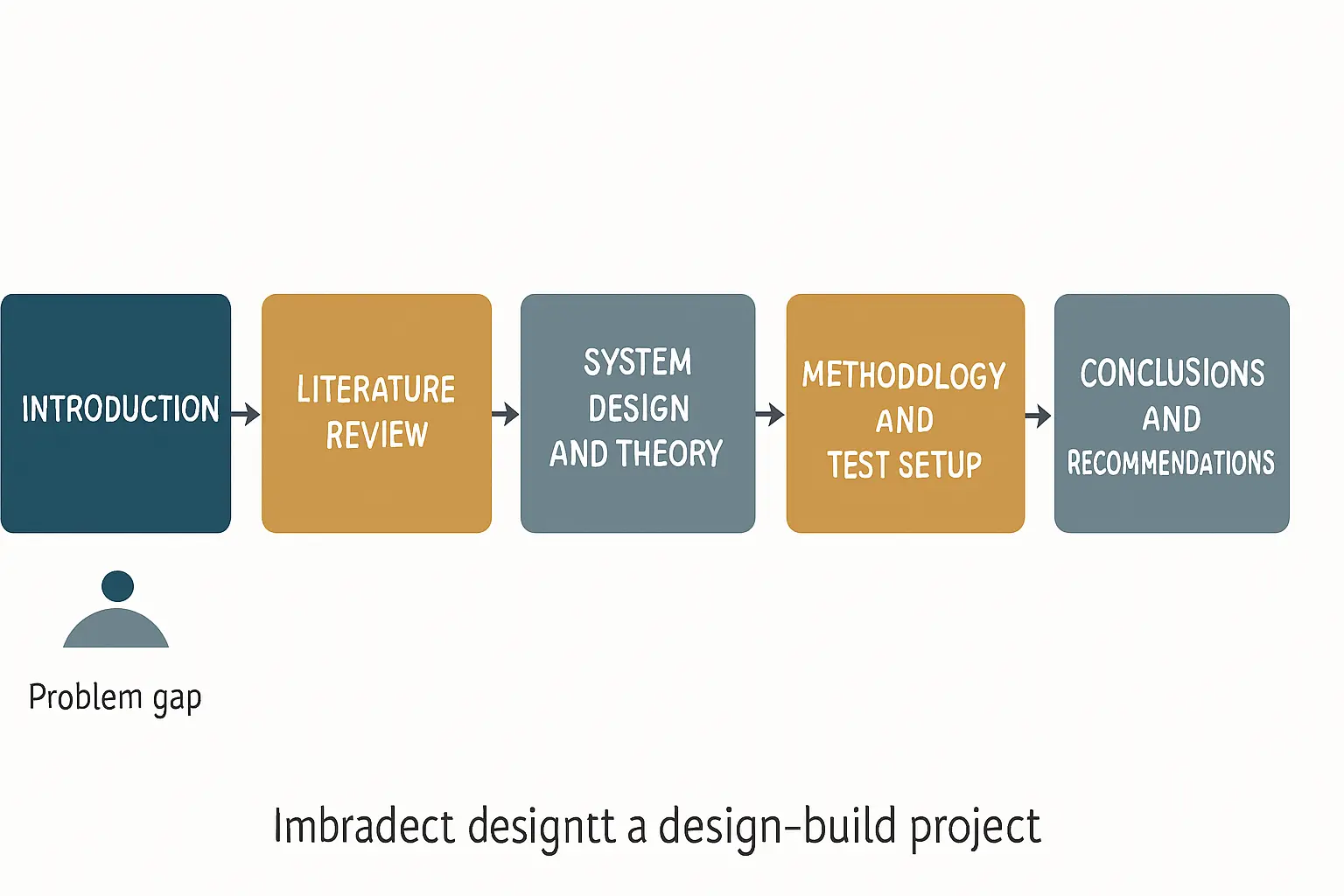
The standard IMRaD sequence — Introduction, Methods, Results, Discussion — was designed for single-experiment journal articles. Engineering theses are rarely that linear, and the adaptation is usually more substantial than students expect.
The most common structural modifications are:
- Split Methods into two chapters. One chapter covers theoretical background, system design, or model derivation; a second covers the practical test setup, instrumentation, or implementation procedure. This division is standard in both experimental and design/build projects.
- Add a standalone Literature Review. Most engineering programmes require a dedicated Chapter 2 establishing the state of the art before you present your own approach. This is separate from the Introduction, which frames the problem, not the field.
- Merge Results and Discussion. Simulation and design/build projects often analyse each result as it appears rather than presenting all results and then discussing them. Check with your supervisor — it is widely accepted in engineering and avoids the artificial separation of data from interpretation.
- Add a Conclusions and Recommendations chapter. Engineering programmes almost universally require this as a chapter distinct from the Discussion. It summarises contributions, states whether objectives were met, and proposes concrete future work.
A representative master’s engineering thesis structure therefore looks like: Introduction → Literature Review → System Design / Theoretical Background → Methodology / Test Setup → Results and Analysis → Conclusions and Recommendations → References → Appendices. Your department may label chapters differently, but the underlying logic follows this sequence.
3. Writing a Strong Engineering Problem Statement
Engineering problem statements are performance-gap arguments, not research questions about meaning or experience. The structure that examiners consistently reward follows a three-part logic:
- Gap: Identify a specific limitation in current technology, methods, or infrastructure. Precision is essential — “existing heat exchangers are inefficient” is not a problem statement. “Shell-and-tube heat exchangers used in ammonia refrigeration units operating above 30°C exhibit pressure-drop penalties that exceed the design tolerance of current plant specifications” is.
- Objective: State what your thesis aims to achieve — a design target, a performance improvement target, a validated computational model, a tested and characterised prototype.
- Contribution: Explain what will be new after your work — a novel geometry, a corrected numerical model, an experimentally verified efficiency envelope, a set of design guidelines applicable to a specific operating range.
Avoid opening with “This thesis investigates…” — that phrase signals exploration without direction. Use active, outcome-oriented language: “This thesis designs, fabricates, and characterises…” or “This thesis develops a finite element model for… and validates it against published benchmark data at three mesh refinement levels.”
For a walkthrough of how to structure your opening chapter around this kind of problem statement, the guide to writing a thesis introduction step by step covers the seven elements examiners look for — including how engineering introductions differ in their treatment of scope and objectives.
4. Methodology and Test Setup Chapter
The methodology chapter is where engineering theses diverge most sharply from generic thesis guides. In engineering, this chapter must allow another engineer to replicate your work — and your examiner will mentally run the replication as they read it.
Include all of the following, as relevant to your project type:
- Materials and equipment specifications: Manufacturer, model number, rated range, and calibration status for every instrument or piece of test equipment. “A pressure transducer (Kistler 6056A, ±0.5% FS, calibrated November 2025)” is the level of detail required. Generic descriptions such as “a pressure sensor was used” are not acceptable.
- Test protocols and operating conditions: Precise values — temperature, flow rate, applied load, voltage, frequency — and the sequence in which tests were run. If you followed a published standard (ASTM E8, ISO 6892, IEEE 1588-2019), cite it by number and state any deviations explicitly.
- Repeatability and sample size: State how many times each test condition was repeated and justify that number. In experimental theses this is usually informed by a preliminary uncertainty analysis or a statistical power calculation for comparative tests.
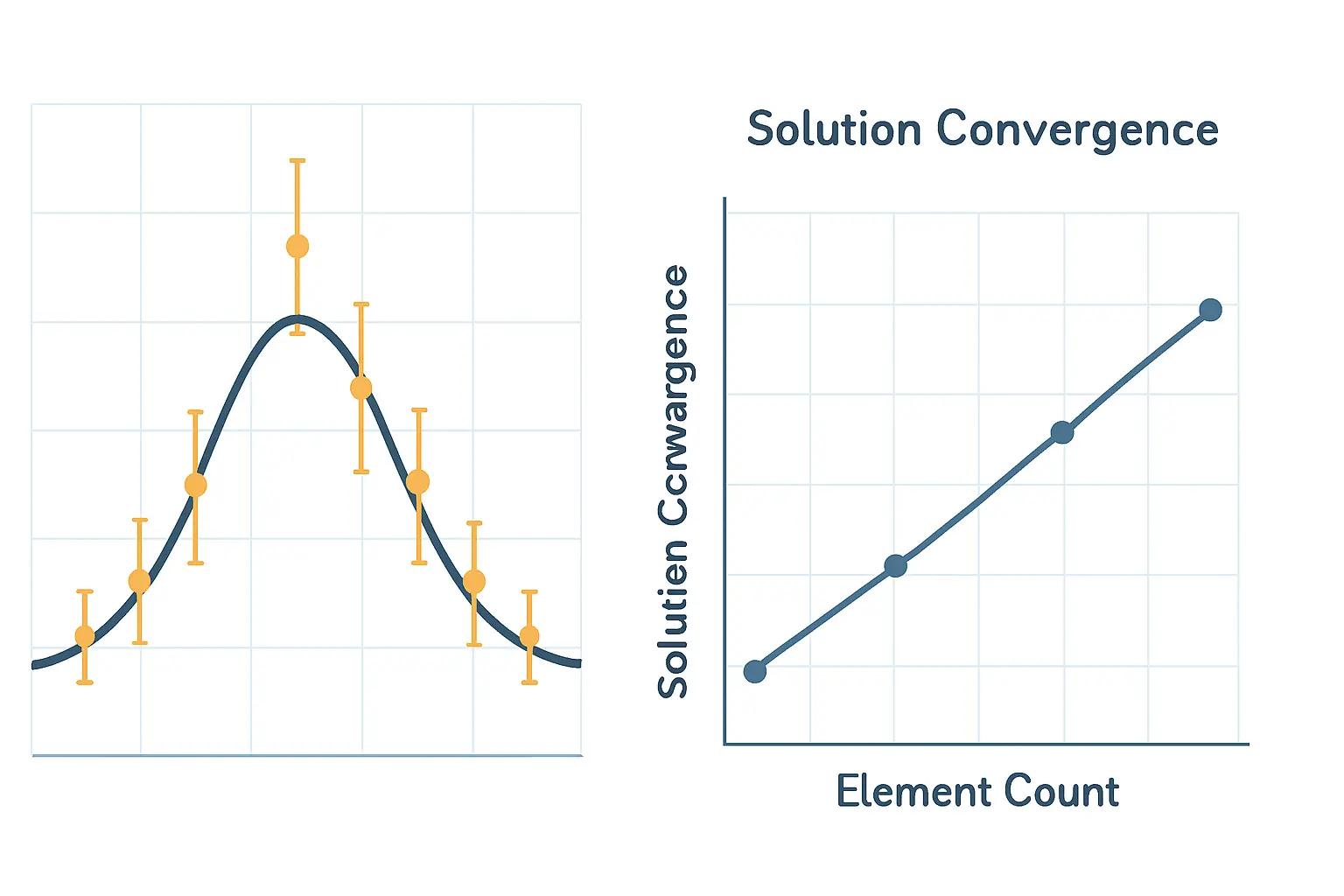
- For simulations — solver settings and mesh details: Element type, element count, and mesh independence study results showing that the solution does not change significantly upon further refinement. Solver convergence criteria and time-step settings where applicable.
- For design/build — design rationale: Why you chose a particular geometry, topology, material, or circuit configuration over alternatives that were considered. Reference applicable design codes or standards (ASME BPVC, Eurocode 3, IPC-2221) where they constrained your choices.
5. Results, Figures, Equations, and Validation
Engineering results chapters carry more data density than almost any other discipline. The conventions for presenting that data are stricter than in social science or humanities, and examiners notice deviations immediately.
Figures
In IEEE style, figure captions go below the figure, formatted as “Fig. 1. [Description ending with a full stop].” Every figure must be cited in the text before it appears — “The measured pressure drop as a function of Reynolds number is shown in Fig. 1.” Do not paste raw MATLAB or Python output without editing axis labels, font sizes, and line weights. Figures where axis text is unreadable at A4 printing size are a routine criticism in examiner reports.
Tables
Table titles go above the table in IEEE style, formatted as “TABLE I. [Description].” Use Roman numerals for table numbering. Every value must include its units in the column header or in a footnote. Avoid merging cells unnecessarily — clarity takes priority over visual design.
Equations
Number every equation you reference later in the text. Use LaTeX (via Overleaf or a local installation) or the MathType-compatible Word equation editor. Equations are centred with the equation number right-aligned in parentheses: (1), (2). Define every symbol the first time it appears, either inline or in a nomenclature section placed before the introduction.
Uncertainty and Validation
Experimental theses require an uncertainty analysis. At minimum, report measurement resolution uncertainty and repeatability uncertainty, combined in quadrature to give the combined standard uncertainty. The international reference is ISO/IEC Guide 98-3 (the “GUM” standard); ASME PTC 19.1 is an equivalent approach used widely in US engineering programmes.
Simulation theses require a validation section comparing your model’s outputs to published experimental data or an analytical solution for a limiting case. A percentage error is necessary but not sufficient — you must also explain whether the discrepancy falls within the model’s known assumptions and whether it affects your conclusions.
For a more detailed treatment of how to report quantitative findings and avoid the markup patterns examiners flag most, the guide to writing your results chapter covers both quantitative and structured reporting approaches.
6. Dealing With Negative Results
Negative results in engineering — a prototype that underperformed its specification, a simulation that diverged from experimental data, a design that failed a structural load test — are more common than most students realise and more intellectually valuable than most supervisors frame them.
The governing principle is this: a result is data, not a verdict on your competence. An examiner who finds that your prototype missed its target is not concerned by the gap. They are concerned if the gap is unexplained, or if you omitted data to conceal it.
The correct sequence is:
- Report the results fully. Present all data honestly in your results chapter with the same rigour as your positive results. Error bars, uncertainty bounds, and anomalous data points must appear.
- Perform a root cause analysis in the Discussion. Was the underperformance due to manufacturing tolerance, a modelling assumption that broke down outside its valid range, material batch variability, or a flaw in the test protocol? Engineering examiners regard a well-argued root cause analysis as a genuine intellectual contribution — it demonstrates that you understand your system well enough to diagnose why it behaved as it did.
- Reframe as a boundary condition. “The prototype achieved target performance at flow rates below 2 L/min but degraded above that threshold due to turbulence-driven mixing” is useful engineering knowledge. Stating it explicitly as a scope boundary for future work is rigour, not weakness.
- Do not revise your objectives retroactively. If your introduction stated a performance target that was not met, acknowledge the gap directly in your conclusions. Quietly omitting the original target and presenting a revised one is regarded as a serious academic integrity failure.
7. IEEE Referencing: What Changes Compared to APA
Many UK and Australian engineering programmes accept APA 7, but US programmes, those aligned with IEEE journals — electrical engineering, computer science, telecommunications, robotics — and many continental European institutions require IEEE style. The differences are substantial enough that switching styles mid-thesis creates real inconsistencies in existing text.
| Feature | APA 7 | IEEE |
|---|---|---|
| In-text format | (Author, Year) | [1], [2], [3] |
| Reference list order | Alphabetical by author surname | Numerical, in order of first citation |
| Author name format | Surname, F. M. | F. M. Surname (initials before surname) |
| Article title | Sentence case, no quotation marks | Sentence case, in quotation marks |
| Journal or book title | Sentence case, italicised | Title case, italicised |
| Year of publication | Immediately after author name | At the end of the reference entry |
Set your citation manager (Zotero or Mendeley) to the correct style on day one. Converting 200-plus references from APA to IEEE after submission draft is one of the most avoidable time costs in a thesis project. The University of Pittsburgh library and the University of Illinois ECE department both publish concise IEEE style guides that are freely accessible and regularly updated — use them as your primary reference alongside your programme handbook. See the Pitt IEEE citation guide and the Illinois ECE thesis IEEE reference guide for worked examples.
8. Discussion, Conclusions, and Recommendations
The engineering Discussion chapter answers one central question: do your results meet the objectives stated in your introduction? Every paragraph should trace back to a specific objective and deliver a verdict — met, partially met, not met — with an explanation of why.
Avoid generic interpretation. “The results are consistent with expectations” conveys nothing. “The measured heat transfer coefficient at Re = 10,000 fell within 8% of the Dittus–Boelter correlation, which is within the ±10% validity range stated for turbulent internal flow in smooth tubes” conveys engineering judgement.
The Recommendations section — sometimes a separate chapter — is where your engineering contribution translates into actionable guidance. Strong recommendations are specific and testable: “Future work should characterise the modified fin geometry at Reynolds numbers above 50,000 using the test rig developed in Chapter 3, with additional thermocouple instrumentation at mid-span.” Vague recommendations (“further research is needed”) add no value and are noted negatively in examiner reports.
For a structured approach to writing the discussion chapter that holds up across engineering and other disciplines, the discussion chapter guide on Tesify.pro covers the structural moves and the mistakes examiners flag most often. For the complete thesis workflow from topic selection to submission, the step-by-step thesis writing guide maps every stage end to end.
FAQ: Writing an Engineering Thesis
How long should an engineering master’s thesis be?
Most engineering master’s theses run between 60 and 100 pages, which typically corresponds to roughly 15,000 to 25,000 words including appendices, figures, and reference lists. The body text alone is usually 10,000–20,000 words. Your programme handbook specifies the exact requirement, and word-count targets vary more widely in engineering than in humanities disciplines. For a broader cross-discipline comparison, see average thesis word counts by discipline.
Do engineering theses always use IMRaD structure?
No. Engineering theses adapt IMRaD rather than follow it literally. The core logic — establish context, describe what you did, show what you found, explain what it means — holds, but the chapter labelling and sequencing depend on your project type. Design/build and simulation projects typically expand the Methods section into separate chapters for system design and test setup, and most engineering programmes require a standalone Conclusions and Recommendations chapter that goes beyond a standard IMRaD Discussion.
What citation style do engineering theses use?
It depends on your institution and discipline. IEEE style — numbered references in square brackets, cited in order of first appearance — is standard for electrical engineering, computer science, and telecommunications. Mechanical, civil, and chemical engineering programmes vary between IEEE and APA 7. Always confirm with your programme handbook before you start, and set the correct style in your reference manager from day one.
What should I do if my prototype did not meet its performance targets?
Report the results in full and perform a root cause analysis in your Discussion chapter. Identify whether the shortfall stems from manufacturing tolerance, a modelling assumption, material variability, or a test protocol flaw. A well-argued root cause analysis is regarded by most engineering examiners as a genuine intellectual contribution — it demonstrates that you understand your system deeply enough to diagnose why it behaved as it did. Never omit or adjust results to close the gap between targets and outcomes.
How is a simulation thesis validated?
By comparing the model’s outputs against published experimental data or an analytical solution for a limiting or simplified case. The validation section should state the percentage discrepancy, explain whether it falls within the model’s known assumptions, and confirm that it does not compromise the conclusions drawn from the simulation. A mesh-independence study — showing that results do not change significantly when the mesh is refined — is also a required part of the methodology chapter for finite element and CFD work.
Where do figure captions go in an engineering thesis?
In IEEE style, figure captions go below the figure. Table titles go above the table. This is the reverse of some other disciplines and publication styles, so check whether your programme requires IEEE or its own formatting specification. Regardless of style, every figure and table must be cited in the body text before it appears, and every value in a table must carry its units in the column header or a footnote.
Write your thesis with AI
Structure, draft, cite, and format your thesis faster with Tesify’s AI writing tools, automatic bibliography, and plagiarism checker. Free to start, no credit card required.






Leave a Reply