
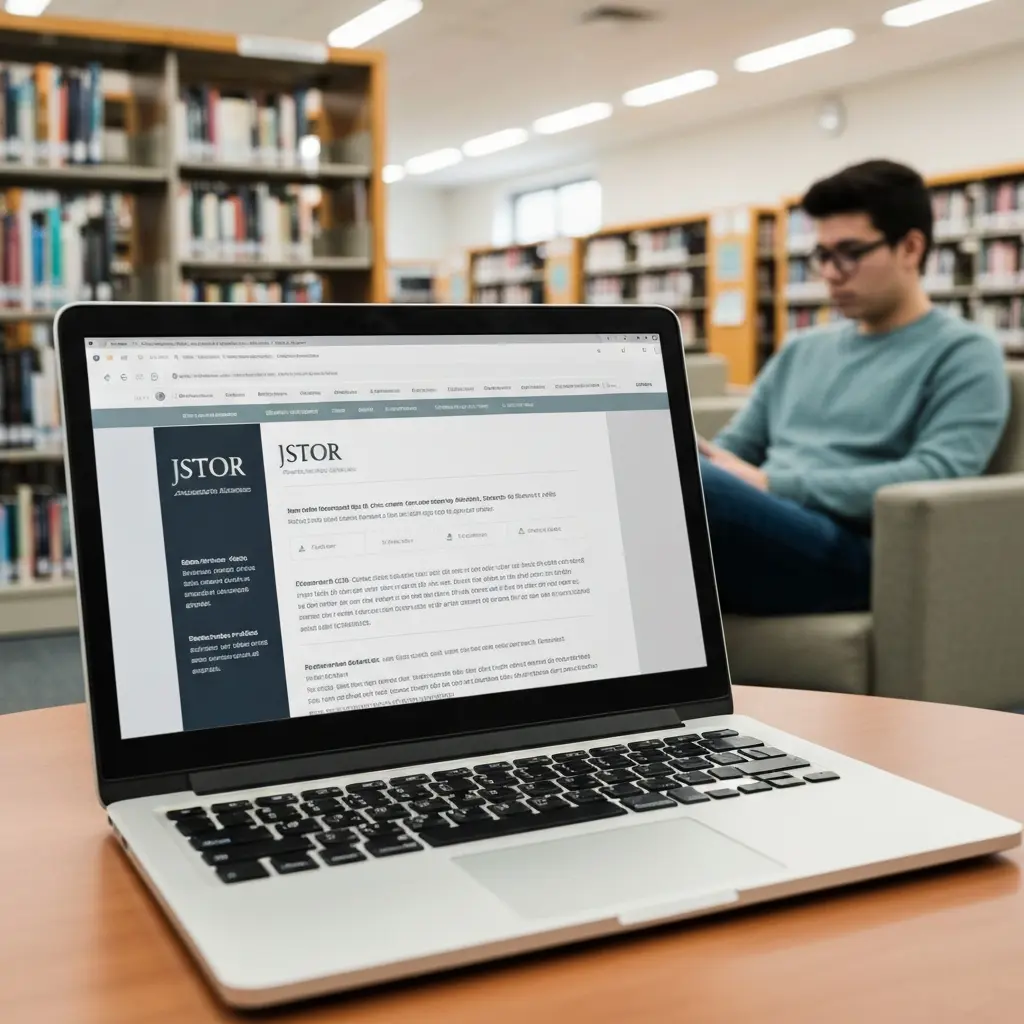
How to Access JSTOR for Free: 6 Legitimate Methods for Students (2026)
JSTOR contains over 12 million academic articles, books, and primary sources across virtually every discipline — and for many students, hitting a paywall when trying to access a source needed for a thesis or essay feels like a brick wall. The good news: JSTOR free access is more widely available than most students realise. There are six legitimate methods to access JSTOR content without paying, and at least two of them almost certainly apply to you right now.
This guide explains every method clearly — who each one works for, how to set it up, and what limitations apply. Whether you are a current enrolled student, an independent researcher, a secondary school student, or simply someone who needs occasional access to academic sources, there is a route here for you.
What Is JSTOR?
JSTOR (Journal Storage) is a digital library founded in 1995 that provides access to academic journals, books, images, and primary sources. It is owned by ITHAKA, a not-for-profit organisation. JSTOR hosts content from over 1,000 publishers across more than 75 disciplines — from history and economics to biology and law.
Critically for researchers, JSTOR’s journal archives often extend back to volume 1, issue 1, making it invaluable for historical literature reviews and tracing the development of ideas across decades. Most current subscription journals have a “moving wall” — a delay of 3–5 years before articles become available on JSTOR — but older content is frequently the most useful for contextualising a literature review anyway.
Method 1: University or Library Institutional Access
If you are a currently enrolled student at any university or college with a JSTOR subscription, this is by far the best option — you get full access to all content your institution subscribes to, including PDFs.
How to use it:
- Go to JSTOR.org
- Click “Log in” in the top right corner
- Select “Log in through your institution” (or “Access through your library”)
- Search for your institution by name
- Authenticate using your campus credentials (student email, student ID, or library card)
Once authenticated, you can access full PDFs for all content within your institution’s subscription tier. Most universities also enable off-campus access through this route via SSO (single sign-on) or proxy server — you do not need to be on campus Wi-Fi.
Pro tip: Link your personal JSTOR account to your institutional login. This means if you later graduate, you can still access your saved articles and reading lists — even if full-text access reverts to the free tier.
Method 2: Free Personal Account (100 Articles Per Month)
JSTOR’s personal account programme, officially called “Register & Read,” allows anyone with an email address to read up to 100 articles per 30-day period for free — without any institutional affiliation required. This is the most widely overlooked free access route.
Limitations to know:
- You can read articles online but cannot download PDFs on the free personal account
- The 100-article limit resets every 30 days (not monthly — it’s a rolling 30-day window)
- Some newer journal content may not be available on the free tier
- You can save articles to your Workspace and return to them within your access window
For most thesis research, 100 articles per month is sufficient — especially if combined with method 1 for PDFs of the most critical sources and method 3 for open access content. As JSTOR’s official support page confirms, registration requires only a valid email address.
Method 3: JSTOR Open Access Content
A growing proportion of JSTOR’s content is permanently free to anyone — no account, no login, no limits. JSTOR’s open access and free content library includes:
- All content from participating open-access journals
- Public domain books and archival content
- Content released under Creative Commons licences
- Specially designated free collections (e.g., COVID-19 research, certain humanities collections)
When you search JSTOR, look for the green “Open Access” or “Free” label on search results. These can be downloaded immediately as PDFs without any account.
Method 4: Secondary School Access
JSTOR provides free access to secondary schools (high schools / sixth-form colleges) in many countries through its dedicated secondary schools programme. If your school is enrolled, you can access a substantial content package at no cost. Students working on extended essays, pre-university research projects, or IB/A-Level coursework should ask their school librarian whether the school is registered.
Method 5: Alumni Access via Your University
Many universities maintain library access for alumni — either free or at a reduced rate. After graduation, check your university’s alumni services: some institutions offer continued full JSTOR access through alumni library card schemes (e.g., many UK Russell Group universities), while others provide discounted individual subscriptions. This option is particularly useful for postdoctoral researchers and professionals who need periodic academic source access without institutional affiliation.
Method 6: Public Library Partnerships
Some public library systems have partnership arrangements with JSTOR or with database aggregators that include JSTOR content. This varies significantly by country and local library authority. In the US, many state library systems provide access to JSTOR or similar databases with a public library card. In the UK, check your local authority library service — some provide access to academic databases remotely.
Even where direct JSTOR access is not available, public libraries can request articles through interlibrary loan (ILL) — a free service that retrieves copies of specific articles from other libraries. This is slower (typically 1–5 days) but works for any article regardless of your access tier.
Free JSTOR Alternatives for Academic Research
| Resource | What It Provides | Best For |
|---|---|---|
| Google Scholar | Free links to open-access PDFs; institutional login integration | Finding free versions of paywalled articles |
| Semantic Scholar | 200M+ papers; AI-powered search; free PDF links | STEM and interdisciplinary research |
| PubMed Central | Free full-text biomedical and life sciences articles | Health sciences research |
| arXiv | Free preprints in physics, math, CS, economics | Current STEM research (pre-peer review) |
| ERIC (Education) | Free education research database (US Dept of Education) | Education and pedagogy research |
Tips for Getting the Most from JSTOR
- Use advanced search — JSTOR’s advanced search allows you to filter by discipline, journal, publication date range, and article type. Much more precise than a basic keyword search.
- Save to Workspace — create a free JSTOR account and save articles to Workspace so you can return to them easily across sessions.
- Check Google Scholar first — many JSTOR articles have legally free versions on author websites, institutional repositories, or ResearchGate. Google Scholar’s “All versions” links often surface these.
- Use citation tracking — JSTOR shows “Cited by” and “Related items” for most articles. This is invaluable for snowball literature searching.
- Email authors directly — if you cannot access a paper, it is entirely acceptable to email the corresponding author. Most academics are happy to share their work — and it can spark a useful connection.
For a complete research workflow, combine JSTOR access with our guides on doing a thorough literature review and APA citation format so every source you find ends up properly cited in your thesis.
Frequently Asked Questions
Is JSTOR completely free?
Not entirely, but substantial free access is available. A free personal account allows you to read (not download) up to 100 articles every 30 days. Open-access content can be downloaded without any account. Full PDF download access requires either an institutional subscription or a paid individual plan.
How do I access JSTOR without a university account?
Register for a free personal JSTOR account at jstor.org using any email address. This gives you read-only access to up to 100 articles per 30 days. You can also access all open-access content on JSTOR without any account at all — search for content with the “Free” or “Open Access” label.
How many articles can I access for free on JSTOR per month?
With a free JSTOR personal account, you can read up to 100 articles within any rolling 30-day period. This limit does not apply to open-access content, which is unrestricted. Articles can be read online but not downloaded as PDFs on the free account tier.
Can I download JSTOR articles for free?
Open-access content on JSTOR can be downloaded free of charge by anyone. Paywalled content requires either an institutional subscription or a paid individual JSTOR plan to download as PDF. The free personal account allows online reading only, not PDF download.
Does JSTOR work after graduation?
Full institutional access through your university typically ends when your student credentials expire, usually at or shortly after graduation. However, many universities offer alumni library access that includes database subscriptions. Check your university’s alumni services. As a fallback, the free personal JSTOR account with 100 articles per month is available to anyone permanently.
Cite Everything You Find with Tesify
Once you have the sources, Tesify helps you integrate them properly into your thesis — with correct academic tone, paraphrasing that avoids plagiarism, and well-structured arguments.
Write your thesis with AI
Structure, draft, cite, and format your thesis faster with Tesify’s AI writing tools, automatic bibliography, and plagiarism checker. Free to start, no credit card required.





Leave a Reply