
Harvard Referencing Guide 2026: Rules, Examples & Common Mistakes
Harvard referencing is the most widely used citation style in UK universities — but it comes with a catch: there is no single, universal standard. Oxford Brookes, UCL, Edinburgh, and dozens of other institutions each publish their own variation of the Harvard author-date system, which means a rule that works at one university may not be acceptable at another. This complete Harvard referencing guide covers the core rules that apply across all UK institutions, explains every source type you are likely to encounter, and flags the ten mistakes that cost students marks every year.
Whether you are writing your first essay or finishing a dissertation, this guide will give you everything you need to reference accurately and confidently in 2026.
What Is Harvard Referencing?
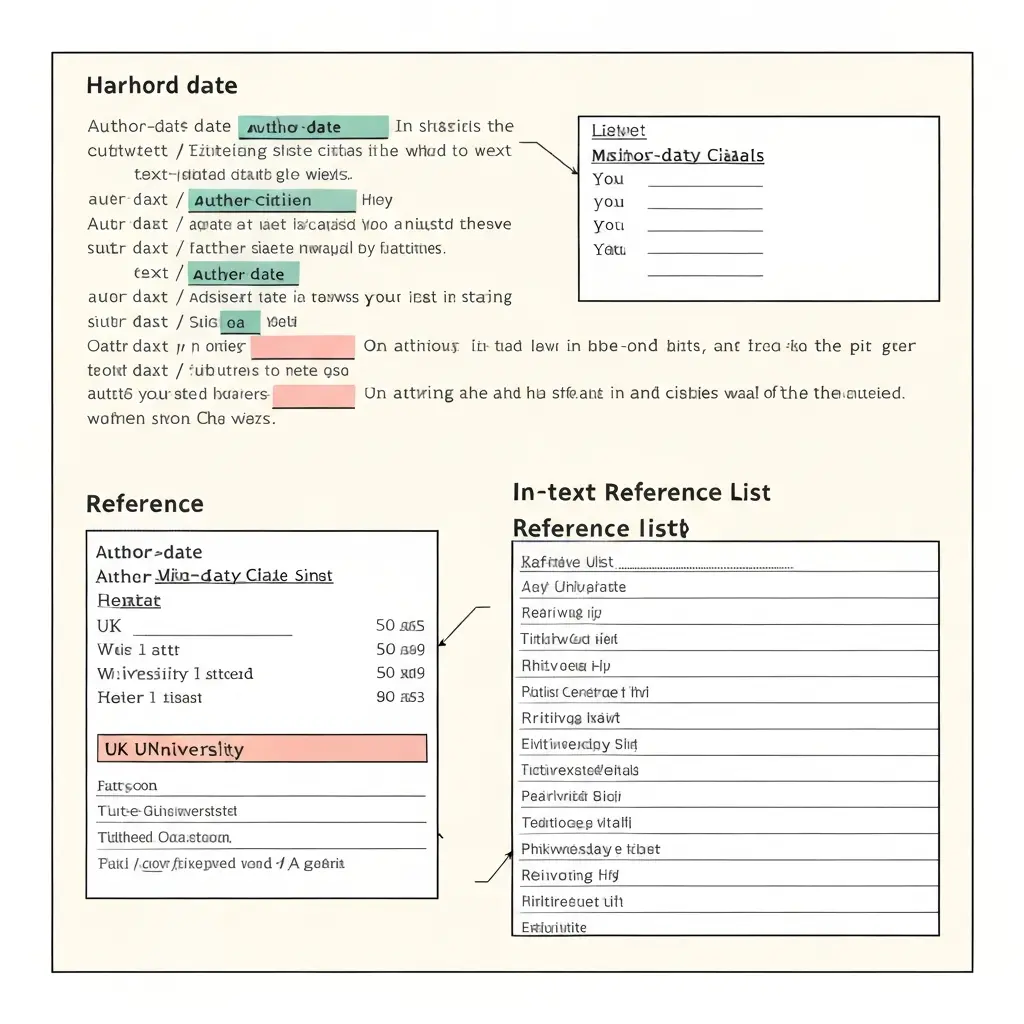
Harvard referencing is an author-date citation system. Every time you use someone else’s idea, data, or wording in your writing, you insert a short in-text citation — typically the author’s surname and the year of publication in brackets — and then include a full reference entry in an alphabetically ordered reference list at the end of your work.
Despite its name, Harvard referencing was not invented at Harvard University. It developed independently in the 19th century and was later popularised by academic publishing in the UK. Today it is the dominant style at British universities across the arts, social sciences, business, and health disciplines.
The most authoritative guide used by UK institutions is Cite Them Right (Pears and Shields, 2022), now in its 12th edition. Many universities — including Newcastle, Manchester Metropolitan, and Dundee — explicitly direct students to follow Cite Them Right Harvard. In summer 2025, Cite Them Right updated several rules: the place of publication is no longer required for printed books, and journal articles with an article number (rather than page range) now use “article” rather than “article number” in the reference.
The Two Components of Every Harvard Reference
- In-text citation: A brief pointer in the body of your work — e.g., (Smith, 2024) or Smith (2024)
- Reference list entry: Full bibliographic details at the end — author, year, title, source, and access information
Every in-text citation must have a matching reference list entry, and every reference list entry must correspond to a source actually cited in the text. There should be no orphaned entries either way.
Harvard vs APA: Key Differences
Harvard and APA citation format look similar — both use author-date in-text citations — but they diverge on several important details. If your department accepts either style, the table below will help you choose and apply each correctly.
| Feature | Harvard (Cite Them Right) | APA 7th Edition |
|---|---|---|
| Standard body | No single governing body; Cite Them Right is de facto UK standard | American Psychological Association (APA) |
| In-text separator | (Smith, 2024) — comma between author and year | (Smith, 2024) — same format |
| Multiple authors in-text | Up to 3 authors listed; 4+ use et al. | 3+ authors always use et al. from first citation |
| Reference list authors | All authors listed (et al. only for 10+) | Up to 20 authors listed; 21+ use et al. |
| Author initials | Smith, J. (surname, initial) | Smith, J. (same format) |
| Book title formatting | Italic, sentence case | Italic, sentence case |
| Journal article title | No italics, no quotes, sentence case | No italics, no quotes, sentence case |
| Journal name | Italic, title case | Italic, title case |
| Place of publication | No longer required (updated 2025) | Never required (removed in APA 7) |
| DOI format | Available at: https://doi.org/… | https://doi.org/… (no label) |
| Running head | Not required | Not required in student papers (APA 7) |
| Section label | “Reference List” or “References” | “References” |
| Best for | UK humanities, social sciences, health, business | Psychology, US institutions, international journals |
Bottom line: If you are studying at a UK university and your handbook says “Harvard”, follow Cite Them Right Harvard — not APA. They look similar but the differences matter to markers.
In-Text Citations: Every Scenario Covered
In-text citations appear within the body of your work, immediately after the idea, quotation, or paraphrase you are attributing. The basic format is (Surname, Year). Below are all the variations you will encounter.
1. Single Author
Place the surname and year in brackets. If you are quoting directly, add a page number.
- Paraphrase: The study found no significant difference between the groups (Johnson, 2023).
- Direct quote: “Critical thinking is not a skill that develops in isolation” (Johnson, 2023, p. 47).
- Narrative: Johnson (2023) argues that critical thinking requires deliberate practice.
2. Two Authors
List both surnames, connected by “and” (not “&”).
- (Williams and Clarke, 2022)
- Williams and Clarke (2022) demonstrate that…
3. Three Authors
List all three surnames in the order they appear in the source.
- (Ahmed, Patel and Singh, 2021)
4. Four or More Authors (et al.)
Use the first author’s surname followed by et al. (meaning “and others”). Note: in the reference list, list all authors.
- (Harrison et al., 2020)
- Harrison et al. (2020) found that…
5. Organisation or Corporate Author
Use the organisation’s name in place of a personal author. Abbreviate on subsequent citations if the full name is long, but write it out in full on the first citation.
- First citation: (World Health Organization, 2023)
- Subsequent citations: (WHO, 2023)
6. No Author
Use a shortened version of the title in place of an author. Italicise book/report titles; use quotation marks for article/webpage titles.
- (Annual Report on Mental Health, 2022)
- (“Rising costs in higher education”, 2023)
7. Multiple Sources in One Citation
List sources alphabetically within the same brackets, separated by a semicolon.
- (Daly, 2019; Marsh, 2021; Yuen, 2022)
8. Secondary Source (Citing a Source You Have Not Read)
This is sometimes called an indirect citation. You should always try to access the original source. If you genuinely cannot, use “cited in” to show where you found the reference to the original work.
- Brown’s 1987 model (cited in Davies, 2020, p. 112) proposes…
- In the reference list, cite only the source you have actually read (Davies, 2020).
Reference List Format: 10 Source Types
Your reference list goes at the end of your work, on a new page, under the heading Reference List or References. Entries are listed alphabetically by the first author’s surname. Below are correct formats for the ten source types you will use most often in 2026, following Cite Them Right Harvard updated guidance.
1. Book (Print)
Format: Surname, Initial. (Year) Title: subtitle. Edition (if not first). Publisher.
Example: Pears, R. and Shields, G. (2022) Cite them right: the essential referencing guide. 12th edn. Red Globe Press.
Note: place of publication is no longer required under the 2025 Cite Them Right update.
2. Journal Article
Format: Surname, Initial. (Year) ‘Article title’, Journal Name, Volume(Issue), pp. first–last. Available at: https://doi.org/… (Accessed: DD Month YYYY).
Example: Nguyen, T. and Okafor, L. (2024) ‘Digital literacy and academic performance in UK higher education’, British Journal of Educational Technology, 55(3), pp. 412–429. Available at: https://doi.org/10.1111/bjet.13401 (Accessed: 10 March 2026).
3. Website / Webpage
Format: Surname, Initial. or Organisation (Year) Title of page. Available at: URL (Accessed: DD Month YYYY).
Example: Office for National Statistics (2025) Student numbers in UK higher education: 2024–25. Available at: https://www.ons.gov.uk/education/student-numbers-2024 (Accessed: 15 January 2026).
4. Government or Institutional Report
Format: Author/Organisation (Year) Title of report. Report number (if applicable). Publisher.
Example: Department for Education (2025) Higher education statistical bulletin 2025. DfE. Available at: https://www.gov.uk/government/statistics/he-stats-2025 (Accessed: 20 February 2026).
5. Lecture Notes / Slides
Format: Surname, Initial. (Year) ‘Title of lecture‘. Module name [Lecture notes/slides]. Institution. Available at: VLE/URL (Accessed: DD Month YYYY).
Example: Okafor, L. (2025) ‘Introduction to qualitative research methods‘. SOCI2001 Research Methods [Lecture slides]. University of Edinburgh. Available at: https://learn.ed.ac.uk/… (Accessed: 5 October 2025).
6. Podcast
Format: Surname, Initial. (Year) ‘Episode title’, Podcast Name, DD Month. Available at: URL (Accessed: DD Month YYYY).
Example: Sandel, M. (2024) ‘Justice and the limits of the market’, The Public Philosophy Podcast, 3 April. Available at: https://www.bbc.co.uk/sounds/play/… (Accessed: 12 November 2025).
7. YouTube Video
Format: Surname, Initial. or Channel Name (Year) Title of video [Video]. Platform. DD Month. Available at: URL (Accessed: DD Month YYYY).
Example: TED (2024) How to think like a scientist [Video]. YouTube. 7 June. Available at: https://www.youtube.com/watch?v=… (Accessed: 19 January 2026).
8. Social Media Post
Format: Surname, Initial. or Username (Year) ‘First 30 words of the post’ [Platform post]. DD Month. Available at: URL (Accessed: DD Month YYYY).
Example: NHS England [@NHSEngland] (2025) ‘We have launched a new national campaign to support mental health in universities across England…’ [Twitter/X post]. 14 February. Available at: https://twitter.com/NHSEngland/status/… (Accessed: 1 March 2026).
9. Dissertation or Thesis
Format: Surname, Initial. (Year) Title of dissertation. Type of thesis (BA/BSc/MA/PhD). Institution.
Example: Adeyemi, O. (2025) The impact of remote learning on postgraduate student wellbeing in UK universities. PhD thesis. University of Bristol.
10. Generative AI (e.g., ChatGPT)
There is no single agreed standard for citing AI-generated content in Harvard style. Most UK universities updated their guidance in 2024–2025. The most commonly recommended format follows the pattern below, but you must check your own university’s policy — some institutions (including UCL) instruct students not to cite AI in the reference list at all, but to acknowledge it in an acknowledgements section instead.
General format: Company (Year) Name of AI tool [AI language model]. Version if known. DD Month. Available at: URL (Accessed: DD Month YYYY).
Example: OpenAI (2025) ChatGPT [AI language model]. Response to query about academic integrity, 5 March. Available at: https://chat.openai.com (Accessed: 5 March 2026).
Harvard Formatting Rules
The content of each reference matters, but so does the visual presentation. These formatting rules apply to the reference list as a whole.
Hanging Indent
Every reference entry uses a hanging indent: the first line is flush with the left margin, and all subsequent lines are indented by 1.27 cm (0.5 inches). This makes it easy to scan author surnames at a glance.
To apply a hanging indent in Microsoft Word: select your reference list text → Paragraph → Indentation → Special → Hanging → 1.27 cm.
Alphabetical Order
Entries are sorted alphabetically by the first author’s surname. When an author has multiple entries, list them chronologically (earliest first). If two entries have the same author and year, add a lowercase letter after the year: (Smith, 2023a) and (Smith, 2023b).
Capitalisation Rules
- Book titles: Sentence case — capitalise only the first word and proper nouns. Example: An introduction to academic writing
- Journal article titles: Sentence case — same rule. Example: ‘The role of feedback in undergraduate learning’
- Journal names: Title Case — capitalise every major word. Example: British Journal of Educational Psychology
- Report/webpage titles: Sentence case.
Italics
Italicise the title of stand-alone works: books, reports, journal names, film titles, YouTube video titles. Do not italicise the titles of articles or chapters (these appear in single quotation marks instead).
Spacing and Page Layout
Most universities expect double-spacing within and between reference entries, but some accept single-spacing. Check your submission guidelines. The reference list begins on a new page after your conclusion or appendices.
10 Common Harvard Referencing Mistakes
| # | Mistake | Correct Approach |
|---|---|---|
| 1 | Using “&” instead of “and” in in-text citations | Always write “and”: (Smith and Jones, 2023). “&” is APA style. |
| 2 | Using et al. for three-author sources in-text | List all three authors for 2–3 authors. Only use et al. for 4+. |
| 3 | Omitting the accessed date for online sources | All websites, databases, and online content need “Accessed: DD Month YYYY”. |
| 4 | Title case for book and article titles | Book and article titles use sentence case. Journal names use Title Case. |
| 5 | Italicising journal article titles | Italicise the journal name, not the article title. Article titles go in single quotation marks. |
| 6 | Citing a source in the text but omitting it from the reference list | Every in-text citation needs a matching reference list entry. Do a final cross-check. |
| 7 | Including place of publication for books | Since the 2025 Cite Them Right update, place of publication is no longer required for printed books. |
| 8 | Listing references in order of appearance rather than alphabetically | Harvard always uses alphabetical order by surname. Vancouver uses appearance order. |
| 9 | Not adding a page number for direct quotes | Direct quotations require a page number: (Smith, 2023, p. 45) or (Smith, 2023, pp. 45–46). |
| 10 | Mixing Harvard rules from different university guides | Pick one guide — your university’s own or Cite Them Right — and stick to it throughout. |
Harvard at Different UK Universities
Because Harvard is not governed by a single organisation, every UK university publishes its own variation. Most follow Cite Them Right closely, but there are notable differences in punctuation, use of “and” versus “&”, DOI presentation, and how AI sources are handled. Here is what you need to know at three leading institutions.
Oxford Brookes University (Brookes Harvard)
Oxford Brookes uses what it calls “Brookes Harvard”, which it explicitly states is the same as Cite Them Right Harvard. Students can select either label in reference management tools such as Cite This For Me. Brookes Harvard is used across a large number of courses but individual departments may specify alternatives, so always check your module handbook. One distinctive feature of Brookes guidance: it encourages students to use the “Cite Them Right Online” database, which is accessible free of charge through the Brookes library.
UCL (University College London)
UCL has developed its own Harvard style guide through UCL Library Services. Crucially, UCL does not have a single referencing style mandated across the university — different faculties and even individual programmes may use different styles. Always consult your programme handbook first. UCL’s Harvard guide differs from Cite Them Right in one significant area: generative AI citation policy. UCL does not include AI tools in the reference list; instead, students must acknowledge AI use in a separate acknowledgements section, stating the tool used and how it was used. For all other source types, UCL Harvard aligns closely with the standard Cite Them Right rules.
University of Edinburgh
Edinburgh is one of many UK research-intensive universities that adopts Cite Them Right Harvard as its default standard, though individual schools may specify variants (such as Vancouver for medicine or OSCOLA for law). Edinburgh’s library provides a detailed online guide at library.ed.ac.uk, and students have free access to the Cite Them Right Online platform through their university login. Edinburgh’s guidance for online sources is particularly strict: the accessed date must be recorded, and URLs must be functional at the time of submission where possible.
A Note on the “Many Harvards” Problem
Research from the University of Lincoln and others highlights a common student frustration: looking up Harvard rules on multiple websites produces inconsistent answers. The solution is simple — identify which guide your university officially endorses (usually on the library website), download or bookmark it, and follow only that guide for the duration of your degree. Using Cite Them Right as your single reference is a safe bet for the vast majority of UK institutions.
For a deep-dive into another major citation style, see our guides on Chicago citation and MLA format. If your thesis involves primary research, you may also find our guide on research methodology citations useful for referencing interviews, surveys, and observational data.
Frequently Asked Questions
Is Harvard referencing the same at every UK university?
No. Harvard is not a standardised system — each UK university publishes its own version. Most follow Cite Them Right Harvard (sometimes called “Cite Them Right 12th edition”), but differences exist in punctuation, author formatting, how DOIs are presented, and how AI tools are cited. Always check your specific university’s library guide before submitting assessed work.
When do I use et al. in Harvard referencing?
In-text: use et al. when a source has four or more authors (e.g., Harrison et al., 2024). For sources with one, two, or three authors, list all surnames. In the reference list: list all authors unless there are more than ten, in which case you may use et al. after the tenth author name.
Do I need a page number for paraphrases in Harvard style?
Page numbers are required for direct quotations: (Smith, 2024, p. 34). For paraphrases — where you express someone else’s idea in your own words — page numbers are not required, though many tutors encourage them for longer sources such as books, as they allow the reader to locate the specific argument being referenced.
What is the difference between a reference list and a bibliography in Harvard style?
A reference list contains only the sources you have actually cited in your text. A bibliography includes all sources cited plus additional background reading that informed your work but was not directly cited. Most UK university assignments ask for a reference list, not a full bibliography. Check your assignment brief or module handbook to confirm which is expected.
How do I cite a source with no author in Harvard style?
Use a shortened version of the title in place of the author. For books and reports, italicise the title in both the in-text citation and reference list: (Annual Report on Housing, 2023). For websites and articles, use single quotation marks: (“University funding pressures”, 2024). In the reference list, file the entry under the first significant word of the title (ignoring “The”, “A”, “An”).
How do I reference a lecture in Harvard style?
Include the lecturer’s surname and initial, year, the title of the lecture in italics, the module name and type (e.g., [Lecture notes] or [Lecture slides]), the university, and where the materials can be accessed (e.g., the VLE). Example: Patel, R. (2025) Introduction to macroeconomics. ECON1001 Principles of Economics [Lecture slides]. University of Edinburgh. Available at: https://learn.ed.ac.uk/… (Accessed: 10 October 2025).
Can I cite ChatGPT or other AI tools using Harvard referencing?
Guidance varies by institution. Many UK universities following Cite Them Right now include AI tools in the reference list using a format that names the company as author (e.g., OpenAI), the tool name in italics, the label [AI language model], and the date and URL accessed. However, some universities — including UCL — instruct students not to include AI tools in the reference list but to acknowledge their use in a separate acknowledgements section. Always check your own university’s current AI citation policy, as this area is evolving rapidly.
Has Harvard referencing changed recently?
Yes. In summer 2025, Cite Them Right (the most widely used Harvard guide in UK universities) made two notable changes: the place of publication is no longer required in references for printed books, and journal articles referenced by article number (rather than volume and page range) now use “article” instead of “article number”. Additionally, most universities updated their guidance on citing generative AI tools throughout 2024–2025. If you have older Harvard guidance from a previous year, check whether your university has updated its library guide.
Stop Formatting Your References by Hand
Building a reference list from scratch is time-consuming and error-prone. Tesify’s Auto Bibliography generates Harvard-formatted references for every source type — books, journals, websites, AI tools, and more — so you can focus on the writing that actually matters.
Write your thesis with AI
Structure, draft, cite, and format your thesis faster with Tesify’s AI writing tools, automatic bibliography, and plagiarism checker. Free to start, no credit card required.




Leave a Reply