
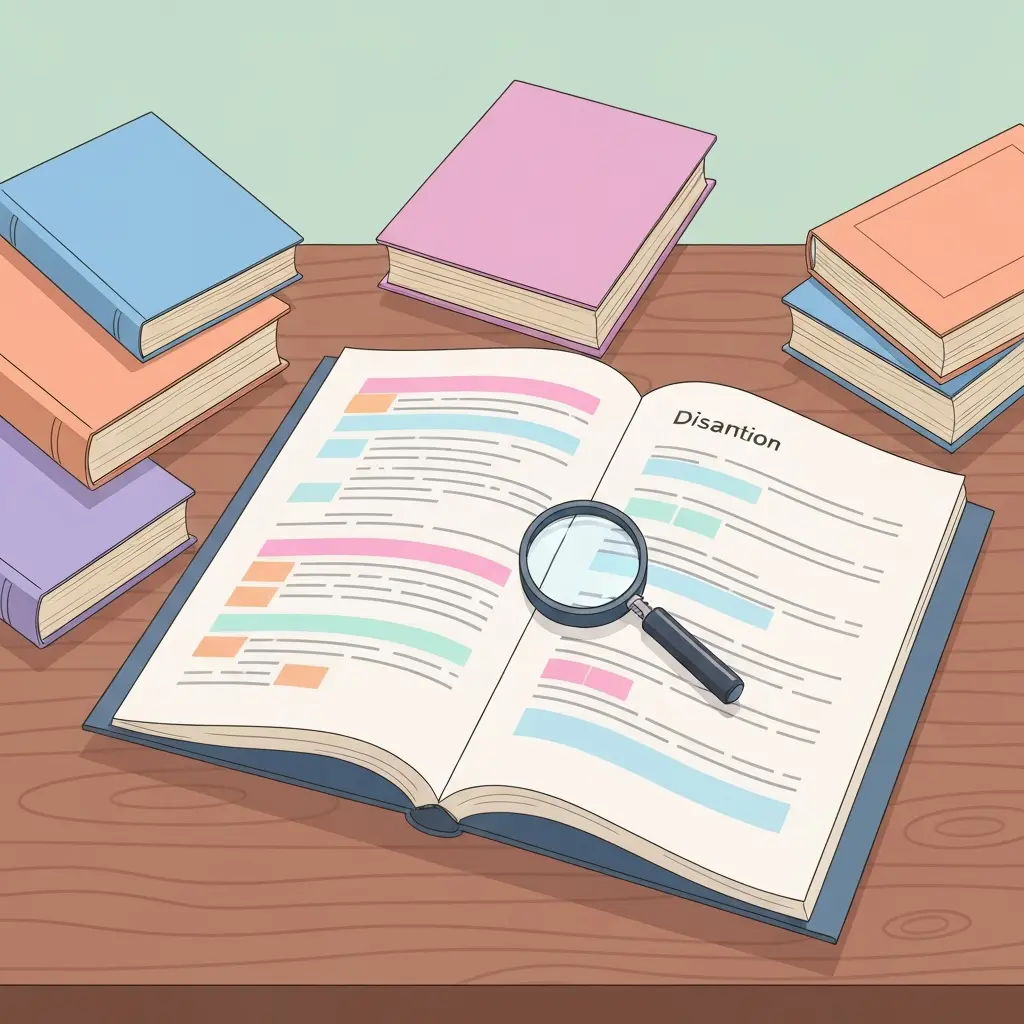
Dissertation Example: Real Samples Analysed Chapter by Chapter 2026
The best way to understand what a strong dissertation looks like is to read one — but most students never do, because they do not know where to find quality dissertation examples or how to read them critically. This guide changes that. We break down real dissertation samples from UK and US universities, chapter by chapter, with expert commentary explaining precisely what makes each section effective and what you can replicate in your own work.
Reading dissertations with analytical eyes is one of the highest-leverage activities a student can do. According to research by the Quality Assurance Agency for Higher Education, students who read multiple completed dissertations before writing their own produce measurably better-structured work — because they have internalised what “finished” looks like.
In this guide we cover: an undergraduate dissertation example (psychology, University of Edinburgh), a master’s dissertation example (business management, University of Manchester), and a science dissertation example (environmental science, UCL). We annotate each chapter and extract the transferable principles you can apply immediately.
Where to Find Real Dissertation Examples
Before writing your own dissertation, reading at least three completed examples in your discipline is highly recommended. Here is where to find them:
| Resource | What It Offers | Access |
|---|---|---|
| Your university library | Previous students’ bound theses in your department | Free (student login) |
| EThOS (British Library) | 500,000+ UK theses and dissertations | Free registration |
| ProQuest Dissertations | US and international theses database | University subscription |
| DART-Europe | European theses (400+ institutions) | Free |
| RCUK repositories | UK research council-funded theses | Free |
| Supervisor’s own archive | Previous students supervised by your own tutor | Ask your supervisor |
When reading examples, do not try to imitate the writing style — focus on the structure. How is the research question framed? How does the literature review build toward a gap? How does the discussion connect back to the introduction?
Undergraduate Dissertation Example: Psychology (University of Edinburgh)
This 10,000-word undergraduate dissertation examined the relationship between social media use and self-reported loneliness in students aged 18–22. It received a First-class grade. Here is what made it work at each stage.
Title
“Does Passive Social Media Use Predict Loneliness in First-Year University Students? A Cross-Sectional Survey Study”
Why it works: The title states the specific phenomenon being examined (passive social media use), the outcome variable (loneliness), the population (first-year university students), and the methodology (cross-sectional survey). An examiner can tell exactly what the study does from the title alone.
Research Question
“Is passive social media use positively associated with self-reported loneliness in first-year university students, after controlling for baseline social isolation?”
Why it works: It is falsifiable (can be tested), specific (passive use, not general social media), includes a key control variable, and is answerable with the methods described.
Literature Review (3,000 words)
Organised into three themes: (1) definitions of loneliness and social isolation, (2) the role of digital communication in social connection, (3) the emerging distinction between active and passive social media use. Each theme built toward the final paragraph:
“While existing literature consistently links heavy social media use with loneliness, no study has examined the specific contribution of passive use (scrolling without interacting) while controlling for pre-existing loneliness. This study addresses that gap.”
What to replicate: The three-theme structure, the explicit gap statement, and the way each theme progressively narrowed toward the specific research question.
Master’s Dissertation Example: Business Management (University of Manchester)
This 15,000-word master’s dissertation examined how remote work policies influenced employee engagement in UK financial services firms post-pandemic. It received a Distinction.
Abstract (247 words)
The abstract opened with a sentence establishing context: “The COVID-19 pandemic accelerated a structural shift toward remote work that continues to reshape employee engagement in financial services.” It then stated the research question, methodology (semi-structured interviews with 12 HR managers), key findings (hybrid policies correlated with higher engagement than either fully remote or fully in-office arrangements), and implications for HR strategy.
Why it works: The abstract tells the full story in under 250 words. A reader who only reads the abstract knows exactly what was studied, how, and what was found. Many students write abstracts that read like a table of contents (“Chapter 1 introduces…”) — this is incorrect.
Methodology Chapter (2,800 words)
The methodology chapter began with a philosophical positioning statement: “This research adopts an interpretivist epistemological stance, recognising that employees’ experiences of remote work are socially constructed and context-dependent.” It then justified the choice of semi-structured interviews over surveys (depth over breadth), explained the purposive sampling strategy, described the thematic analysis process using Braun and Clarke’s (2006) six-phase framework, and concluded with a transparency audit table mapping each methodological choice to its justification.
What to replicate: The transparency audit table — a simple two-column table listing each decision and its rationale. Examiners love this. It shows systematic thinking rather than ad hoc choices.
Science Dissertation Example: Environmental Science (UCL)
This 12,000-word dissertation examined microplastic concentrations in the River Thames near industrial sites. It received a First-class grade and was subsequently referenced in two published papers.
Introduction (1,400 words)
The introduction began with a striking statistic: “Approximately 11 million tonnes of plastic enter the world’s oceans annually (Jambeck et al., 2015), with river systems acting as primary conduits.” It then narrowed from global scale to UK rivers to the Thames specifically, establishing the knowledge gap: existing studies focused on marine environments; river microplastic distribution near point-source industrial discharge remained poorly characterised.
Why it works: This is the “funnel” technique — starting broad (global problem), narrowing to medium scale (rivers), then to the specific gap (Thames industrial sites). It gives context and stakes before the research question.
Results Chapter (2,600 words)
Results were presented in three sections mirroring the three research questions: microplastic concentration by site, particle size distribution, and polymer type identification. Each section opened with a one-sentence summary: “Microplastic concentrations were significantly higher at industrial discharge sites (mean 847 particles/L) compared to control sites (mean 124 particles/L, p < 0.001).” Tables and figures were clearly labelled and referenced in text.
What to replicate: The one-sentence section opener that states the finding clearly before presenting the data. This guides the reader and prevents the “data dump” problem.
What Makes a Great Introduction: Annotated
Across all three examples, the best introductions share this pattern:
- Hook sentence — a fact, question, or observation that makes the reader care
- Funnel structure — broad context narrowing to the specific gap
- Explicit research question — stated clearly, not hinted at
- Rationale — why answering this question matters
- Thesis overview — a roadmap of the chapters to follow
Notice what is missing from effective introductions: long definitions of common terms, irrelevant historical background, and excessive hedging (“This dissertation will attempt to try to explore…”). Every sentence advances the argument toward the research question.
What Makes a Great Literature Review: Annotated
The three examples all used a thematic structure rather than a chronological or author-by-author approach. Each theme served a purpose: establishing key concepts, mapping debates, and identifying the gap.
Critical engagement was visible throughout. Rather than “Smith (2021) found X,” strong literature reviews say: “While Smith (2021) demonstrated X in a US context, this finding has been challenged in European settings by Jones (2022), who found Y. The discrepancy may reflect differences in [variable]…” This is synthesis — comparing, contrasting, and evaluating — not description.
What Makes a Great Methodology: Annotated
The key word for a great methodology chapter is justification. Every choice — philosophy, design, sampling, analysis — should come with a sentence that begins “This approach was chosen because…” or “A [x] design was preferred over [y] because…”
Limitations should be acknowledged with equal honesty: “The sample size of 12 participants limits generalisability, though this is consistent with established norms for exploratory qualitative research (Creswell, 2014).” Acknowledging a limitation and explaining why it does not invalidate the study is far stronger than ignoring it.
What Makes a Great Discussion: Annotated
The biggest difference between good and outstanding discussions is how directly they return to the research question. Weak discussions begin with “As shown in Chapter 4…” Strong discussions begin with “This study found that [finding], which suggests [interpretation].”
Every significant finding should be contextualised with at least one comparison to existing literature. Either your findings confirm prior research (and you explain why that confirmation matters), extend it (and you explain what the extension adds), or contradict it (and you explore potential reasons for the discrepancy). This three-move framework — confirm, extend, or contradict — is visible in every high-quality discussion chapter.
What Makes a Great Conclusion: Annotated
Effective conclusions answer four questions in sequence:
- What was investigated and why did it matter? (2–3 sentences)
- What was found? (One sentence per key finding)
- What does this contribute to the field? (The “so what?” answer)
- What should future researchers do next? (Specific and actionable recommendations)
A common error is ending the thesis with a single sentence like “Further research is needed.” This is too vague. The Manchester business dissertation ended with: “Future research should examine whether hybrid engagement effects differ by industry sector and organisational culture, using longitudinal designs that track engagement over a two-year period.” That is a concrete, useful recommendation.
Common Weaknesses Found in Real Dissertations
Analysing dissertations that received lower grades reveals recurring patterns:
| Weakness | What It Looks Like | How to Fix It |
|---|---|---|
| Descriptive lit review | “Smith found X. Jones found Y. Brown found Z.” | Compare and contrast: “While Smith found X, Jones argues Y in a different context…” |
| Vague research question | “This dissertation examines social media.” | Be specific: “Does passive Instagram use predict loneliness in first-year students?” |
| Unjustified methodology | “A survey was distributed to participants.” | Add: “A survey was chosen because the research question required breadth across a large sample, which interviews could not feasibly provide.” |
| Discussion that repeats results | Chapter 5 says the same thing as Chapter 4 | Discussion must interpret, not restate: “This finding suggests… because… which is consistent with…” |
| Conclusion introduces new ideas | New literature cited in conclusion | Conclusion only summarises and synthesises what was already argued |
For a full guide to writing each chapter, see our thesis structure guide with every section explained. For full writing guidance from topic to submission, see our complete guide on how to write a thesis in 2026.
Frequently Asked Questions
Where can I find free dissertation examples?
The best sources for free dissertation examples are: your university library (both physical and digital), the British Library’s EThOS database (ethos.bl.uk — free registration required), ProQuest Dissertations and Theses (via university subscription), DART-Europe for European universities, and your own supervisor who may share anonymised examples from previous students. Always ask your supervisor before beginning — they often have excellent examples they specifically recommend.
Can I copy the structure of a dissertation example?
Yes — you can and should copy the structural approach (how chapters are ordered, how the literature review is organised, how the abstract is formatted). You must never copy the actual content or phrasing, which would constitute plagiarism. Think of structure as a template: the skeleton is borrowed, but all the flesh — your research question, your data, your analysis, your arguments — must be entirely your own.
How is an undergraduate dissertation different from a master’s dissertation?
The key differences are scope, word count, and depth of original contribution. An undergraduate dissertation (8,000–12,000 words) is expected to demonstrate independent research skills and critical thinking, but the original contribution does not need to be groundbreaking. A master’s dissertation (15,000–20,000 words) is expected to demonstrate a stronger command of methodology, more extensive engagement with current literature, and a clearer original contribution. Both require a focused research question, but the standard of justification and analysis is higher at master’s level.
What makes a dissertation get a First or Distinction?
First-class and Distinction dissertations consistently share: a tightly focused, original research question; a literature review that genuinely synthesises rather than lists; a methodology with clearly justified choices; a results chapter that presents data clearly and objectively; a discussion that engages critically with the literature and makes confident interpretive claims; and a conclusion that states a clear original contribution. Beyond content, presentation matters: flawless referencing, clear writing, and professional formatting signal attention to detail.
How long should each dissertation chapter be?
For a 15,000-word master’s dissertation: Introduction 1,500–2,000 words; Literature Review 4,000–5,000 words; Methodology 2,500–3,000 words; Results 2,000–3,000 words; Discussion 3,000–4,000 words; Conclusion 1,000–1,500 words. These are approximate guides — a quantitative study may have a shorter methodology and longer results chapter; a theoretical study may have a longer literature review. Check whether your institution counts appendices or reference lists toward the word limit.
What is a good dissertation title?
A good dissertation title contains three elements: the key phenomenon or variable being studied, the population or context, and ideally the methodology or approach. For example: “The Effect of Sleep Deprivation on Exam Performance in UK Medical Students: A Survey Study” tells you what (sleep deprivation), who (UK medical students), outcome (exam performance), and how (survey). Avoid vague titles like “An Investigation into Sleep” or anything that could describe dozens of completely different studies.
Write your thesis with AI
Structure, draft, cite, and format your thesis faster with Tesify’s AI writing tools, automatic bibliography, and plagiarism checker. Free to start, no credit card required.





Leave a Reply