

Degree Apprenticeship Statistics 2026: Starts, Levels and the Level 7 Funding Change
Degree-level apprenticeships — Levels 6 and 7 — accounted for 60,350 starts in England in 2024/25, or 17.1% of all apprenticeship starts, up from 50,110 the previous year. Growth is concentrated at Level 7, which rose 40.7% ahead of a funding restriction that took effect in January 2026.
All figures below come from the Department for Education’s Apprenticeships official statistics release, updated in July 2026. Where a figure covers a part-year, that is stated explicitly — the 2025/26 data run from August 2025 to April 2026 only, and are not comparable with full-year totals.
Key findings
- Degree-level apprenticeship starts (Levels 6 and 7) reached 60,350 in 2024/25, up from 50,110 in 2023/24.
- Those starts made up 17.1% of all apprenticeship starts in 2024/25.
- Level 7 starts grew 40.7% to 33,560, close to one in ten of all apprenticeship starts.
- 39.8% of all starts were at Level 4 or above in 2024/25, up from 36.0% the year before.
- Total apprenticeship starts in 2024/25 were 353,500, 4.1% above 2023/24.
- From January 2026, Level 7 apprenticeships are government-funded only for learners aged 16–21, care leavers, and those with an EHCP aged under 25 at the start.
How fast are higher apprenticeships growing?

The apprenticeship system is shifting upward. In 2024/25 higher apprenticeship starts hit their highest recorded volume, 15.1% above 2023/24, while intermediate starts fell 7.3%. Level 2 apprenticeships made up just 18.6% of all starts.
The part-year data confirm the trend continuing. Between August 2025 and April 2026, higher apprenticeship starts rose 13.6% to 126,660, against 111,520 in the same window a year earlier.
| Level | Starts | Change on same period last year |
|---|---|---|
| Level 4 | 41,430 | +15.7% |
| Level 5 | 31,290 | +20.6% |
| Level 6 (degree) | 25,140 | +4.9% |
| Level 7 (master’s) | 28,800 | +11.6% |
| All higher (Level 4+) | 126,660 | +13.6% |
Note what that table shows about the top two tiers. Level 7 now out-starts Level 6: 28,800 against 25,140. In share terms, Level 7 represents 9.3% of all starts and rising, while Level 6 sits at 8.1% and has slipped slightly from 8.4%.
What are the levels, in plain terms?
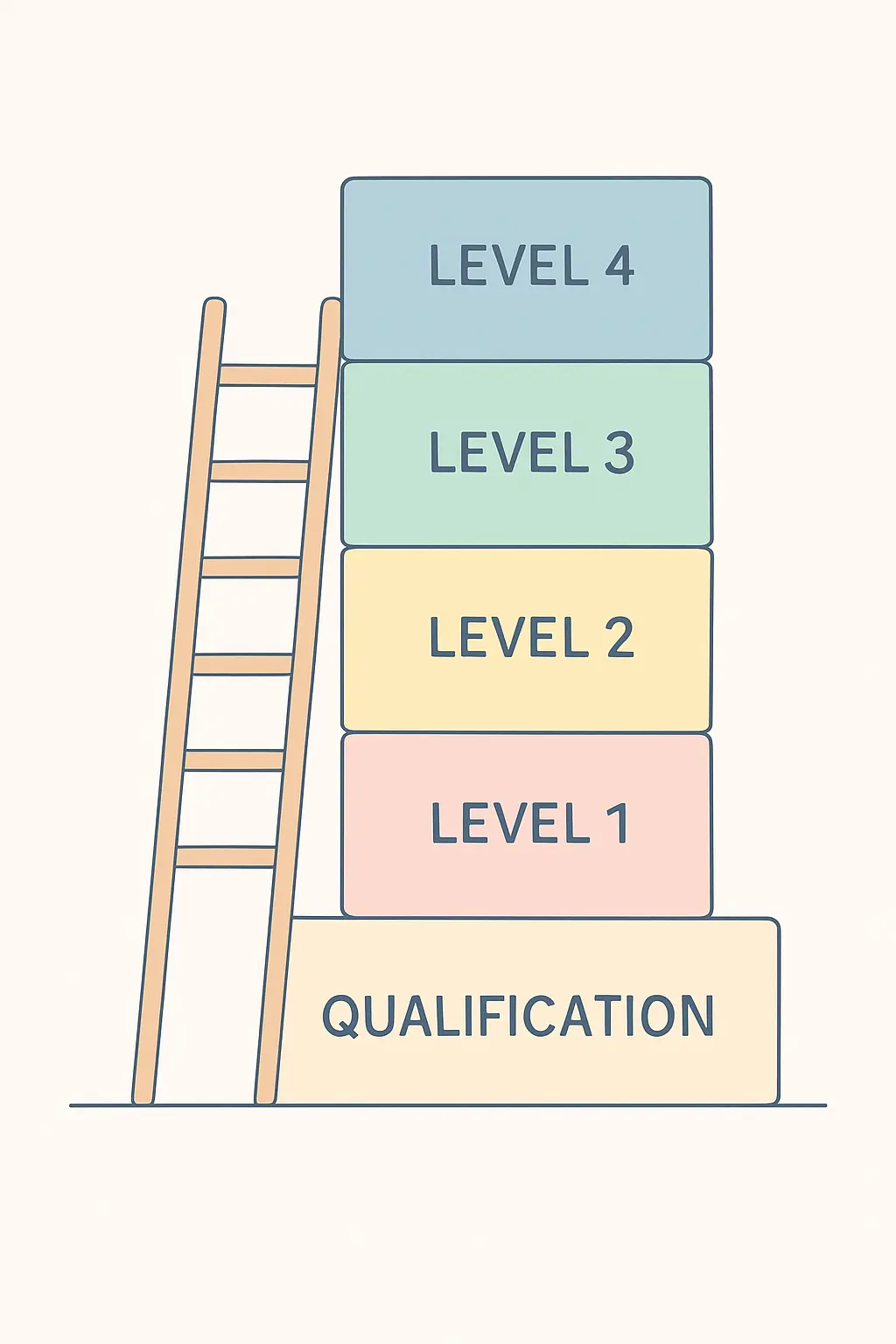
| Level | Broad equivalence | Statistical category |
|---|---|---|
| Level 4 | Certificate of Higher Education | Higher apprenticeship |
| Level 5 | Foundation degree, HND | Higher apprenticeship |
| Level 6 | Bachelor’s degree | Higher / degree apprenticeship |
| Level 7 | Master’s degree | Higher / degree apprenticeship |
This distinction causes persistent confusion in reporting. A headline about “higher apprenticeships” includes Levels 4 and 5, which are not degrees. When you see a degree apprenticeship figure, check whether it means Levels 6 and 7 only, or everything from Level 4 upward — the two numbers differ by more than a factor of two.
Why did Level 7 spike?

The 40.7% jump in Level 7 starts is not organic demand growth alone. DfE attributes much of it to a policy announcement: from January 2026, Level 7 apprenticeships are government-funded only for learners aged 16 to 21, for care leavers, and for those with an Education, Health and Care Plan who are under 25 at the start of the apprenticeship.
Employers and providers responded by starting Level 7 learners before the restriction applied. This is a durable lesson about apprenticeship data: a large single-year movement at one level is often a policy artefact rather than a change in underlying appetite. Expect the 2026/27 Level 7 figures to fall sharply as a result, and read that fall accordingly.
For anyone over 21 considering a Level 7 apprenticeship from 2026 onward, the practical consequence is that employer funding — through the levy or direct contribution — matters far more than it did. If you are weighing this against a conventional taught route, our master’s degree UK guide covers the fee and funding comparison.
Who is taking these apprenticeships?
The age profile has shifted upward alongside the level mix, and the Level 7 surge explains much of that shift. Over half of all starts in 2024/25 — 51.3% — were by learners aged 25 and over.
Business, Administration and Law is the largest sector subject area, with 95,980 starts in the August 2025 to April 2026 period. STEM subjects account for a substantial further share.
Apprenticeship starts tend to come either from new employees with up to three months’ service or from established staff who have been with the employer for more than a year — a reminder that a large proportion of degree apprentices are existing employees being upskilled, not school leavers entering work.
How long do they take, and how many finish?
Average apprenticeship duration was 622 days in 2024/25, down slightly from 630 days in 2023/24. Duration is significantly longer for Level 6 and Level 7 apprenticeships, which is what you would expect of a degree delivered alongside full-time work.
On completions, achievements rose 14.0% to 146,210 in the August 2025 to April 2026 period, against 128,290 in the same window the previous year. That is a volume figure, not a rate.
For achievement rates — the proportion of starters who complete — the authoritative source is DfE’s national achievement rate tables, published in March 2026 covering the 2024/25 academic year and now folded into the main apprenticeships release. We have deliberately not quoted a single headline completion rate here: rates vary substantially by level, sector and provider, and a single national figure would misrepresent the picture for any specific programme. Consult the achievement rate tables for your own level and route.
What this means if you are choosing a route
Three things follow from the data for anyone weighing a degree apprenticeship in 2026.
First, the route is no longer niche. At 17.1% of starts, degree-level apprenticeships are a mainstream part of the system, and the qualification you receive sits at the same framework level as a conventionally studied degree.
Second, the Level 7 funding change materially alters the calculus for older learners. If you are over 21 and not a care leaver or EHCP-eligible, government funding is no longer available, so your employer’s willingness to fund becomes the deciding factor.
Third, duration is real. At an average well above 622 days for Levels 6 and 7, you are committing years to studying alongside a job. The academic workload is genuine, and the written assessment at the end is substantial — many students find the demands comparable to those described in our guide to writing a thesis while working full-time.
If you are looking at work-integrated routes more broadly, the professional doctorate occupies similar ground one level higher, for practitioners researching inside their own organisation.
Frequently asked questions
How many degree apprenticeships are there in the UK?
In England, degree-level apprenticeships at Levels 6 and 7 recorded 60,350 starts in 2024/25, representing 17.1% of all apprenticeship starts. These DfE figures cover England only; Scotland, Wales and Northern Ireland publish separate statistics under different systems.
Is a degree apprenticeship the same as a degree?
The academic qualification is the same. A Level 6 apprenticeship leads to a bachelor’s degree and a Level 7 to a master’s, awarded by a university in the normal way. The difference is delivery: you are employed throughout, your employer and government fund the training, and you complete an end-point assessment alongside the academic award.
Why are Level 7 apprenticeship starts falling from 2026?
From January 2026, government funding for Level 7 apprenticeships is restricted to learners aged 16 to 21, care leavers, and those with an Education, Health and Care Plan aged under 25 at the start. The 40.7% surge in Level 7 starts during 2024/25 reflected employers starting learners ahead of that change, so a sharp fall in subsequent years is expected.
What is the difference between a higher apprenticeship and a degree apprenticeship?
“Higher apprenticeship” is the official statistical category covering everything from Level 4 upward. “Degree apprenticeship” refers specifically to Levels 6 and 7, which carry a bachelor’s or master’s degree. Levels 4 and 5 are higher apprenticeships but not degree apprenticeships.
Are apprenticeship numbers rising or falling overall?
Rising, and shifting upward in level. Total starts reached 353,500 in 2024/25, 4.1% above 2023/24. Growth is concentrated at higher levels — Level 4 and above accounted for 39.8% of starts — while intermediate starts fell 7.3%.
Where can I find apprenticeship achievement rates?
DfE’s national achievement rate tables, published in March 2026 for the 2024/25 academic year and included in the main apprenticeships statistics release. Rates differ substantially by level, sector subject area and training provider, so look up the figures for your specific route rather than relying on a national average.
Studying at Level 6 or 7 alongside a full-time job? Tesify builds the scaffolding around your written work — a chapter outline, a formatted bibliography, cited references and an AI-use declaration for submission.
Write your thesis with AI
Structure, draft, cite, and format your thesis faster with Tesify’s AI writing tools, automatic bibliography, and plagiarism checker. Free to start, no credit card required.






Leave a Reply