
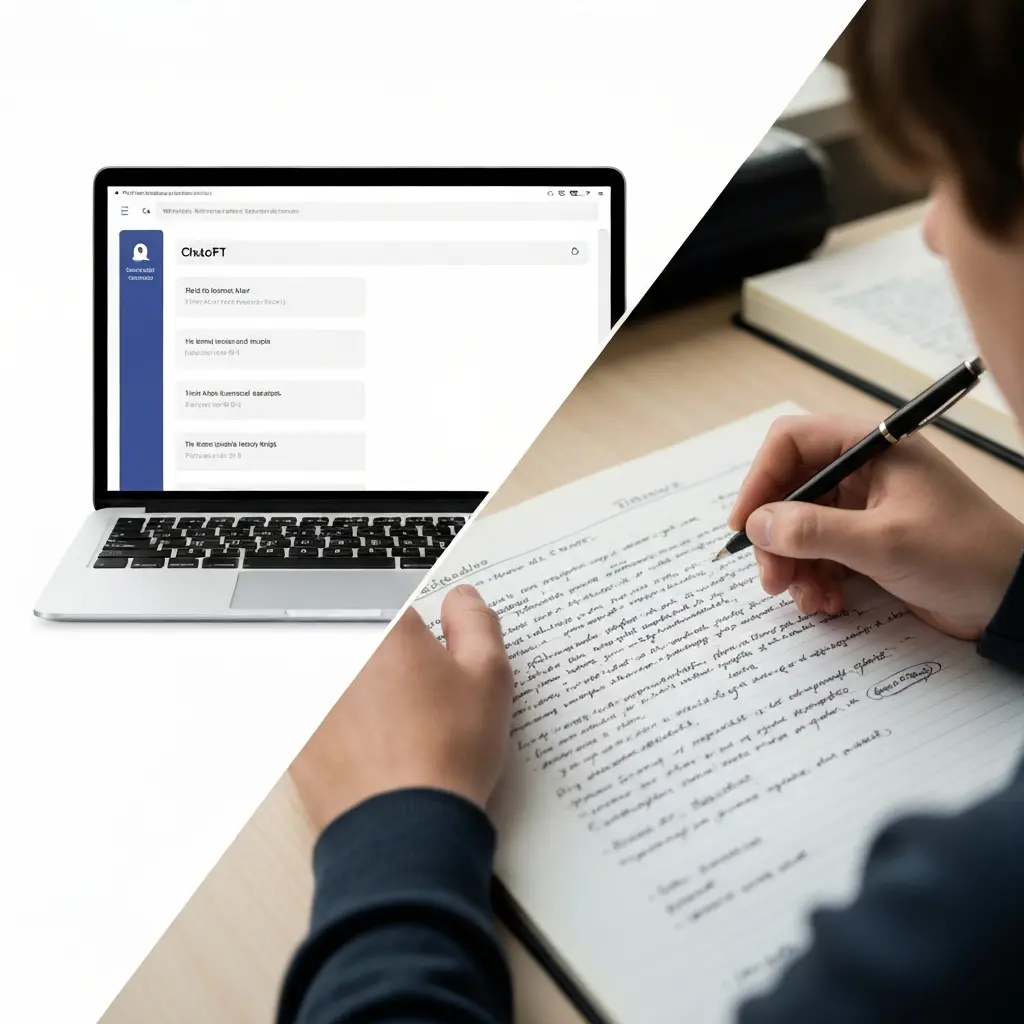
ChatGPT for Thesis Writing: The Honest 2026 Guide (What Works, What Doesn’t)
Every graduate student has heard the question by now: can you use ChatGPT for thesis writing? The honest answer is more nuanced than either the enthusiasts or the sceptics want to admit. ChatGPT can genuinely accelerate certain parts of the thesis process — and it can also fabricate citations, produce superficially confident nonsense, and land you in an academic misconduct hearing if misused. This guide gives you the full picture: what ChatGPT actually does well, where it reliably fails, how to stay within your institution’s policy, and when a purpose-built academic tool like Tesify will serve you better.
Since GPT-4 launched in March 2023, universities worldwide have scrambled to update their AI policies. By early 2026, the landscape has settled into a rough consensus: AI tools may be used for specified support tasks, but submitting AI-generated text as original scholarship remains a breach of academic integrity at virtually every institution. Understanding that boundary precisely is the first skill any thesis student needs to develop.
This guide draws on published research, institutional policy documents from Oxford, Cambridge, Harvard, and MIT, and the rapidly evolving evidence base on AI detection accuracy. It is updated for 2026 — the year in which AI policy enforcement has moved from aspiration to operational reality.
University AI Policies in 2026: What Is and Isn’t Allowed
The most important thing you can do before using any AI tool in your thesis is read your institution’s specific policy. What Oxford permits, your programme may prohibit — and what one supervisor considers acceptable brainstorming support, another may regard as contractual misconduct.
The Spectrum of Institutional Policies
By 2026, university AI policies have largely converged around three positions:
| Policy Type | What It Allows | Example Institutions (approximate) |
|---|---|---|
| Permitted with disclosure | AI may be used for specified support tasks; all use must be declared in the thesis | MIT, many US research universities |
| Task-specific permission | AI permitted for grammar/spell-checking; prohibited for content generation | Oxford, Cambridge, most UK Russell Group |
| Full prohibition | No AI tools permitted in any aspect of thesis work | Some humanities programmes, art schools |
What “Disclosure” Actually Means
Where AI use must be disclosed, institutions increasingly require a specific AI use statement in the thesis — typically in the acknowledgements or a dedicated methodological note. The statement should specify: which tools were used, for what purposes, and at which stages. Vague statements like “AI tools were used in the preparation of this thesis” are no longer considered sufficient by most research integrity offices.
What ChatGPT Actually Does Well for Thesis Writing
Strip away the hype and the fear, and ChatGPT is a powerful text-based reasoning engine with a particular talent for tasks that involve language, explanation, and structure — but no reliable access to verified facts or academic databases.
Brainstorming Research Angles
When you are stuck on how to frame a research question, ChatGPT can generate a dozen alternative angles in under a minute. You will discard most of them — but two or three will productively challenge your initial framing. This is the thinking-partner use case, and it is genuinely valuable.
Example prompt: “I’m writing a master’s thesis in sociology on gig economy workers in the UK. I’m currently framing this as a study of precarious employment. What are three alternative theoretical framings I should consider?”
Improving Sentence Clarity and Flow
Paste a paragraph you know is clunky into ChatGPT with the instruction “improve the clarity and flow of this academic paragraph without changing its meaning or adding new content.” The output is rarely publication-ready, but it often reveals how your argument could be expressed more clearly — and then you rewrite it in your own words.
Generating Literature Search Terms
ChatGPT is good at suggesting synonyms, related concepts, and Boolean search string variations for literature searches. It will not find you actual papers (and its suggestions about specific papers are unreliable), but it can expand the semantic range of your database searches significantly.
Explaining Statistical Concepts
If you are a social science student who has never run a confirmatory factor analysis and your methodology requires one, ChatGPT can explain the concept, the assumptions, the R or SPSS syntax, and common pitfalls — all at your requested level of complexity. This saves hours of hunting through dense statistical textbooks for explanations that were written for statisticians, not psychologists or sociologists.
Outline Drafting
Generating a chapter outline from a brief description of your thesis is a legitimate early-stage use. Ask for a detailed outline, then modify it substantially based on your own thinking. Never submit an AI-generated outline as your original intellectual structure — but using it as a springboard for your own planning is a different matter.
Getting Unstuck
Writer’s block at the thesis level is frequently about clarity — you do not know what you think, so you cannot write it. Explaining your current stuck point to ChatGPT and asking it to reflect your argument back to you often reveals precisely where your thinking is fuzzy. The Socratic dialogue mode (“Ask me questions about my methodology until you understand it”) is particularly useful.
Where ChatGPT Fails (and Fails Badly)
Original Analysis
ChatGPT cannot analyse your data. It cannot run your statistical tests, perform your thematic coding, or draw warranted conclusions from your specific findings. When it appears to conduct analysis, it is pattern-matching to what analysis looks like — which means it produces confident-sounding text that lacks the actual analytical substance your examiners will probe in the viva.
Sustained Academic Register
Academic writing in your discipline has specific conventions — hedging language, citation integration patterns, the relationship between argument and evidence, disciplinary vocabulary — that vary between fields and have evolved over decades of scholarly practice. ChatGPT’s academic prose is competent but generic. Experienced examiners frequently flag AI-generated text precisely because it lacks the distinctive scholarly voice of a researcher immersed in a specific literature.
Knowledge Currency
ChatGPT’s training data has a cutoff date. For many fast-moving fields — AI policy itself, genomics, climate science, macroeconomics — its knowledge may be significantly out of date by 2026. It will not flag its own knowledge gaps; it will simply answer confidently with outdated information.
Logical Consistency Across a Long Document
ChatGPT operates on a context window. It cannot hold an 80,000-word thesis in mind and ensure that the theoretical framework in Chapter 2 is consistent with the discussion in Chapter 5 and the conclusions in Chapter 7. Maintaining argument coherence across a thesis requires human oversight that no current AI can provide.
The Hallucinated Reference Problem
This section deserves special emphasis because the consequences of getting it wrong are severe. ChatGPT fabricates academic references. This is not a bug that will be fixed — it is a structural property of how large language models generate text. The model predicts plausible continuations, and a plausible continuation after “Smith (2019) argues that…” is an author name, journal, volume, and page number — whether or not that paper exists.
In 2023 and 2024, multiple high-profile legal and academic submissions were embarrassed when ChatGPT-generated citations turned out not to exist. By 2026, examiners routinely spot-check references during viva examinations, and a fabricated citation is treated as academic misconduct, not innocent error.
For verified literature searching, use tools designed for the task: Elicit and Consensus pull from real academic databases and show you the actual papers. They are far more reliable than ChatGPT for building your bibliography.
AI Detection: How Accurate Is It in 2026?
Students who believe they can paraphrase ChatGPT output sufficiently to evade detection are taking a significant risk. Turnitin’s AI detection capability, launched in April 2023 and substantially updated through 2024 and 2025, now identifies AI-generated writing with reported accuracy rates above 98% for unmodified text and meaningfully higher false-positive rates for heavily paraphrased text than many students expect.
GPTZero, Copyleaks AI Detector, and iThenticate all offer institutional-grade detection. Most major universities have integrated one or more of these into their submission workflows by 2026. The detection arms race will continue — but the institutional risk-reward calculation has shifted decisively: the probability of detection is high enough, and the consequences (typically failure of the thesis plus academic misconduct proceedings) severe enough, that attempting to pass AI writing as your own is not a rational choice.
It is also worth noting that experienced supervisors and examiners in many fields can identify AI-generated text through stylistic and substantive cues — a point repeatedly made in academic integrity research published through 2025. For the full statistical picture, see our AI thesis writer vs ChatGPT comparison 2026. Our independent review of the best plagiarism and AI detection tools for students also covers which free-tier options are worth using before you submit.
How to Use ChatGPT Ethically in Your Thesis
Ethical AI use in thesis writing follows a clear principle: use AI as a thinking partner and an efficiency tool, not as a writing substitute. Every paragraph in your thesis should represent your thinking, your synthesis of the literature, your analytical judgement.
The “Blank Page Test”
A useful heuristic: if you could not write a rough version of what you are about to ask ChatGPT to produce, do not use ChatGPT to produce it. Use AI to refine, clarify, and improve what you have already thought through — not to generate thinking you have not done.
Disclosure Practices
Where your institution requires disclosure, be specific. A good AI use statement might read: “AI language tools (specifically ChatGPT-4o) were used in the preparation of this thesis for the following purposes: generating initial literature search terms (Chapter 2), improving sentence clarity during editing (all chapters), and explaining statistical concepts consulted during methodology planning (Chapter 3). No AI-generated text has been included in the thesis as submitted.”
Using ChatGPT by Thesis Chapter: A Practical Breakdown
| Chapter | Permitted and Useful | Avoid |
|---|---|---|
| Introduction | Generating alternative framings; improving clarity | Using AI to state your research contribution |
| Literature Review | Generating search terms; identifying thematic groupings from your notes | Generating summaries of papers; producing any reference list |
| Methodology | Explaining statistical or qualitative concepts; checking that your design description is clear | Generating methodological justifications you have not thought through yourself |
| Results/Findings | Checking that your description of results is clear to a non-specialist reader | Any interpretation; any data presentation |
| Discussion | Stress-testing your argument by asking ChatGPT to challenge it | Generating interpretations or connections to the literature |
| Conclusion | Checking that your stated contribution matches your actual findings | Any content generation |
| Abstract | Checking concision and clarity after writing your own draft | Generating the abstract |
Better Alternatives to ChatGPT for Specific Tasks
ChatGPT is a general-purpose tool deployed in an academic context. Purpose-built academic tools frequently outperform it for specific thesis tasks.
For Literature Searching: Elicit and Consensus
Both tools search real academic databases and return verified papers with proper citations. Elicit can extract key claims from papers and summarise findings across a set of sources — a function that would take hours manually and that ChatGPT cannot perform reliably. These are the tools to use for your literature review groundwork.
For Citation Management: Zotero
Zotero is free, open-source, and integrates with your word processor to format citations automatically in APA, Harvard, Chicago, MLA, or any other style. It is the standard tool among serious researchers and eliminates the manual citation errors that cost students marks.
For Writing Assistance: Tesify
Tesify is purpose-built for graduate students writing theses and dissertations. Unlike ChatGPT, which is designed for general conversation, Tesify understands thesis structure, academic voice conventions, and the chapter-by-chapter logic of a research document. It provides structured writing guidance, chapter outlines, academic style feedback, and citation formatting support — without the hallucination risk that makes ChatGPT unreliable for academic reference work.
For AI writing support that is explicitly designed for the academic context, Tesify is a more appropriate choice than a general-purpose chatbot. If you are assessing broader AI content strategy tools for your academic blog or research dissemination, Authenova offers enterprise-grade AI content automation with strong academic SEO capabilities.
For Grammar and Style: Grammarly Academic
Grammarly’s academic tier goes beyond spell-checking to address formality level, passive voice overuse, citation suggestion, and clarity scoring. It is widely permitted by institutions because it functions as an advanced proofreading tool rather than a content generator.
Real Use Cases: What Graduate Students Actually Do
A 2025 survey by the European University Association found that 67% of graduate students reported using AI tools at some point in their thesis process — up from 34% in 2023. The breakdown of use cases reveals a pragmatic pattern:
- Grammar and language improvement — cited by 58% of AI users, particularly among non-native English speakers
- Brainstorming and idea generation — 41% of users
- Literature search term generation — 38%
- Explaining methodological concepts — 29%
- Generating prose or paragraphs — 21% (though many of these students acknowledged policy uncertainty about whether this was permitted)
The data suggest that most students are already using AI responsibly — for support tasks, not as a ghostwriter. The challenge is ensuring that the 21% generating prose understand the risks, and that all students are disclosing use where required. For a comprehensive data overview, see the AI thesis writer vs ChatGPT 2026 comparison.
Students looking for a more structured approach to integrating ChatGPT into every stage of the writing process — from topic selection through to final editing — will find our complete guide to using ChatGPT for thesis writing in 2026 a practical complement to this overview.
German-speaking students will find the legal and policy landscape for AI use in their Bachelorarbeit or Masterarbeit explored in detail in this German guide on AI use in Bachelorarbeit — what is permitted and what is not. The French academic context is similarly addressed in this French guide to AI for university mémoire writing.
For a broader strategic view of how to structure your entire thesis process — from topic selection to the viva — see our comprehensive guide on how to write a thesis step by step in 2026.
Frequently Asked Questions
Is using ChatGPT for thesis writing allowed?
It depends on your institution’s AI policy, which has evolved rapidly since 2023. Most universities now permit AI for specific tasks (brainstorming, grammar checking, paraphrasing support) but prohibit submitting AI-generated text as original work. Check your department’s regulations and your supervisor’s guidance before using ChatGPT in any capacity.
Can ChatGPT write my entire thesis?
No, and you should not attempt this. ChatGPT cannot conduct real research, access proprietary databases, verify facts with certainty, or produce a novel contribution to knowledge. Submitting ChatGPT-generated text as your own work constitutes academic misconduct at virtually every university. Detection tools like Turnitin AI detection and GPTZero are increasingly accurate.
Does ChatGPT hallucinate academic references?
Yes, frequently. ChatGPT fabricates plausible-sounding citations — complete with authors, journals, volume numbers, and page ranges — that do not exist. This is called hallucination. Never use a ChatGPT-generated reference without verifying it exists in Google Scholar, PubMed, or your library catalogue. Including fabricated citations is a serious academic integrity breach.
What is ChatGPT actually useful for in thesis writing?
ChatGPT is genuinely useful for: brainstorming research angles, improving sentence clarity, generating initial literature search terms, drafting outlines, explaining statistical concepts in plain language, and getting unstuck when writer’s block hits. These tasks involve using AI as a thinking partner rather than a ghostwriter.
How do I use ChatGPT ethically for my thesis?
Use ChatGPT as a thinking partner, not a writing substitute. Disclose AI use according to your institution’s policy. Never submit AI-generated paragraphs as your own prose. Use it for tasks like: explaining a complex statistical method you plan to use, generating a list of potential search terms for a literature review, or getting plain-language feedback on whether your argument is clear.
Will my university detect if I used ChatGPT?
Detection accuracy is improving rapidly. Turnitin’s AI detection, launched in 2023 and significantly updated in 2024–2025, can identify AI-generated text with increasing reliability. GPTZero and Copyleaks also offer institutional-grade AI detection. Paraphrasing ChatGPT output reduces (but does not eliminate) detection risk — and still constitutes misconduct if your institution prohibits AI use.
What is a better alternative to ChatGPT for thesis writing?
For thesis-specific tasks, Tesify is purpose-built for graduate students — offering structured writing assistance, APA/Harvard/MLA citation formatting, chapter-by-chapter guidance, and an academic voice that ChatGPT’s general-purpose model cannot reliably sustain. Elicit and Consensus are better than ChatGPT for literature searching because they cite real, verified papers.
Write Your Thesis Smarter with Tesify
Tesify is the AI academic writing assistant built specifically for graduate students — not a general-purpose chatbot repurposed for thesis work. It understands chapter structure, academic register, citation conventions, and the specific challenges of long-form research writing. Use it to write faster, write better, and stay clearly within your institution’s AI policy.
Try Tesify free today — and write your thesis with confidence.
Write your thesis with AI
Structure, draft, cite, and format your thesis faster with Tesify’s AI writing tools, automatic bibliography, and plagiarism checker. Free to start, no credit card required.





Leave a Reply