

Case Study vs Policy Analysis Thesis in Public Administration: Which Type Fits Your Research Question? (2026)
MPA and MPP students hit this fork earlier than almost any other discipline: your programme lets you choose between a traditional case-study thesis and a client-facing policy analysis, and the two are graded against genuinely different standards, use different structures, and suit different research questions. Picking the wrong one does not just cost you time — it can mean spending months building an analysis your committee cannot fairly evaluate against the criteria they actually hold.
1. Side-by-Side Comparison
| Feature | Case study thesis | Policy analysis |
|---|---|---|
| Question type | Explanatory — why/how did this happen | Prescriptive — what should the decision-maker do |
| Audience | Academic committee, scholarly literature | A named client, agency or decision-maker |
| Core deliverable | A theory-informed explanation, tested against evidence | A ranked set of feasible options with a recommendation |
| Standard of success | Rigour, theoretical contribution, methodological transparency | Political, legal, administrative and budgetary feasibility of the recommendation |
| Timeframe orientation | Retrospective — explains something that already happened | Forward-looking — informs a decision not yet made |
2. The Case Study Thesis: Structure and Fit
A case-study thesis in public administration follows the standard social-science shape — literature review, theoretical framework, methodology, findings, discussion — applied to a single bounded unit: one agency’s implementation of a reform, one city’s response to a crisis, one programme’s rollout across several sites treated as embedded sub-cases. It suits a question like “why did this state’s Medicaid expansion implementation diverge from the statute’s intent?” — a question that wants depth, process detail and theoretical explanation rather than a decision to be made right now.
Choose this route when you want your committee to evaluate you on the same terms as a political science or sociology case study: within-case process tracing, cross-case comparison logic, and explicit engagement with the theoretical literature on implementation, bureaucracy or institutions. It is the safer choice when no real client relationship is available or appropriate, and when your genuine interest is in the explanation itself rather than in producing an actionable deliverable. For the general mechanics of case study design — single vs multiple case, embedded vs holistic, and Yin’s design tests — see our guide to case study research and how to use it in your dissertation, and for the wider qualitative toolkit a public administration case study typically draws on, see our qualitative research methods guide.
3. The Policy Analysis: Structure and Fit
A policy analysis capstone is structured around a decision, not a literature. It typically opens by defining the problem as the client understands it, lays out the criteria the decision will be judged against (cost, equity, political feasibility, administrative burden), generates a bounded set of realistic alternatives, projects each alternative’s consequences against the criteria, and closes with a specific, actionable recommendation. It suits a question like “should the city’s housing authority adopt a coordinated-entry system for its waitlist, and if so, which of three implementation models?” — a genuinely open decision a real actor needs to make.
Because the deliverable is a recommendation to a specific audience, a policy analysis is judged less on theoretical novelty and more on whether the alternatives were genuinely feasible, the criteria were the right ones for that client’s actual constraints, and the recommendation could survive contact with the agency’s real budget and politics.
4. Bardach’s Eightfold Path, Adapted for a Thesis
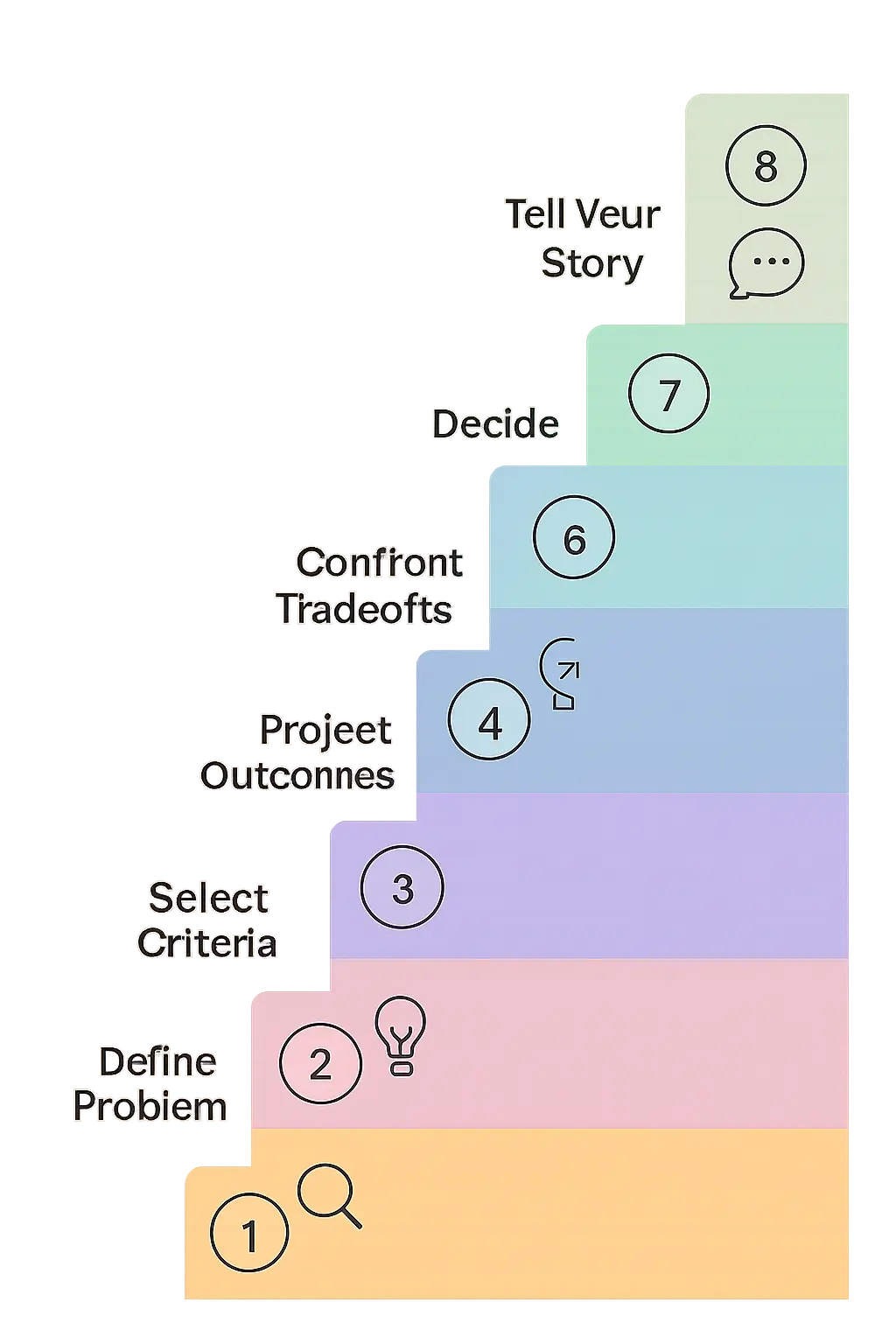
Eugene Bardach’s “Eightfold Path” is the most widely taught framework for structuring a policy analysis in MPA and MPP programmes, and adapting its steps into thesis-length chapters is a reliable way to organise the capstone:
- Define the problem precisely, in terms the client would recognise as their own
- Assemble the evidence — data, prior evaluations, comparable jurisdictions’ experience
- Construct the alternatives — a genuinely distinct, feasible set, not a straw-man plus your preferred option
- Select the criteria the alternatives will be judged against
- Project the outcomes of each alternative against those criteria
- Confront the trade-offs explicitly rather than hiding them
- Decide — state the recommendation clearly
- Tell your story — write it so the client can act on it, not just understand it academically
Mapping these eight steps onto four or five thesis chapters (problem definition and evidence; alternatives and criteria; projected outcomes and trade-offs; recommendation and implementation plan) gives a policy analysis the chapter-length structure a committee expects from a capstone document, without forcing it into a literature-review-first shape that does not fit the genre.
5. The Client Problem: Real, Simulated or Retrospective

Not every programme can place every student with a live agency client, and three variants are common in practice:
- Real, current client — an agency, nonprofit or legislative office with an actual open question, ideally with a named contact who will read the final memo. The strongest version, but dependent on placement availability.
- Simulated client — a realistic but hypothetical decision-maker role, used when a genuine placement is not available; still requires the same feasibility discipline as a real client, argued rather than assumed.
- Retrospective client — analysing a decision an agency already made, reframed as “what should they have done, given what was known at the time,” which borrows the case study’s historical grounding while keeping the policy analysis’s prescriptive structure.
Whichever variant you use, state it explicitly in your methodology section — a committee evaluating a simulated-client analysis applies slightly different feasibility scrutiny than one evaluating a document written for a named, real decision-maker.
6. Can You Combine Both?
Some programmes accept a hybrid: an explanatory case study of why a policy problem exists and persists, followed by a shorter prescriptive section recommending a course of action. This works when your committee explicitly permits it and when the explanatory section is genuinely necessary to justify the recommendation rather than added as padding. Confirm with your programme handbook or capstone coordinator before assuming a hybrid is acceptable — many programmes require one form or the other specifically because the evaluation rubrics differ.
7. A Decision Procedure
If you are still unsure, work through these questions in order: Is there a specific decision-maker who needs an answer soon (policy analysis), or are you trying to explain something that already happened (case study)? Do you have, or can you construct, a genuine client relationship (policy analysis), or is your interest primarily theoretical (case study)? Does your programme’s rubric reward theoretical contribution to a literature (case study) or feasibility and actionability (policy analysis)? Answering these three questions honestly resolves the choice for the large majority of MPA and MPP students before they have written a single chapter. The underlying decision echoes a broader methodological fork covered in our guide to desk-based versus primary-data dissertations — a policy analysis usually leans toward primary engagement with a client and stakeholders, while a case study can be built entirely from documentary and secondary sources.
For the wider methodology-chapter conventions either format still needs — research design justification, data sources, and how to report your approach — see our guide on writing a research methodology chapter for your thesis, and for how to frame the limits of a single-case or single-client analysis honestly, see our guide on writing a research limitations section.
8. Two Worked Titles (Illustrative)
Seeing the same underlying topic split into both formats makes the difference concrete.
Case study version: “Why Did County X’s Body-Worn Camera Programme Stall After Full Funding Was Approved? A Process-Tracing Account of Implementation Failure.” This asks an explanatory question about a completed sequence of events, draws on implementation theory (top-down vs bottom-up models), and is evaluated on the strength of its causal account and its engagement with the implementation literature.
Policy analysis version: “Should the City of Y Adopt Mandatory Body-Worn Cameras for Patrol Officers? A Feasibility Analysis of Three Procurement and Deployment Models.” This asks a forward-looking question for a named decision-maker (the police commission), generates concrete alternatives, and is evaluated on whether the recommendation could survive the city’s actual budget cycle and union negotiations.
Both are legitimate MPA capstones on the same underlying substantive topic — body-worn camera policy — but they are different documents, answer different questions, and would be assessed by different rubrics even within the same programme.
Frequently Asked Questions
Is a policy analysis easier than a case study thesis?
Not easier, just differently demanding. A policy analysis trades theoretical literature engagement for the discipline of constructing genuinely feasible alternatives and defending a recommendation against real-world constraints — a different, not lighter, form of rigour.
Do I need a real client for a policy analysis capstone?
It is the strongest version but not the only accepted one. Simulated-client and retrospective-client variants are common where a live placement is unavailable, as long as you argue feasibility with the same discipline a real client relationship would require and state the variant explicitly in your methodology.
What is Bardach’s Eightfold Path?
A widely taught framework for structuring a policy analysis: define the problem, assemble evidence, construct alternatives, select criteria, project outcomes, confront trade-offs, decide, and tell your story to the client. It maps well onto thesis-length chapters for a public administration capstone.
Can I combine a case study and a policy analysis in one thesis?
Some programmes accept a hybrid — an explanatory section followed by a shorter prescriptive recommendation — but only when your committee explicitly permits it. Confirm with your programme handbook or capstone coordinator, since many programmes grade the two formats against different rubrics.
Which format do NASPAA-accredited MPA programmes typically allow?
Both are common across NASPAA-accredited MPA and MPP programmes, and many departments offer students a choice between a traditional thesis and an applied/client-based capstone. The exact rubric, client-sourcing process and permitted variants (real, simulated or retrospective client) differ by programme, so confirm the specific requirements in your own capstone handbook rather than assuming a national standard applies uniformly.
Will a policy analysis hurt my chances of a PhD later?
Not inherently. PhD admissions in public policy and public administration value evidence of methodological competence and a clear research interest; a well-executed policy analysis demonstrates applied rigour, while a case study more directly demonstrates the theoretical and literature-engagement skills a PhD programme will build on. If PhD study is a firm goal, discuss the choice with a prospective PhD advisor, since preferences vary by sub-field and programme.
Write Your Public Administration Capstone With Confidence
Tesify’s AI-powered academic writing tool helps MPA and MPP students structure either a case-study thesis or a policy-analysis capstone, chapter by chapter, in the format your programme expects.
Write your thesis with AI
Structure, draft, cite, and format your thesis faster with Tesify’s AI writing tools, automatic bibliography, and plagiarism checker. Free to start, no credit card required.





Leave a Reply