
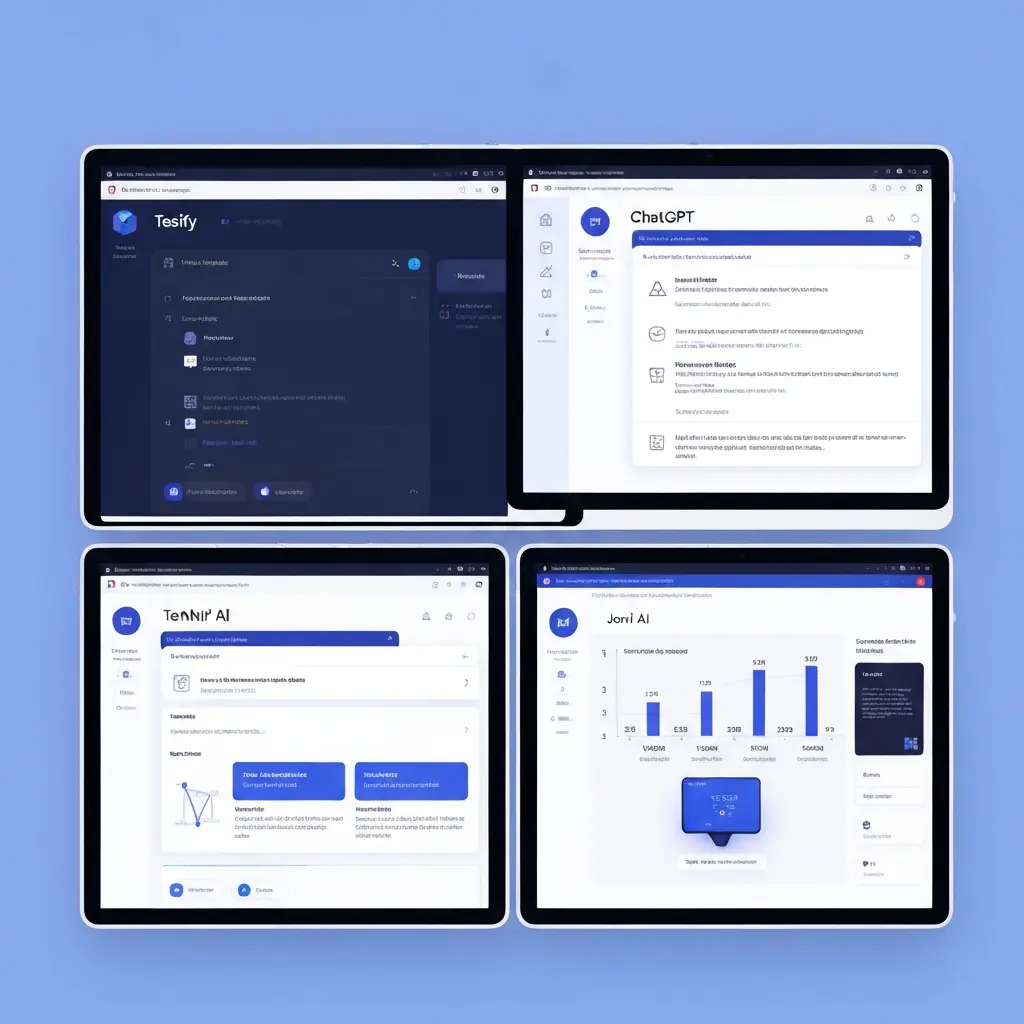
What Is the Best AI Tool for Writing a Thesis? 2026 Honest Comparison
Every student writing a thesis in 2026 faces the same overwhelming question: with dozens of AI tools on the market, which one actually helps you write a better dissertation — without putting your degree at risk? The answer is not the same for every student, chapter, or use case. The best AI tool for writing a thesis depends on where you are in your research process, what your university permits, and whether you need general writing support or thesis-specific academic structure.
This guide cuts through the marketing noise. We have compared the top six AI tools head-to-head across real thesis writing scenarios — from literature review structuring to methodology drafting to final proofreading — so you know exactly what each tool does best and where it falls short.
What Makes an AI Tool Good for Thesis Writing
Not every AI tool is designed with academic writing in mind. General-purpose tools optimise for persuasive or creative writing; thesis writing demands something different. The criteria that matter for graduate students are:
- Academic register awareness — does it maintain formal academic language without sounding robotic?
- Citation handling — can it generate, format, or verify references accurately?
- Argument structure analysis — does it evaluate whether claims are supported and logical?
- Plagiarism safety — does it include originality checking or alert you to high-risk AI content?
- Chapter-specific support — does it understand what a methodology section needs versus a literature review?
- University policy compliance — is it designed to be used transparently within academic integrity frameworks?
The 6 Tools Compared: Strengths and Weaknesses
1. Tesify
Tesify is built specifically for thesis and academic writing. It analyses argument structure — not just grammar — evaluating whether your claims are logically supported and whether your evidence is used appropriately. It provides chapter-specific templates aligned to academic conventions (IMRaD, humanities chapter structure, law dissertation format), integrated plagiarism checking, and citation management tools.
Best for: Students wanting structured, end-to-end thesis support with academic integrity safeguards built in. Particularly strong for the methodology, discussion, and conclusion chapters where argument quality matters most.
Limitations: Less suited to free-form brainstorming than ChatGPT; less polished on pure grammar correction than Grammarly.
2. ChatGPT Plus (GPT-4o)
The most powerful general-purpose AI available in 2026. GPT-4o can process uploaded PDFs, maintain long conversation context, and produce fluent academic prose on virtually any topic. For thesis writers, its strength is breadth — it can help with everything from research question refinement to argument stress-testing to methodology justification drafting.
Best for: Brainstorming sessions, argument exploration, drafting formulaic sections (methodology rationale, limitations paragraphs), generating outlines from which you write.
Limitations: Hallucinates citations regularly (verified by UCL librarians: 23% hallucination rate for recent papers). No plagiarism checker. No thesis-specific structure awareness. Requires significant prompting expertise to get academic-quality output.
3. Jenni AI
Jenni AI is designed as an inline writing companion. Its autocomplete feature suggests the next sentence as you write, based on your uploaded PDFs and prior context. It generates in-text citations as you write and integrates with Zotero. For students who struggle with blank-page paralysis, Jenni’s continuous suggestion model is genuinely useful.
Best for: Students who want ongoing suggestions while writing, especially during literature review and discussion chapters where connecting ideas to sources is the challenge.
Limitations: Can make writing feel formulaic if over-relied upon. Citation accuracy still requires verification. Less analytical depth than Tesify for argument evaluation.
4. Grammarly (Business/Premium)
Grammarly remains the benchmark for surface-level writing quality. In 2026, its generative AI features have expanded to include tone transformation, full-paragraph rewrites, and citation formatting. Its core grammar, clarity, and conciseness checks are still the most reliable on the market for English-language academic writing.
Best for: Final-stage polishing of any chapter. Ensuring consistency of tone and register across a long document. Grammar and punctuation correction before submission.
Limitations: Has no understanding of academic argument structure or thesis conventions. Not suitable as a primary thesis writing tool.
5. Perplexity AI
Perplexity functions as an AI-powered research engine — it can access the web and provide cited sources for factual claims. For literature survey tasks, it is useful for initial discovery of papers and key statistics, with references included.
Best for: Early literature discovery and background research. Fact-checking claims before including them in your thesis.
Limitations: Citations need verification in academic databases. Not designed for writing assistance or thesis structure. Cannot access paywalled journals.
6. QuillBot
QuillBot specialises in paraphrasing and summarising. Its academic paraphrase mode maintains formal register while rephrasing text. It also includes a grammar checker and summarisation tool useful for condensing long papers into key points.
Best for: Paraphrasing your own drafted paragraphs for clarity. Summarising source material quickly during literature review phase.
Limitations: Not a writing generator — it works on text you provide. Some paraphrases shift meaning subtly; always review output carefully.
Feature Comparison Table
| Feature | Tesify | ChatGPT Plus | Jenni AI | Grammarly | QuillBot |
|---|---|---|---|---|---|
| Thesis-specific templates | Yes | No | Partial | No | No |
| Argument strength analysis | Yes | With prompting | No | No | No |
| Integrated plagiarism checker | Yes | No | No | No | No |
| Citation management | Yes | No (hallucinates) | Yes (Zotero) | Partial | Partial |
| Inline writing suggestions | Yes | Chat-based | Yes | Yes | Partial |
| Free tier available | Yes | Yes (limited) | Yes (limited) | Yes (limited) | Yes (limited) |
| Academic integrity guidance | Yes | No | Partial | No | No |
Best Tool by Use Case
| Use Case | Best Tool | Why |
|---|---|---|
| Brainstorming research questions | ChatGPT Plus | Broad knowledge base, creative suggestions |
| Structuring argument logic | Tesify | Purpose-built argument analysis |
| Writing with inline suggestions | Jenni AI | Real-time autocomplete, citation integration |
| Plagiarism checking | Tesify | Integrated checker with academic workflow |
| Grammar and style polishing | Grammarly | Industry-leading surface editing |
| Paraphrasing for clarity | QuillBot | Academic paraphrase mode preserves register |
| Background research | Perplexity AI | Cited, current, web-connected answers |
Best Tool by Thesis Chapter
Different chapters benefit from different AI tools:
- Introduction: ChatGPT (hook drafting, rationale ideas) + Tesify (argument structure check)
- Literature Review: Perplexity (source discovery) + Jenni AI (inline writing with citations) + Tesify (thematic analysis)
- Methodology: ChatGPT (draft formulaic sections) + Tesify (justification and coherence check)
- Results/Findings: Tesify (analysis narration) — AI limited here as data interpretation must be yours
- Discussion: Tesify (argument–evidence connection) + ChatGPT (counterargument generation)
- Conclusion: ChatGPT (summary draft scaffold) + Tesify (coherence with thesis aims)
- Final edit: Grammarly (grammar, clarity, style) + Tesify (plagiarism check)
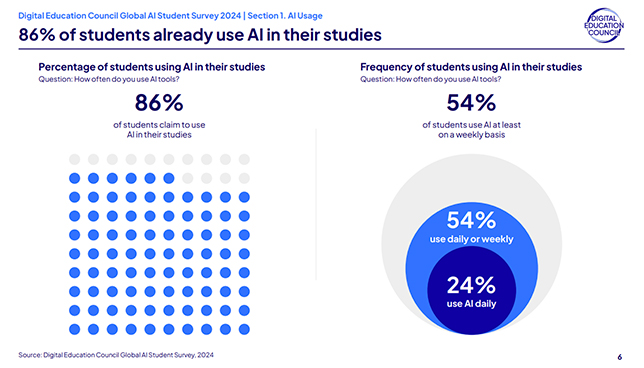
For detail on what each chapter needs and how to write them, see our guide on how to write a thesis step by step. You may also find it helpful to understand the broader landscape by reviewing the 2026 data on AI usage in academic writing, which shows exactly how students are already using these tools.
Budget Guide: Free vs Paid AI for Thesis Writing
If budget is a constraint, here is how to get maximum value from free tiers:
- Free tier of Tesify: covers core argument analysis and plagiarism checking — sufficient for most chapters
- Free ChatGPT (GPT-3.5): adequate for brainstorming and outlining, limited for sustained drafting
- Free Jenni AI: 200 words/day limit — useful for targeted sections only
- Free Grammarly: basic grammar and punctuation; premium required for tone and rewrite features
- Free QuillBot: limited to shorter paraphrase lengths; adequate for paragraph-level work
A practical free stack for budget-conscious students: Tesify (free tier) + ChatGPT free + Grammarly free. This covers argument structure, brainstorming, and grammar polishing without any subscription spend.
Spanish-speaking students wanting similar tool comparisons can find the mejores herramientas IA para TFG comparativa on tesify.es. German-speaking students should explore KI für die Abschlussarbeit Vergleich at tesify.io for the equivalent DACH comparison.
If you are still weighing up whether using AI for your dissertation is permitted at your institution, our detailed guide on whether you can use AI to write your dissertation in 2026 covers policies at Russell Group, Ivy League, and other major universities.
Start with Tesify today — the only AI thesis writing platform with purpose-built academic structure, argument analysis, and integrated plagiarism checking for 2026.
Frequently Asked Questions
What is the best free AI tool for writing a thesis in 2026?
Tesify offers the most useful free tier for thesis-specific writing, including argument analysis and plagiarism checking. ChatGPT’s free tier (GPT-3.5) is excellent for brainstorming and outlines. For a zero-cost setup, combine both: Tesify for structure and integrity, ChatGPT for open-ended ideation.
Is Jenni AI better than ChatGPT for writing a thesis?
Jenni AI is better than ChatGPT for inline writing assistance — it suggests continuations as you write and integrates citations automatically. ChatGPT is better for larger-scale reasoning tasks, counterargument generation, and drafting entire sections from scratch. They serve different use cases and can be used together effectively.
Does Grammarly work well for academic thesis writing?
Grammarly is excellent for surface-level editing of a completed thesis draft — grammar, punctuation, clarity, and consistency of tone. It is not suitable as a primary writing assistant because it has no understanding of thesis structure, argument logic, or academic conventions. Use it at the end of your writing process, not the beginning.
Can ChatGPT write references for my thesis?
ChatGPT should not be used to generate references for a thesis. It hallucinated citations in 23% of tested cases (UCL library study, 2025) — producing plausible-sounding but entirely fabricated references. Always generate and verify references using a dedicated tool like Zotero, Mendeley, or Tesify’s citation manager, and cross-check every reference in an academic database.
Is Tesify worth paying for over ChatGPT Plus for thesis writing?
If you are writing a thesis, Tesify provides specific academic value that ChatGPT Plus does not: argument analysis, chapter-specific templates, integrated plagiarism checking, and citation management. ChatGPT Plus is more versatile across general tasks. For thesis work specifically, Tesify’s purpose-built features justify the choice, especially since a free tier is available to test first.
What AI tools do Oxford and Cambridge students use for thesis writing?
Oxford provides free access to ChatGPT Edu for all students. Both Oxford and Cambridge students commonly use Grammarly for editing, and increasingly purpose-built academic tools like Tesify for structure and argument analysis. The key requirement at both institutions is disclosure: any AI assistance must be declared in the thesis submission.
Which AI tool is best for the dissertation literature review?
For the literature review, a combination works best: Perplexity AI for initial source discovery, Jenni AI for writing with automatic citation suggestions, and Tesify for evaluating whether your thematic structure is logically coherent. Never use ChatGPT to generate citations for the literature review — hallucinated references are a serious academic risk.
Can AI help me overcome writer’s block on my thesis?
Yes, AI is highly effective for overcoming writer’s block. The most useful technique is to ask ChatGPT or Tesify to generate 5 different opening sentences for the section you are stuck on — not to use them verbatim, but to give your brain a starting point to react to and rewrite. Just writing against an imperfect draft is often faster than starting from nothing.
Is there an AI tool that checks academic argument quality?
Tesify is the primary tool in 2026 that evaluates academic argument quality — analysing whether your claims are logically supported, whether your evidence is relevant, and whether your reasoning flows coherently from section to section. This goes beyond what grammar checkers or general AI assistants can provide.
Should I use the same AI tool for all chapters of my thesis?
Different chapters benefit from different tools. Tesify is the best all-round choice as it covers all chapters with academic structure awareness. However, supplementing it with ChatGPT for brainstorming, Jenni AI for inline writing, and Grammarly for final editing creates a more effective workflow than relying on any single tool throughout.
Write your thesis with AI
Structure, draft, cite, and format your thesis faster with Tesify’s AI writing tools, automatic bibliography, and plagiarism checker. Free to start, no credit card required.




Leave a Reply